%20(1)-B86R08ZzwhPzS6UZbG3mSxRWPCwGwn.png)



The most popular advice about hiring an agencia de marketing starts in the wrong place: compare services, browse portfolios, then choose the team you like. I'd start with the contract. A persuasive pitch won't protect you when priorities change, approvals stall, or organic traffic falls while your brand gains visibility in AI-generated answers.
My recommendation is straightforward: design the partnership before buying the services. Define the commercial outcome, the evidence you'll accept, and the decisions each side owns. Then evaluate whether the agency can operate inside that agreement.
Spis treści
- Why Hiring an Agencia de Marketing Is a Contract Problem First
- The Services an Agencia de Marketing Actually Sells
- How Agencia de Marketing Pricing Really Works
- A Real Workflow for Shortlisting an Agencia de Marketing
- Rethinking KPIs When AI Overviews Rewrite the SERP
- Governance, Cadence, and the Communication Gap
- Questions to Ask Before You Sign With an Agencia de Marketing
- Your Decision Framework for This Week
Why Hiring an Agencia de Marketing Is a Contract Problem First
I wouldn't approve an agency proposal that promises growth without defining what growth means. More traffic, more inquiries, and more profitable customers aren't interchangeable. If we leave those distinctions unresolved, we'll eventually argue about a dashboard instead of making decisions.
The failure pattern I watch for starts with an attractive scope of work. We agree on campaigns, articles, and meetings, but never establish which business constraint we're trying to remove. When performance disappoints, we discover that we bought production capacity while expecting commercial judgment.
Define the partnership before the deliverables
I build the agreement around these principles:
- Outcomes: Name the business change we want, such as qualified sales opportunities or profitable customer acquisition. Separate that outcome from the activities intended to produce it.
- Evidence: Agree on definitions, data access, attribution limits, and the baseline. Neither side should get to redefine success after seeing the results.
- Accountability: Assign ownership of implementation, approvals, measurement, and corrective action. Include client obligations, not just agency obligations.
This also means distinguishing a vendor relationship from a performance partnership. I can hire a vendor to produce approved landing pages against a specification. If I want a performance partner, I must give that team access to customer research, conversion data, and the authority to recommend changes.
Contract test: If the agency delivers every item in the scope but the business doesn't improve, does the agreement tell us what happens next?
I don't expect an agency to guarantee revenue it can't control. Your pricing, inventory, sales follow-up, and product experience all affect the result. I do expect the team to identify those dependencies before accepting responsibility.
My own obligation is equally clear: provide access, name an accountable decision-maker, and approve or reject work within the agreed window. You can't demand accountability while withholding the inputs required to act.
A strong contract makes uncertainty manageable. A weak contract merely makes the invoice predictable.
The Services an Agencia de Marketing Actually Sells
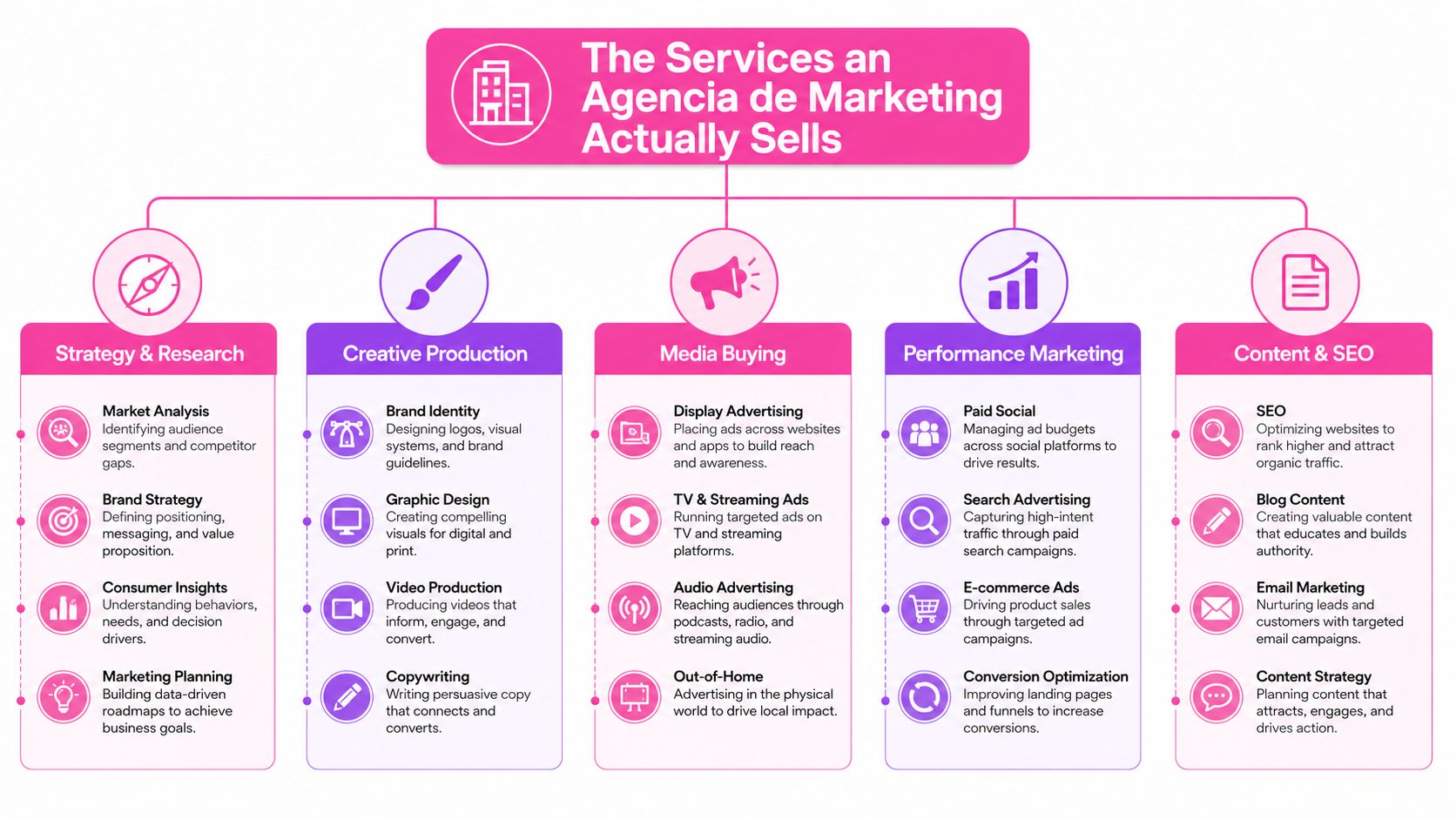
I separate agency services by the decisions and assets I'm buying, not by the names on a capabilities page. “Growth,” “digital transformation,” and “integrated marketing” tell me very little until we translate them into work.
Buy the work that removes your constraint
Strategy and research should produce decisions: which customers to pursue, which alternatives we compete against, and why someone should choose us. For positioning, market research, or brand architecture, I ask for the research method and the decision document. Cost depends on research depth, stakeholder access, and how many decisions remain unresolved, not how polished the presentation looks.
Creative production includes identity, copy, design, video, and campaign assets. I specify formats, revision boundaries, source-file ownership, and production responsibilities. Creative earns its budget when we need to explain the offer, test a message, or adapt an asset for distribution. A redesign without a diagnosed communication problem is a discretionary purchase.
Dla media buying, I'm purchasing planning, placement, budget control, and buying execution across paid search, paid social, programmatic advertising, or influencer partnerships. I want to know who approves spend and how placement quality gets checked. Influencer work also needs clear usage rights and disclosure responsibilities.
Performance marketing connects acquisition to conversion. I look for landing-page work, audience testing, offer experiments, and feedback from actual buyers. I won't accept a plan that optimizes cheap inquiries while ignoring whether sales can use them.
Keep SEO and measurement connected to implementation
Dla content and SEO, I separate technical fixes, editorial production, internal linking, link acquisition, and digital PR. An audit isn't implementation. I require a named owner for each recommended change and a process for validating it after release.
Google describes query fan-out, issuing related searches across subtopics and data sources, in its guidance on AI search features. My practical response is to map connected buyer questions to appropriate pages, then validate the grouping against live results. Different wording doesn't automatically justify different URLs.
I treat analytics and conversion-rate optimization, or CRO, as shared infrastructure. Tagging defines what we record; dashboards organize it; A/B testing compares alternatives; lifecycle work helps us follow up after acquisition. Before buying experiments, I check whether we can reliably measure the event we want to improve.
For a hypothetical mid-size e-commerce business, I'd allocate budget by bottleneck:
- Unreliable purchase tracking: Repair measurement before expanding acquisition.
- Weak product-page persuasion: Prioritize copy, merchandising, and conversion work.
- Limited qualified reach: Fund media tests and commercial search coverage.
- Poor repeat purchasing: Investigate lifecycle communications and customer experience.
For a startup validating demand, I'd favor learning over a large production commitment. For an enterprise defending an established category, I'd require coordination across brand, acquisition, technology, and measurement. Neither needs every service because the agency sells it.
How Agencia de Marketing Pricing Really Works
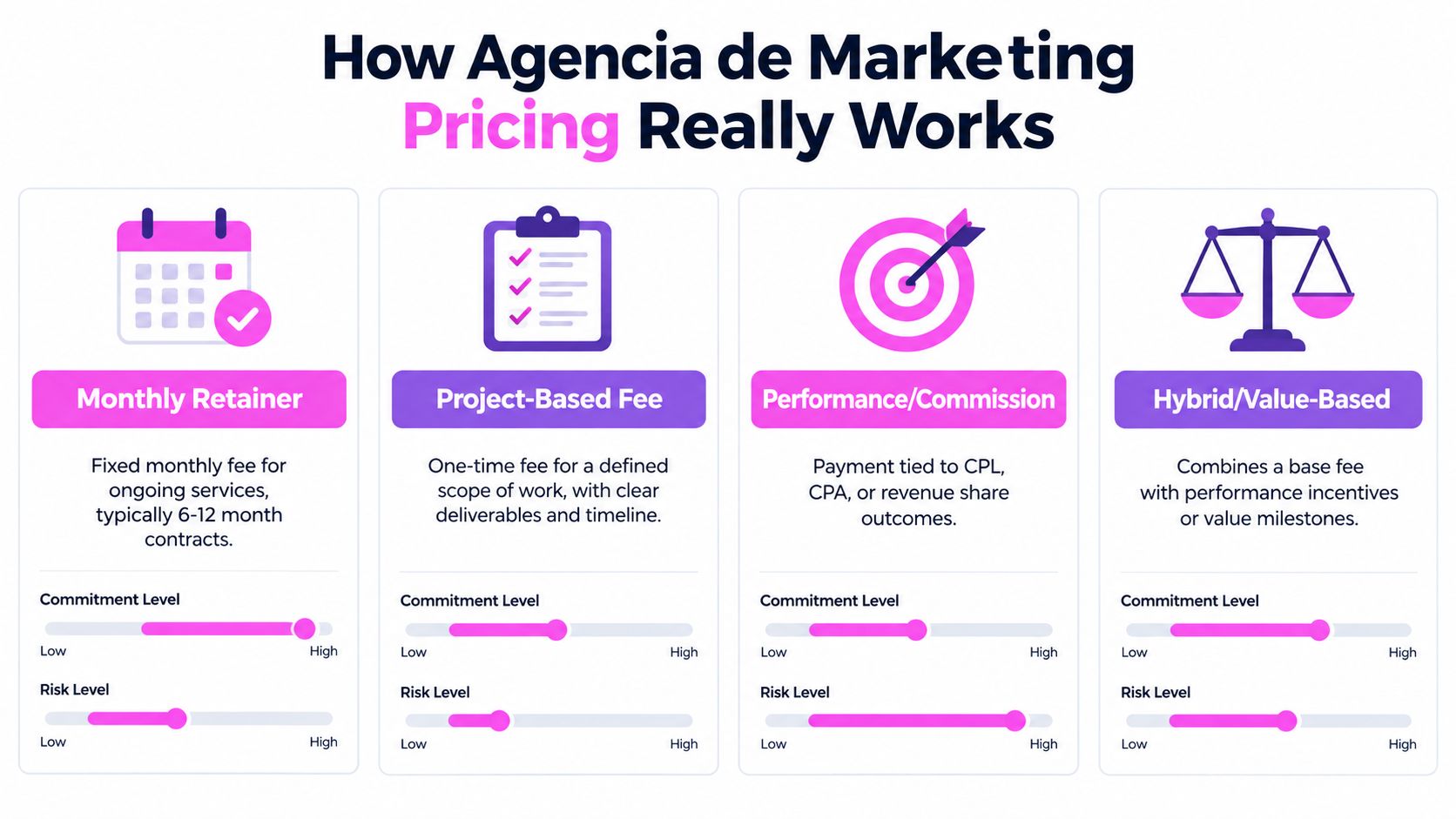
I compare pricing models by asking who absorbs uncertainty. A fixed fee can protect your budget while encouraging the agency to limit labor. A performance fee can reward outcomes while encouraging aggressive attribution. Neither arrangement is automatically fair.
Retainers and projects need different protections
With a monthly retainer, I buy continuing capacity and responsibility. The agency protects its margin through staffing mix, workload limits, and repeatable processes. That can work well when priorities evolve, provided we agree on how work gets reprioritized.
I ask for the roles assigned, expected senior involvement, included production capacity, and the treatment of unused capacity. Dividing the fee by committed hours gives a blended labor rate, not a senior strategist's rate. Without an allocation by role, any claim about the price of senior time is guesswork.
For a project-based fee, I want a bounded problem and observable acceptance criteria. A positioning engagement or site migration can suit this model because we can define what completion means. The agency protects its margin by estimating effort and controlling revisions; I protect my investment by defining dependencies, acceptance, and handover.
A useful project comparison divides the fee across milestones and deliverables, then checks what remains outside scope. A seemingly inexpensive website project may exclude migration, analytics validation, copy, or post-launch fixes.
| Model | Where I'd use it | Clause I'd scrutinize |
|---|---|---|
| Retainer | Ongoing work with changing priorities | Capacity, staffing, and reprioritization |
| Project fee | A defined implementation or decision | Acceptance criteria and revision limits |
| Performance fee | Outcomes we can verify and influence | Qualification, attribution, and exclusions |
| Hybrid | Stable execution plus uncertain upside | Baseline compensation and bonus rules |
Performance pricing needs commercial boundaries
Cost per lead, or CPL, pays for inquiries. Cost per acquisition, or CPA, pays for an agreed acquisition event. Revenue share pays against an agreed revenue base. I wouldn't sign any of these without defining duplicates, existing customers, cancellations, refunds, and disputed attribution.
Revenue isn't profit. My break-even check is contribution after product costs, fulfillment, refunds, media spend, and agency compensation. If that contribution doesn't support the fee, scaling the campaign won't repair the economics.
With hybrid or value-based pricing, I prefer a base fee for agreed execution and a variable component for a clearly defined result. For value-based work, I still require acceptance criteria; pricing against expected value doesn't excuse an ambiguous deliverable.
A performance contract should reward incremental value, not give the agency ownership of every sale your business would have made anyway.
Before signing, I request an all-in cost schedule:
- Media costs: Disclose management fees, buying markups, rebates, and commissions.
- Technology costs: Identify platform pass-throughs, account ownership, and cancellation terms.
- Setup and production: Separate onboarding, creative, tracking, and implementation charges.
- Exit costs: Specify exports, source files, transition support, and access removal.
I reject pricing that combines vague capacity, hidden charges, restrictive renewal terms, and agency-owned accounts. That's a lock-in mechanism, not an incentive model.
A Real Workflow for Shortlisting an Agencia de Marketing
I begin with a written business problem, then assemble a manageable candidate list. I don't start by searching for agencies with the most impressive websites. Their own marketing is relevant, but it isn't proof that they can solve my constraint.
If the missing capability is executive direction rather than execution, I'd examine that before procuring an agency. Big Moves Marketing's fractional CMO guide for founders is a useful resource to consider while distinguishing strategic leadership from outsourced delivery.
Trace the claimed result back to evidence
For each candidate, I request permission to examine relevant client domains and ask what the team owned. Did they write the content, implement technical changes, acquire links, or advise an internal team? I need that distinction before evaluating the result.
I then use domain and keyword-gap research to inspect commercial query coverage, ranking URLs, and competing pages. Historical SERP checks help me compare the claimed engagement period with observable movement. I also review publishing dates and revisions, but I don't equate frequent publishing with effective publishing.
Agency Vetting Checklist
| Category | Evidence sources | Key signals |
|---|---|---|
| Commercial relevance | Client pages, case-study scope, keyword gaps | Coverage aligned with the client's offer |
| Search execution | Ranking URLs, historical SERPs, technical change records | Changes consistent with the claimed work |
| Content quality | Published pages, update history, author information | Buyer usefulness and distinct page intent |
| Link acquisition | Referring domains, anchors, linking pages | Relevant editorial context and explainable acquisition |
| AI visibility | Trigger queries and cited URLs | Citation evidence rather than screenshots alone |
| Wpływ na biznes | Authorized analytics and sales records | Qualified outcomes with stated attribution limits |
Backlink data gives me questions, not a verdict. Repeated commercial anchors or unrelated placements justify investigation, but I can't prove a link was bought just by looking at a report. I ask the agency to explain acquisition methods and provide examples of outreach or editorial coverage.
Evidence boundary: Public search data can corroborate visibility. It can't independently verify revenue, profitability, or the agency's contribution.
Move a finalist from pitch to proposal
Consider a hypothetical finalist claiming success with an e-commerce category. On the first call, I ask which pages changed, what the client implemented, and which measurement event supported the claim.
Before the proposal review, I inspect those pages, relevant SERPs, and referring domains. Then I ask the finalist to reconcile the public evidence with an authorized, anonymized reporting extract. If the case study celebrates informational traffic but the proposal promises purchase growth, I ask for the missing connection.
I'd advance a candidate who explains limitations and supplies a reproducible account of the work. I'd reject one who treats questions about attribution as distrust. Verification is part of procurement, not an insult.
Rethinking KPIs When AI Overviews Rewrite the SERP
I won't let an SEO contract treat rankings as a reliable substitute for visits. Pew Research Center's analysis of nearly 69,000 searches from 900 U.S. adults in March 2025 found traditional-result clicks on 8% of visits with an AI summary, compared with 15% without one, in its research on Google users and AI summaries.
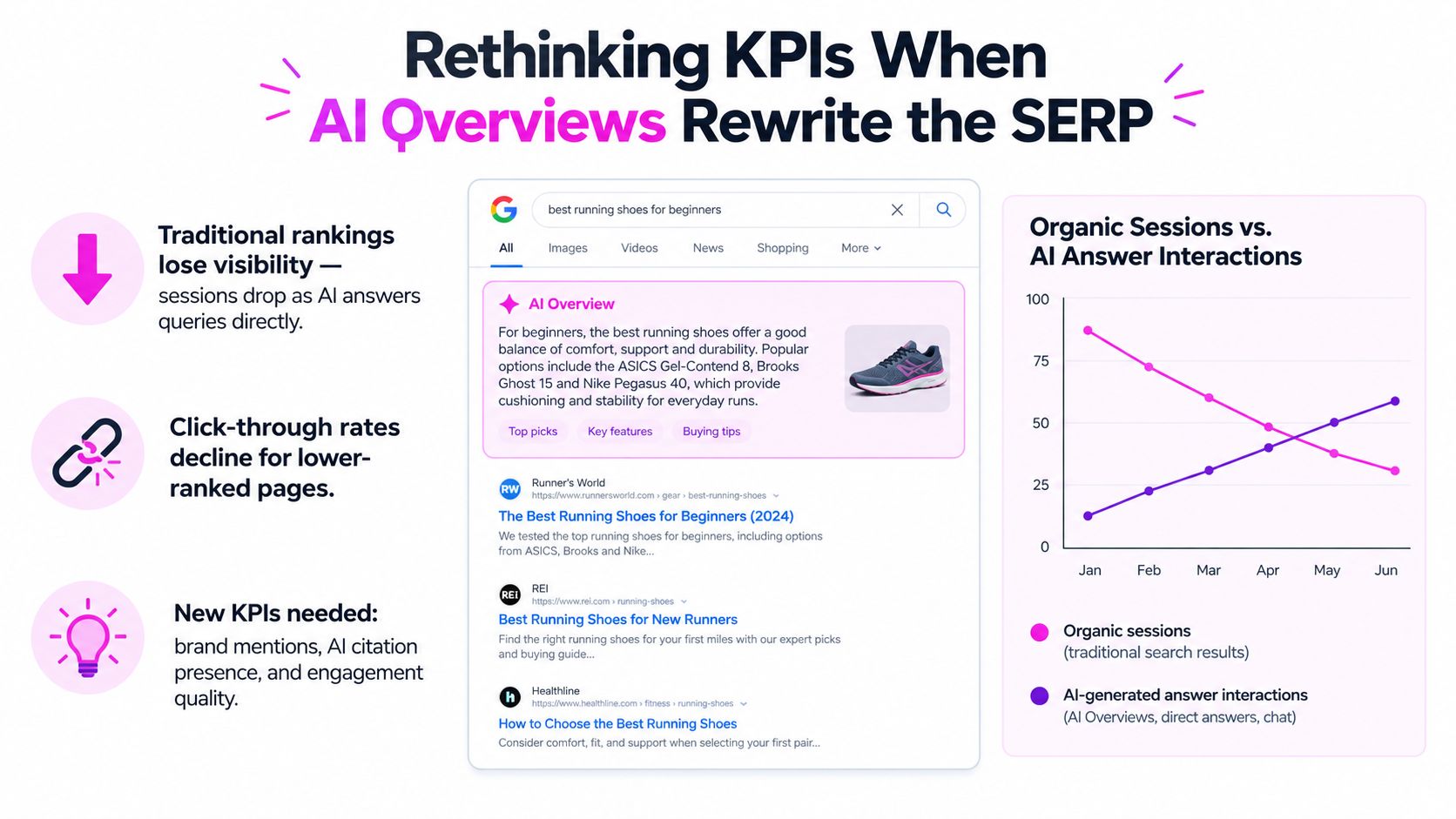
A separate analysis of more than 3,100 queries reported 61% lower organic CTR i 68% lower paid CTR for searches displaying AI Overviews, while cited pages experienced 35% higher organic CTR i 91% higher paid CTR, jak wynika z Seer Interactive's summary of its AI Overview CTR research. I don't treat those findings as a guaranteed benefit from earning a citation; they describe observed differences, not a contractual promise.
Separate exposure from commercial influence
My reporting stack distinguishes signals rather than collapsing them into a visibility score:
- Search exposure: Track ranking URLs, impressions, and the queries displaying AI Overviews.
- Answer inclusion: Record the cited URL, query, observation date, and search conditions.
- Brand demand: Monitor branded searches and direct traffic, while acknowledging that other channels can influence both.
- Commercial quality: Inspect qualified organic sessions, assisted conversions, and sales-qualified opportunities using agreed definitions.
I compare clicks and engaged sessions against impressions to investigate where the journey changed. Losing visits because an answer satisfies the query isn't the same as losing demand. Equally, a citation isn't proof that someone remembered the brand or later purchased.
Put measurement limits in writing
I'd adapt this clause with procurement and legal counsel:
Reporting clause: The agency will report agreed visibility, citation, engagement, and qualified-outcome measures against the approved baseline. Reports will disclose tracking changes, attribution assumptions, client-led activity, and material external events. The agency may claim contribution only where documented work and supporting evidence justify it; correlation alone will not be presented as causation.
I also require a consistent query sample and documented collection method. Otherwise, either side can select favorable screenshots and call them a trend.
My recommendation isn't to abandon traffic. It's to stop asking traffic to represent every stage of the customer journey.
Governance, Cadence, and the Communication Gap
I'd rather hire a capable team with explicit decision rights than a brilliant specialist who won't document how work gets approved. Expertise matters, but I can't use it if nobody knows who can authorize a change.
In PMI's 2025 survey of 130 U.S. agency professionals, 97% reported a major campaign challenge, 55% reported budget overruns, 54% overdue deadlines, and 34% campaigns that failed to resonate, as detailed in PMI's agency campaign-challenges announcement. I read those findings as a reason to investigate operating conditions, not as proof that every failure originates with an agency.
Assign decisions, not just job titles
I use a RACI-style matrix: responsible means doing the work, accountable means owning the final decision, consulted means providing input, and informed means receiving the outcome. I translate those labels into actual names during onboarding.
| Decyzja | Responsible | Accountable | Consulted |
|---|---|---|---|
| Campaign brief | Agency lead | Client marketing owner | Sales and product |
| Budget change | Agency media lead | Client budget owner | Finance |
| Tracking release | Implementation owner | Client analytics owner | Agency analyst |
| Claim approval | Content owner | Client approver | Legal or subject expert |
| Corrective plan | Agency account lead | Client marketing owner | Channel specialists |
I set approval windows and explain what happens when we miss them. The agency should record the dependency and propose a revised schedule, not launch unapproved work or pretend the original deadline remains achievable.
Make changes visible before they become disputes
My change-order rule requires a written description, business reason, fee impact, schedule impact, and displaced work. I also reserve an agreed experimentation budget, so we can test a hypothesis without renegotiating every minor variation.
- Weekly status: Resolve blockers, dependencies, and decisions.
- Monthly review: Examine performance, data quality, and corrective actions.
- Quarterly strategy: Reconsider priorities, economics, and the service mix.
- Escalation: Name the decision-maker when working-level owners can't resolve an issue.
For dashboard design, I'd use the agency SEO reporting guide as a practical reference while agreeing on a single measurement record.
I judge onboarding by whether we can use the document during a disagreement. A welcome presentation isn't governance. Named owners, approval rules, and an escalation path are.
Questions to Ask Before You Sign With an Agencia de Marketing
I send diagnostic questions before the final meeting and require written answers. That gives us a record to compare with the proposed contract, rather than relying on assurances made during a pitch.
Ask for definitions and demonstrations
- Outcomes and measurement: “Which business event defines success, and how will you report AI Overview visibility?” A weak answer lists dashboard metrics. A strong answer defines the event, baseline, collection method, and attribution limits. Verify public visibility separately from private commercial outcomes.
- Operating model: “Who approves work, what response commitment applies, and how will you price scope changes?” “We're flexible” isn't enough. Ask for an approval matrix, change-order example, and escalation procedure.
- Expertise and proof: “Show relevant clients where you influenced revenue, identify your work, and let me inspect their SERPs.” A strong answer connects implementation records with authorized business evidence. Public data can verify search movement, not the revenue claim.
- Resilience: “What happens if our strategist leaves or a channel underperforms?” Ask for the replacement process, knowledge-transfer requirements, and a sample corrective plan. Verify this through client references, not search rankings.
Check whether the proposal matches the answer
For paid acquisition, I'd compare media buying agency fees using AdManage.ai's guide while requesting an itemized commercial schedule. Treat it as a comparison resource, not evidence that a particular fee fits your economics.
If you need help forming the search questions before procurement, use the free SEO consultation resource to prepare a focused discussion.
My final check is simple: does the written proposal contain the commitments the team just described? If not, ask for a revision. The salesperson's answer won't resolve a dispute unless we translate it into an obligation.
Your Decision Framework for This Week
Write a one-page outcomes brief before contacting an agencia de marketing. Require finalists to answer the diagnostic questions in writing. Then incorporate the measurement and governance commitments into the contract before work begins.
Avoid hiring on chemistry, accepting vague reporting for a lower fee, or postponing AI visibility measurement. You owe the agency clear decisions and usable inputs. The agency owes you transparent execution, defensible evidence, and a correction process when the plan doesn't work.
I'd use SemDash (SemDash) as one option for checking competitor keywords, ranking pages, backlink gaps, historical SERPs, and AI Overview citations during agency evaluation. Visit the platform to build an evidence file for your finalists, then use those findings to ask sharper questions before signing.