

The most popular advice about AI search visibility is to keep doing good SEO and wait for the citations to follow. I wouldn't build a reporting stack around that assumption. A strong ranking tells me where a page appears in conventional search, not whether an AI answer uses its evidence, links to the right URL, or represents the product accurately.
I treat AI visibility as a citation-quality problem, not a mention-volume contest. That changes which pages I audit, how I brief writers, and what I'm willing to call progress.
Spis treści
- Why Ranking First No Longer Guarantees AI Visibility
- What AI Search Visibility Actually Means
- The Two-Stage Model Behind Every AI Answer
- Why Citation Is Not the Same as Traffic
- The Crawlability Audit That Comes Before AI Optimization
- Rebuilding Pages Around Sub-Question Coverage
- Building the AI Visibility Dashboard That Actually Holds Up
- What to Change in Your SEO Workflow This Week
Why Ranking First No Longer Guarantees AI Visibility
Ranking first and being cited are different outcomes. I still want strong organic positions, but I won't use them as proof that a page contributes to an AI-generated answer. My rank tracker and citation report need to answer different questions.
Consider an illustrative audit, not a claimed client result. My password-management landing page holds the top conventional position for a broad category query, yet the generated answer cites a competitor's device-support documentation. Rewriting my landing page's title wouldn't address that gap if the answer needs specific compatibility evidence that my page doesn't provide.
The comparison below captures the distinction I'm looking for.
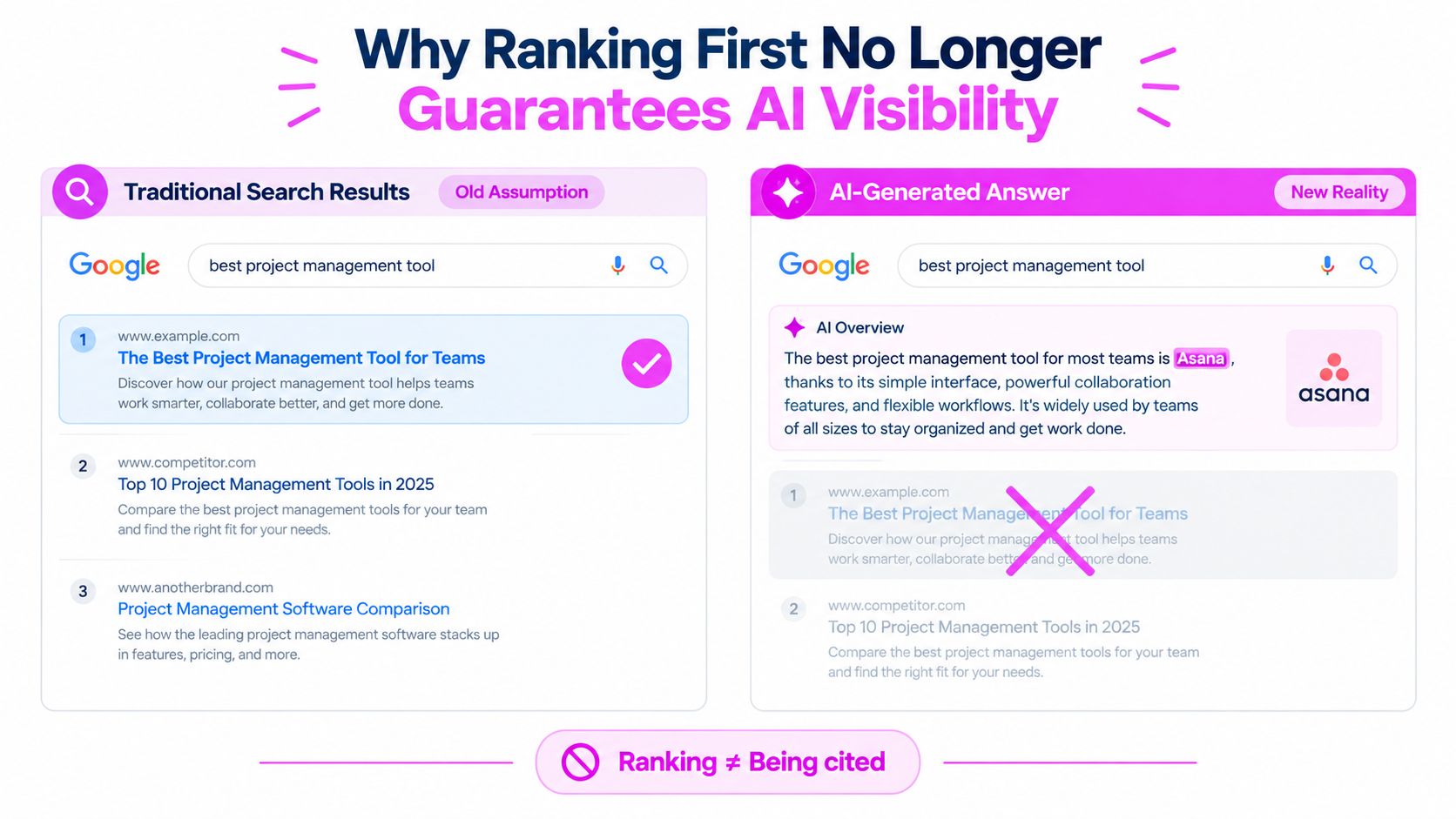
Diagnose the missing outcome
I separate the diagnosis before changing anything:
- Ranking gap: My target page isn't competitive in conventional results.
- Citation gap: My domain ranks, but another URL supplies the answer's evidence.
- Representation gap: My brand appears, but the answer misstates a feature or overlooks a relevant use case.
For an additional audit perspective, I'd pair that comparison with CitationOS AI visibility audit insights. I'd use it as a resource for framing the investigation, not as proof that a particular tactic guarantees inclusion.
I also wouldn't assume more owned pages or backlinks solve every absence. In Ahrefs' analysis of 75,000 brands, YouTube mentions correlated more strongly with AI brand visibility than link volume or total page count. I read that as a reason to investigate third-party corroboration, not as a causal instruction to publish videos.
My operational questions are narrower: What counts as visibility? Which evidence does the answer use? What page-level change could close the observed gap? Those questions lead to a better backlog than another export of ranking movements.
What AI Search Visibility Actually Means
I define AI search visibility as the likelihood that my brand or page is selected as a source, cited in an answer, and substantively represented in the wording or evidence a user reads. I can estimate observed frequency across a query sample, but I can't turn that sample into a universal probability for every user.
I distinguish the source relationship from the commercial outcome. A page can support an answer without making its product the preferred choice, and a product can receive a recommendation without its own website receiving a link.
This diagram illustrates the source relationship I want to inspect.
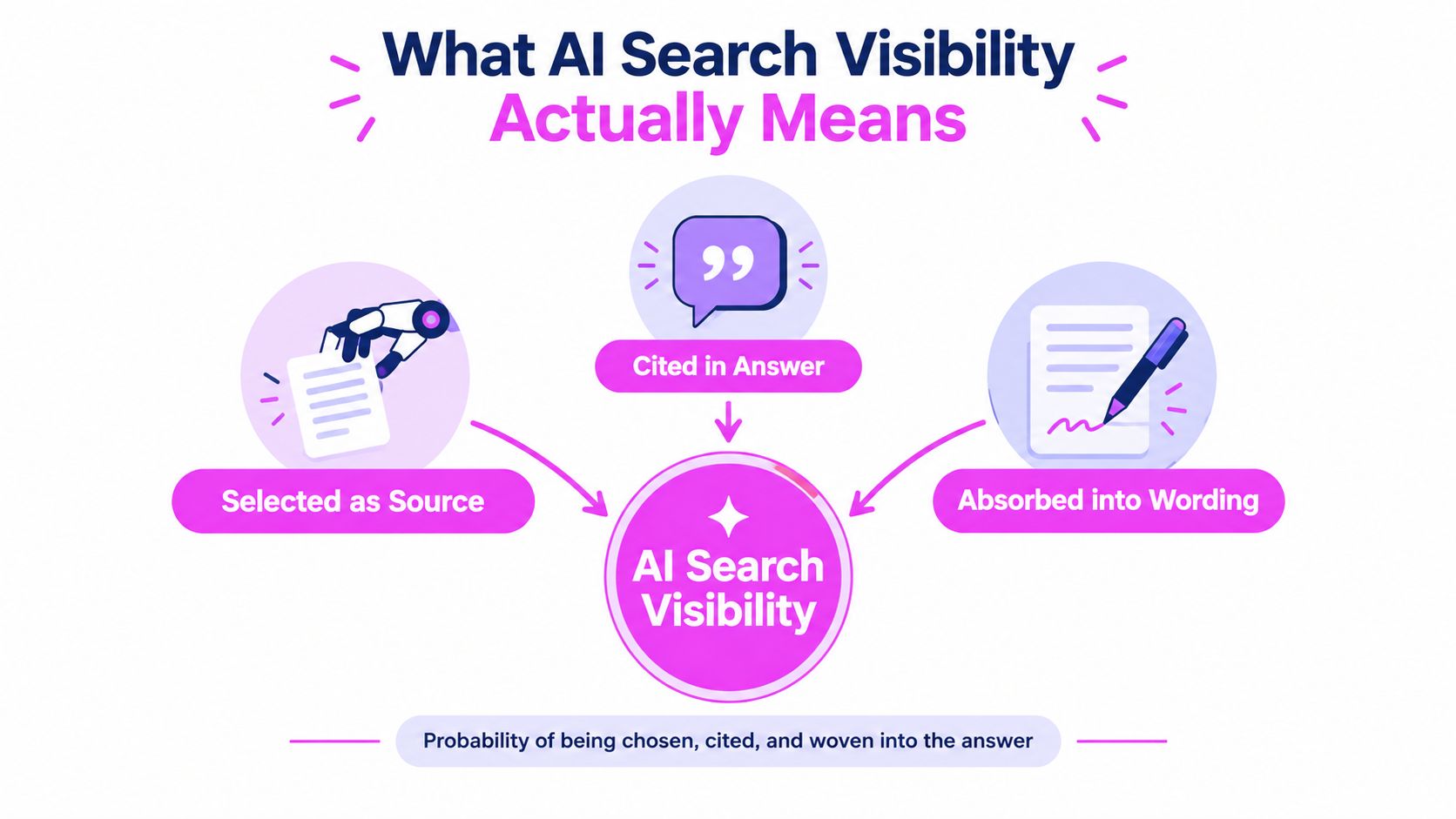
Keep the outcomes distinct
For a hypothetical password-manager comparison, I'd record the results like this:
| Observed outcome | Illustrative answer behavior | What I record |
|---|---|---|
| Mentioned | The answer names my product among available options | Brand presence and context |
| Cited | The answer links to my security documentation | Exact URL and supported claim |
| Polecane | The answer identifies my product as suitable for the user's needs | Recommendation, rationale, and conditions |
These aren't mutually exclusive categories. My product might receive all of them, or it might receive a citation only because its documentation explains a category-wide security concept.
For mentions, I'd investigate entity clarity and independent descriptions of the brand. For citations, I'd inspect the page's evidence and extractable passages. For recommendations, I'd check whether accurate product capabilities match the user's constraints.
I use citation with an identifiable URL and a supported claim as the strongest auditable source-visibility outcome. That doesn't mean it's automatically the most valuable business outcome. It means I can inspect it.
The proposed citation-selection and citation-absorption framework helps make that inspection concrete by emphasizing semantic alignment, structural legibility, evidence density, and domain context. I keep weaker signals in the report, but never let an unlinked mention substitute for verified use of a target page.
The Two-Stage Model Behind Every AI Answer
I use the two-stage framework as a diagnostic model, not a claim that I can see an AI system's internal retrieval process. Citation selection asks whether my page becomes a usable source; citation absorption asks whether its content substantively supports the generated answer.
The distinction helps me choose a fix. If my evidence isn't accessible or relevant, polishing its prose won't resolve selection. If my page is cited but its useful claims aren't represented, I need to inspect clarity, context, and evidence rather than celebrate the citation.
Here's the model I apply when reading an answer.
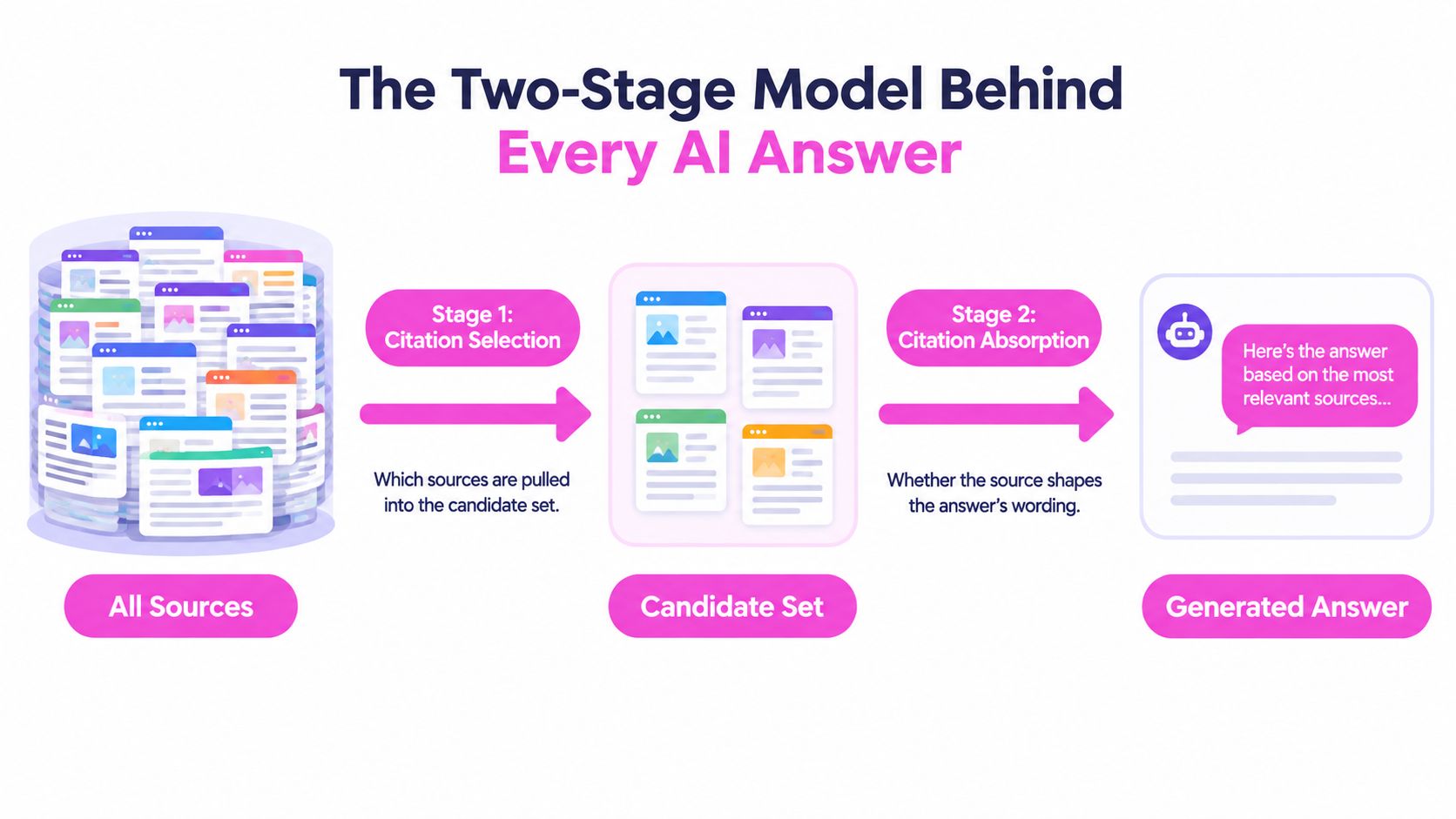
Audit the answer's sub-questions
Google explains that AI Overviews and AI Mode can use query fan-out, issuing related searches across subtopics and data sources before constructing an answer, in its guidance on AI features and websites. I therefore audit the questions behind the answer, not just the original keyword.
For an illustrative B2B SaaS query about enterprise password management, I'd look for security architecture, administrative controls, supported devices, and migration requirements. A broad product page might be cited while contributing little beyond a general description. A documentation page might supply the actual implementation detail.
My reverse-engineering checklist is short:
- Identify the claim: What specific statement sits beside the citation?
- Inspect the passage: Can I locate evidence that supports the statement on the cited page?
- Check the scope: Does the answer preserve limitations, prerequisites, and exceptions?
- Assign a hypothesis: Is the likely problem access, relevance, structure, or insufficient evidence?
I don't label an uncited page as a confirmed selection failure because I can't observe the hidden candidate set. I record a testable hypothesis instead.
For a complementary walkthrough, use the video below alongside an actual query and its cited pages.
My aim is to produce a defensible edit: a clearer answer, better-supported claim, or more appropriate destination URL. It isn't to reverse-engineer an invisible scoring formula.
Why Citation Is Not the Same as Traffic
I won't translate citation appearances into projected visits. In Pew Research Center's analysis of browsing activity from more than 900 U.S. adults i nearly 69,000 Google searches, traditional-result links received clicks on 8% of visits with an AI summary versus 15% without one, while summary links received clicks on 1% of visits, according to its Google AI-summary click-behavior analysis.
I interpret those observations as a measurement warning, not proof that citation has no value. I might gain accurate exposure without a visit, but I can't claim revenue or influence from that exposure alone.
Citation vs Click Combinations and What They Mean
I use “high” and “low” relative to my own query sample and reporting baseline, not as universal thresholds.
| Scenario | Citation in AI answer | Click-through volume | What it actually means |
|---|---|---|---|
| Evidence exposure | Wysoki | Niski | My content is used, but visits remain limited |
| Discovery and action | Wysoki | Wysoki | I have both exposure and traffic to investigate for conversion quality |
| Conventional traffic strength | Niski | Wysoki | I'm earning visits without substantial observed AI citation |
| Visibility deficit | Niski | Niski | I need to diagnose access, relevance, competition, and demand |
I also keep Google's AI surfaces separate. AI Mode and AI Overviews shared at least one identical cited URL for the same query only 13.7% of the time in the reported citation-overlap analysis. I wouldn't use presence in one surface to certify presence in the other.
Reporting rule: A citation is evidence of inclusion, not evidence of a visit, persuasion, or a sale.
To earn the next click, I'd give the reader something the summary can't complete: an implementation checklist, comparison tool, original dataset, or migration resource. I'd then report visibility, extractability, a downstream action separately, including when the last field remains unknown.
The Crawlability Audit That Comes Before AI Optimization
Before rewriting copy, I verify that the important answer can be retrieved and rendered. Google's generative AI optimization guidance makes publicly accessible, crawlable content foundational; it also describes JavaScript processing through crawling, rendering, and indexing. I don't assume that a complete-looking browser page proves reliable search access.
My representative edge case is a product page whose introductory copy loads immediately, while compatibility details appear only after a visitor opens an interactive panel. I'd test that implementation rather than declaring all JavaScript content unusable. The relevant question is whether the evidence appears in retrievable, rendered HTML without the interaction.
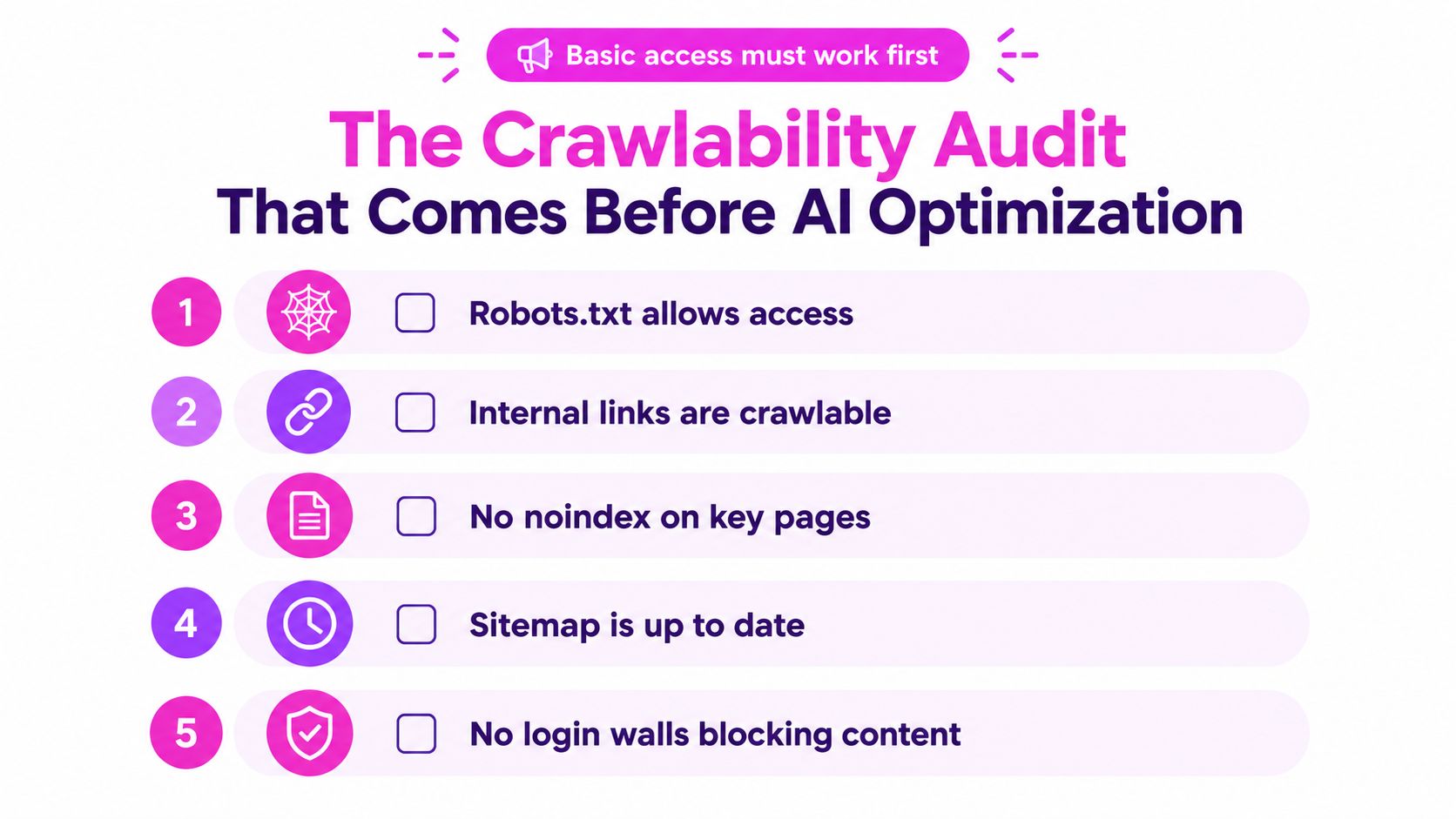
I start with the access checks shown below.
Follow the retrieval path
- Robots.txt: Check whether the relevant crawler can access the page and required resources. I distinguish crawling restrictions from indexing directives.
- HTTP status: Inspect the actual response, including redirects and intermittent errors, before evaluating the copy.
- Canonical directives: Confirm the declared preferred URL matches the intended evidence destination. I investigate conflicts rather than assuming a canonical dictates citation behavior.
- Noindex rules: Check both page markup and response directives on priority pages.
- Internal links: Verify that relevant pages are connected through crawlable links with understandable anchor text.
- Server response versus rendered DOM: Compare the title, main answer, headings, evidence links, and structured data across both representations.
I'd also verify sitemap hygiene and public access where relevant, without treating sitemap inclusion as proof of indexing. If I need implementation support, AY Rank's technical SEO audit is an option to evaluate alongside an internal crawl and rendering review.
My acceptance test isn't merely that the page loads. It's that I can reliably retrieve the important claims, identify their supporting links, and reach the intended URL. Crawlability is the floor, not proof that the answer deserves selection.
Rebuilding Pages Around Sub-Question Coverage
I'd rebuild an illustrative password-management SaaS topic around buyer questions, not inflate a landing page with loosely related FAQs. The starting problem is a broad page that says the product is secure, flexible, and easy to migrate to, but leaves the evidence scattered across documentation.
My first deliverable would be a sub-question map. I'd associate each question with an existing URL, a directly usable answer, and the product evidence required to substantiate it.
Turn the map into content decisions
| Sub-question | Content block I'd build | Evidence I'd require |
|---|---|---|
| Security | Explain the relevant security architecture and its limitations | Current technical documentation |
| Compliance | State supported requirements and the boundaries of each claim | Applicable, current compliance documentation |
| Device support | Provide a compatibility table with exceptions | Maintained support specifications |
| Ceny | Explain plan eligibility, inclusions, and billing conditions | Current published plan information |
| Migration | Describe prerequisites, import options, and failure handling | Verified implementation instructions |
I'd keep concise answers on the main product page and link to deeper resources where the task justifies them. I wouldn't create a separate page for every wording variation. A distinct URL earns its place when it supports a distinct user task and contains enough evidence to stand alone.
For the structural work, I'd use the approach in how to optimize for AI Overviews alongside the actual citation audit. My writing brief would specify the question, answer-first passage, proof, caveat, and destination URL, not simply the target keyword.
I'd rather publish a narrow answer I can substantiate than a comprehensive-looking page filled with unsupported certainty.
After implementation, I'd compare the cited destination and supported passage against the baseline. A different citation URL would be an observation to investigate, not automatic proof that my rewrite caused the change.
The trade-off is maintenance. More substantive coverage can mean more pages, tighter internal linking, and additional product-review work. I'd consolidate overlapping answers and assign evidence ownership before expanding the library, otherwise I'd create contradictions that make accurate extraction harder.
Building the AI Visibility Dashboard That Actually Holds Up
My dashboard starts with an observation record, not a blended visibility score. I need to know what I tested, which surface produced the answer, and what I can verify from that answer. Without that record, a movement in the chart is difficult to explain.
For Google-specific collection, SemDash (SemDash) is one option alongside manual checks and a reporting sheet: its AI Overviews visibility report identifies domain mentions and exact cited URLs, allowing comparison with conventional ranking pages. I'd use how to track AI Overviews to structure that workflow, while keeping other platforms in separate records.
Capture fields that support decisions
- Query and intent: Preserve the wording and classify the task so informational exposure doesn't get confused with buying consideration.
- Platform and observation context: Record the surface, date, and relevant test conditions. An absent AI Overview differs from an answer that omits my brand.
- Mention, citation, and recommendation: Store independent fields, including the exact cited URL.
- Answer position and prominence: Distinguish a central recommendation from a supporting reference.
- Accuracy and sentiment: Record whether the answer is correct and how it frames the brand. Positive wording doesn't excuse a false claim.
- Evidence and downstream outcomes: Preserve the supported passage, referral observations, conversions, and branded-search changes where measurable.
I'd sample priority queries weekly, run a fuller sweep monthly, and compare competitors quarterly. That's my proposed operating cadence, not a research-backed performance prescription.
Preserve platform boundaries
I'd give Google AI Overviews, AI Mode, ChatGPT, and Gemini separate columns or report views. I wouldn't claim that the Google-specific tool above measures all of them, or average their results into a score that hides missing coverage.
For an advisory practice, I'd connect this backlog to a broader planning resource such as Advisor Momentum's SEO roadmap for RIAs, keeping citation work accountable to business priorities.
My leadership view would show the observed gap, proposed fix, owner, and outcome. If I can't explain which page needs attention, I've built a dashboard that reports activity without helping anyone make a decision.
What to Change in Your SEO Workflow This Week
I'd change the acceptance criteria for SEO work before expanding the content budget. A completed rewrite shouldn't mean only that copy shipped and rankings held. I want an accessible answer, verified evidence, a deliberate destination URL, and a baseline against which I can inspect later observations.
I'd also stop promising citation lifts from formatting changes alone. Clear headings and self-contained answers are sensible implementation choices, but I can't guarantee selection by applying a template. My team needs permission to report an unsuccessful test without disguising it as progress.
Make the decisions explicit
- Choose the measurement unit: Make the cited URL and supported claim inspectable. Keep aggregate metrics for summaries, not diagnosis.
- Set the technical gate: Resolve access and rendering uncertainty before commissioning a content rewrite.
- Assign evidence ownership: Have product, legal, or subject-matter reviewers approve claims within their remit.
- Prioritize actionable gaps: Start where a relevant query, a useful existing page, and a fixable deficiency intersect.
- Define the commercial test: Decide what useful next action the destination offers and how you'll observe it.
My first test would be a priority topic with a clear ranking-to-citation mismatch. I'd preserve the initial answer, inspect the competing cited passage, document the hypothesis, and change the smallest meaningful content or technical variable. I'd avoid rewriting the entire topic library before learning whether my diagnosis holds.
Decision standard: Don't call a test successful because the brand appeared. Call it successful only against the outcome you defined before the change.
Over the coming year, I'd organize this work around evidence maintenance, product accuracy, and platform-specific observation rather than an endless publishing quota. The reporting function should help me distinguish access problems from content gaps and unsupported business assumptions.
I don't need perfect attribution to begin. I need honest boundaries around what I observed, what I inferred, and what remains unproven. That's how I'd keep AI search visibility useful to the business instead of turning it into another vanity metric.
SemDash offers AI Overviews visibility reporting with domain mentions and exact cited URLs, alongside keyword and page-level competitive analysis. Visit SemDash (SemDash) to compare your ranking pages with your cited pages and build a prioritized audit backlog around the gaps.