%20(1)-B86R08ZzwhPzS6UZbG3mSxRWPCwGwn.png)


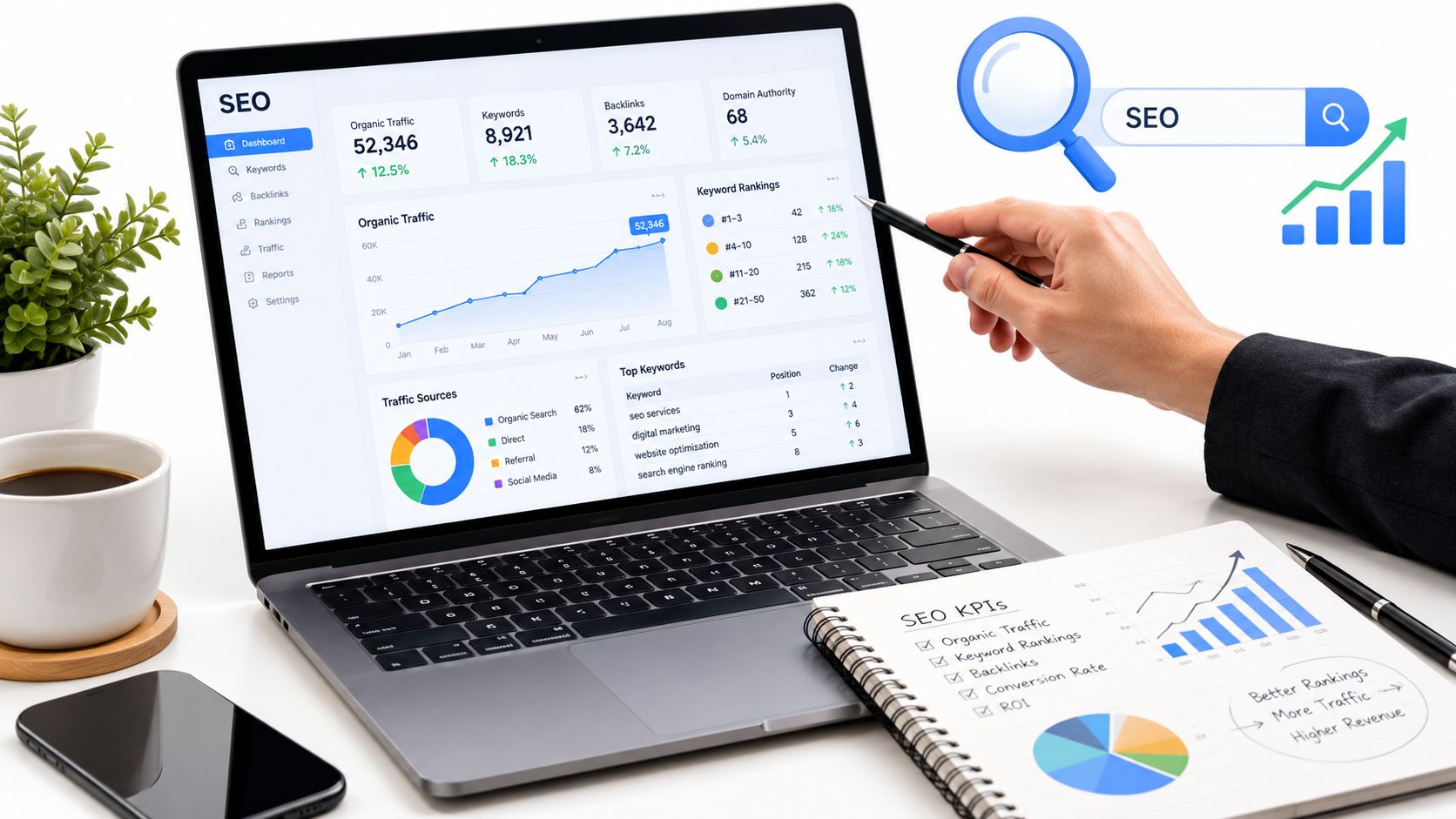
You've noticed a problem, but you can't yet tell whether it's technical, editorial, competitive, or commercial. Organic traffic has flattened, a competitor keeps appearing for the searches that matter, or your team has published several pages without knowing whether any of them target the right intent. A free SEO consultation sounds like a sensible first step, provided it produces more than a friendly conversation and a list of familiar recommendations.
A useful consultation should reduce uncertainty. You should leave knowing which pages deserve attention, what evidence supports each recommendation, what your team can realistically implement, and how you'll measure the result. The call isn't a magic button, and it shouldn't be a disguised ranking guarantee. It's a short diagnostic that helps you decide whether SEO deserves more investment, where that investment should go, and what should wait.
Spis treści
- Why a Free SEO Consultation Exists
- What a Strong Free Consultation Typically Includes
- How to Evaluate Whether a Consultation Offer Is Worth Your Time
- Technical Health Checks I Expect in a Real Consultation
- Common Mistakes People Make Before and During a Consultation
- Preparing Access, Goals, and KPIs Before the Call
- Next Steps After a Consultation
Why a Free SEO Consultation Exists
A business owner usually books a consultation after an uncomfortable moment. Perhaps a product page that once attracted qualified visitors has slipped, or a new site has been live for months without gaining meaningful search exposure. In many cases, the owner doesn't need another explanation of what SEO is. They need someone to distinguish the expensive problems from the merely visible ones.
That distinction matters because SEO grew out of a much simpler web. The strongest historical evidence places the first documented use of the phrase “search engine optimization” around 1997, when webmasters were already editing meta tags, repeating keywords, and trying to improve placement in early search engines. The historical record of the term and its early development) also shows that SEO didn't begin with one universally documented event. It developed as practitioners responded to changing ranking systems.
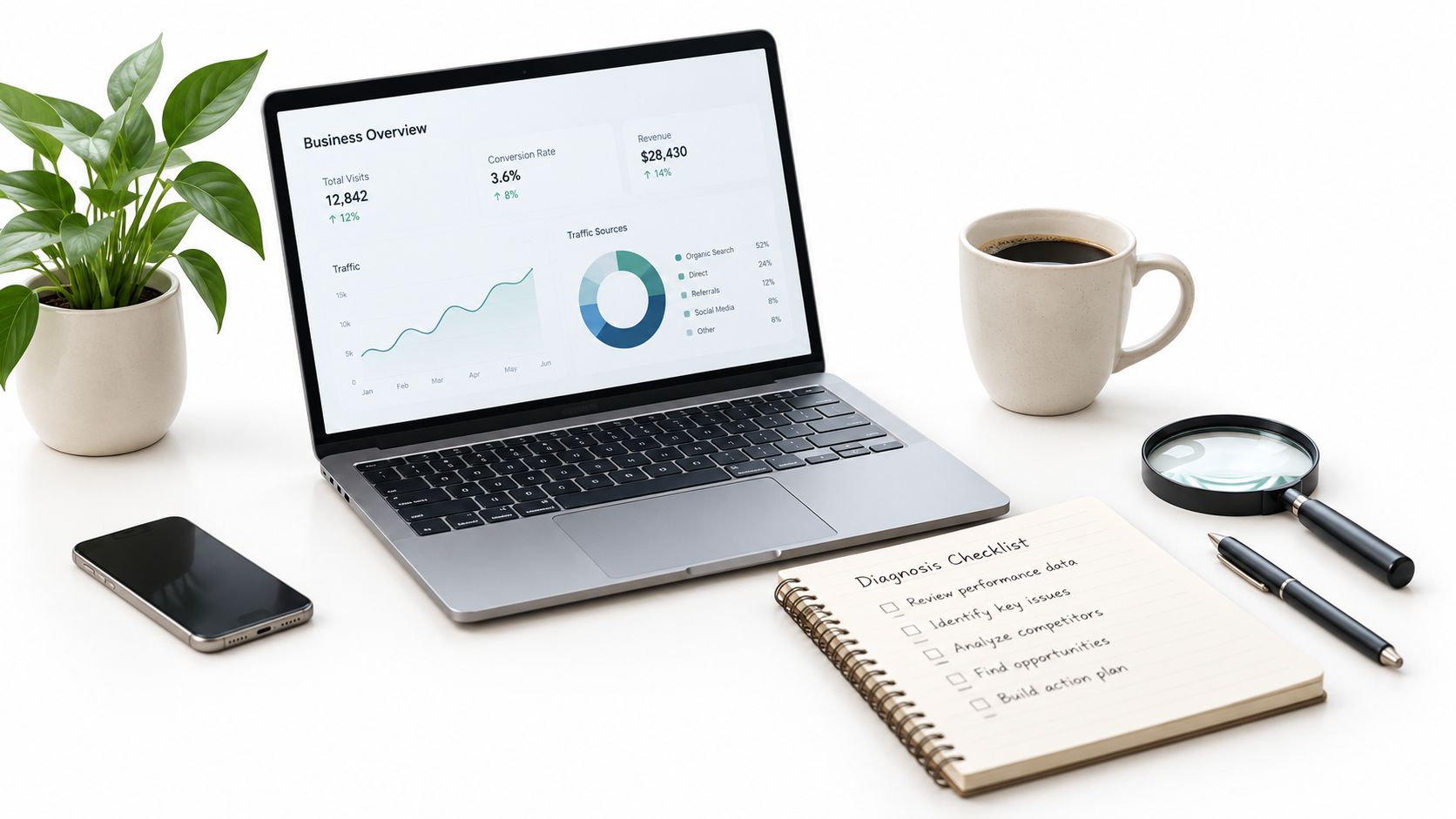
A diagnostic, not a promise
I treat a free SEO consultation as a risk-reduced decision point. It should establish what's currently measurable, identify a small number of meaningful opportunities, and test whether those opportunities fit the business model. A consultant who promises immediate rankings skips the hardest part, which is determining whether the site can satisfy the searcher and convert the resulting demand.
SEO is already a mainstream activity for smaller businesses. A 2024 survey of 272 U.S. SMB marketers wykazała, że 72% were doing some form of search marketing and 94% considered SEO effective within their marketing strategy. The same survey reported that 68% focused primarily on on-page SEO, while 25% concentrated on off-page tactics, and that 23% spent less than $1,000 per month on SEO while 46% spent less than $5,000 per month. The survey findings published by Search Engine Roundtable help explain why prioritization is so valuable. Many teams recognize the channel but can't fund every possible activity.
Praktyczna zasada: A consultation earns its value by telling you what not to do yet.
That may mean postponing link acquisition until important pages convert, consolidating overlapping articles instead of publishing more, or abandoning keywords that attract attention but not buyers. A realistic call won't remove uncertainty completely. It will make the next decision clearer.
What a Strong Free Consultation Typically Includes
I expect a serious consultant to begin with evidence, not a screen share of a generic audit tool. The first question should be what the business needs from organic search, whether that means qualified enquiries, product discovery, local actions, subscriptions, or another measurable outcome.
Start with a Search Console baseline
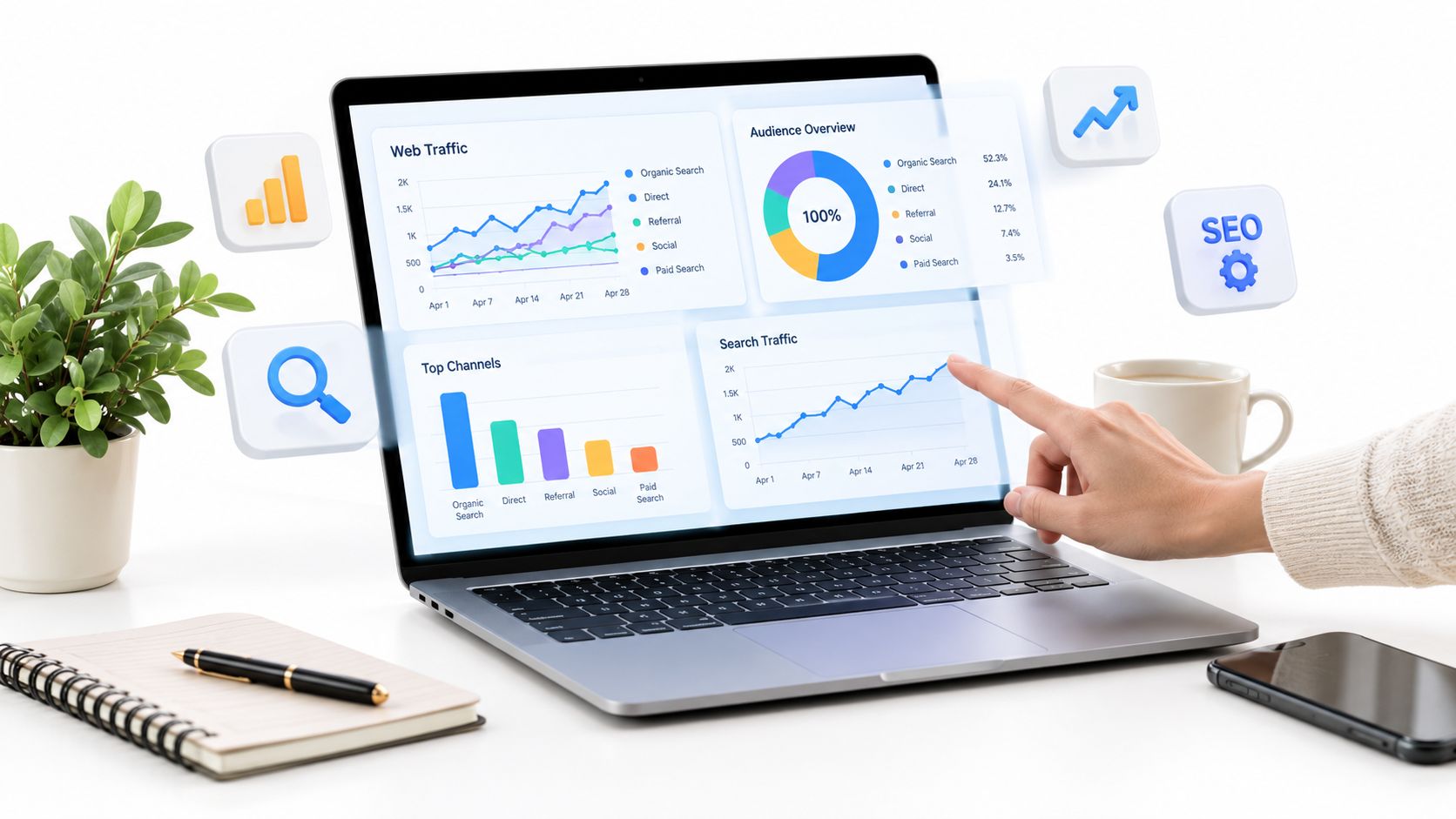
Google Search Console provides the most useful starting point for a site that already receives search exposure. Its Performance report includes clicks, impressions, click-through rate, and average position, with segmentation by query, page, country, device, date, and search appearance. Google's Performance report documentation explains the available dimensions and metrics.
I export a page and query baseline before interpreting performance. Then I separate branded searches from non-branded searches, compare equivalent date ranges, and look for patterns rather than isolated rankings.
- High impressions with low CTR often points toward a weak title, unhelpful snippet, poor intent alignment, or a SERP feature that absorbs attention.
- High CTR with low impressions can indicate that the page satisfies a narrow set of searches but lacks broader query coverage or sufficient ranking strength.
- Falling clicks with stable impressions suggests that CTR, search-result layout, or competing features may have changed.
The point isn't to produce a larger spreadsheet. It's to connect a page-level observation to a decision with commercial relevance.
Separate the signal from the recommendation
Next, I test whether the problem is technical, content-related, authority-related, or caused by search intent. A crawl report may show missing metadata, but that doesn't prove metadata is limiting the page. A keyword gap may reveal terms competitors rank for, but it doesn't prove your site should create a page for every term.
A useful deliverable ranks recommendations by impact, effort, confidence, and business fit. It should identify the URL or template involved, explain the evidence, name the owner who would implement the change, and specify what measurement should move afterward.
The consultation should also account for capacity. A small internal team may be able to improve existing pages but lack time for a large digital PR campaign. An agency may have writers and developers but need a clearer prioritization system across several clients. Good advice changes with those constraints.
How to Evaluate Whether a Consultation Offer Is Worth Your Time
Before booking, I look for evidence that the consultant has designed a diagnostic process rather than a lead-generation script. The offer should state what happens during the call, what access or information is needed, and what you'll receive afterward. “We'll review your website and discuss growth” isn't a scope. It's an invitation to find out the scope later.
The strongest signal is a clear connection between findings and decisions. Ask, “If you identify ten issues, how will you decide which three come first?” A credible answer should involve business value, implementation effort, search demand, competition, technical dependencies, and the team's ability to execute.
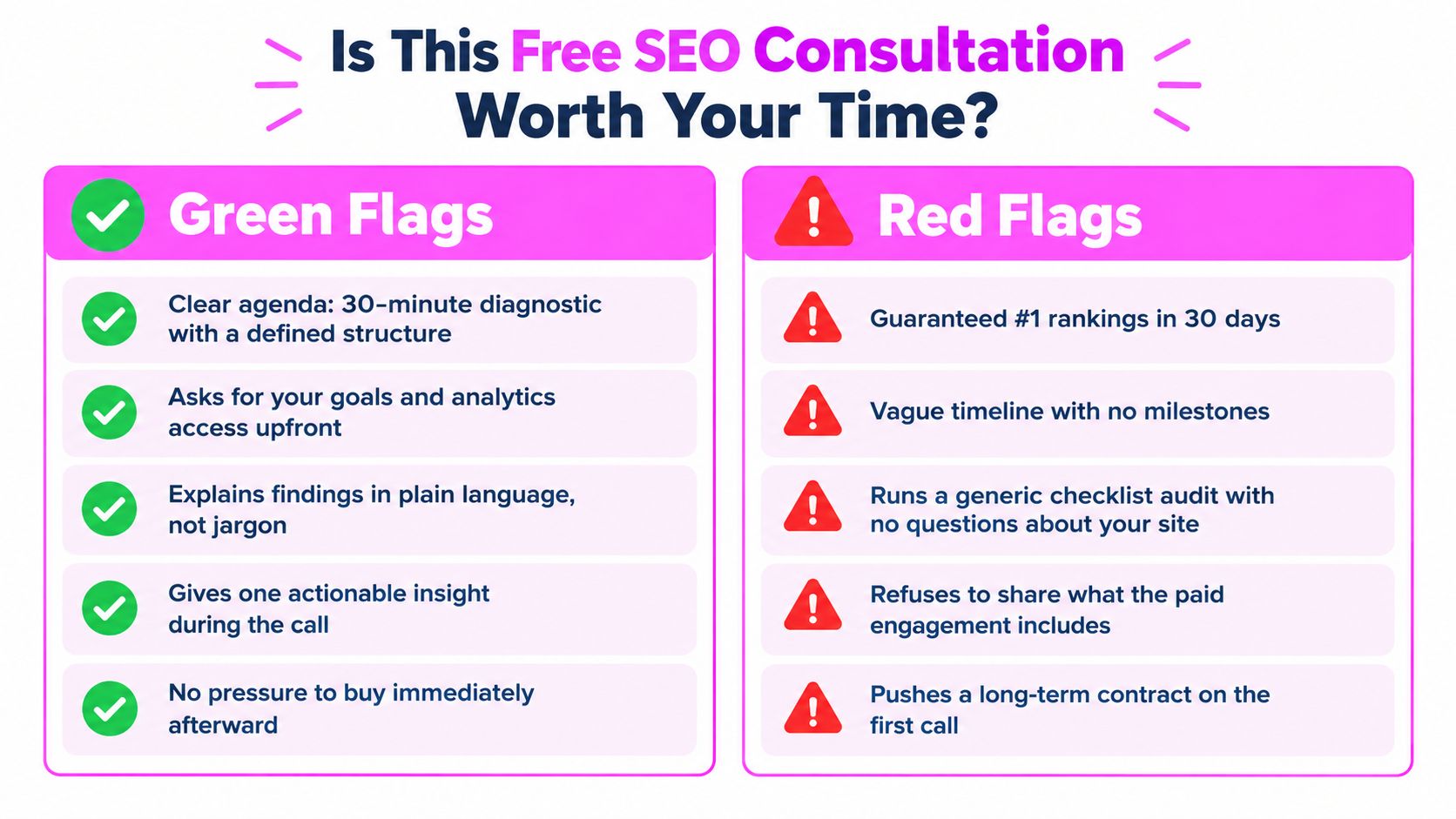
Red flags that waste time
I'm cautious when an offer includes ranking guarantees, unexplained urgency, or a long checklist with no questions about the business. A consultant can diagnose observable conditions, but they can't control competitors, algorithm changes, searcher behavior, or the resources available to implement recommendations.
The budget question deserves a direct answer. A 2025 UK SME study wykazała, że 67% cited budget constraints as their main SEO barrier, while 54% lacked in-house expertise, 48% struggled to measure ROI, and 41% were unsure which tactics to prioritize. The UK SME SEO findings make a strong case for scoped advice, not an oversized programme that the team can't execute.
Look for these characteristics:
- Transparent scope: The consultant defines the call length, preparation, data required, and follow-up.
- Specific deliverables: You receive prioritized findings, not only screenshots from an audit platform.
- Plain explanations: The consultant can explain canonicalization, crawlability, or intent without hiding behind jargon.
- Resource awareness: Recommendations reflect your developers, writers, approval process, and available budget.
- No forced commitment: A useful diagnosis can stand on its own, even if you don't purchase implementation support.
A long report can be less useful than three well-supported decisions.
Technical Health Checks I Expect in a Real Consultation
Two traps appear repeatedly in free audits. The first is treating a laboratory speed score as the whole technical diagnosis. The second is treating a crawl report as proof that pages are indexed.
I separate crawling from indexing. Google discovers URLs through links, sitemaps, and redirects, and a page can be live while remaining difficult to discover if it's orphaned, reachable only through JavaScript interactions, or absent from the site's internal linking structure. I test representative URLs in URL Inspection, check ordinary crawlable <a> links, review the sitemap as a discovery aid, and verify the indexed URL and canonical selection after deployment. I also keep robots.txt separate from indexing controls. Robots.txt can prevent crawling, but Google's guidance on meta robots directives explains why a noindex directive can't be processed if crawling is blocked first.
A practical audit checklist can help organize this work, especially when a team needs to review crawl paths, indexation, templates, and internal links in a consistent order. I use the Digital Skyrocket audit checklist as a useful reference point, then adapt the checks to the site's architecture and business priorities.
Field performance versus lab scores
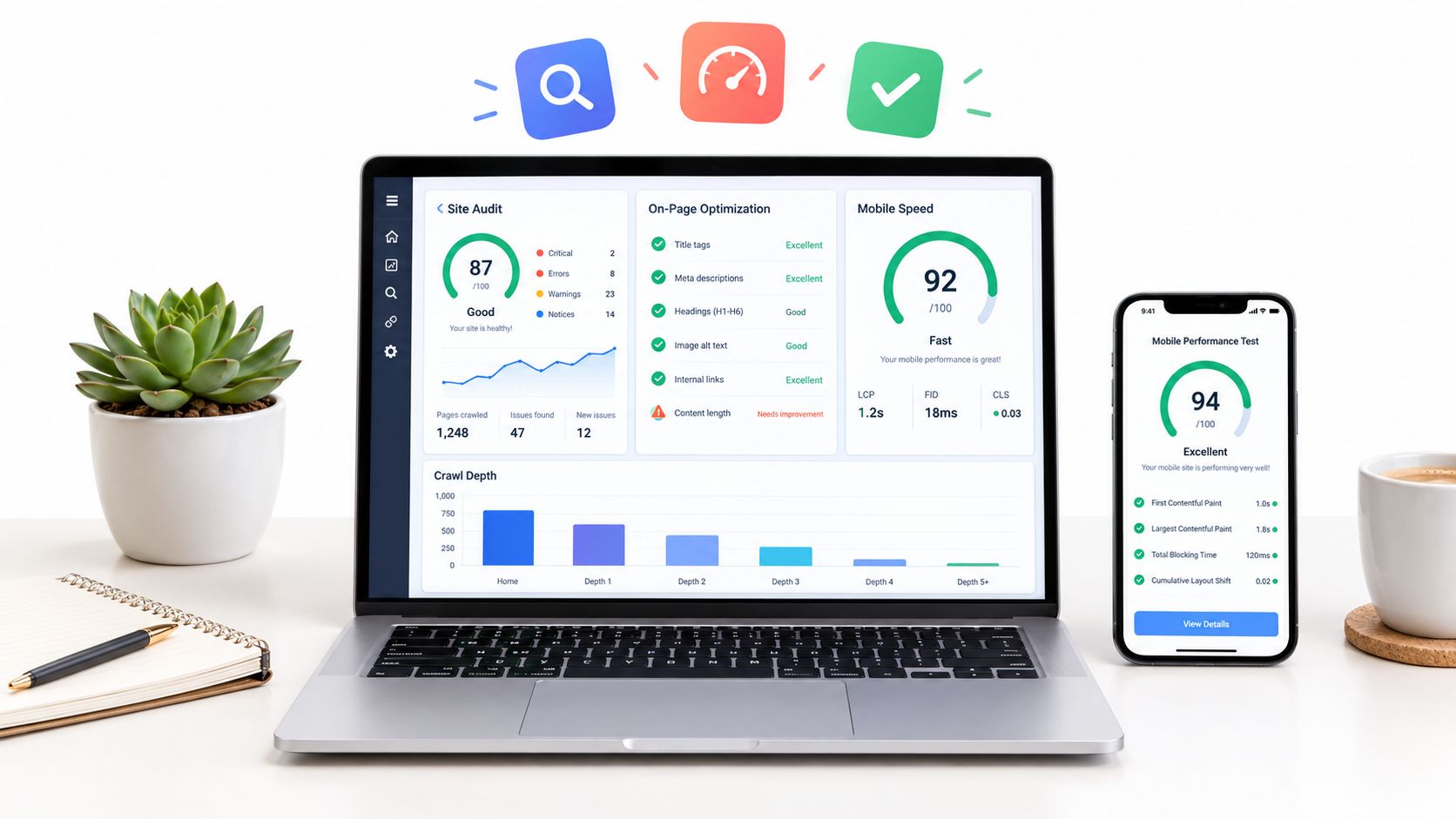
The second trap is recommending speed work from a single Lighthouse result. Google Search Console's Core Web Vitals report uses real-user data over a rolling 28-day period and assigns a URL group according to its worst-performing relevant metric. The good thresholds are LCP at 2.5 seconds or less, INP at 200 milliseconds or less, and CLS at 0.1 or less. Values beyond 4 seconds, 500 milliseconds, and 0.25 respectively are classified as poor, according to Google's Core Web Vitals documentation.
Those thresholds make prioritization possible:
- Poor LCP: Investigate server response, render-blocking resources, and oversized hero media.
- Poor INP: Look for long JavaScript tasks and unnecessary client-side work.
- Poor CLS: Check image dimensions, advertising slots, and injected components that shift the layout.
I segment the findings by template and device, fix the highest-volume poor groups first, and allow enough field data to accumulate before judging the result. Structured data follows the same discipline. I validate eligibility with the Rich Results Test, inspect the live URL, and confirm that marked-up information is visible, current, crawlable, and indexable. Markup alone doesn't guarantee an enhanced result.
Common Mistakes People Make Before and During a Consultation
The most common mistake is arriving with a symptom instead of a decision. “Our rankings are bad” doesn't tell me which searches matter, which pages should rank, or whether a ranking would create commercial value. A better opening is, “We need more qualified enquiries from these service pages, but we don't know whether the constraint is visibility, intent, or conversion.”
Historical context is just as important. Bring known migrations, redesigns, domain changes, major template releases, content removals, manual actions, and periods when traffic changed. Without that timeline, a consultant may interpret a deliberate page consolidation as a technical loss, or mistake a seasonal pattern for an indexing problem.
Bring the information that changes the diagnosis
I'd prepare:
- Business priorities: Identify the products, services, locations, or customer types that matter most.
- Priority URLs: List the pages you believe should attract demand, even if they currently receive little search traffic.
- Conversion paths: Explain what a valuable visit does, such as submitting a form, requesting a demonstration, completing a purchase, or calling the business.
- Analytics context: Share the relevant Search Console and analytics segments, not only a total traffic chart.
- Implementation constraints: State who can edit templates, publish content, approve changes, and investigate technical issues.
- Past work: Record what has already been tested, including changes that produced no visible improvement.
Don't spend the call asking for a large keyword list if the site has overlapping pages competing for the same intent. Sometimes the best recommendation is to consolidate, redirect, or stop pursuing a low-value topic.
Budget constraints make this sharper. The useful question isn't “What SEO tactics can we buy?” It's “Which action has a credible path to business value with the people and time we have?”
Preparing Access, Goals, and KPIs Before the Call
Preparation should make the consultation faster, but it shouldn't turn into an access scavenger hunt. I usually need Google Search Console, analytics data, sitemap status, a basic description of the site architecture, and a list of important conversion actions. Read-only access is often enough for diagnosis.
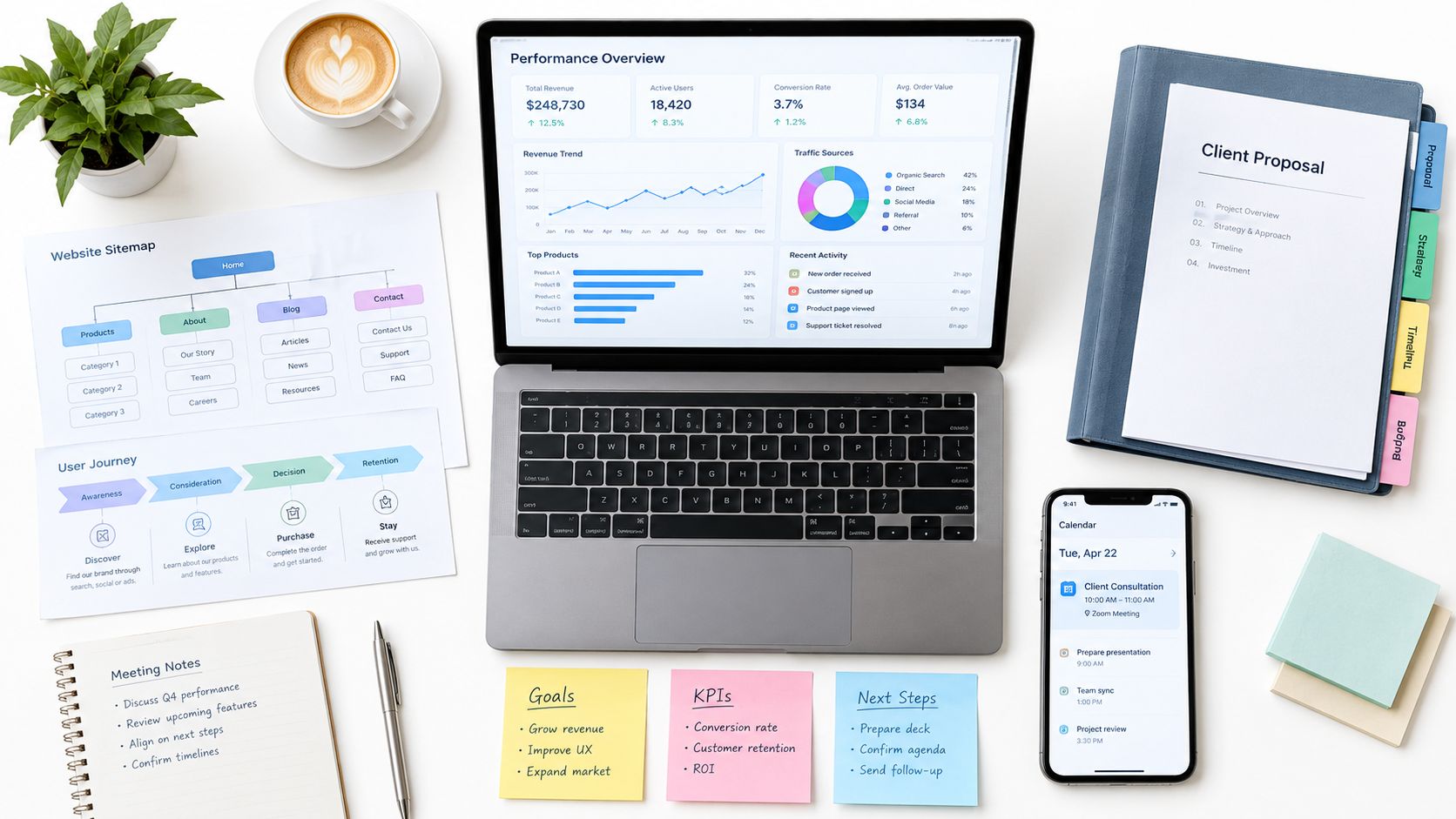
Before the call, record the segments you care about. Save queries, landing pages, countries, devices, branded demand, non-branded demand, clicks, impressions, CTR, and average position for the relevant comparison period. Google's Search Console performance guidance notes that the report retains 16 months of data history, while its default view shows the previous three months. The longer window helps separate a real trend from a short-lived fluctuation or seasonal change.
Turn goals into a decision frame
A vague goal such as “increase organic traffic” isn't enough. Define the audience, the page type, and the business action that matters. A product-led SaaS team may care about qualified sign-ups from comparison pages. A local service company may care about calls and completed enquiry forms. An editorial site may prioritize engaged visits, but it still needs a clear definition of engagement.
Use the consultation to create a small action plan with five fields:
- Finding: What did the evidence show?
- Affected asset: Which URL, template, query group, or process is involved?
- Action: What specific change should someone make?
- Owner and effort: Who can implement it, and how difficult is it?
- Measurement: Which metric or segment will show whether the change helped?
This structure prevents an audit from becoming a document nobody opens again. For broader measurement context, the SemDash guide to monitoring web traffic can help teams think beyond a single ranking number.
A short video can also help align stakeholders before the call:
Share the action plan with the person who controls implementation, not only the person attending the consultation. A technically correct recommendation fails if the developer never sees it, the content lead can't approve it, or nobody owns the follow-up measurement.
Next Steps After a Consultation
A consultation shouldn't end with “publish more content” or “build more links.” Convert each recommendation into an ordered decision. A quick win may involve improving an existing title or repairing an internal link. A foundational fix may involve changing a template, resolving canonical conflicts, consolidating pages, or improving the conversion path. The order depends on dependencies, not on which task sounds easiest.
I also challenge the assumption that SEO should now optimize only for clicks. Google AI Overviews can change how users interact with traditional results. Pew Research's analysis of 68,879 Google searches from more than 900 U.S. adults found that traditional-result clicks occurred in 8% of searches when an AI summary appeared, compared with 15% without one. Only 1% of searches with an AI summary produced a click on a cited source link, while 26% ended the browsing session compared with 16% without a summary, according to Pew Research's analysis of Google AI summaries.
Measure two outcomes separately
A consultation should therefore ask two different questions:
- Does the page attract qualified visits and conversions?
- Does the brand or page appear in answer-generated results where relevant?
Those outcomes overlap, but they aren't interchangeable. A cited page may gain visibility without receiving a corresponding visit. A page may earn valuable traffic from a traditional result while never appearing in an AI-generated answer. Track both without promising that one automatically produces the other.
Use Search Console segments and analytics to monitor impressions, clicks, CTR, landing pages, and conversions. Keep the comparison consistent by query type, country, device, and page. Don't treat a single week as a verdict, especially after a technical deployment or content change.
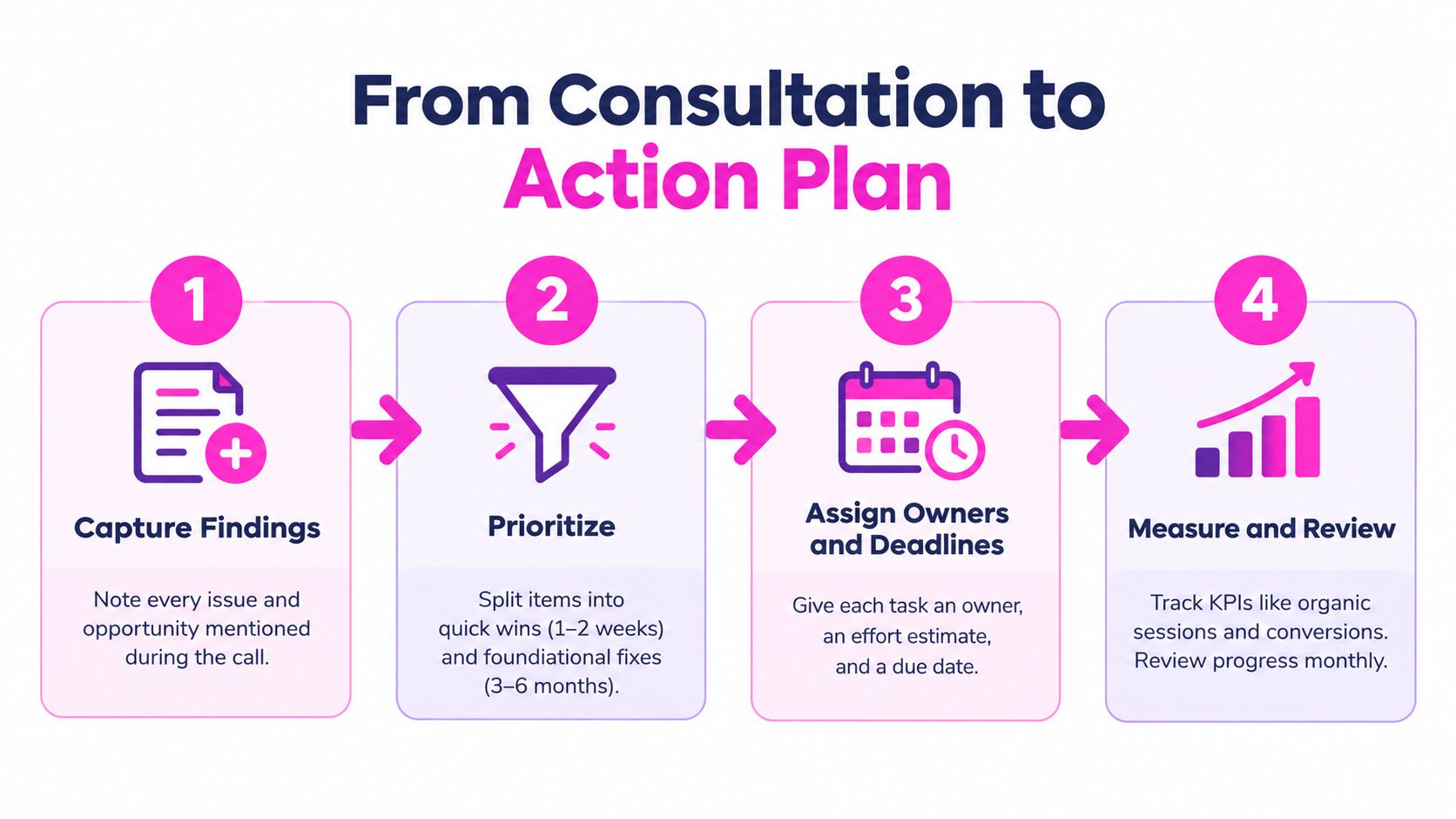
The strongest follow-up plan includes an owner, effort estimate, dependency, due date, baseline, and review point for every priority. If the consultant can't explain what your current team can accomplish, what needs outside support, and what evidence will justify the next investment, the consultation hasn't finished its job.
Użyj SemDash (SemDash) to investigate competitor keywords, backlink gaps, SERP history, content opportunities, and AI Overview citations when turning consultation findings into a prioritized SEO plan. Bring those page-level insights into your next review so your team can choose actions based on evidence, capacity, and commercial intent rather than a generic checklist.