%20(1)-B86R08ZzwhPzS6UZbG3mSxRWPCwGwn.png)

Zero-Click SEO: An AEO Playbook for Marketers

Zero-click SEO is the practice of optimizing for answer-first search surfaces so your brand stays visible even when users never visit your site. The immediate priority: audit your keyword portfolio, identify which queries are being resolved on the SERP itself, and format 40–60 word answer blocks for the highest-value ones. Done well, Answer Engine Optimization (AEO) delivers three measurable outcomes: sustained brand impressions in AI-generated summaries, citation authority inside knowledge panels and featured snippets, and alternative conversion paths that work without a page visit.
Your first 24–72 hours:
- Pull your top 50 informational keywords in Google Search Console and flag any with high impressions but declining CTR — those are your zero-click candidates.
- For each flagged query, check the live SERP and note which feature is resolving it (featured snippet, AI Overview, PAA, local pack).
- Draft a 40–60 word answer block for the three highest-traffic candidates and add FAQPage schema to the corresponding pages.
Wskazówka Pro: Filter Google Search Console by “position 1–5” and sort by lowest CTR. Queries where you rank high but get almost no clicks are almost certainly being resolved by a zero-click SERP feature — start your AEO work there.
Kluczowe wnioski
Zero-click SEO requires shifting from traffic-based measurement to impression and citation-based KPIs, with AEO as the operational framework for capturing brand value when users never click.
| Punkt | Szczegóły |
|---|---|
| Start with CTR gap analysis | Queries with high impressions and low CTR in Search Console are your first AEO targets. |
| Format 40–60 word answer blocks | Concise, direct answers placed at the top of the page are the primary lever for featured snippet and AI Overview eligibility. |
| Schema markup is non-negotiable | FAQPage, HowTo, and LocalBusiness schema make your content machine-readable for zero-click surfaces. |
| Shift KPIs to impressions and citations | Track SERP impression share, AI citation frequency, and branded query lift alongside traditional conversion metrics. |
| Semdash tracks what GSC misses | Semdash’s AI Overview monitoring and SERP tracking surface citation frequency and snippet ownership data that Google Search Console doesn’t provide directly. |
30-day actions: Audit top 50 keywords for CTR gaps / Reformat top 3 zero-click pages with answer-first structure / Add FAQPage and HowTo schema / Set up impression-based reporting in Search Console / Run AI Overview citation check for your domain.
90-day actions: Build one original data asset or tool that forces a click / Expand schema to all informational pages / Launch entity-building outreach (Wikipedia alignment, press coverage) / Review branded search lift as a zero-click conversion proxy / Iterate on answer blocks based on snippet ownership data.
What is zero-click search, and which SERP features cause it?
A zero-click search occurs when a query is resolved directly on the search results page, with no HTTP request ever reaching a publisher’s server. Standard analytics platforms record nothing — no session, no pageview, no bounce. The user got their answer and moved on.
The industry term “zero-click” is a behavioral metric, not a literal description of every SERP. Most results pages still generate some clicks; the point is that a growing share of queries are satisfied before a user ever chooses a result. Similarweb’s analysis frames this as search engines and AI platforms acting as answer engines, synthesizing information from multiple sources rather than routing users to external sites.
The main SERP features driving this behavior:
- Featured snippets: A boxed extract pulled from a ranking page, displayed above organic results. Example: a “how to hard-boil an egg” query that shows a numbered list directly in the SERP.
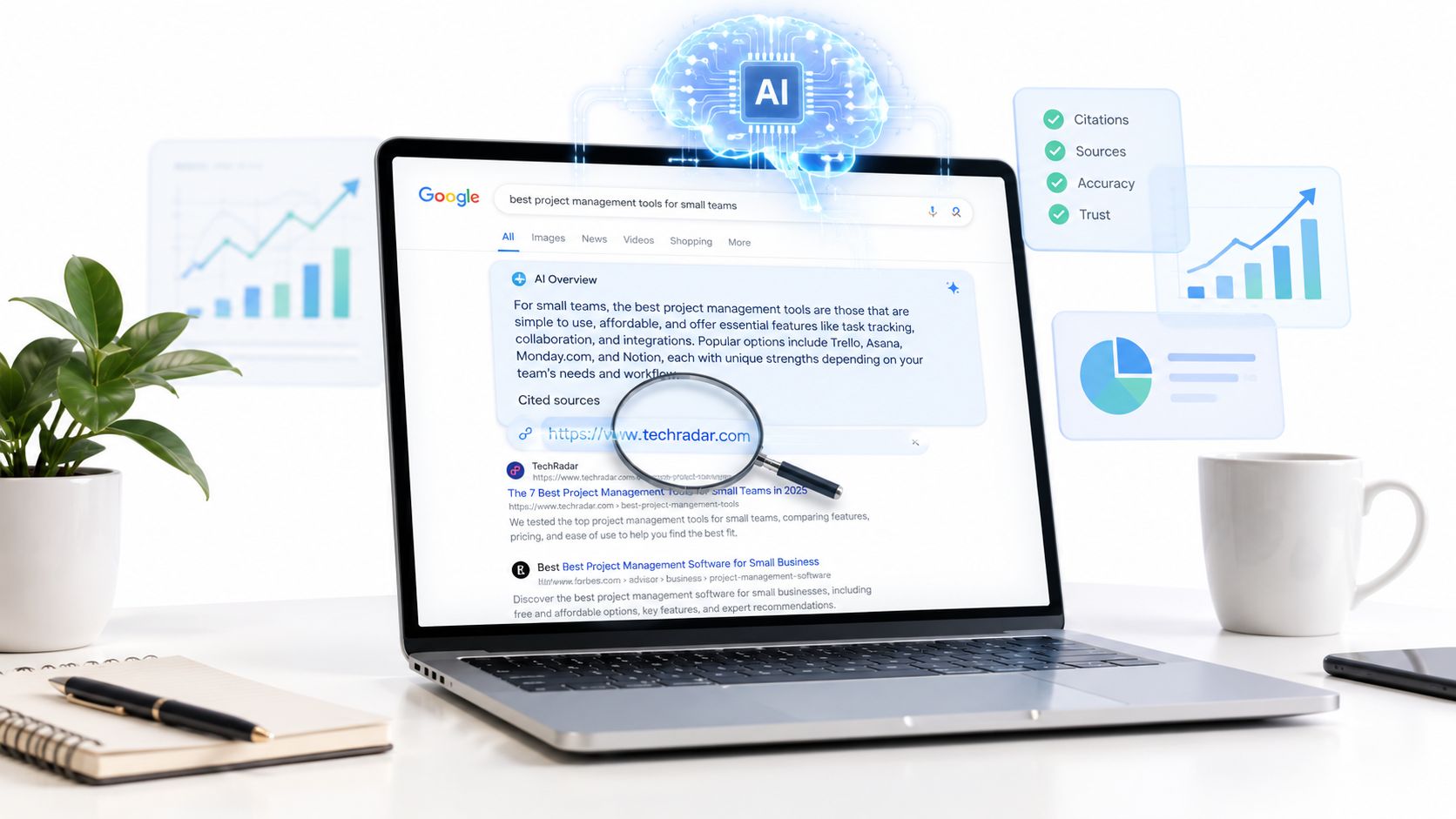
- AI Overviews: Google’s generative summaries that synthesize multiple sources into a single answer block. Unlike featured snippets, they don’t extract from one page — they compose.
- Knowledge panels: Entity-based information cards (for brands, people, places) drawn from structured data and authoritative sources like Wikipedia and Wikidata.
- People Also Ask (PAA): Expandable question-and-answer boxes that resolve follow-up intent without requiring a separate search or site visit.
- Local pack: A map-based cluster of three local business listings with phone numbers, hours, and directions — a conversion that often happens without a click to the business website.
- Direct answers: Single-line factual responses for queries like “What is the capital of France?” or “How many ounces in a pound?”
- Shopping carousels and rich results: Product listings with price, rating, and availability surfaced directly in the SERP.
Each of these features resolves intent at a different depth. A direct answer satisfies a lookup query completely. A featured snippet satisfies most informational queries. An AI Overview can resolve even moderately complex research questions. Understanding which feature is capturing your queries is the first diagnostic step in any zero-click SEO strategy.
Why zero-click searches keep rising
The structural drivers behind zero-click growth are not going away. Three forces are compounding simultaneously.
AI Overviews represent the most significant shift. dokumentowanym przez Search Engine Land that AI Overviews differ from featured snippets in a fundamental way: where snippets extract from a single source, AI Overviews synthesize across multiple sources to compose a new answer. That synthesis model means the SERP itself becomes the destination for a wider range of queries, including moderately complex ones that previously required a site visit to resolve.
Mobile behavior accelerates the trend. On a phone, a featured snippet or AI Overview occupies most of the visible screen. Users scrolling on mobile are far more likely to accept the on-SERP answer than to tap through to a site, wait for it to load, and hunt for the relevant paragraph. Intent consolidation on mobile is real and measurable in CTR data across nearly every informational vertical.
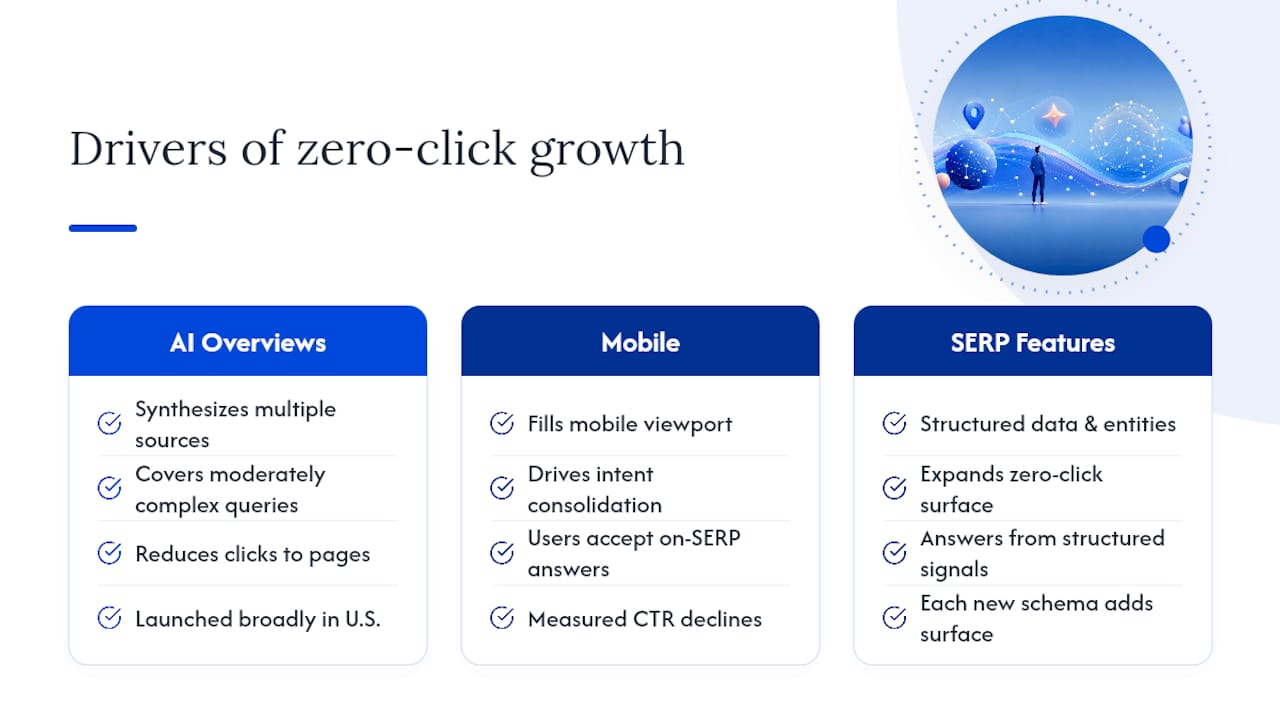
SERP feature expansion and entity-based indexing have broadened the surface area for zero-click resolution. Google’s investment in structured data, Knowledge Graph entities, and rich result types has steadily increased the share of queries that can be answered from structured signals rather than unstructured page content. Every new schema type Google supports is a potential new zero-click surface.
The acceleration over the past two to three years has been notable. AI Overviews launched broadly in the United States recently and now appear across many informational queries. The trajectory points toward more synthesis, more on-SERP resolution, and a continued decline in raw CTR for informational content. Bain & Company’s analysis frames this as a strategic marketing shift, not a temporary algorithm fluctuation.
Stat to know: AI Overviews now appear across a significant share of informational queries in the U.S., and their presence correlates with measurable CTR declines for pages that previously held featured snippet positions.
How zero-click trends affect your traffic, business model, and KPIs
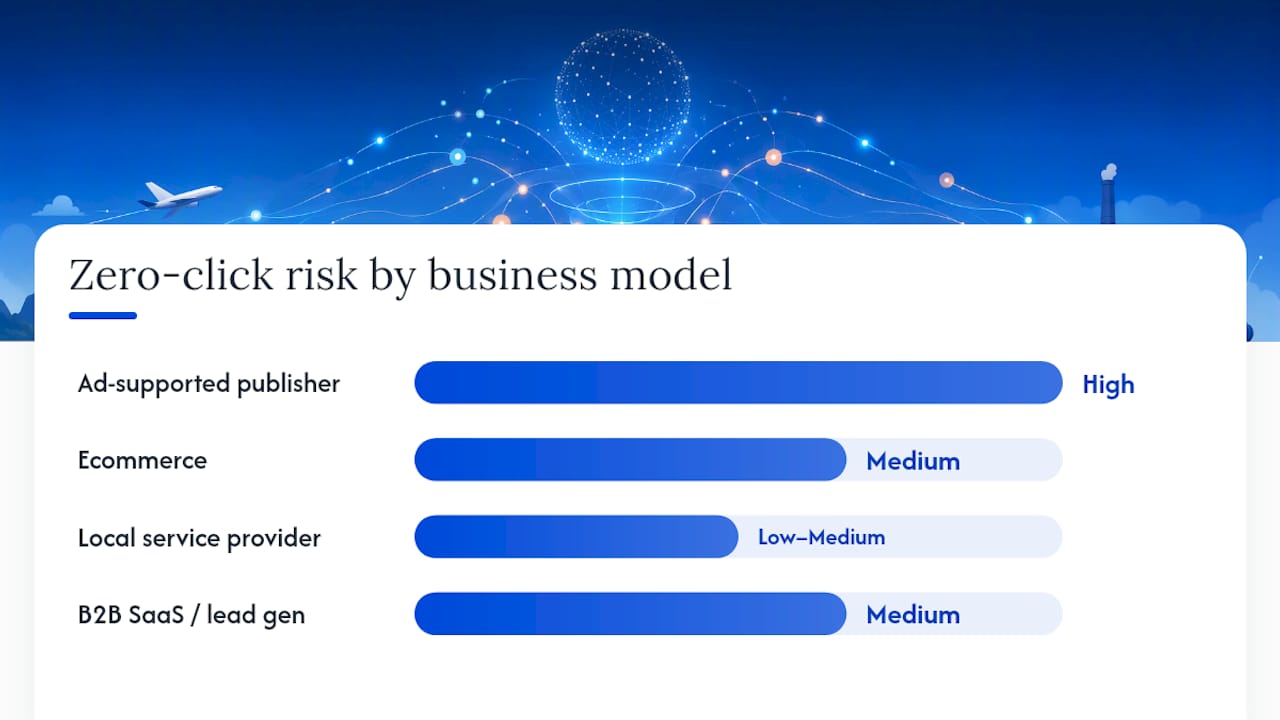
The business impact of zero-click search varies sharply by model. A blanket “traffic is down” narrative misses the nuance that matters for prioritization.
Ad-supported publishers face the most direct threat. Their revenue depends on pageviews, and zero-click resolution cuts that inventory at the source. For these businesses, the answer is not purely AEO — it’s audience ownership through email, push notifications, and social, combined with content that genuinely requires a site visit (long-form analysis, original data, interactive tools).
Ecommerce sites are more insulated on transactional queries, where users still click to compare, configure, and buy. The risk is higher on informational and comparison queries that feed the top of the funnel. A user who gets a product comparison resolved by an AI Overview may never reach the category page.
Local service providers occupy an interesting middle ground. The local pack delivers phone numbers, directions, and hours directly in the SERP — which means a call or a map tap can convert without a site visit. WordStream’s tactical guide notes that local SEO remains high-leverage precisely because local pack conversions bypass the website entirely and still represent real business outcomes.
B2B lead-driven sites tend to see zero-click impact concentrated on awareness-stage queries. Decision-stage queries (pricing, demos, comparisons) still drive clicks because users need to evaluate before committing.
The KPI shift that follows from this analysis:
| Business model | Zero-click risk level | Recommended KPI shift |
|---|---|---|
| Ad-supported publisher | Wysoki | Impressions, email subscribers, direct traffic share |
| Ecommerce | Średni | Branded search volume, assisted conversions, ROAS |
| Local service provider | Low to medium | Local pack appearances, call volume, direction requests |
| B2B SaaS / lead gen | Średni | AI citation frequency, branded query lift, pipeline influenced |
Standard pageview tracking does not capture zero-click interactions. Shifting to impression-based reporting in Google Search Console, tracking branded search trends, and monitoring AI Overview citation frequency gives a far more accurate picture of actual SERP presence.
A step-by-step AEO framework you can implement today
Answer Engine Optimization is not a replacement for classic SEO — it’s a layer on top of it. The following framework treats AEO as a sequential workflow, not a checklist of isolated tactics.
Step 1: Identify your zero-click queries. Pull all keywords where you rank in positions 1–10 but CTR is below your site average. Cross-reference with live SERP checks to confirm which feature is resolving the query. Prioritize by search volume and business value, not just traffic potential.
Step 2: Categorize by intent and conversion value. Not all zero-click queries deserve the same investment. A query that resolves in a knowledge panel for a competitor’s brand name is not your fight. A query that resolves in a featured snippet for a problem your product solves is worth engineering for.
Step 3: Craft answer-first content. Place a direct, concise answer in the first paragraph of the relevant page. WordStream recommends 40–60 word answer blocks for snippet eligibility. Use the question as a subheading (H2 or H3), follow immediately with the answer, then expand with supporting detail. For comparison queries, use tables. For process queries, use numbered lists.
Step 4: Implement structured data. Schema markup is the technical layer that makes your content machine-readable for zero-click surfaces:
- FAQPage schema for Q&A content — increases PAA and Q&A snippet eligibility.
- HowTo schema for procedural content — surfaces as step snippets.
LocalBusinessschema for location-based entities — supports local pack and knowledge panel accuracy.Article,Organization, aAuthormarkup for E-E-A-T signals — reinforces entity authority.
Step 5: Build entity signals and brand authority. Consistent NAP (name, address, phone) across directories, a Wikipedia or Wikidata presence for established brands, and authoritative backlinks from relevant domains all strengthen your entity graph. Press release distribution to news outlets builds both citation authority and brand-level entity signals simultaneously.
Step 6: Create SERP-aware conversion paths. Design content so that the fragment Google or an AI Overview might syndicate includes your brand name and a clear next step. A user who reads your answer in an AI Overview and never visits your site should still encounter your brand. Email capture offers, gated tools, and direct brand search prompts embedded in the answer fragment itself are the mechanics here.
Step 7: Monitor and iterate. Track featured snippet ownership, PAA appearances, AI Overview citation frequency, and branded query trends on a weekly cadence. Update answer blocks when a competitor displaces your snippet. Schema audits should run monthly.
Wskazówka Pro: When you add FAQPage or HowTo schema, validate it immediately with Google’s Rich Results Test before deploying. Invalid markup is silently ignored — you won’t see an error, you just won’t get the feature.
Tactics mapped to each zero-click SERP feature
Winning featured snippets
The formatting pattern that earns featured snippets is consistent: a question as a heading, a direct 40–60 word answer immediately below it, and supporting detail after. Use definition-style answers for “what is” queries, numbered lists for process queries, and tables for comparison queries. The extractable lead line — the sentence Google is most likely to pull — should be the very first sentence of your answer block, not buried in paragraph three.
Optimizing for AI Overviews
AI Overviews favor topical depth and multi-source authority. A single well-optimized page is less likely to be cited than a site with a coherent cluster of content covering a topic from multiple angles. Original data, proprietary research, and interactive tools (calculators, configurators, datasets) are the assets that force a click even when an AI Overview is present — because the Overview cannot reproduce them. Search Engine Land’s guide makes this point directly: unique assets are the primary lever for retaining clicks in an AI Overview environment.
Ludzie też pytają
PAA boxes are driven by question clustering. Identify the three to five questions most commonly associated with your target query (Google’s own PAA suggestions are a reliable source), write a short anchor answer for each (two to three sentences), and group them in an FAQ section on the relevant page. FAQPage schema on that section increases eligibility.
Knowledge panels and entity signals
Knowledge panels are built from structured signals: Wikipedia/Wikidata entries, consistent Organization schema, verified Google Business Profiles, and authoritative third-party citations. For brands, the priority is consistency — the same name, description, and founding details everywhere Google might look. For individuals, Author markup and a consistent byline across authoritative publications builds the entity signal.
Local pack
Google Business Profile hygiene is the primary lever: complete profile, accurate hours, recent photos, and a steady cadence of genuine reviews. LocalBusiness schema on your site reinforces the structured signals. Review velocity matters — not just the aggregate rating, but the recency of reviews relative to competitors.
Rich media placements
Video content with a transcript and VideoObject schema can surface as a video snippet. Images with descriptive alt text and ImageObject markup are eligible for visual answer panels. Both require the underlying content to answer a clear query — decorative media rarely earns a rich result.
Common pitfall: Over-optimizing for snippets that fully satisfy intent without any conversion hook. If your featured snippet answers the question so completely that there is no reason to click, you’ve optimized yourself out of traffic. Leave a deliberate gap — a related question, a tool, a dataset — that requires a site visit to resolve.
Wskazówka Pro: Add a “See the full comparison” or “Use our free calculator” line at the end of your answer block. Google sometimes includes this in the snippet, and it gives users who do see the on-SERP answer a reason to click through.
How to measure zero-click influence and report it to stakeholders
Clicks are no longer a complete picture of search performance. The KPIs that matter in a zero-click environment span impressions, citations, and downstream brand signals.
Core impression-based and citation-based KPIs:
- SERP impression share: Total impressions in Google Search Console, trended over time, segmented by query type.
- Featured snippet ownership rate: The percentage of your target queries where you hold the snippet position.
- PAA appearance frequency: How often your content appears in People Also Ask boxes for tracked queries.
- AI Overview citation frequency: Tracked via tools like Semdash’s AI Overview checker, which monitors when and where your domain is cited in AI-generated summaries.
- Branded query lift: Month-over-month growth in searches for your brand name, which often reflects zero-click brand exposure converting to direct intent.
- Assisted conversions: Conversions where organic search appeared earlier in the path, even if it wasn’t the last touch.
Google Search Console is the baseline. Filter by query, sort by impressions, and look for the divergence between impression growth and CTR decline — that gap is your zero-click footprint. Server-side data (direct traffic trends, branded search volume) provides a secondary signal that zero-click visibility is generating downstream intent.
Dashboard framing for executives: Lead with the impression trend line, not the traffic line. Show AI citation frequency as a new metric alongside branded search lift. The narrative is: “Our SERP presence is growing. Fewer users are clicking through on informational queries because the SERP is answering them — but our brand is in the answer. Here’s how that’s converting downstream.”
The measurement pitfall to avoid: attributing all CTR decline to zero-click behavior. Ranking drops, seasonality, and competitor content improvements also reduce CTR. Isolate zero-click impact by filtering for queries where your position is stable or improving but CTR is falling — that’s the cleanest signal.
How Semdash supports your AEO workflow
A practical AEO workflow needs data at every stage: discovery, monitoring, formatting audits, and iteration. Semdash is built to cover each of those stages in a single interface.
Workflow in practice:
- Discover zero-click keywords: Użyj narzędzia do narzędzie do badania słów kluczowych to identify informational queries in your niche, filter by SERP features present, and surface clusters where featured snippets or AI Overviews are already resolving intent.
- Track AI Overview mentions: Semdash’s AI Overview monitoring tracks when your domain appears in AI-generated summaries, giving you citation frequency data that Google Search Console doesn’t surface directly.
- Audit pages for answer-first formatting: SERP tracking with historical data lets you see when a page gained or lost a featured snippet position, so you can correlate formatting changes with snippet ownership.
- Monitor citation and impression changes: Consolidated dashboards show impression trends, snippet ownership, and PAA appearances alongside backlink and authority signals.
A concrete use case: you identify a cluster of “how to” queries in your niche where competitors hold featured snippets. Semdash’s keyword clustering groups them by semantic intent. You reformat the top three pages with 40–60 word answer blocks and HowTo schema. Two weeks later, Semdash’s SERP tracking shows your page entering the snippet position for two of the three queries, and AI Overview citation frequency for your domain increases on those topics.
On E-E-A-T and AEO: The same signals that build E-E-A-T — author markup, consistent entity data, authoritative backlinks, original research — are the signals that increase AI Overview citation frequency. AEO and E-E-A-T are not separate workstreams. They reinforce each other, and the brands that treat them as one integrated effort tend to see compounding returns faster.
For teams building out their AI search visibility strategy, Semdash provides the data layer that makes AEO measurable rather than speculative.
The part most teams get wrong about AEO
The conventional wisdom says zero-click search is a threat to be defended against. Protect your snippets, add schema, write shorter answers. That framing is incomplete, and it leads teams to optimize defensively when the real opportunity is offensive.
The teams seeing the strongest results from AEO are not the ones who added FAQ schema to their existing pages. They’re the ones who redesigned their content architecture around answer-first intent: every page starts with the direct answer, every topic cluster has a clear entity hub, and every piece of original research or tooling is built specifically because it cannot be reproduced in an AI Overview.
The 30-day priority is not a wholesale content rewrite. It’s identifying the five queries where you rank in the top three but hold no snippet, formatting those pages with answer-first structure and appropriate schema, and setting up impression-based reporting so you can see the effect. The 90-day priority is building the original assets — datasets, calculators, proprietary research — that give users a reason to click even when the SERP has already answered their surface question.
One more thing teams consistently underestimate: the brand signal that zero-click visibility generates. A user who reads your brand name in an AI Overview three times in a week and never clicks is not a lost conversion. They’re a warmed prospect. Branded search lift is the metric that captures this, and it’s almost always underreported in standard SEO dashboards.
Semdash gives you the data layer AEO actually requires
Most SEO platforms were built for a click-based world. Semdash was designed with AI-era search in mind, which means the features that matter most for AEO — AI Overview monitoring, featured snippet tracking, semantic keyword clustering, and SERP history — are core to the platform, not add-ons.
For teams running the AEO framework described in this guide, Semdash covers every workflow step: discover zero-click keyword clusters with the keyword research tool, track AI Overview citations for your domain, monitor featured snippet ownership over time, and audit backlink authority to strengthen entity signals. The credit-based subscription model means you pay for what you actually use, with no long-term contract locking you in before you’ve validated the workflow.
Start with the free SEO tools to run your first zero-click audit, or explore the full platform at Semdasz powiedział: to see how AI Overview monitoring and SERP tracking work together in a single dashboard.
Źródła
- Zero-Click Searches And How They Impact Traffic | Similarweb
- Zero-click searches and the future of your marketing funnel | HubSpot Blog
- Zero-click result — Wikipedia
- Zero-Click Searches: What They Are & How SEOs Can Adapt | Search Engine Land
- 4 Ways to Optimize for Zero-Click Searches | WordStream
- Goodbye Clicks, Hello AI: Zero-Click Search Redefines Marketing | Bain & Company
- Schema
- Schema
FAQ
What exactly is zero-click SEO?
Zero-click SEO is the practice of optimizing content to appear in answer-first SERP features — featured snippets, AI Overviews, knowledge panels, PAA boxes — so your brand is visible even when users resolve their query without clicking through to your site.
How do AI Overviews differ from featured snippets?
Featured snippets extract a passage from a single ranking page; AI Overviews synthesize information from multiple sources into a composed answer. AI Overviews tend to reduce click-through more broadly because they resolve more complex queries on the SERP itself.
Which schema types matter most for zero-click optimization?
FAQPage and HowTo schema are the highest-priority types for most sites. FAQPage increases eligibility for PAA and Q&A snippets; HowTo markup makes procedural content eligible for step snippets. LocalBusiness schema is the priority for location-based entities targeting the local pack.
How do you measure zero-click SEO performance?
Track SERP impression share and featured snippet ownership in Google Search Console, monitor AI Overview citation frequency with a tool like Semdash, and watch branded query volume as a downstream signal that zero-click exposure is generating direct intent.
Does zero-click search hurt all businesses equally?
No. Ad-supported publishers face the highest risk because their revenue depends directly on pageviews. Ecommerce and B2B lead-gen sites are more insulated on transactional queries. Local service providers can actually benefit, since local pack conversions — calls and direction requests — happen without a site visit and still represent real business outcomes.