

You've opened an anchor report and found a familiar mess: brand names, repeated commercial keywords, image filenames, and links labeled read more. You need to decide what to fix without turning every link into the same keyword phrase.
I'd start with a simpler question: Can you predict the destination from the anchor alone? A useful anchor text example should help you make that decision, not just give you another category to add to a spreadsheet.
Spis treści
- Anchor Text Types at a Glance
- What Anchor Text Is and How Search Engines Read It
- Descriptive Anchors That Say Where the Link Goes
- Branded and Exact-Match Anchors Where Each Pays Off
- Image Links and Sponsored Anchors to Qualify
- How to Audit Anchor Text on Your Own Site
- Rewrite Your First Five Links This Week
Anchor Text Types at a Glance
| Anchor type | Example anchor | Works when | Main risk |
|---|---|---|---|
| Descriptive | download the annual accessibility report | The destination is a specific resource | Wording runs long if you link a full sentence |
| Branded | Acme Analytics | Citations, press mentions, and homepage links | Says nothing about the target's topic |
| Exact-match | enterprise keyword tracking | The sentence reads naturally and the target matches the phrase | Repetition across unrelated sites can look manipulative |
| Partial-match | guide to keyword tracking tools | You want topical context without forcing the exact phrase | Describes the exact target phrase less directly |
| Naked URL | ` | Source lists and footnotes | Gives little context beyond the address |
| Generic | click here, read more | Almost nowhere without supporting context | Gives no topic or standalone purpose to screen-reader users |
Descriptive anchors are my default for resource links. Name the document, task, or answer, then remove any words you don't need to distinguish it from nearby destinations.
Branded anchors work when you're identifying an organization. Use Acme Analytics for a company citation, but don't expect that wording to explain a specialized guide.
Exact-match anchors aren't automatically wrong. Keep enterprise keyword tracking when that's what the destination covers and the phrase belongs in the sentence.
Partial-match anchors give you more editorial room. Guide to keyword tracking tools identifies both the topic and the format without making you write around a rigid keyword.
Naked URLs make sense when you need to show the address itself. In ordinary prose, replace the address with wording that explains why you'd follow it.
Generic anchors require the most skepticism. Read more might work in a clearly labeled component with an accessible link name, but it's a poor default for an editorial paragraph.
Use categories to diagnose, not prescribe
These categories overlap. A descriptive anchor can also contain an exact-match keyword, and a brand-plus-topic phrase can serve both identification and navigation.
Don't label an anchor good or bad from its category alone. Judge the destination, surrounding sentence, and reason for linking.
Before continuing, open a page you own and label each link using this table. You'll have a concrete set of decisions to work through rather than an abstract anchor-distribution problem.
What Anchor Text Is and How Search Engines Read It
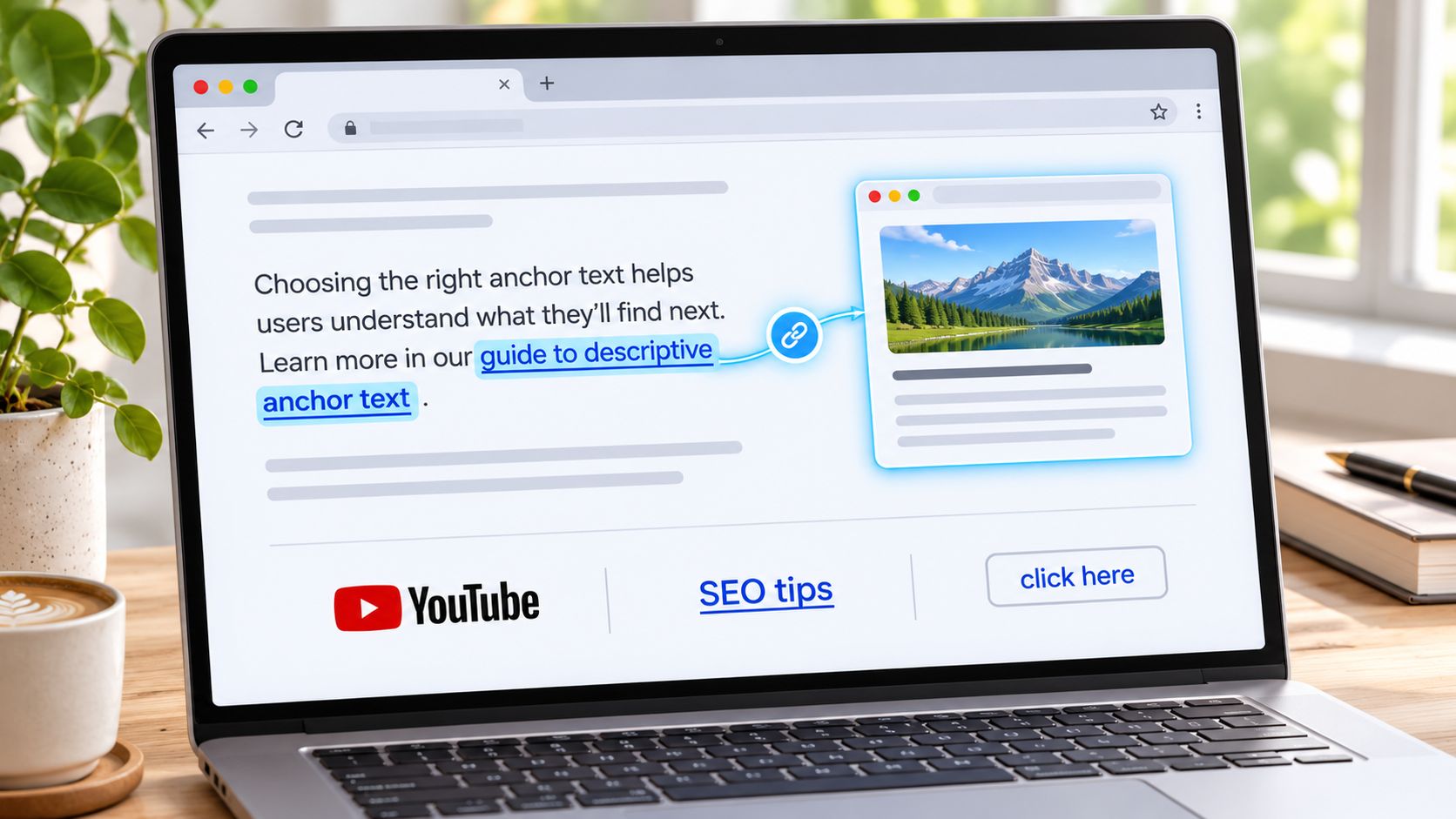
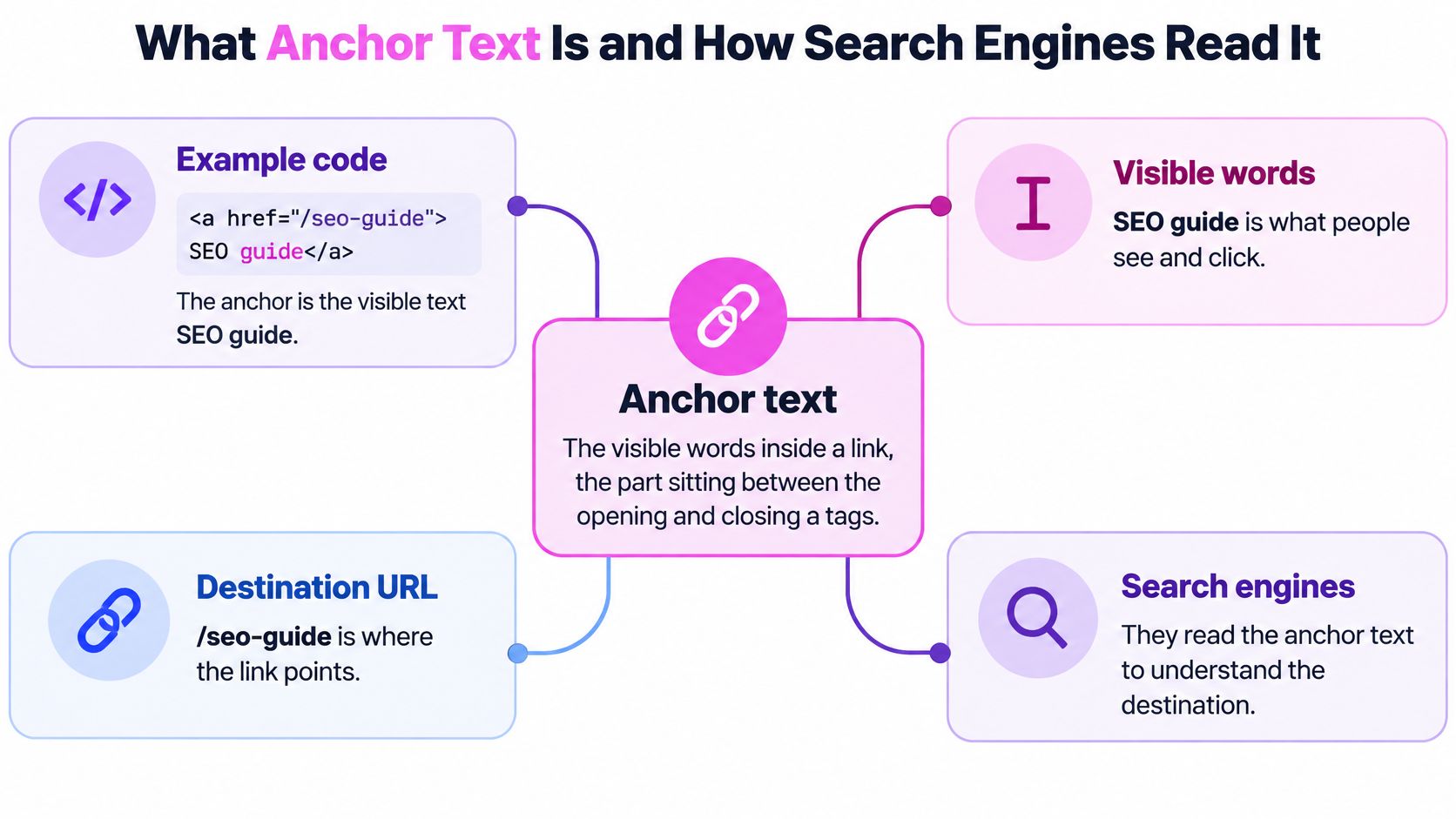
Anchor text is the visible wording inside a hyperlink, normally between the opening and closing HTML a tags. Google's link best practices explain that this wording gives users and search systems information about the destination, while crawlable links help Google discover pages and assess relevance.
Take this example: <a href="/seo-guide">SEO guide</a>. You see SEO guide as the clickable label; the href value, /seo-guide, identifies where you'll go.
Use this diagram to separate the label from the destination.
Think of the anchor as a shop sign
If you walk past a sign saying Open, you know you can enter, but not what you'll find. Hardware and Tools gives you a reason to step inside.
Apply that distinction to links. You're naming the destination before someone visits it, while also giving search systems context about the relationship between the pages.
For an image-only link, you might have no visible wording at all. Google can use the image's alt attribute as anchor text, so an empty alternative or a filename leaves you without a useful description.
Audit habit: Record what the link actually communicates, not what you intended it to communicate.
Keep these fields in your export:
- Exact visible phrase: Preserve the wording rather than summarizing it.
- Linking URL: Record the page containing the link.
- Target URL: Record the destination, including whether a redirect changes it.
- Link format: Distinguish text-based links from image-based links.
With these fields, you can compare equivalent links and trace a problem back to its implementation.
Descriptive Anchors That Say Where the Link Goes
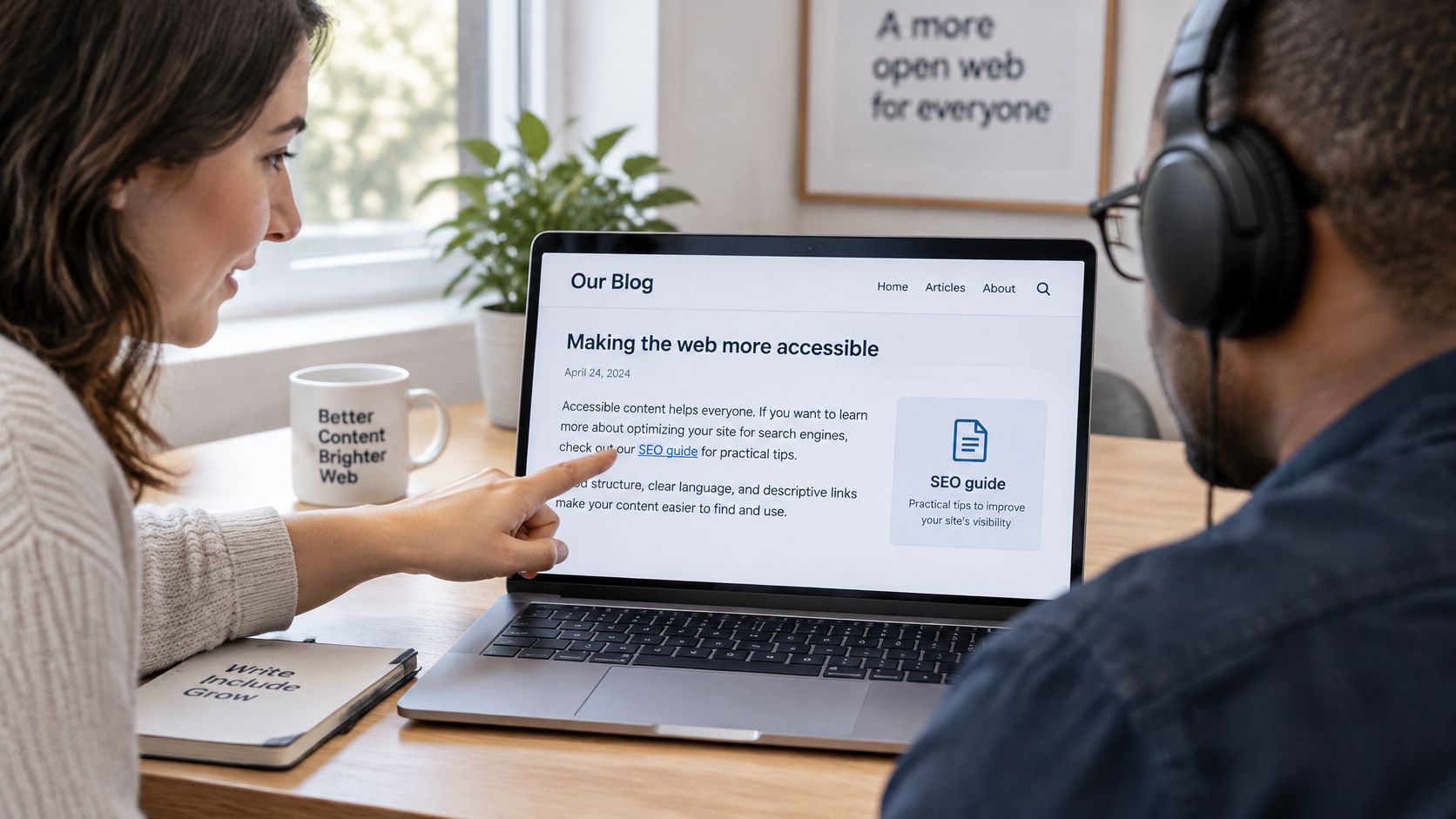
Describe what you'll find at the destination. Don't assume the address supplies enough context: W3C's link-purpose guidance explains why descriptive link text helps you distinguish destinations, including when using a screen reader to review links outside their surrounding paragraphs.
Treat accessibility and SEO as the same editing task here: make the next step understandable. Review the wording alongside the destination, not in isolation from it.
Replace vague actions with named destinations
| Before | After | What you now know |
|---|---|---|
| click here to download | download the annual accessibility report | You'll receive a particular report |
| learn more | compare enterprise pricing plans | You'll reach a commercial comparison |
| this article | our technical SEO audit checklist | You'll get a checklist for a defined task |
Notice how the rewrite changes the expectation, not just the keyword coverage. Compare enterprise pricing plans signals a different next step from request an enterprise quote, even if both destinations discuss pricing.
I'd use roughly three to six words as an editing guide, not a search-engine limit. If a nearby heading already names the resource, a two-word anchor can work, but only when you retain enough context to distinguish its purpose.
Use the video as another prompt to inspect how your link wording works in context.
Run the destination-promise test
- Check accuracy. Does your anchor name what's on the target page?
- Read the complete sentence aloud. If you've distorted the grammar to fit a keyword, rewrite the sentence.
- Check delivery. Follow the link and verify that you can immediately find the promised resource or action.
Google's SEO Starter Guide supports descriptive, natural link wording rather than forced keyword repetition. I'd reject a checklist anchor pointing to a general services page, even if you've optimized that page for the same topic.
Fix that mismatch by changing the destination or changing the promise. Adding more keywords won't repair it.
Branded and Exact-Match Anchors Where Each Pays Off
If you're adding exact-match anchors to reach a target percentage, you're treating an audit signal as a ranking target. That is a poor basis for an anchor strategy. The best wording is usually the shortest phrase that sets an accurate expectation for readers scanning links out of context.
The observational study summarized by DeepSmith's anchor-text analysis examined 19,840 keywords and roughly 384,614 pages. It reported a weak correlation of about 0.14 to 0.19 between exact-match anchor prevalence and ranking position, with a median exact-match share of zero across ranking positions. Those findings do not establish that exact-match wording causes higher rankings. Authority, relevance, brand strength, and editorial context also affect the relationship between anchors and ranking position.
Choose the label for the job
Use a branded anchor when the link's purpose is to identify a company or product. For a press citation or homepage reference, Acme Analytics names the entity without suggesting that the link leads to a specific tutorial.
Użyj exact-match anchor when the target keyword accurately describes the destination and fits the sentence. Enterprise keyword tracking suits a focused page about that subject. It creates the wrong expectation when the destination is a homepage covering several unrelated products.
Branded wording is not automatically better than a partial match. In an explanatory sentence, “keyword tracking tools” may tell a reader more than “Acme Analytics,” particularly when the destination is educational material rather than a company introduction. Choose the shortest wording that makes the next click clear.
Keep the wording that best explains the next click. Don't replace it just to change an anchor-type percentage.
A naked URL written out in full can work in footnotes or source lists when readers need the address itself. In a sentence, use a destination label if it makes the link's purpose clearer.
Handle anchors you can't edit without overreacting
Suppose you find these external references:
- A journalist's citation: Acme Analytics links to the homepage. Leave it if identifying the company is the purpose.
- A forum recommendation: Enterprise keyword tracking links to the same homepage. One natural use does not, by itself, justify asking for a rewrite.
- An unrelated-domain cluster: Many referring domains repeat that commercial phrase. Inspect the referring pages, placements, timing, and acquisition method.
Treat a cluster as a reason to investigate, not as proof of a penalty. Check whether the links come from independent editorial references, syndicated content, paid placements, or automated links before deciding what action to take.
For a worked contrast, consider a link to an educational article in a product-comparison paragraph. Acme Analytics identifies the publisher; enterprise keyword tracking names a topic but may imply a product page. If the destination is a guide, guide to keyword tracking tools sets the clearest expectation, even when neither existing option fits.
Exact-match distribution helps flag patterns for review. It is not a percentage to optimize toward. Choose the wording that accurately describes the destination and makes sense to a reader scanning the link on its own.
Image Links and Sponsored Anchors to Qualify
For an image-only link, write the alternative text around the link's function. W3C's image-link technique supports naming the purpose of the destination rather than relying on an unhelpful image label.
| Existing alt | Replacement alt | Accessible link wording |
|---|---|---|
| IMG_2231.jpg on a PDF icon | Download the annual accessibility report | An action and a named document |
| logo.png in the header | Acme Analytics homepage | The brand and navigation destination |
| Empty alt on a pricing icon | Compare enterprise pricing plans | The comparison available after clicking |
With those replacements, you give a screen reader meaningful wording to announce, rather than an upload filename or an unnamed destination. Inspect the rendered accessible name too, particularly when you combine icons, visible text, and accessibility attributes in a component.
Separate disclosure from link qualification
Rewriting a commercial anchor doesn't disclose an affiliate relationship. The FTC's endorsement guidance requires clear and conspicuous disclosure and explains why disclosure available only through a hyperlink is inadequate.
Place plain wording such as I get commissions for purchases made through links in this post beside the relevant review or recommendation. Check the mobile layout so you don't separate that statement from the endorsement with banners, images, or collapsed content.
- Identify the arrangement: Check whether money, products, services, or a contractual benefit influenced the link.
- Qualify the link: Require
rel="sponsored"or an appropriaterel="nofollow"implementation for paid placements. - Avoid commercial keyword demands: Don't make an optimized exact-match phrase a condition of the placement.
Google's spam policies flag paid links and optimized anchors in sponsored articles, guest posts, and press releases when used to pass ranking credit manipulatively. Switching to a brand name doesn't fix an unqualified paid ranking link.
I'd prioritize shared header components and repeated image-link templates. You can repair every inheriting page through the component instead of editing each instance.
How to Audit Anchor Text on Your Own Site
Start with an export, but don't stop at a distribution chart. You need to inspect whether each link helps you reach the right page.
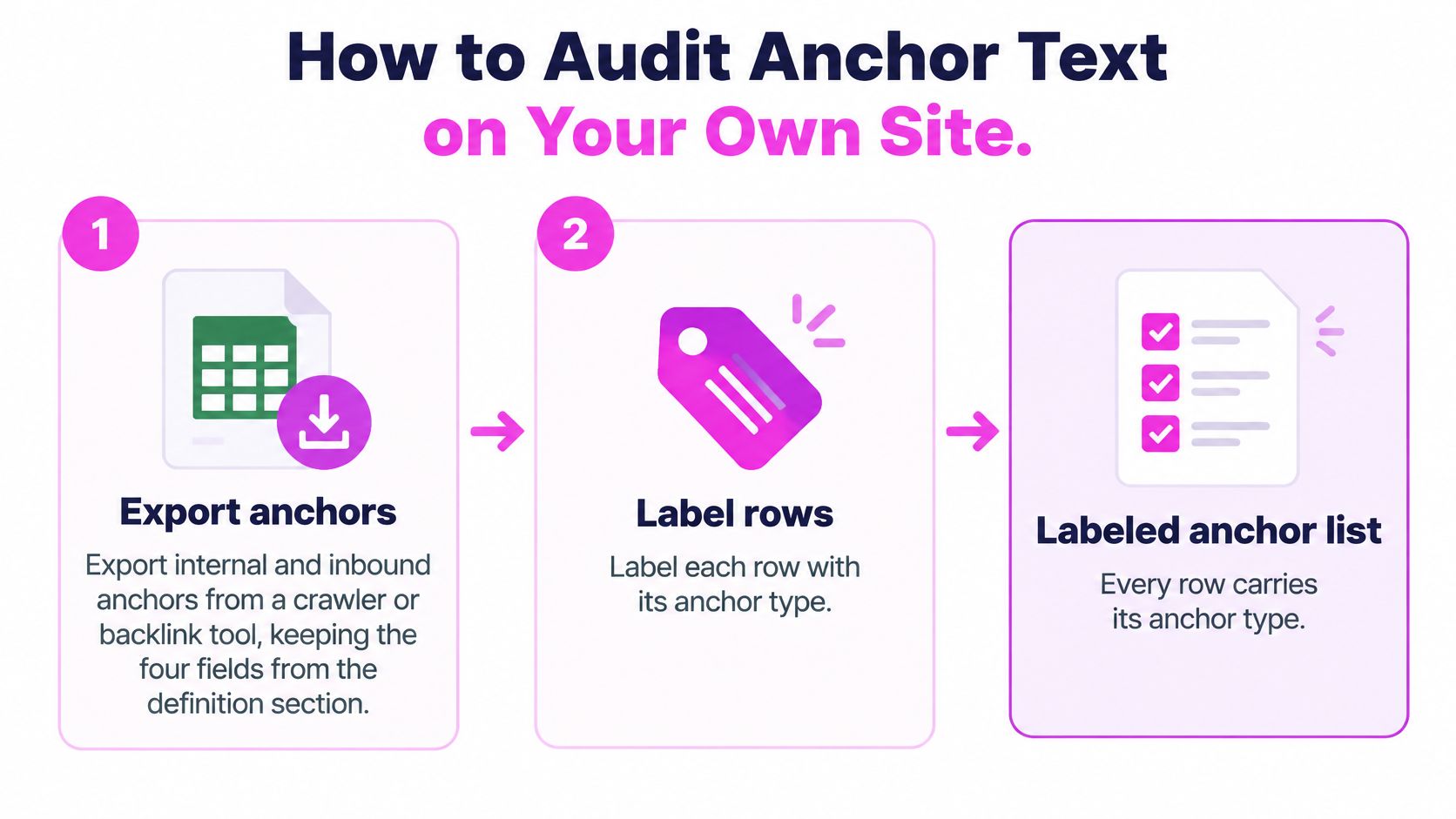
Use the export-and-label workflow to create a reviewable inventory.
Build the review queue
- Export internal and inbound links. Use a crawler and backlink tool, retaining the exact anchor, linking URL, target URL, and link format.
- Label each row by anchor type. Keep image-based links identifiable even when their alternative text is descriptive or branded.
- Open the targets. Verify that you can complete the action or find the resource named by each anchor.
- Flag generic and mismatched anchors first. You can usually resolve these without debating keyword strategy.
- Compare wording by target. If, for example, you find twenty variations for the same page, check whether you've drifted into inconsistent terminology.
- Fix internal links before pursuing external edits. Review your architektura strony internetowej so you don't optimize labels for unnecessary or poorly placed links.
- Monitor the changed pages. I'd plan an eight-to-twelve-week observation window, noting content edits, redirects, and algorithm updates alongside rankings and traffic.
The Mission Growth discussion of Zyppy's 2024 case study reports that, across 50 sites, internal-anchor variations per page had a negative correlation of -0.337 with traffic change after Google updates. Treat that as a pattern to review, not a required number of variations or proof that standardizing wording will increase traffic.
Turn flags into decisions
| Audit flag | Likely cause | Działanie |
|---|---|---|
| Many identical commercial anchors from unrelated domains | Possible manipulative or undisclosed paid links | Investigate the source and acquisition method, then request qualification or removal where warranted |
| click here or read more repeated across pages | Templated navigation or CMS defaults | Rewrite the template so each link names its destination |
| Anchor points to a page that doesn't match it | Moved page or wording written for a different target | Retarget the link or rewrite the anchor |
| Twenty or more wordings for one target page | Potentially unplanned internal linking over time | Standardize main terminology and vary where the sentence needs it |
| Image link with filename or empty alt | Upload default or missing alternative text | Describe the link's function in its alt text |
The wording-count row is a hypothetical review trigger, not an SEO threshold. Keep legitimate distinctions when you link to different sections or tasks on the same page.
Rewrite Your First Five Links This Week
Pick a small batch you can inspect properly. I'd start with five links, prioritizing the traffic of their target pages, then selecting the clearest mismatches within that group.
Don't begin by replacing every occurrence of a keyword. You'll lose useful sentence-level distinctions and make it harder to identify which edits helped navigation.
Make each change traceable
- Check existing expectations. Our SemDash Anchors report shows why people link to a page. Review the wording linking sites already use before deciding how to label your internal destination.
- Choose the shortest accurate rewrite. Confirm that it fits the sentence and that the target delivers the promised resource or action.
- Verify the destination works. If you encounter an unavailable page, use a broken-link diagnosis workflow before polishing its anchor.
- Log the original wording, replacement wording, source URL, target URL, and implementation date.
- Schedule a review. I'd make an initial check after four to six weeks, then continue monitoring rather than attributing every ranking movement to the rewrite.
Keep the change log: You need to know exactly what changed before you can make a useful comparison.
Avoid mass replacement to manufacture consistency. Preserve natural editorial wording when it remains accurate, and standardize only where inconsistent terminology makes the destination harder to recognize.
Set your next review date before closing the spreadsheet. Queue the next five links, give each a proposed rewrite, and leave a clear reason for the change so you can approve or reject it quickly.
We offer backlink research and an Anchors report that shows why people link to a page. Visit SemDash (SemDash) to inspect the wording pointing to your priority pages and choose your first batch of anchor-text fixes.