


Publishing more related articles isn't a reliable answer to how to build topical authority. You can cover every keyword in a topic and still end up with interchangeable pages, confused URL targeting, and no additional business value.
I'd treat topical authority as a testable operating hypothesis: choose a subject you can help with, build a connected set of useful pages, and measure whether that investment outperforms comparable content you leave unchanged. Keep rankings, citations, and commercial outcomes separate, so a bigger publishing calendar doesn't get mistaken for progress.
Spis treści
- The Build Sequence at a Glance
- Define a Subject Boundary You Can Defend
- Cluster Queries by Intent and Assign One URL Each
- Build the Pillar and Spokes with Links Readers Follow
- Earn References Without Triggering Link Spam
- Plan for AI Overview Click Loss
- Measure the Cluster and Start Your First Week
The Build Sequence at a Glance
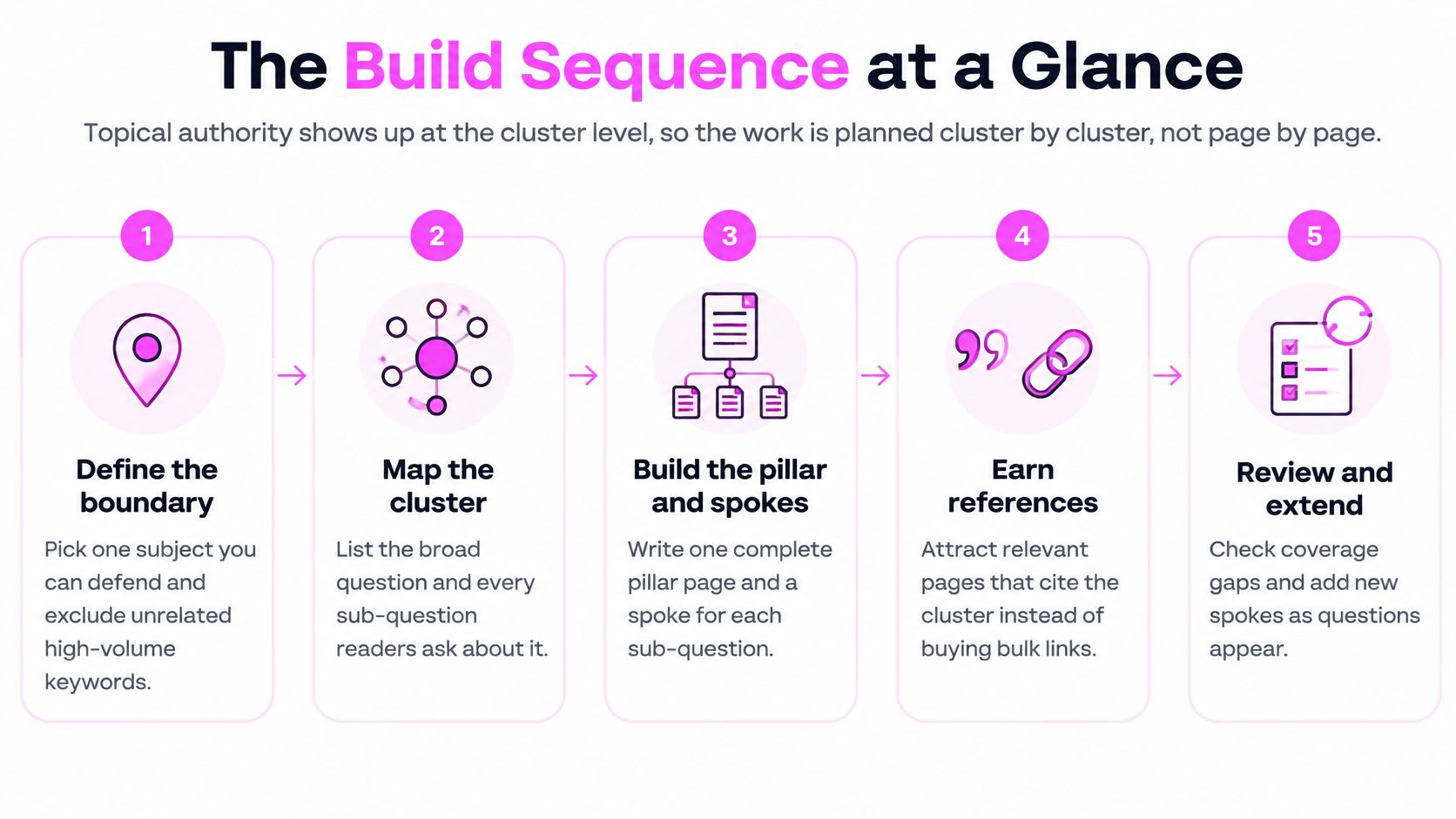
Start with a subject boundary, map the demand, assign page ownership, build the content, earn references, and measure the result. Plan around clusters rather than isolated pages, because you need to assess how the connected collection performs, not just whether a new article ranks.
| Phase | What You Produce | Done When |
|---|---|---|
| Define subject boundary | One-sentence scope and five named exclusions | Every candidate page passes the boundary test |
| Map queries and competitor pages | Query inventory with competitor top pages attached | Gap list covers the cluster's main questions |
| Cluster and assign intent | Page-level groups, one intent and one URL each | Every target query maps to exactly one URL |
| Build pillar and spokes | One pillar and supporting pages linked in both directions | No cluster page is orphaned |
| Earn references | Editorial links to the pillar and key spokes | Each link comes from a page with a real reason to cite |
| Measure cluster outcomes | Scorecard compared against an unexpanded control | Baseline is recorded before the first edit |
The measurement row describes the final evaluation, not when tracking begins. Record the baseline before changing content, and keep a dated change log throughout implementation.
Why the order matters
Set the boundary after clustering and you'll rationalize unrelated topics because they already look like opportunities. Start writing before assigning URLs and you'll commission overlapping pages that later need consolidation.
Build the architecture around reader needs. Google's SEO Starter Guide recommends useful content and relevant internal links that help readers and search engines discover related pages and understand site structure.
Each phase should constrain the next. If a proposed cluster fails the commercial relevance or expertise test, drop it before drafting, even if competitors attract traffic from it.
Starting rule: Choose one commercially relevant cluster this week and complete the boundary, inventory, and intent mapping before writing a page.
Don't set an article quota. Set a coverage standard, reserve maintenance capacity, and treat any cluster-level improvement as something to investigate rather than automatic proof of authority.
Define a Subject Boundary You Can Defend
The expensive mistake is chasing unrelated high-volume queries because a keyword tool makes them look accessible. I'd reject those opportunities before comparing search volume or difficulty, because traffic outside your audience's actual work creates another publishing obligation without a clear business purpose.
Użyj Google's people-first content guidance as an editorial test: identify your intended audience, maintain a primary focus, demonstrate expertise, and help readers finish their task.

Run the boundary test
- Name the audience and job. For a SaaS site, write: We help in-house SEO teams diagnose and implement technical SEO workflows. That includes crawl audits, redirect planning, and log-file checks, with a clear connection to the product's capabilities.
- Write five exclusions. In this example, exclude general marketing strategy, social media management, paid advertising, sales prospecting, and graphic design. Explicit exclusions prevent a loosely related keyword from becoming an excuse to expand.
- Test task completion. For each proposed title, ask whether you can provide enough instruction for the reader to act. If you can only summarize definitions, narrow the scope or involve someone qualified to supply the missing detail.
Then assign page roles. Use a foundational pillar for the overall workflow, how-to spokes for execution, comparison pages for meaningful choices, and troubleshooting pages for failures.
For redirect planning, a how-to page might cover URL inventory, destination selection, implementation checks, and validation. A troubleshooting page could address redirect chains or destinations that don't match the original page's purpose. Don't combine those tasks merely because both contain the word redirect.
Define finished before drafting
Require a procedure, constraints, a worked example, and the next decision. A log-file guide, for example, should explain what to inspect, what access you need, how to interpret a sample request, and when the finding justifies further investigation.
Keep those standards in a one-page boundary document alongside the scope, exclusions, audience, and page roles. Check every proposed title against it. Mentioning the target phrase isn't completion, even when the page sits on the correct URL.
Cluster Queries by Intent and Assign One URL Each
Intent decides the page, not keyword volume. Start with the task behind the query, then use the search results to check whether you've interpreted that task correctly.
- Collect within the boundary. Combine keyword discovery, People Also Ask, People Also Search, and competitor top pages. Save the ranking URLs alongside the queries, not just the terms.
- Compare result overlap. Group queries whose leading results share most of the same URLs. Use the same location, device, and collection period so you're comparing like with like.
- Assign the dominant intent. Read the actual pages. A title containing guide can still lead to a product-led comparison rather than an instructional resource.
- Choose the owning URL. Record the primary query, supporting queries, intent, page type, existing or proposed URL, and parent pillar in a mapping sheet.
- Inspect duplicate ownership. If separate groups have the same intent and owning URL, merge them. If different URLs compete for the same task, decide which should remain primary before drafting.
For implementation detail, use this keyword clustering guide to organize the mapping work.
Use overlap as a review rule
I'd use six shared URLs among the top ten as a working threshold for combining queries on one page. Below four shared URLs, I'd usually separate them; in the middle, I'd read the results manually. That's a practitioner heuristic, not a published ranking threshold.
Say your sample results suggest that what is topical authority, topical authority examples, and topical authority tools serve the same broad learning need. You could cover them within one guide, but split tools into a comparison page if the results instead favor product evaluations.
Give topical authority in local SEO its own page when the results become local-pack heavy and the task requires location-specific implementation. Don't force it into the general guide just because the wording overlaps.
| SERP Pattern | Intencja | Page Type to Assign |
|---|---|---|
| Guides and tutorials dominate the top ten | Informacyjne | Pillar guide or how-to spoke |
| Product pages and listicles dominate | Badanie komercyjne | Comparison or best-of page |
| Brand names and login pages dominate | Nawigacyjne | No cluster page; skip the group |
| Forums and Q&A threads dominate | Problem-solving | Troubleshooting spoke with fixes |
| Tools and calculators dominate | Transakcyjne | Tool page, or drop the group from the cluster |
Use the table as a starting classification, not an excuse to ignore exceptions. Skip navigational groups aimed at someone else's brand; route your own login queries to the appropriate utility page.
Your final cannibalization check is straightforward: don't deliberately assign the same primary task to competing URLs. Ranking fluctuations alone don't prove cannibalization, but inconsistent URL ownership deserves investigation.
Build the Pillar and Spokes with Links Readers Follow
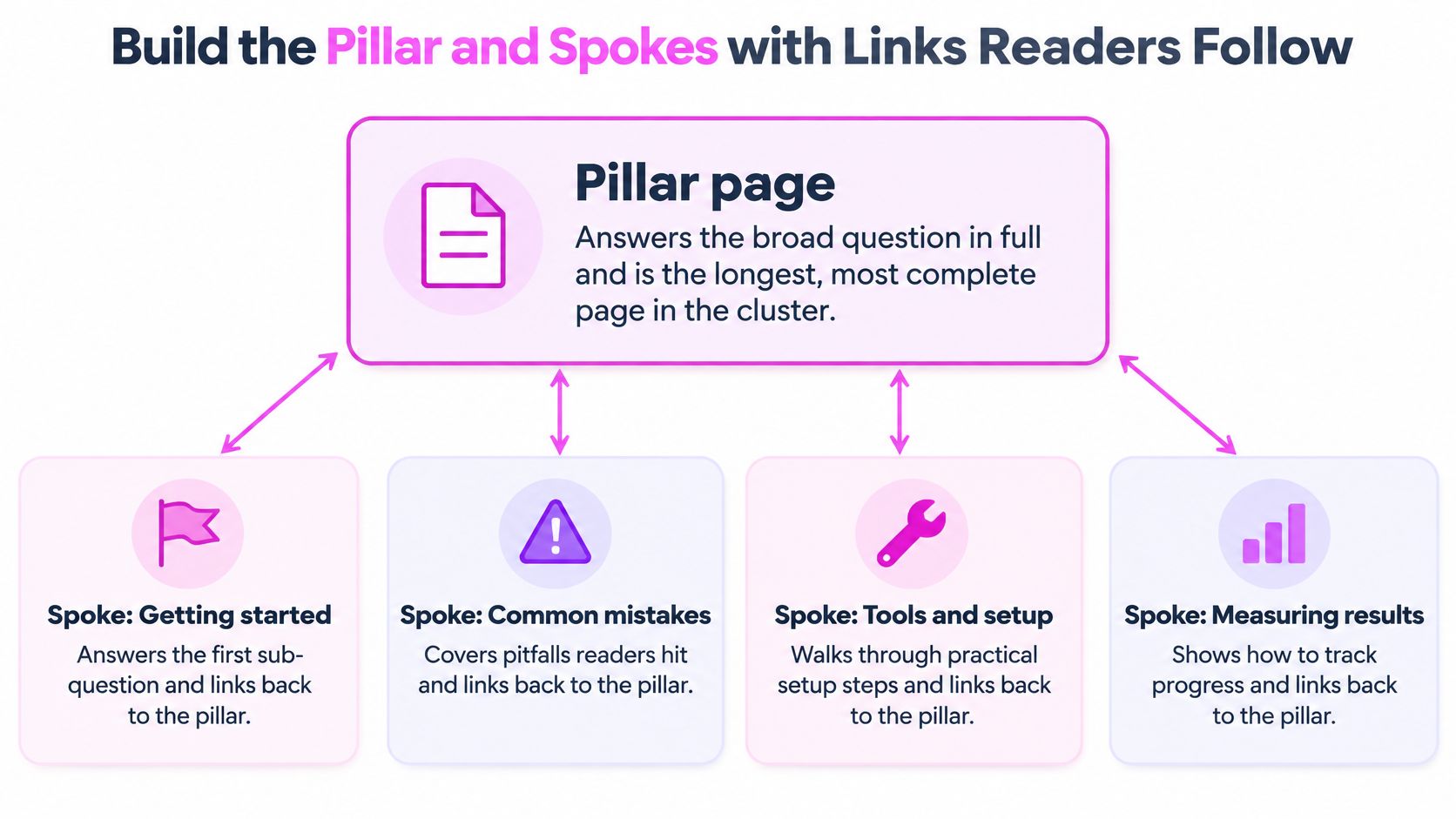
Build the pillar to answer the broad question completely and link to every supporting page. I'd normally make it the longest, most thorough overview in the cluster, while keeping detailed execution on the relevant spokes rather than duplicating entire procedures.
Each spoke should answer a narrower question from your mapping sheet. Give readers enough context to understand the procedure without forcing them to read the pillar first.
Implement the linking sequence
- Publish the pillar first. Establish the parent destination before releasing spokes. Add links to supporting pages as they become available, rather than publishing links to nonexistent URLs.
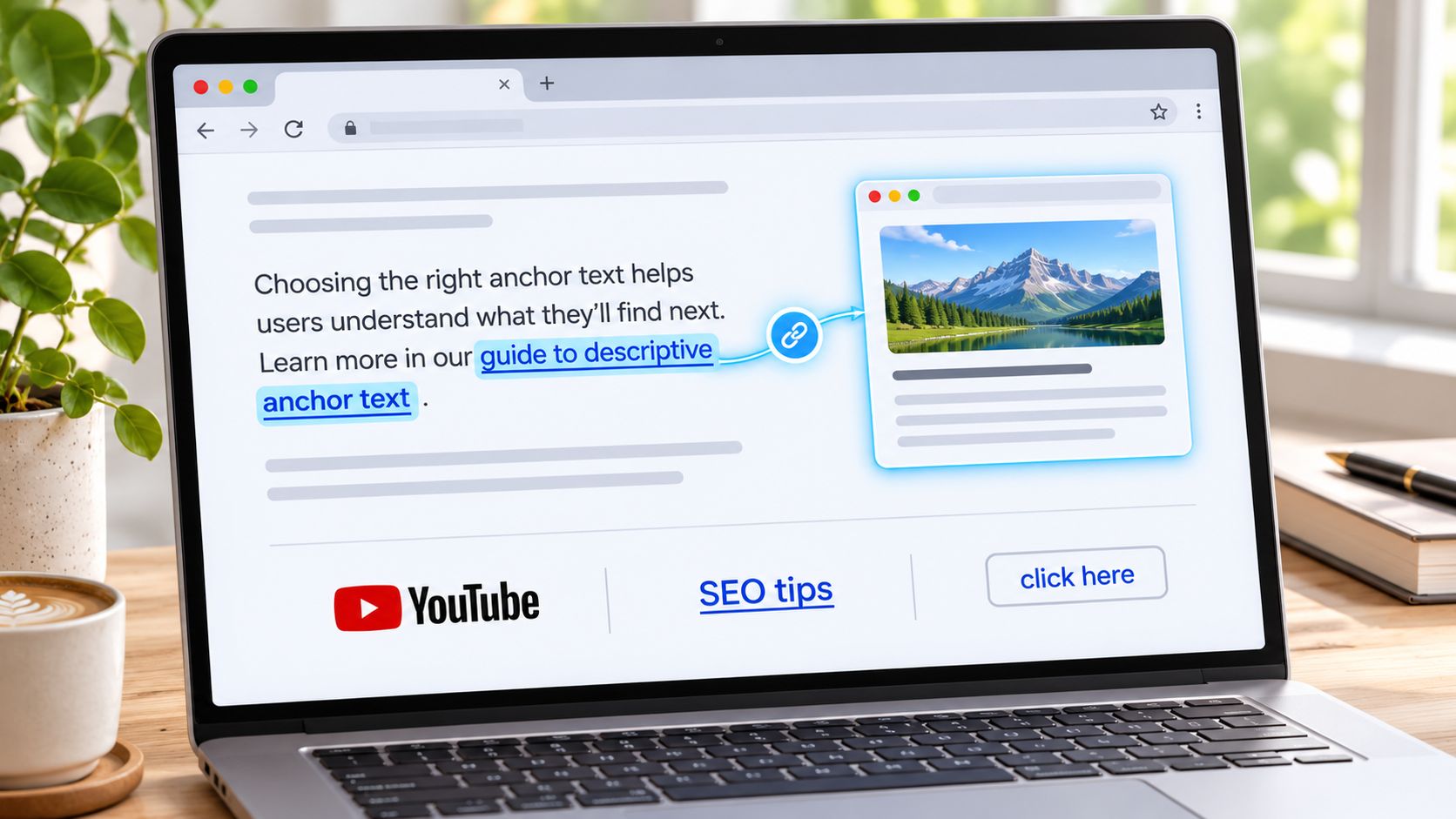
- Connect every spoke back. Use descriptive anchors such as technical SEO audit workflow or broken-link recovery guide. Avoid click here, which doesn't explain the destination.
- Link useful siblings. From a crawl-audit finding about redirect chains, link to the redirect troubleshooting procedure where that next action becomes relevant.
- Crawl the cluster. Compare the planned URL inventory with the crawler's internal-link report. Investigate pages that appear in the inventory but have no incoming internal links.
- Resolve each orphan. Add a contextually relevant pathway, consolidate the page, or remove it from the cluster plan if it has no meaningful relationship.
Check the implementation, not just the visual appearance. Google's crawlable-link guidance recommends HTML anchor elements with an href attribute and says every important page should receive a link from another page on the site. A button or script-only control isn't a substitute unless the underlying implementation supplies that crawlable link.
Don't prescribe a link count per article. Prescribe a useful next step wherever the reader needs one.
A sitemap doesn't explain why two pages belong together. Contextual links do that work through placement and descriptive anchor text.
Before signing off, follow the journey yourself: broad topic, narrow procedure, related troubleshooting, then back to the overview. If you reach a dead end, fix the pathway rather than adding unrelated links to satisfy a quota.
Earn References Without Triggering Link Spam
A growing backlink count can conceal a worsening acquisition pattern. I'd assess why another page links to you before treating the reference as evidence of recognition.
Links still matter: Google's ranking-systems guide describes PageRank as part of its systems from the beginning and explains that link analysis helps identify what pages concern and which may be useful.
| Link Situation | Attribute to Use | Safe to Pursue? |
|---|---|---|
| Editorial mention from a relevant site that would cite the page | Standard followed link | Yes |
| Sponsored post or paid placement | rel=sponsored lub rel=nofollow |
Yes, if disclosed and qualified |
| Commercial arrangement with no qualifying attribute | None | No |
| Reciprocal link pages built only for exchange | None | No |
| Automated or bulk link creation | None | No |
Google's spam policies identify paid links passing ranking credit, excessive exchanges, and automated link creation as link-spam patterns; qualifying commercial links with rel="sponsored" lub rel="nofollow" addresses the paid-link policy concern.

Make the citation useful before making the pitch
Start with publications whose readers match the cluster's audience. Inspect the relevant article and identify exactly where your resource would improve its explanation.
Offer something specific: an original dataset with a transparent method, a worked redirect-mapping template, or a procedure with documented limitations. A generic guide that repeats the prospect's existing advice isn't a compelling addition.
Then check the arrangement. Don't exchange money or goods for unqualified ranking-credit links, and don't build reciprocal resource pages solely to manufacture exchanges.
I'd favor a smaller set of contextually justified references over a burst of mechanically similar placements. That's a defensible acquisition standard, not a claim that fewer links automatically produce better rankings. Record the destination pillar or spoke, referring page, acquisition date, and relationship type so you can distinguish editorial recognition from paid exposure during evaluation.
Plan for AI Overview Click Loss
A randomized field experiment found that Google AI Overviews produced a 39.8% reduction in outbound organic clicks and a 34.5% increase in zero-click searches, according to the AI Overview click-reduction paper. These figures are evidence of a potential click trade-off, not a forecast for any one topic cluster.
Measure visibility separately from visits. A page can inform an answer system while attracting fewer clicks, so rankings and organic traffic alone may miss whether the cluster is building recognition or qualified demand.
Design for answers and action
- Separate answerable questions from execution tasks. Flag queries a summary could satisfy, then distinguish those from queries requiring a procedure, example, or consequential decision.
- Answer directly near the opening. For summary-friendly queries, give a specific, attributable answer early. Treat this as an editorial choice that makes the page easier to extract from, not a guaranteed way to earn a citation.
- Give readers a reason to visit. Add usable templates, documented decision criteria, failure cases, and worked examples. Don't hide the answer to force a click; make the page valuable beyond the summary.
- Track downstream demand. Monitor citations alongside branded searches, direct visits, assisted conversions, and signups. Keep these measures distinct, since a citation alone does not show that it caused a sale.
Use this guide to SEO for AI Overviews to review query-level exposure and the URLs cited. A citation with falling clicks is neither automatic success nor failure. Check whether recognition and qualified demand increased before deciding what to change.
Measure the Cluster and Start Your First Week
Topical authority isn't a proven site-wide ranking factor. An independent review of topical-authority evidence found no study with a stated method directly linking site-wide topic coverage to rankings. I'd therefore test the investment rather than use a proprietary authority score as proof.
Before the first edit, record rankings, impressions, clicks, conversions, internal-link counts, and referring domains. Separate existing pages from newly published pages, so additional inventory doesn't masquerade as improvement to established content.
Choose an unexpanded control with reasonably similar intent, seasonality, and starting performance. Keep its content stable where practical, and log unavoidable changes.
| Metryka | Where to Read It | Warning Sign |
|---|---|---|
| Target queries ranking on the mapped URL | URL-level rank tracking | Query ranks on a different URL than planned |
| Non-brand clicks per cluster | Search Console, grouped by cluster | Spokes gain impressions but clicks stay flat against the control |
| Indexed cluster URLs | Search Console indexing report | Spokes excluded or unindexed |
| Pages cited in AI answers | AI Overview citation tracking | Cited URLs are not the pages you own |
| Branded searches and direct visits | Search Console and analytics | Visibility rises while brand demand stays flat |
| Target queries mapped to the correct URL | Cluster mapping sheet | Any query mapped to two URLs or to none |
Compare outcomes without overstating causation
Compare changes against the control, not just against the previous period. Annotate seasonality, major SERP changes, new backlinks, and sitewide technical releases. You won't eliminate every confounder, but you can avoid crediting content expansion for an improvement that affected the whole site.
Keep search performance, AI citations, and business outcomes as distinct scorecard views. Review quarterly: refresh changed intent, merge duplicates, and redirect obsolete URLs to relevant replacements.
Pause expansion when mapped queries consistently reach the intended pages but outcomes remain flat against the control. Investigate the offer, page usefulness, and competitive requirements before commissioning more content.
Your first-week checklist
- Set the scope. Write the boundary sentence and exclusions for a commercially relevant cluster.
- Complete the inventory. Attach competitor pages and assign an intent and owning URL to each group.
- Save the baseline. Include the control and your change log.
- Draft the pillar. Resolve the broad explanation before commissioning spokes.
- Schedule the decision. Set a review date four months out to decide whether to expand, repair, or shift focus.
Our SemDash content-gap workflow shows topics competitors cover that your site doesn't, as a prioritized list of content ideas. Use that list as candidates for your boundary test, not an automatic publishing queue.
Visit SemDash (SemDash) to research competitor gaps, group queries into page-level topics, and inspect the URLs behind your search visibility. Our SEO Academy offers video tutorials on SEO strategies and using SemDash tools, so you can turn one selected cluster into a mapped, measurable publishing plan.