

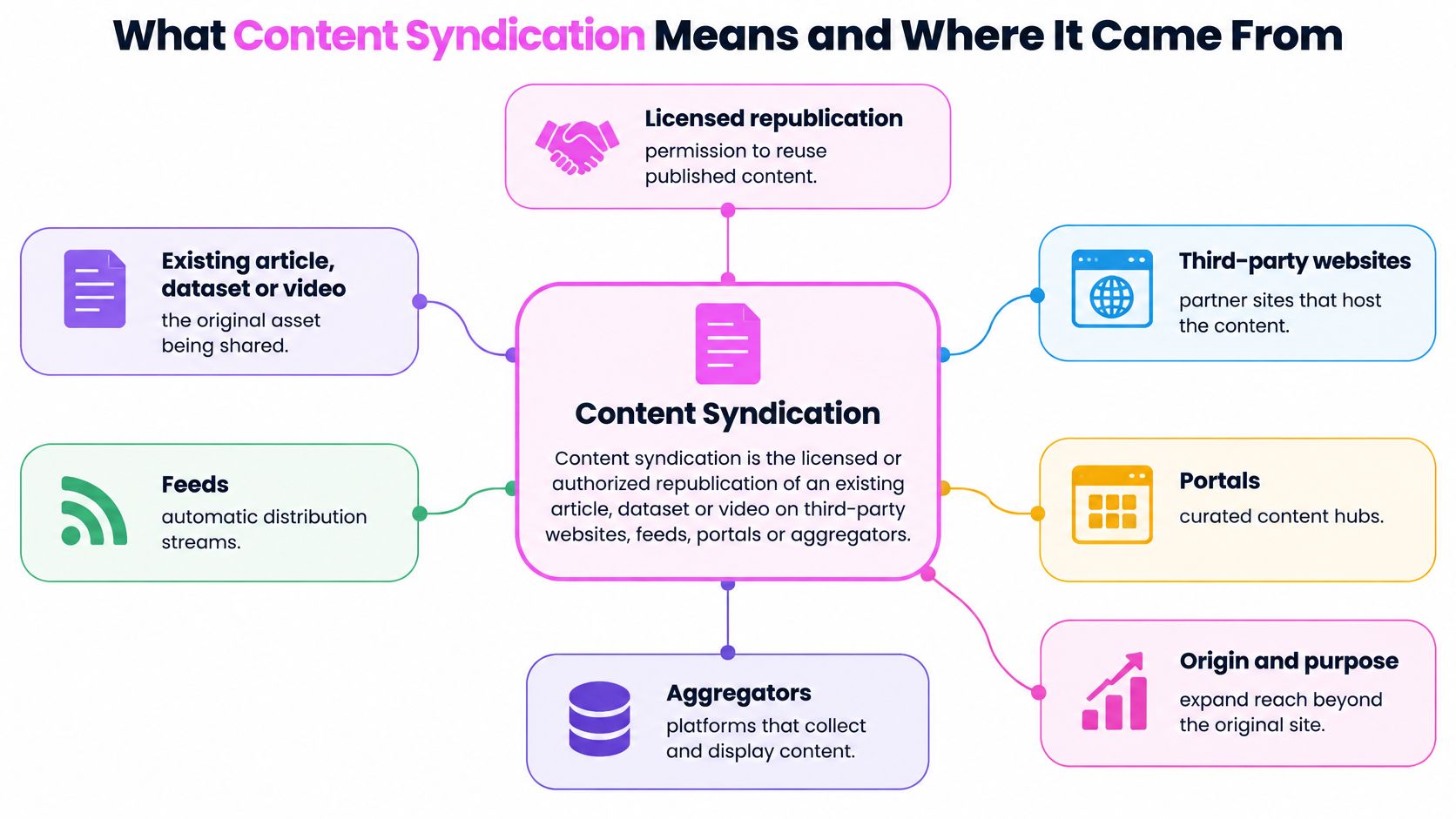
Content syndication is the licensed or authorized republication of an existing article, dataset or video on third-party sites, feeds or aggregators to extend its reach beyond the original publisher.
The popular advice to republish with a canonical link and move on leaves out the decision that matters most: should the partner's page appear in search at all? I'd settle that before approving the placement. Attribution identifies the source; indexing controls determine whether the copy can compete in search. Treating those as separate decisions makes syndication easier to govern and much easier to measure.
Spis treści
- What Content Syndication Means and Where It Came From
- Types of Content Syndication and When Each One Fits
- SEO Benefits and Risks of Republished Articles
- Canonical Tags, Noindex and Which Control to Use
- A Worked Example and the Agreement Checklist
- Measuring Placements and Running the Post-Publication Audit
What Content Syndication Means and Where It Came From
Think of a newspaper columnist whose work runs in local papers under the same byline. Each paper gets permission to publish the column, while the writer reaches readers outside the original publication. You're extending distribution, not commissioning a new article for every outlet.
For a digital equivalent, say you publish a detailed procurement guide. An industry portal republishes the approved text, credits your author and links to your original. You've syndicated an existing asset. If you instead write a fresh article exclusively for that portal, you've made a guest contribution.
This diagram separates the original asset from its distribution channels.
The mechanics began with feeds
According to Wikipedia's RSS history, Netscape released the earliest RSS version, RDF Site Summary 0.90, on March 15, 1999, for the My.Netscape.com portal. With RSS, you could distribute a title, short description and link through an XML feed, letting subscribers receive updates in aggregator software rather than visit every website.
The lasting principles are straightforward:
- One original asset: You create and maintain a primary version.
- Machine-readable distribution: You give another system a repeatable way to collect updates.
- Downstream access: You make the asset discoverable through channels beyond your own domain.
You don't need RSS to use those principles. A licensing agreement, a publisher's import workflow or a product feed can separate content creation from delivery just as effectively.
Ask whether the same asset could serve another site's readers with permission and clear source credit. If it could, you have a syndication candidate, not necessarily a syndication deal worth accepting.
Audience fit still matters. A relevant specialist publication can be a better destination than a larger site whose readers have no reason to act on your advice.
Types of Content Syndication and When Each One Fits
Choose the distribution model before negotiating technical controls. Otherwise, you can end up debating canonical tags for a campaign whose real purpose is collecting whitepaper registrations.
I'd use the following comparison to establish what you're distributing, where readers encounter it and which duplication questions you need to resolve.
Content syndication models compared
| Model | How content moves | Who gains reach | SEO duplication exposure |
|---|---|---|---|
| RSS feed | Title, summary and link in an XML feed | Readers in aggregator apps | Low when the feed carries excerpts |
| Licensed republication | Full or partial article on a partner domain | Partner's audience | High without noindex or a clear canonical decision |
| Publisher network or portal | Article placed in a curated collection | Network readers | Medium, governed by the network's indexing terms |
| B2B lead syndication | Gated asset promoted on partner sites | Partner's registrants | Low to medium, with content often staying on partner pages |
| Product content syndication | Product data feeds to retailers and marketplaces | Retail channels | Medium, with duplicate product copy common |
Match the model to the job
With RSS, you're answering: how can subscribers receive updates without checking your website? Excerpts preserve a reason to visit the original, so check whether your feed exports summaries or full text.
With licensed republication, the question is whether another publication can serve your article to its audience. Negotiate full text versus excerpts explicitly. Don't assume permission to republish also defines editing rights, duration or search treatment.
With publisher networks, you're buying or arranging access to an existing distribution system. Check individual destinations rather than assuming every site uses the same template, attribution placement or indexing configuration.
Dla B2B lead syndication, ask who owns the registration relationship. Define qualification criteria, consent handling, lead routing and follow-up responsibilities before celebrating downloads. A contact record isn't automatically a qualified prospect.
Dla product content syndication, your immediate concern is accurate, synchronized product information. Separate essential specifications from descriptive copy you can tailor for different retail contexts, rather than rewriting factual attributes merely to make them look different.
You can combine these models with digital PR for SEO, but don't confuse republication with editorial coverage. In a PR campaign, you might earn an independent article discussing your findings. In syndication, you authorize reuse of the asset itself.
That distinction changes what you should negotiate and what you can reasonably count as success.
SEO Benefits and Risks of Republished Articles
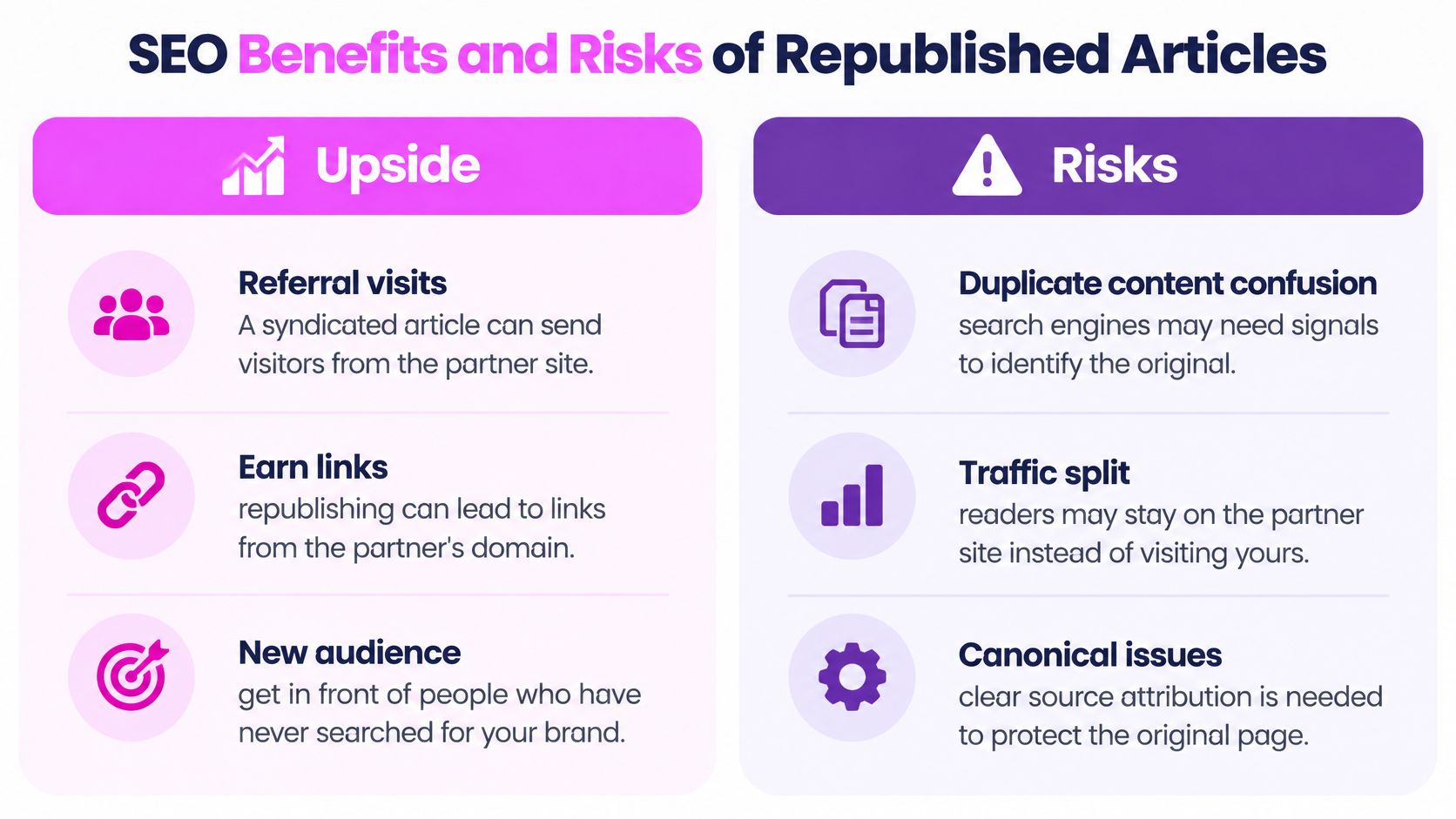
You can use syndication to reach readers who haven't searched for your brand, earn referral visits and acquire links from a relevant publication. The strongest fit is usually an asset that already answers a specific audience's question, paired with a publication that serves that audience.
Use this comparison to weigh distribution gains against the search trade-offs.
The risk isn't simply identical wording
Don't treat authorized duplication as an automatic spam penalty. Your practical exposure is losing control over which URL appears for your target queries, alongside spending crawl resources on copies you don't need indexed.
Testing described in PressPilot's press-release SEO guide found inconsistent outcomes across Google Search, Google News, Discover and generative-search systems: sometimes the original ranked, sometimes the syndicated version ranked, and sometimes both appeared. That's a reason to choose a search objective explicitly, not a reason to reject every placement.
Under Google's canonicalization troubleshooting guidance, syndicated pages can differ sufficiently from their originals that cross-domain canonicals aren't recommended as the primary control; when you want to keep the copy out of search, the partner should prevent its indexing.
The cause-and-effect chain matters. You authorize distribution, the partner publishes a searchable page, and a search engine must decide how to represent overlapping material. You may gain exposure while making your original URL's visibility less predictable.
Decision rule: If you wouldn't accept the partner ranking instead of your source page, resolve indexing before publication.
Separate audience value from search ownership
Say a trade publication republishes your software-buying guide. You might reach procurement managers through its newsletter even if its article never appears in organic search. You don't need an indexable partner copy to benefit from that distribution channel.
Conversely, you might accept ranking competition when broad discovery matters more than keeping every organic visit on your domain. Make that a deliberate exchange, with a useful conversion path and access to performance reporting.
For complementary thinking about protecting the value of your original pages, consider the SEO strategy from Excellorix. Use that perspective to distinguish content you want distributed widely from content whose primary job is attracting search visits to your own site.
Keep this search-control question in mind when reviewing syndication advice in video form.
Canonical Tags, Noindex and Which Control to Use
A canonical is a preference signal, not an ownership certificate. RFC 6596 defines the canonical relation as identifying a preferred resource among duplicated resources, allowing applications to focus processing on that target and disregard the referring copy.
For syndication, I'd treat that mechanism as conditional. The copy needs a suitable relationship to the original, the target must work, and the publisher must implement the signal correctly.
Syndication indexing controls compared
| Kontrola | What it signals | Reliability for syndicated copies | Use when |
|---|---|---|---|
| Cross-domain canonical | Partner copy points to the original as preferred URL | Hint only, can be overridden | Copy stays close to the original and the tag is verified live |
| Noindex on partner copy | Partner copy is kept out of the search index | High when agreed and implemented | Reach-only syndication where the source should retain search visibility |
| Attribution link to source | Visible credit and a referral path | Gives provenance and traffic, not indexing control | Every placement, alongside another control |
| No control | Partner copy indexed as published | Search engine chooses the canonical | Only when duplicate exposure is an accepted cost |
If source-page consolidation is the objective, I'd prefer noindex on the partner copy over relying on canonical selection. That excludes the copy rather than asking a search engine to choose your preferred version.
But implementation matters: the search engine must be able to crawl the page to discover its noindex directive. Blocking crawling isn't a substitute for making the directive readable. Use this meta robots tag guide when translating the agreement into an actual page-level implementation.
Inspect the implementation, not the promise
For a canonical-based arrangement, check the live page source. Confirm that the target resolves successfully, remains crawlable and indexable, and represents the original or a suitable superset.
Then check for operational failures:
- Template overrides: A publishing template can replace the agreed canonical with a self-reference or the partner's homepage.
- Conflicting instructions: Don't rely on a page's canonical as the primary consolidation mechanism while simultaneously asking for that page's exclusion through noindex.
- Editorial changes: A heavily repackaged article may no longer support the canonical relationship you approved.
- Later edits: Recheck after migrations or template changes, because a correct launch implementation doesn't guarantee a correct permanent setup.
Google's cross-domain canonical explanation confirms that a canonical can point to another domain, but Google can still select a different page.
A contract records what the publisher agreed to do. The live HTML records what the publisher actually implemented.
Don't interpret a working attribution link as proof that the technical setup is correct. Test each control against its own purpose.
A Worked Example and the Agreement Checklist
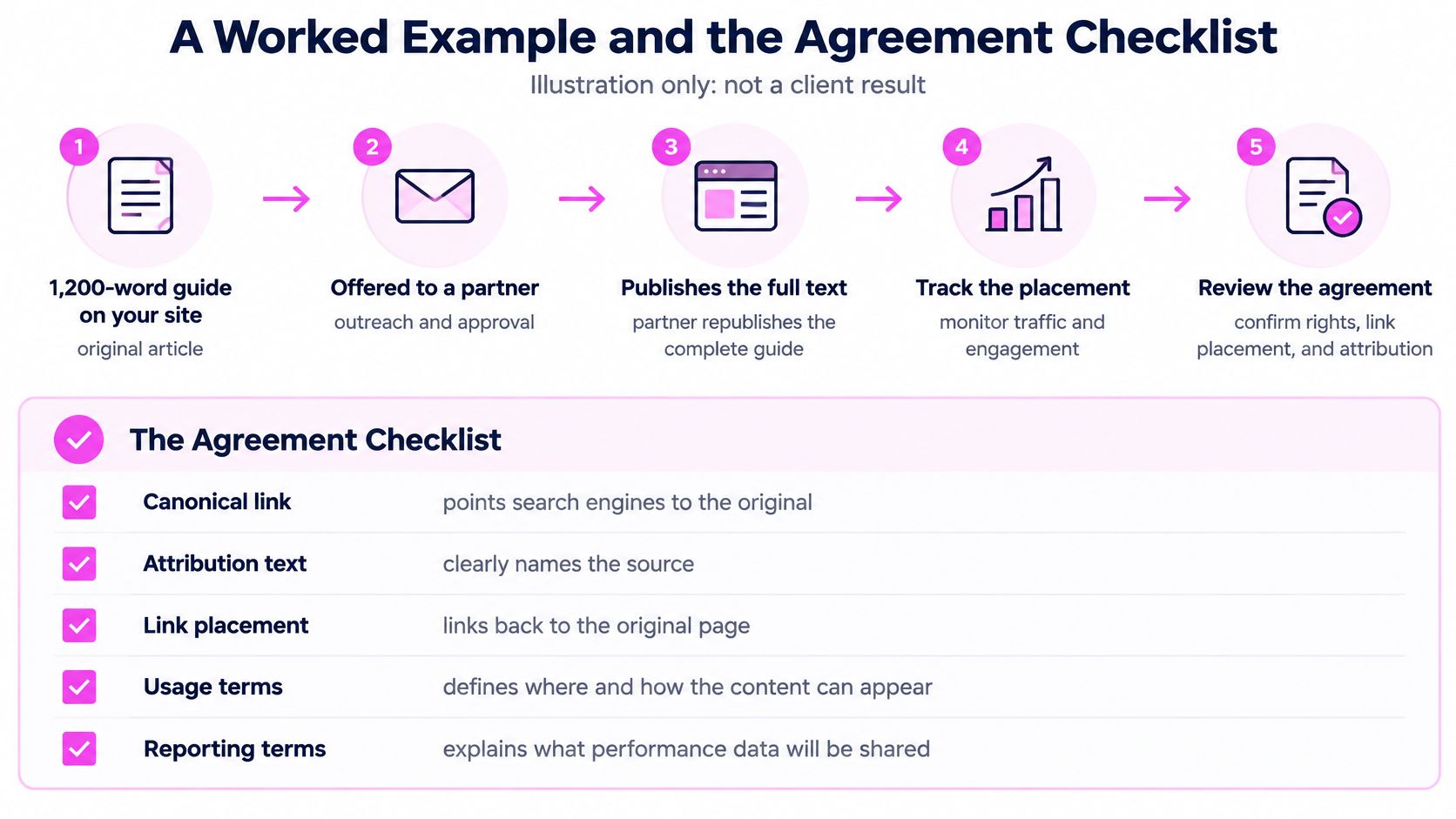
Illustration only, not a client result: say you offer a partner a 1,200-word guide from your website for full-text republication. You agree on author credit and a link, but leave indexing unspecified.
In the first version of this scenario, the partner's template overwrites the intended canonical. Its page starts ranking for your target query, while you discover that the commercial agreement provides no clear correction process.
In the revised version, you name the source URL, approve the exact text, define attribution and require noindex. Assume the partner implements that treatment correctly: its copy stays out of the index while your source retains its rankings. That outcome illustrates successful control of the copy, not a guarantee against unrelated ranking changes.
Use the workflow graphic as a governance reminder, rather than treating its canonical item as mandatory for every placement.
Choose the objective before drafting terms
I'd choose reach-only for this placement: you want access to the partner's existing readers without adding another searchable copy. Write that objective beside the source URL and required indexing treatment.
For an authority-building arrangement, prioritize attribution and appropriate crawlable links. For discovery, explicitly accept possible ranking competition. Don't describe all these objectives as interchangeable benefits while leaving the technical decision unresolved.
Copy this agreement checklist
- Source and version: Record the exact original URL and approved article text so you can distinguish authorized reuse from unapproved changes.
- Credit and attribution: Specify the author credit, attribution wording and visible link placement.
- Reuse scope: State whether permission covers excerpts, full text or an adapted version, including permitted edits.
- Publication window: Define when publication can begin, how long permission lasts and whether exclusivity applies.
- Link policy: Record the destination, tracking parameters and appropriate treatment of commercial links.
- Indexing treatment: Name the required directive or canonical configuration and who verifies it.
- Corrections and removal: Assign a contact, update rights and a takedown process.
- Reporting and commercial rights: Define performance reporting, audience-data ownership, lead routing and monetization permissions.
Google's duplicate-content guidance distinguishes duplicate content from automatic spam violations and explains the user-experience and crawling problems duplicate URLs can create. That supports governing reuse carefully rather than banning it outright.
If your partner removes sections, adds commentary or substantially changes the headline and framing, reassess the approved treatment. Don't let editorial permission become permission to change the technical agreement.
Measuring Placements and Running the Post-Publication Audit
Measure audience distribution separately from search behavior. You can receive qualified leads while losing source-page visibility, or preserve your rankings while getting almost no useful audience engagement.
For the audience layer, track referral sessions, engaged sessions, newsletter sign-ups, qualified leads and assisted conversions. For the search layer, record partner indexation, selected canonical where accessible, and the original URL's visibility for its intended queries.
Google's documentation on canonical pages explains that it can group nearly identical pages across domains and index the selected canonical. Evaluate the page cluster, meaning your original and its syndicated copies together, rather than interpreting each partner's impressions as entirely incremental exposure.
Build an auditable placement record
Use a spreadsheet or reporting database with a row for each published URL. Keep the source URL as a shared identifier so you can group copies without losing placement-level detail.
This is the kind of analysis to bring into your reporting workspace.

Run the audit in this order:
- Capture the baseline. Export the source page's search queries, rankings, clicks and sessions before publication. Note major edits or technical changes so you don't attribute every subsequent movement to syndication.
- Identify the placement. Log the partner URL, publication date, approved version and objective. Add campaign parameters to referral links, using consistent source, medium and campaign values.
- Inspect the live page. Check HTML and applicable response directives for the agreed noindex or canonical treatment. Confirm the attribution link works and that a template hasn't replaced its destination.
- Map search overlap. Record indexing status, declared canonical, referring domain and competing keywords. Use URL-level SERP history to distinguish a partner replacing your source from a partner appearing for a different query.
- Separate conversion paths. Report direct referral conversions apart from assisted conversions. A buyer may discover you through the partner and return later through branded search or direct navigation.
- Review the cluster over time. Compare the source against baseline over the following weeks, alongside partner referrals and relevant search changes. Reinspect technical controls if results diverge from the agreement.
Use Google Search Console for properties you control and GA4 for your own referral and conversion reporting. You generally won't have full indexation diagnostics for a partner's property, so distinguish observed search results from information the partner shares.
Decide what deserves another placement
For finding unrecorded copies, Google plagiarism-checking methods from Lumi Humanizer can complement phrase searches and URL checks. Use those methods to locate reuse, then check permissions before labeling a copy unauthorized.
Don't declare success from clicks alone. A broad publication might send visitors who never fit your buyer profile; a specialist outlet might send fewer visits but stronger enquiries. Compare qualified outcomes and the cost of producing, negotiating and maintaining the placement.
Also check who captures the valuable action. If readers register on the partner's site, you need agreed reporting or lead delivery to understand the return.
For our publishing packages, every package includes a PDF with live URLs of all the customer's articles. Use that inventory as the starting point for an audit, not as proof that each placement produced leads or preserved the source's search visibility.
I'd repeat a placement when you can explain the qualified audience benefit and accept the observed indexing outcome. If the partner displaces a source you intended to protect, fix the implementation before expanding distribution.
We offer SEO research tools for comparing keywords, backlinks and ranking URLs, alongside optional news-site publishing with backlinks. Visit SemDash (SemDash) to evaluate distribution opportunities and track whether your syndicated coverage adds useful visibility or competes with your source pages.