Clean labels are not enough. Even on Fisher's iris dataset, a benchmark so small and tidy that it became a teaching standard, different classification methods return different accuracy scores on the same rows. I wouldn't transfer any of those results to SEO. I would take the warning seriously: a tidy spreadsheet doesn't prove the labels are useful.
Most keyword exports become difficult to use before anyone reads them, because nobody decided what each row is for. I sort queries by intent, cluster, opportunity tier, funnel stage, and brand status before I let search volume drive a publishing decision. Otherwise I'm prioritizing demand without knowing what I'd need to build.
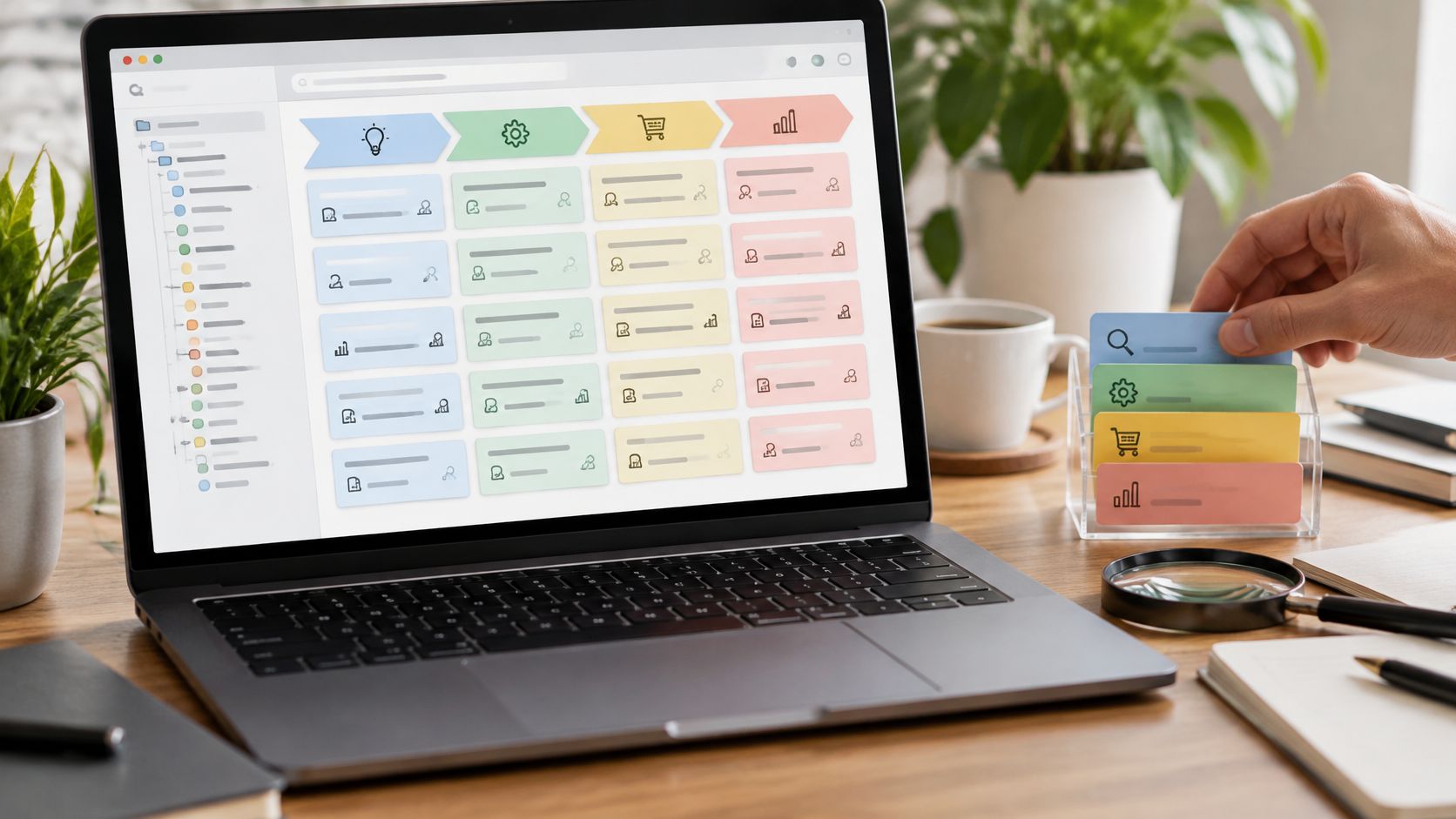
Eight classifications I run before touching a keyword list is my operating sequence, not a demand for eight separate spreadsheets. I keep the labels together, with evidence and a review status beside them.
I consider a label good enough to act on when I can explain the decision, identify the evidence, and name what would make me change it.
Order matters here. Some labels survive contact with a real SERP. Others collapse the moment results get mixed, and intent is usually the first to go. I'd rather know which classification will break before I build on it than discover it after commissioning twenty pages.
For these classification examples, I'd use a working sheet with query, target URL, classification, evidence, and review status. I'd keep uncertain rows visible rather than forcing a confident answer. The expensive mistake isn't leaving a keyword unclassified. It's commissioning the wrong page because a convenient label looked authoritative.
Spis treści
- 1. Search Intent Classification (Informational, Navigational, Transactional, Commercial)
- 2. Keyword Clustering by SERP Overlap
- 3. Opportunity Tiering by Volume and Keyword Difficulty
- 4. Content Funnel Stage Classification (Top, Middle, Bottom of Funnel)
- 5. Brand vs. Non-Brand Keyword Classification
- 6. URL and Page-Type Classification
- 7. Backlink Classification by Link Type and Anchor Text
- 8. Industry, Topic, and Text Classification Methods
- How the eight classification examples differ in basis, best use, and main risk
- How I'd Sequence These Classifications on Your Next Project
1. Search Intent Classification (Informational, Navigational, Transactional, Commercial)
I start with the page I'd need to publish, not the wording I'd like to target. For a query such as running shoes, I'd inspect whether Google mainly returns category pages, product listings, buying guides, or something else. If I find shopping-led results, I wouldn't commission an informational article just because writing one feels easier.

I use informational for learning, navigational for reaching a known destination, transactional for taking action, and commercial for evaluating options. I treat those as working definitions, not properties permanently attached to words.
- Informacyjna: Dla how to fix a leaking faucet, I'd expect to build a tutorial if guides and demonstrations dominate.
- Nawigacyjna: Dla Search Console login, I'd recognize a destination request rather than a realistic acquisition target.
- Komercyjna: Dla best CRM for consultants, I'd investigate comparison formats and evaluation criteria.
- Transakcyjna: Dla buy trail running shoes, I'd assess whether a shoppable category page can satisfy the request.
My rule for mixed intent
I review the leading organic results, record their formats, and separate ads from organic evidence. I also check the target country and device context so I don't classify against an irrelevant result set.
I approve the label when the dominant format is clear and I can deliver that format credibly. When I find a genuine split, I record primary and secondary intent, then either choose a defensible angle or defer the query.
I'd use these SEO keyword examples to sharpen the vocabulary, but I'd validate the actual results before briefing content. I'd also revisit valuable queries periodically, especially before a substantial rewrite.
2. Keyword Clustering by SERP Overlap
I wouldn't build separate comparison pages for email marketing tools, best email marketing software, a email marketing platforms merely because an export gives each phrase its own row. I'd compare the ranking URLs first. If I repeatedly find the same pages answering those searches, I'd consider a shared target page.
I wouldn't apply that reasoning to email marketing jobs. Shared vocabulary doesn't give me a shared audience, task, or page format.

I compare URLs, then test the brief
I normalize tracking parameters before comparing results, but I preserve meaningful path differences. I compare ranking pages rather than domains because a publisher can rank different pages for distinct needs.
My merge rule is practical: can I write a coherent page brief that satisfies every query in the proposed cluster? If I need an unrelated section, a different conversion action, or a conflicting format, I split the cluster even when I see some overlap.
- Name the cluster: I choose a representative primary keyword and retain the variants beneath it.
- Assign a destination: I map the cluster to an existing URL or a proposed page, not just a topic name.
- Review valuable clusters first: I investigate commercially relevant demand before polishing peripheral groups.
I'd use a semantic keyword clustering workflow to generate candidates, then challenge the grouping against search results. For another approach to the process, I'd compare the keyword grouping strategies described by Transactional with my own merge rules.
I'd be especially careful with chain-shaped clusters. If I can connect one query to another only through an intermediate phrase, I wouldn't assume every query belongs on the same page. I'd compare each member with the cluster's intended destination.
3. Opportunity Tiering by Volume and Keyword Difficulty
I don't treat Keyword Difficulty as a publishing instruction. I use it as a screening signal, then inspect the pages I'd need to outrank. A low score doesn't help if I can't provide the required product inventory, original evidence, or specialist expertise.
For a small SaaS site, I'd compare a narrow integration query with a broad software-category term. I might prioritize the integration query despite lower demand if I can demonstrate the workflow and connect it directly to a trial.
My tiers reflect investment decisions
- Quick wins: I can satisfy the intent with existing expertise, a credible page, and a manageable production effort.
- Core targets: I have a strong business reason to compete, but I need deeper content, better internal links, or supporting assets.
- Long-term bets: I need substantial authority, original evidence, product development, or sustained investment before I can compete credibly.
I'd place volume and difficulty into a simple relative grid, then add business relevance and incumbent strength. I wouldn't sum those fields into a supposedly scientific score unless I could explain the weighting. I'd rather keep the decision visible than hide it behind a formula.
Investment rule: I won't call a cluster a quick win until I can describe why our page deserves to replace something already ranking.
For a broad query dominated by government resources and established publishers, I'd ask whether I can offer a meaningfully different answer. If not, I'd deprioritize it rather than interpret difficulty as a challenge to spend harder.
I'd re-tier when the evidence changes: stronger rankings, new product capabilities, weaker competing pages, or a changed result format. I'd also distinguish an easy publication from an achievable ranking opportunity. I can publish almost anything quickly; I can't make every page competitive quickly.
4. Content Funnel Stage Classification (Top, Middle, Bottom of Funnel)
I use funnel labels to choose the next helpful action, not to pretend every buyer follows a neat sequence. For what is CRM, I'd usually offer an explanation and a relevant next step. For CRM comparison, I'd help evaluate options, while HubSpot pricing would need decision-stage treatment.
I keep intent and funnel stage in separate columns. I might classify a query as informational while still placing it close to purchase, especially when I'm answering a technical objection or migration concern.

I map the next action before assigning the stage
For a B2B software project, I'd inventory awareness guides, comparison pages, implementation resources, and product pages. If I found plenty of explanations but no credible evaluation content, I'd prioritize that gap instead of commissioning another introductory guide.
For an e-commerce project, I'd connect a buying guide to the relevant category and explain the selection criteria before asking for a purchase. I'd then measure whether readers use those links and continue toward a meaningful action.
- Top of funnel: I help readers understand the problem and identify useful options.
- Middle of funnel: I help readers compare approaches, requirements, and trade-offs.
- Bottom of funnel: I remove practical obstacles to purchasing, booking, or starting.
I approve a funnel label when I can name the reader's immediate decision and the page's appropriate next action. If I can't do that, I'd review the audience assumption rather than debate the label.
I wouldn't judge every stage by immediate purchases. I'd examine assisted journeys, qualified enquiries, product exploration, and direct conversions separately, while avoiding claims that every earlier page caused the eventual sale.
5. Brand vs. Non-Brand Keyword Classification
I separate brand traffic before judging whether content is attracting discovery demand. Otherwise, I could mistake increased awareness from advertising, partnerships, or existing customers for stronger non-brand acquisition.
I build the brand dictionary from Search Console queries, product naming, known abbreviations, and actual misspellings. I wouldn't rely on the official company name alone, because readers don't necessarily type it consistently.
I use rules with an exception list
I'd normalize case and whitespace, then apply a regex rule with carefully chosen boundaries. I'd test punctuation, spaced variants, and names embedded inside longer words before using the output in reporting.
For a hypothetical SaaS brand called ClearLedger, I'd test the spaced form clear ledger separately. If I sold accounting software under that name, I'd also inspect whether the phrase appeared in generic accounting searches.
- Own brand: I include company names, distinctive product names, and validated variants.
- Other brands: I keep competitor and partner searches separate when competitive analysis matters.
- Uncertain: I preserve ambiguous matches for review instead of counting them as branded.
I'd keep the dictionary in a shared, versioned file. When I add a missing variant, I'd reprocess the comparison period or clearly annotate the change, so I don't report a classification adjustment as commercial growth.
I'd use this video as supplementary context while keeping the reporting rules documented beside the export.
My acceptance rule is stricter for ambiguous names than distinctive ones. I'd only automate a brand match when I can defend the match from the query context. In monthly reporting, I'd show brand and non-brand clicks side by side, with uncertain demand visible rather than buried.
6. URL and Page-Type Classification
I classify URLs before recommending sitewide fixes. I wouldn't give a product page, a buying guide, and a filtered category the same thin-content diagnosis just because each contains little text. I'd judge whether each page performs its intended job.
I start with crawl exports from a tool such as Screaming Frog and join them to Search Console and analytics records. I use URL patterns as an initial rule, then validate against templates, rendered content, canonical tags, and indexability.
I classify function separately from technical status
For a retailer, I'd distinguish product pages, categories, filters, internal search results, editorial guides, and utility pages. I'd put indexability in a separate field because I might legitimately have both indexable and non-indexable URLs within a page type.
- Product pages: I examine availability, useful specifications, purchase support, and conversion behavior.
- Category pages: I examine selection quality, navigation, relevant demand, and product discovery.
- Editorial pages: I examine task completion, relevance, and progression toward related resources.
- Utility pages: I examine whether I should expose the page to search at all.
For filtered categories, I'd inspect whether I'm creating distinct, useful destinations or repeated combinations with little independent value. I wouldn't automatically noindex every filter, because I might remove a useful landing page for a specific shopping need.
I need a page's function and technical state before I choose its fix. A URL folder alone isn't enough.
I'd apply the same caution to tag archives. If I found archives competing with articles, I'd first assess whether readers benefit from those archives and whether I've built coherent navigation.
My label becomes actionable after representative template checks agree with the rule. When I find exceptions, I'd refine the rule before applying a bulk change.
7. Backlink Classification by Link Type and Anchor Text
I wouldn't make outreach or cleanup decisions from raw backlink counts. I'd classify the referring page, link placement, anchor wording, and link attributes separately. Otherwise, I might confuse a relevant editorial recommendation with a repeated footer link or a paid placement.
For anchor text, I use branded, exact-match, partial-match, generic, and naked-URL categories. I define those categories against the target page, because I can't meaningfully call an anchor exact-match without specifying the query or topic I'm comparing it with.
I review context before judging risk
Suppose I'm reviewing a SaaS profile with repeated commercial anchors from contributed articles. I'd inspect relevance, placement, editorial context, and destination quality before changing outreach priorities. I might favor useful resource references and genuine brand mentions, but I wouldn't prescribe an arbitrary anchor ratio.
- Source type: I distinguish editorial articles, resource pages, directories, forums, and other placements.
- Link attributes: I record sponsored, UGC, and nofollow attributes without treating them as a complete quality judgment.
- Destination: I check whether I'm earning references to useful resources, product pages, or irrelevant URLs.
- Pattern: I investigate sudden repetition, unexpected sources, and changed placements.
I'd manually review the referring domains most relevant to the decision, including prominent sources and suspicious new patterns. I wouldn't assume that a tool's authority score can replace opening the page.
For competitor gap analysis, I'd separate realistic prospects from inaccessible relationships. I can pursue a relevant industry directory or publication; I can't assume I can reproduce a partner relationship just because I found its link.
My action threshold depends on the consequence. I'd accept a provisional category for prospect research, but I'd require much stronger evidence before recommending removal or disavowal.
8. Industry, Topic, and Text Classification Methods
I start with a taxonomy I can maintain, not the most advanced classifier I can access. I'd consider the IAB Content Taxonomy for publishing topics and Google Product Taxonomy for product organization, then choose the structure that fits the decision.
For an e-commerce competitor review, I'd map relevant sections to a consistent product hierarchy. I'd investigate an apparently uncovered subcategory before calling it an opportunity, because I might be looking at a naming difference, unavailable inventory, or a deliberate business exclusion.

I earn automation with a labeled sample
I'd begin with transparent rules for recognizable modifiers such as vs, alternative, a pricing. I wouldn't assume those words guarantee commercial intent, especially when I encounter support queries or unrelated meanings.
I'd hand-label a varied sample, write inclusion and exclusion rules, and preserve a separate evaluation sample. I'd include awkward cases deliberately so I'm not testing only the easiest queries.
- Manual classification: I choose this for small, consequential, or unfamiliar datasets.
- Rules: I choose these when I can describe stable patterns and useful exceptions.
- Models: I consider these when contextual ambiguity creates enough manual work to justify validation.
- Human review: I retain this for uncertain predictions and expensive decisions.
I'd measure errors by category, not just overall agreement. If I repeatedly mislabel rare but valuable purchase queries, I wouldn't accept the system merely because I classify common informational searches well.
I'd set confidence thresholds using observed errors on held-out examples, not a model's unsupported confidence claim. I'd also version the taxonomy, rules, and review decisions so I can explain changes later.
My acceptance rule is operational: I can automate a label when its demonstrated error pattern is tolerable for the action I'll take. I'd require stronger validation for page consolidation than for a provisional topic tag.
How the eight classification examples differ in basis, best use, and main risk
| Item | Classification Basis | Najlepsze zastosowanie | Main Risk |
|---|---|---|---|
| Search Intent Classification (Informational, Navigational, Transactional, Commercial) | SERP composition and the query's likely intent | Matching page format to what searchers expect | Intent can shift, and categories may oversimplify mixed queries |
| Keyword Clustering by SERP Overlap | Shared URLs among top-ranking search results | Grouping queries that one page can target | Overlap thresholds may merge topics that should remain separate |
| Opportunity Tiering by Volume and Keyword Difficulty | Search volume, keyword difficulty, business relevance, and incumbent strength | Prioritizing content by likely return and ranking effort | Difficulty and traffic estimates can be inaccurate or become outdated |
| Content Funnel Stage Classification (Top, Middle, Bottom of Funnel) | Awareness, consideration, or decision intent and commercial value | Balancing content across the buyer journey | Buyer journeys are non-linear, and some queries span stages |
| Brand vs. Non-Brand Keyword Classification | Company, product, and variant name matching | Separating branded demand from non-brand SEO performance | Misspellings may be missed, and ambiguous names may cause false positives |
| URL and Page-Type Classification | URL patterns, templates, schema, and on-page elements | Auditing large sites by page type | Inconsistent structures can cause misclassification |
| Backlink Classification by Link Type and Anchor Text | Link source, attributes, anchor text, and referring-domain quality | Guiding link outreach and backlink cleanup reviews | Labels alone do not show whether a link is good or harmful; context matters |
| Industry, Topic, and Text Classification Methods | Standard taxonomies, rules, machine-learning models, or hybrids | Comparing market coverage and identifying topic gaps | Taxonomies can be too broad, and automated labels can be inaccurate |
How I'd Sequence These Classifications on Your Next Project
I'd start with intent because every later label depends on whether I can build the page searchers expect. I'd then cluster queries into page-level targets, assign opportunity tiers, and map funnel stages. That gives me a publishing order based on achievable work and commercial purpose, rather than a descending volume column.
I'd keep brand separation and page-type labels running from the beginning of reporting. I need those dimensions to distinguish acquisition from existing demand and to judge different templates fairly. I'd classify backlinks when I'm evaluating authority, outreach priorities, or a specific profile concern, rather than delaying the entire content plan until every link has a label.
I'd make review status part of the working file
I'd use clear statuses such as approved, provisional, and needs review. Beside each consequential decision, I'd record the evidence, intended action, owner, and reason to revisit it.
- For a content brief: I need defensible intent, a coherent cluster, and a suitable destination.
- For prioritization: I need business relevance, realistic production requirements, and a credible competitive opening.
- For a technical change: I need validated page types and an understanding of what readers and search engines will lose.
- For link cleanup: I need contextual evidence, not just an alarming score or anchor pattern.
I'd also track the cost of being wrong. I can revise a provisional topic label cheaply, but I can waste substantial work by merging distinct intents into a single page. I'd therefore put more review effort into decisions that are expensive to reverse.
My strongest recommendation: Keep uncertainty attached to the row until someone resolves it. Don't turn missing evidence into a confident category.
Intent is the classification I'd challenge first when the plan stops making sense. If I get the expected format wrong, I can build tidy clusters, polished briefs, and sensible funnel paths around the wrong destination. I'd check that assumption before blaming content length or adding more supporting articles.
I'd revisit the full set each quarter and reopen important labels sooner when results, products, or site capabilities change. I'd sample approved rows as well as unresolved ones, because I won't catch outdated assumptions by reviewing only the rows already marked uncertain.
I'd aim for a system another practitioner can reproduce. If we disagree, I want us debating the evidence and decision rule, not the meaning of an undocumented color in a spreadsheet. That's when these classification examples become useful: I can turn each label into a clear action, explain the trade-off, and revise the decision without rebuilding the project.
I'd use SemDash to bring keyword, SERP, and backlink research into the same content-planning workflow, with intent classification and keyword clustering supporting page-level decisions. Visit SemDash (SemDash) to investigate your target queries, compare competing pages, and build a more defensible publishing order.