%20(1)-B86R08ZzwhPzS6UZbG3mSxRWPCwGwn.png)


A long-tail keyword is a specific, lower-volume query at the long end of the search demand curve. One widely cited analysis reported that 91.8% of search queries are long-tail, while another summary of the same research said 92% of keywords receive 10 or fewer searches per month.
The popular shortcut, “three or more words equals long tail,” is useful only until it sends your strategy in the wrong direction. Search phrase length can hint at specificity, but it doesn't define the opportunity. A four-word query can still be a competitive head term, while a shorter query can reveal sharply defined intent.
I've built semantic cores where the biggest gains came from abandoning impressive-looking volume and grouping specific queries by the problem they represented. The practical question isn't merely, “How many words are in this keyword?” It's, “Where does this query sit on the demand curve, what does the searcher want, and can one page satisfy the surrounding intent?”
Spis treści
- Why the Word Count Myth Hurts Your SEO
- Defining a Long Tail Keyword
- Long Tail Keyword Examples Across Search Intent
- How to Find Long Tail Keywords With Real Tools
- Why Long Tail Keywords Drive More Conversions
- How to Prioritize Long Tail Opportunities
- Optimizing Pages to Rank for Long Tail Queries
- Putting Long Tail Keywords to Work This Week
Why the Word Count Myth Hurts Your SEO
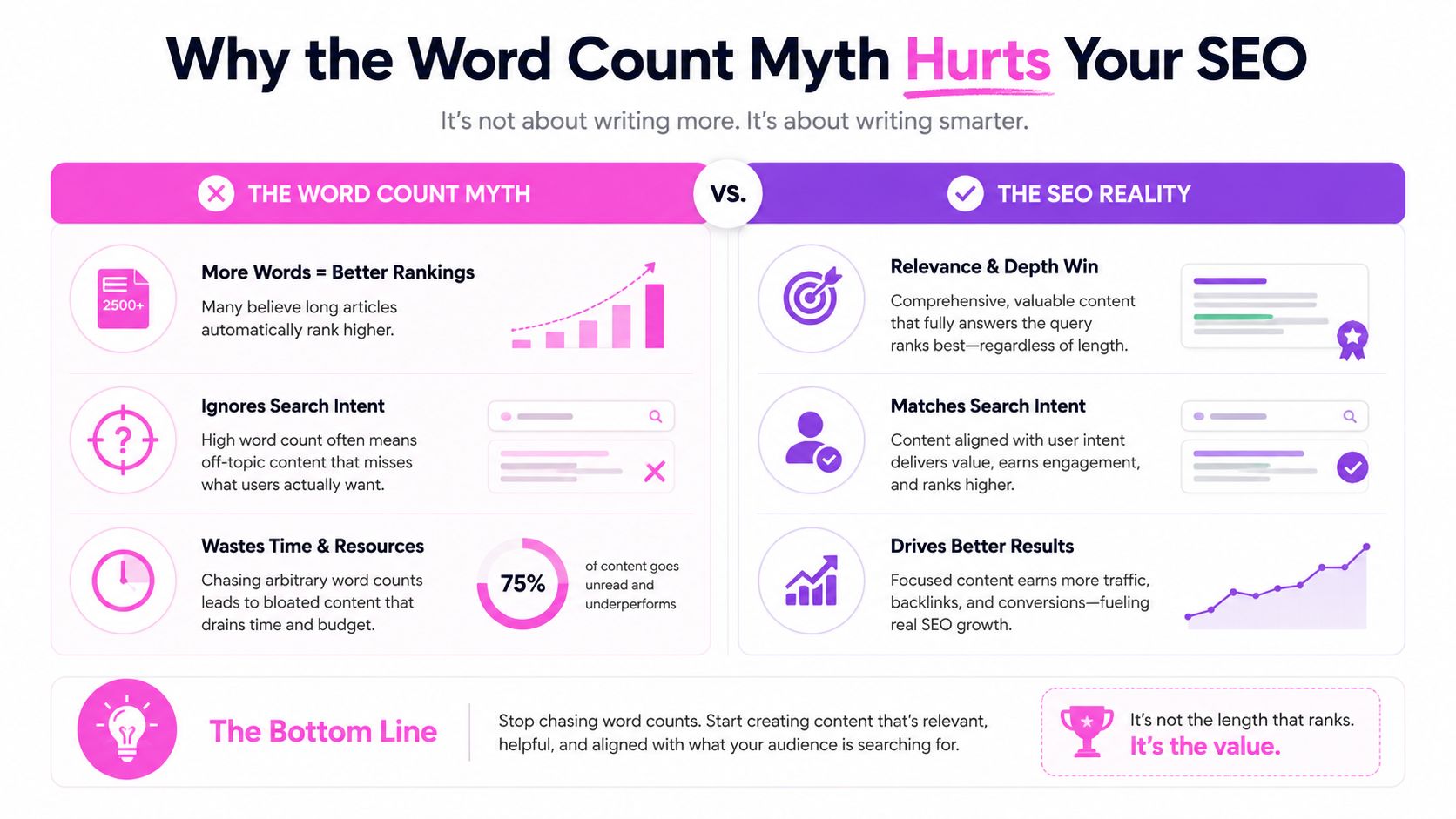
Word count is a poor proxy for long-tail behavior. Ahrefs explains that no universal word-count threshold exists, because a phrase can be long and still behave like a head term if it attracts substantial demand. A shorter query can belong to the long tail when it carries a narrow location, product, audience, or use-case signal.
“Credit card rewards 2024” has four words, but the query remains broad, commercially crowded, and ambiguous. It could lead to comparison research, issuer pages, news coverage, or a general explanation. By contrast, “iPhone repair Brooklyn” has only three words, yet its local and transactional intent is much clearer. “Schema” can be even narrower when it appears in a site-specific search or internal command.
Where the shortcut breaks
I see the word-count mistake most often in editorial calendars. A team filters for phrases with three or more words, chooses “best running shoes for women,” and produces a generic buying guide. The phrase looks long enough to qualify, but the SERP is usually shaped by large retailers, specialist publishers, and brands with strong authority. A short article built around the phrase won't become a long-tail asset just because the title contains more words.
The opposite mistake is also costly. Teams discard shorter phrases with strong modifiers because they don't meet an arbitrary threshold. “Plumber near me” can be broad in one context, but “plumber near me emergency Sunday” communicates a far more urgent and local need. The query's intent signature, not its character count, determines how you should evaluate it.
Praktyczna zasada: Count words only as an initial filter. Validate the demand curve, the SERP, and the specificity of the problem before assigning a page.
The Search Engine Journal guide to long-tail keywords describes these terms as highly specific, lower-volume phrases and notes that practitioners often associate them with three or more words. That convention is fine for brainstorming, but it fails as a final classification system. I use it to generate candidates, then search each candidate and compare the result types, competitors, and intent.
Defining a Long Tail Keyword
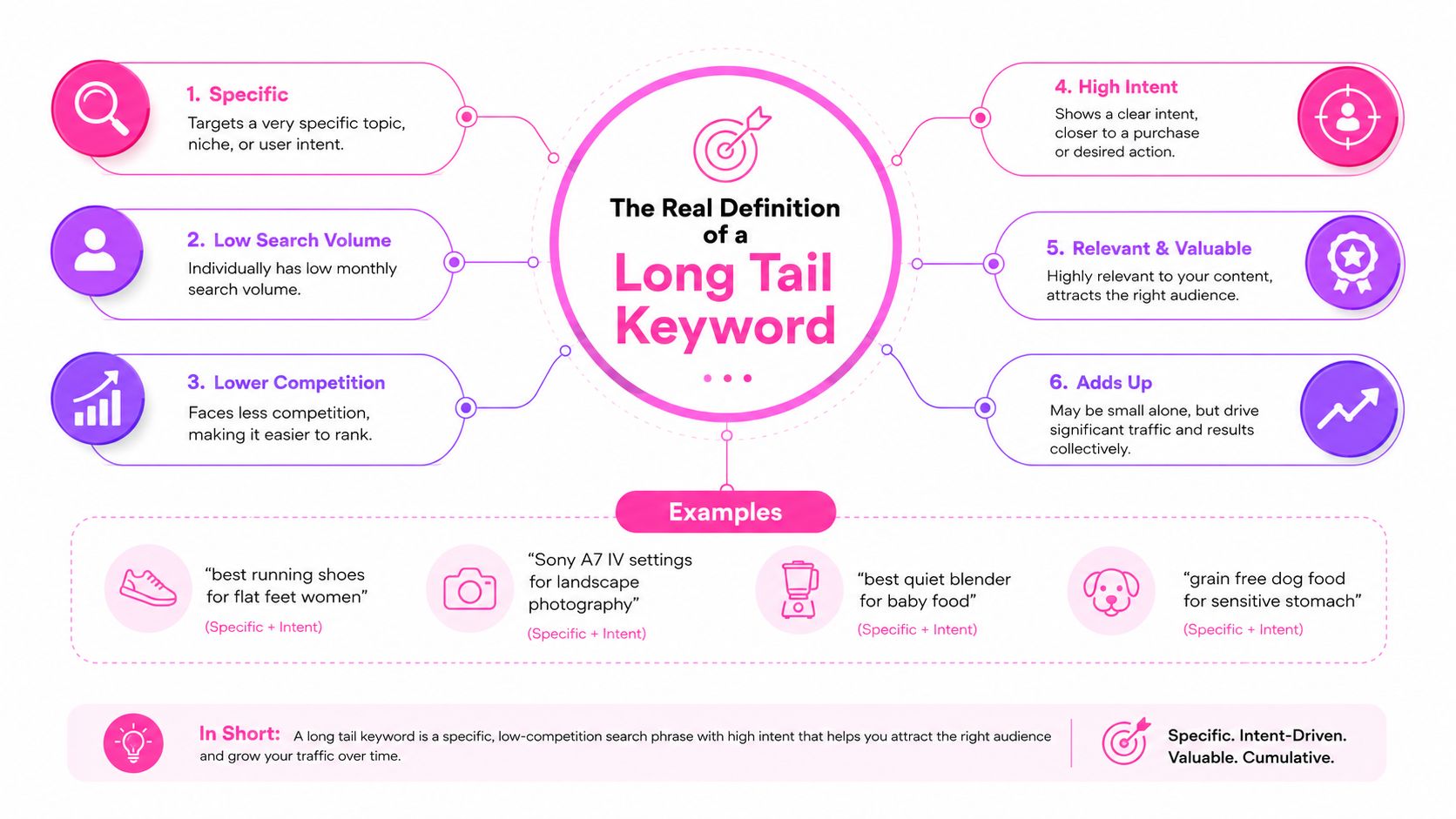
A long-tail keyword is a query with specific intent and comparatively low individual demand, positioned toward the extended end of the search-demand distribution. Word count can be a clue, but it is not the definition. Specificity, demand concentration, and the problem behind the query matter more.
The demand curve provides a stronger model than a word counter. Head terms attract many searchers with mixed intent, like an open ocean. Body terms are more productive inlets, with clearer topics but established competitors. Long-tail queries are narrow creeks where fewer people arrive, yet the searcher often knows exactly what they need.
The long-tail idea is historically connected to Chris Anderson's 2004 Long Tail concept, which showed how many niche interests can collectively outweigh a smaller set of blockbuster products or terms. In SEO, the principle shifted attention from a few broad targets toward groups of specific queries. Industry guidance has also described long-tail terms as accounting for over 70% of search queries, although the exact share varies by dataset and methodology, as summarized by Yoast's long-tail keyword guidance.
Three signals I use
Specific qualifiers identify who, where, why, or under what constraint the searcher is looking. Examples include “for solo real estate agents,” “under $50 a month,” “with bad knees at 40,” and “size 9 wide.”
Clear downstream intent separates a useful long tail from a verbose research query. A phrase naming a product model, location, audience, budget, or comparison gives you a clearer conversion hypothesis than a broad category term. These details also help form intent clusters, so one page can address closely related queries instead of producing a thin page for every wording variation.
A winnable SERP shows whether that specificity creates an opening. Smaller topical sites, local businesses, specialist reviews, or focused product pages appearing beside major domains can indicate a practical opportunity, even when individual volume is modest. In zero-click results and AI-generated overviews, a page also needs a direct answer, distinct evidence, or useful detail that can earn visibility beyond a single blue link.
One analysis of 24 million keywords found that one- and two-word terms were a minority of the database while still driving over 65% of total search volume, and that over 80% of queries were searched fewer than 10 times per month, jak wynika z Link-Assistant's analysis of long-tail keywords. The trade-off is clear. Broad terms concentrate volume, while long-tail demand fragments across many variants.
For another way to classify terms by intent, see SemDash's overview of keyword types. The “long tail” label is relative, not permanent. A phrase can be specific compared with its parent term and still be too competitive for a small site. Use the label to organize research, then let the SERP determine which intent cluster deserves a page.
Long Tail Keyword Examples Across Search Intent
The fastest way to understand long-tail behavior is to compare queries that share a topic but differ in qualification. The qualifier often changes the content type, competitors, and likelihood that a focused page can satisfy the search.
| Intent Type | Head Term Query | Long Tail Version | Why It Wins |
|---|---|---|---|
| Informacyjne | how to start running | how to start running with bad knees at 40 | The audience and constraint define the advice, making a focused guide more useful than a general beginner article. |
| Informacyjne | schema | schema markup for local service pages | The query identifies a specific implementation context and narrows the expected explanation. |
| Komercyjne | best CRM | best CRM for solo real estate agents under $50 a month | The buyer, budget, and use case create a decision-ready comparison. |
| Komercyjne | running shoes | best running shoes for women with wide feet | Fit and audience modifiers make product evaluation more precise. |
| Komercyjne | Ahrefs vs Semrush | Ahrefs vs Semrush for a solo blogger in 2024 | The comparison is framed around a defined buyer rather than the entire market. |
| Transakcyjne | buy running shoes | buy Brooks Ghost 15 women's size 9 wide | Model, audience, size, and width indicate near-purchase intent. |
| Local transactional | plumber near me | plumber near me emergency Sunday | Location, urgency, and availability alter which local businesses can satisfy the query. |
The first informational pair shows why specificity improves content design. “How to start running” requires broad beginner guidance. The qualified version needs advice shaped around joint stress, age, progression, and safety considerations. A focused page can win because it answers a defined problem instead of competing with every running guide.
The commercial examples work differently. “Best CRM” attracts review platforms, vendor pages, and broad comparison content. “Best CRM for solo real estate agents under $50 a month” gives you a clear evaluation frame, including workflow, budget, and user type. The page still needs credible comparisons, but it doesn't need to pretend that every CRM buyer has the same requirements.
The SERP test
I don't call a phrase long-tail until I search it. I check whether the results contain product pages, local listings, comparison pages, forum discussions, or general guides. Then I ask whether the qualifier changes that mix.
If removing the qualifier changes the SERP, the qualifier is doing strategic work.
That rule catches edge cases. “Buy running shoes” and “buy Brooks Ghost 15 women's size 9 wide” may concern the same category, but they demand different landing pages. The second query should map to a product or tightly filtered category experience, not a broad editorial guide. Specificity doesn't just improve targeting. It determines the page that deserves to rank.
How to Find Long Tail Keywords With Real Tools
I start with existing evidence, not a blank keyword tool. A finished list of low-volume phrases can look productive while hiding duplication, weak intent, and pages nobody needs. My workflow moves from broad seeds to observed language, then from raw queries to page-level clusters.
Start with seeds and first-party data
I pull 10 to 20 head terms from analytics, Search Console, existing category pages, and pages that already attract impressions. In Ahrefs or Semrush Keywords Explorer, I inspect related terms and use traffic-share or volume filters to reduce noise. The filters specified here, 1% to 3% traffic share i 50 to 500 monthly searches, are useful starting points for discovery, but I don't treat them as universal qualification rules.
Google often exposes language that third-party databases miss. For each seed, I collect People Also Ask questions, People Also Search For suggestions, autocomplete variations, and related-search phrases. I export the questions rather than copying them into a document one at a time. AI Overviews also deserve inspection, because the result can reveal which pages and entities Google associates with a query, even when the overview reduces traditional clicks.
Extract language, then cluster it
For competitive seeds, I run TF-IDF or n-gram extraction across the top ranking pages using Surfer, Frase, or a small Python workflow. This surfaces recurring attributes, objections, and terminology that I wouldn't invent from a keyword list. I then combine those phrases with customer-support questions, site search terms, and product language.
Finally, I cluster the raw set into intent groups. Tools such as MarketMuse and InLinks can help, while a spreadsheet works when I compare query meaning and likely page type manually. SemDash can also surface long-tail, People Also Ask, and People Also Search suggestions, then group queries into page-level topics to help reduce cannibalization.
| Stage | Primary Tool | Specific Action | Filter / Report |
|---|---|---|---|
| Seed collection | Google Search Console | Export queries from pages already receiving impressions | Performance report, page and query views |
| Expansion | Ahrefs or Semrush | Enter seed terms and export related variations | Traffic-share or volume filters, intent review |
| Question mining | Capture People Also Ask, PASF, autocomplete, and related searches | Group by question type and modifier | |
| Phrase extraction | Surfer, Frase, or Python | Compare top ranking pages for recurring terms and n-grams | TF-IDF or n-gram output |
| Grupowanie | MarketMuse, InLinks, or spreadsheet | Assign queries to page-level intent groups | Topical relevance and SERP similarity |
| Monitorowanie | VisiLocali | Analyse rank movement for agencies across tracked terms and pages | Ranking reports, movement, and visibility trends |
What I discard
I remove near-duplicates that would create several pages for one answer. I also remove phrases whose SERPs demand a format my site can't provide, unless the business case justifies a new content type. A keyword isn't valuable because a tool exported it. It becomes valuable when the query, page type, audience, and business outcome align.
For a deeper process focused on finding attainable opportunities, SemDash's guide to low-competition keyword research is a useful companion. The key operational decision is whether ten variants deserve ten URLs or one complete page. Most of the time, clustering should answer that question before writing begins.
Why Long Tail Keywords Drive More Conversions
Specificity changes the quality of a visit. Someone searching “running shoes” could be browsing styles, researching materials, comparing prices, looking for a store, or trying to understand the category. Someone searching for a named model, width, size, and use case has already supplied several product-selection criteria.
The conversion advantage comes from intent alignment, not from a magical property attached to longer phrases. A study cited by Conductor found that long-tail searchers converted at more than 2.5 times the rate of head-term visitors, as reported in Conductor's long-tail keyword guidance. I use that finding as a directional reason to examine downstream value, not as permission to ignore volume entirely.
Volume is only one input
A high-volume term can produce many visits with weak commercial fit. A lower-volume term can produce fewer visits but a better match between the search, the page, and the offer. That relationship affects conversion rate, sales-qualified actions, assisted revenue, and the amount of explanation required before a user takes the next step.
The demand distribution also makes aggregation necessary. One study cited by Conductor found that the top 100 keywords captured 88.57% of searches and 81.40% of clicks in ad campaigns, leaving the remainder fragmented across many lower-volume queries. I don't read that as an argument against long-tail SEO. I read it as a warning not to build a business plan around isolated phrases. Group related demand into pages that solve one coherent problem.
A low-volume query is not automatically valuable. It needs a clear business action behind it.
The zero-click complication
AI Overviews and other zero-click result features make broad informational queries harder to value by rank alone. A page can appear prominently while receiving less traffic because the searcher gets a sufficient answer on the results page.
Specific queries can still earn clicks when the answer requires product fit, local availability, detailed implementation, or a comparison grounded in the searcher's constraints. I wouldn't claim that every long-tail result avoids AI mediation. Instead, I look for queries where a summarized answer can't complete the task, then make the page useful enough to justify the click.
The practical measurement is revenue per qualified visit, not raw traffic. If a page attracts visitors who already know their problem and can evaluate your solution, it may outperform a broader page even when the broader page wins the ranking report.
How to Prioritize Long Tail Opportunities
I prioritize pages by intent, SERP fit, business value, and aggregation potential. Search volume helps estimate demand, but it doesn't tell me whether a query deserves a standalone URL.
The three common choices are a single high-intent page, a cluster page that serves sibling queries, or a broader authority build covering an entire intent neighborhood. Each has a different cost profile and a different way of compounding.
| Strategy | Effort (hrs) | 6-mo Traffic Potential | Conversion Likelihood | Compounding Value |
|---|---|---|---|---|
| Single long-tail page | Variable | Narrow, focused demand | High when the query is transactional | Limited unless linked into a cluster |
| Cluster page | Variable | Broader aggregate demand | Medium to high when variants share intent | Strong through related coverage |
| Topical authority build | Variable and substantial | Broadest potential across an intent neighborhood | Mixed across informational and commercial pages | Highest when internal links and expertise reinforce one another |
I don't attach invented hour estimates to this matrix because production time varies with research depth, approval cycles, templates, and technical requirements. The useful comparison is relative effort, not false precision.
My decision rules
Choose a single-keyword page when the query has sharp commercial intent, the SERP is clearly separated from its parent topic, and the competition is realistically attainable. A low-difficulty score can support the decision, but the score must be checked against the actual results.
Choose a cluster page when sibling queries ask the same fundamental question with different qualifiers. This is my default because it prevents the common waste of publishing one thin URL per variation. A cluster page should use sections, examples, filters, or FAQs to satisfy the variants without becoming an unfocused encyclopedia.
Choose topical authority when the niche is defensible and the site already has relevant visibility. A group of connected pages can cover discovery, evaluation, implementation, and purchase intent. The value comes from the network, not from any single URL.
I prefer a portfolio weighted toward cluster pages, with selective standalone pages and fewer authority projects. I don't recommend a rigid percentage split for every site. A local service business, ecommerce catalogue, and SaaS company have different page economics. The warning is consistent, though: don't chase 1,000 isolated keyword pages when a smaller number of well-mapped hubs can cover the same demand without cannibalization.
Optimizing Pages to Rank for Long Tail Queries
Long-tail optimization works when the page confirms the query quickly, covers the surrounding intent naturally, and gives search engines a clear internal context. I don't repeat an exact phrase until the copy sounds manufactured. I map each placement to the cluster it serves.
The on-page checklist
- Title tag: Put the primary query or a close grammatical version near the front when it remains readable.
- H1: Mirror the topic without forcing an exact-match title that sounds unnatural.
- Opening copy: Confirm the problem and audience early, ideally within the first 100 words, so the page establishes relevance immediately.
- Subheadings: Use secondary cluster terms as questions, use cases, constraints, and comparison points.
- Body copy: Answer the underlying need rather than inserting every exported variation.
- Images: Write descriptive alt text and captions that clarify the subject, product, or process. This is one of the easiest placements for teams to skip.
- Internal links: Link each cluster page to its pillar with descriptive anchors, and link the pillar back to the most useful supporting pages.
- Dane strukturalne: Use FAQPage when the page contains eligible question-and-answer content, and HowTo for a real step-driven process. Schema clarifies content structure, but it can't rescue a weak answer.
Match every element to intent
A product query shouldn't land on a generic essay if the searcher needs availability, specifications, fit, or checkout access. An implementation query needs examples, prerequisites, steps, and troubleshooting. The page format must match the result types already winning, while offering a clearer answer or a better experience.
For writers who want a practical framework for nailing user intent with SEO, the most useful principle is simple: write for the decision the searcher is trying to make. Don't turn a transactional query into an informational article merely because blog production is easier.
Before publishing, I run a cluster audit:
- Confirm the primary query and its parent topic.
- Check that each major secondary term maps to a useful section.
- Remove variants that belong on another page.
- Verify the title, H1, opening, headings, links, alt text, and schema.
- Search the live SERP again and compare the page against the current result types.
The page should feel well-rounded because it is well-mapped, not because it repeats the same keyword in every paragraph.
Putting Long Tail Keywords to Work This Week
The fastest opportunity usually sits inside your existing query data. Teams spend too much time inventing new keywords while ignoring the specific searches Google already associates with their pages.
Pull 20 long-tail queries from Search Console and group them into three intent clusters. Look for repeated problems, audiences, locations, products, and constraints. If several queries point to one existing page, improve that page before creating another URL.
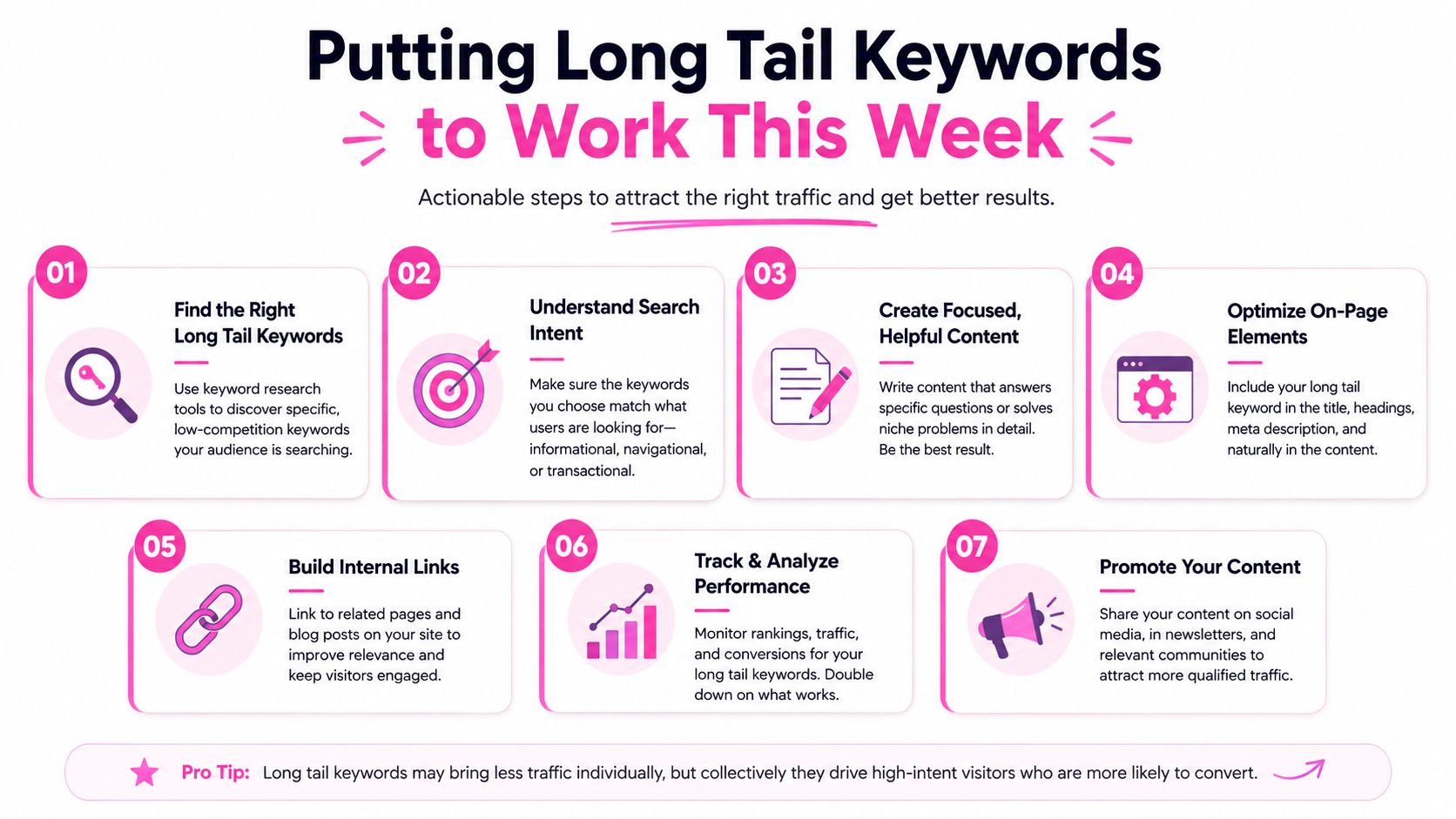
Pick one cluster and write or rewrite one page using the on-page checklist above. Then add FAQPage schema to the five highest-impression, lowest-CTR queries where your site already has relevant content and the structured questions appear on the page. Don't add invented FAQs just to create markup.
The measurement I trust
Śledzić non-branded impressions grouped by intent, not a raw list of keyword positions. Rankings fluctuate, variants overlap, and one page can earn visibility for many related searches. Intent clusters show whether your site is becoming visible for a meaningful problem.
Internal linking determines whether that progress compounds. Link the revised page to its pillar, connect sibling pages where the user needs the next answer, and make sure the pillar points back to the strongest supporting resources. Without those relationships, each page carries its own burden and your topical coverage remains fragmented.
The work for this week is deliberately narrow: reclaim existing associations, improve one cluster, and connect the pages. That process gives you cleaner evidence than publishing a batch of disconnected articles and hoping one happens to rank.
SemDash helps you turn this process into a working research system with keyword discovery, long-tail and PAA suggestions, SERP data, competitor gap reports, and keyword clustering for page-level planning. Visit SemDash (SemDash) to identify the queries your site and competitors already own, group them by intent, and choose the next page with evidence instead of guesswork.