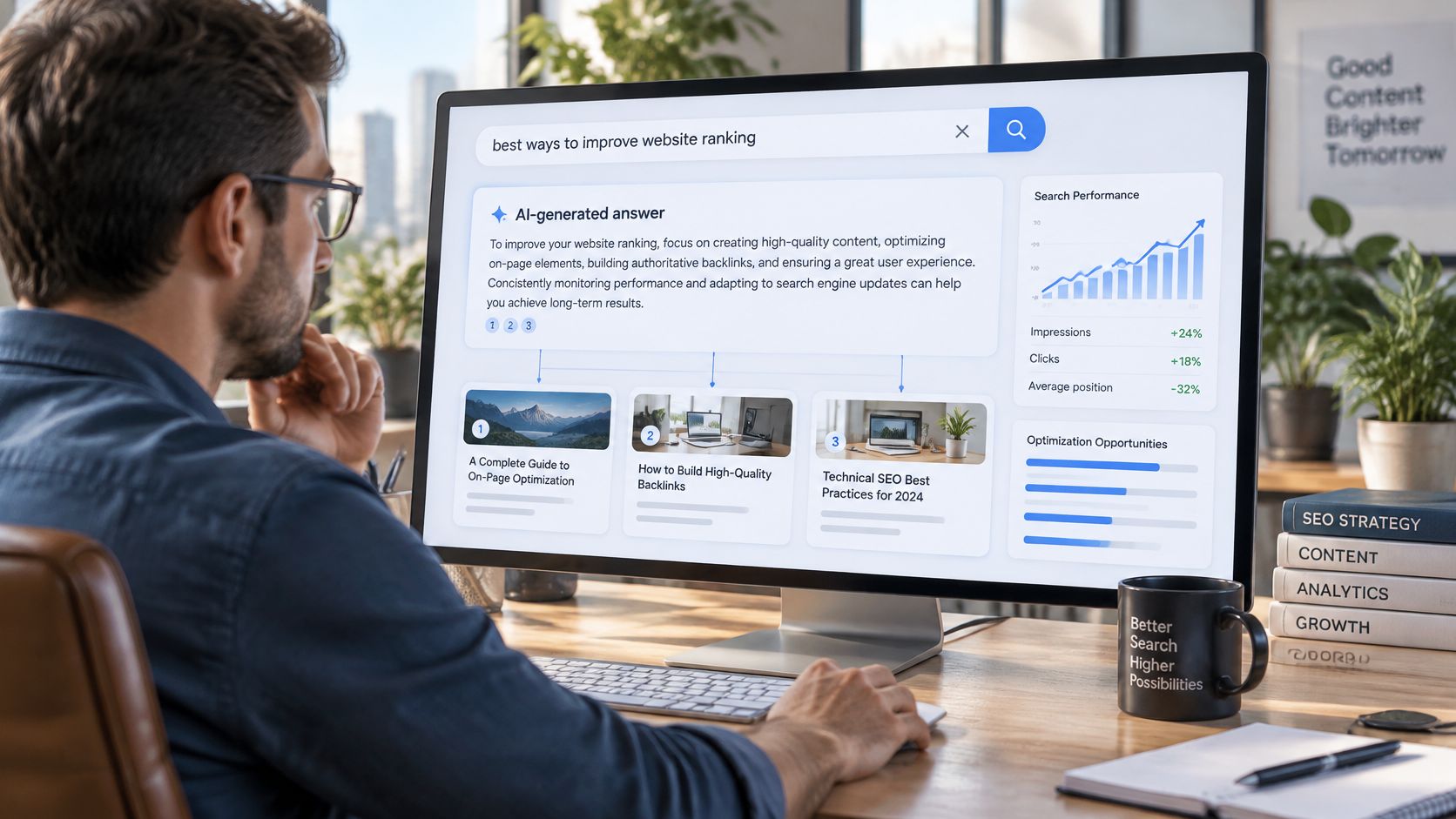


Stop opening the keyword tool first. I know that's backwards from how most retainers start, and it's exactly why so many of them stall. We ship a confident spreadsheet, the client approves words they recognize, and three months later nobody can connect that list to a lead, a sale, or even the page that was supposed to rank.
I've learned to treat SEO for clients as a measurement and handoff system before I treat it as a content plan. If I can't name what converts, which URL should capture it, and how I'll prove whether a change helped, I don't have a strategy yet. I have activity.
Spis treści
- Why SEO for Clients Starts Before the Tool
- Build a Measurement Baseline Before Any Fix
- Map One Intent to One Page Brief
- Run Link Outreach You Can Defend
- Choose Research Tools That Match the Work
- Report Outcomes and Set the Next Retainer
Why SEO for Clients Starts Before the Tool
The mistake I still see on new retainers is simple. Someone types a few head terms into a research tool, sorts by volume, and sends the client a list that looks thorough. It isn't connected to what the business sells, what margin looks like, or which page on the site is the money page.
I answer two questions before I export anything. Co się konwertuje, a which page is supposed to capture that demand? For a service client, that might mean a consultation request from a specific service page, not a newsletter signup from a blog post. For ecommerce, it's a product or category purchase, not traffic to a buying guide that never links anyone forward.
Volume Looks Impressive Until You Price the Click
A high-volume informational term can dominate a spreadsheet and still be the wrong priority. A lower-volume product or service query often carries clearer intent and a shorter path to revenue. I've sat in planning calls where we nearly built a quarter around a broad term because the number looked good in a deck, while the transactional page that paid the retainer sat on page two.
Click distribution is why I push back. One analysis reported the first Google organic result received an average 27.6% of clicks, the second about 15%, and the third about 11%z click share then declining substantially through the remaining first-page positions. That same source summarizes an earlier analysis reporting 31.7% for position one and only 0.78% of users clicking to page two. I treat those as benchmarks, not guarantees, because device, query type, and SERP features change the split.
The practical point holds. Moving a commercial page from page two into the top ten gives it access to clicks that barely existed before. Moving from third to first can lift traffic without finding a new keyword at all.
My priority rule: Volume times difficulty is incomplete until intent, conversion value, and the exact ranking URL sit on the same row.
Visibility Is Not Only a Blue Link
I also check how Google presents the query before I decide what to build. Google was founded in 1998, launched Images in 2001, and introduced Universal Search in 2007, which combined web pages with images, videos, news, and local results on one page, according to Google's own account of its first twenty-five years. That history isn't trivia. It tells you a client may need a local listing, a video, an image asset, or a product page instead of another article.
If I skip that check, I'll brief the wrong format and then blame the writer. I won't do that anymore. The tool comes after the commercial target, every time.
Build a Measurement Baseline Before Any Fix
I don't let anyone ship a technical fix on a new retainer until we can explain later whether it helped. Without a baseline, every traffic move becomes an argument. With one, we can have a calmer conversation about cause, timing, and tradeoffs, supported by a proper review of organic traffic patterns rather than screenshots.
Here's the sequence I run. I pull Google Search Console for indexed pages, clicks, impressions, queries, and page-level performance. Then I crawl representative templates and check indexability, canonicals, redirects, rendering, internal links, and structured-data validity. I don't crawl everything and call it insight. Templates tell me where the systemic problem lives.
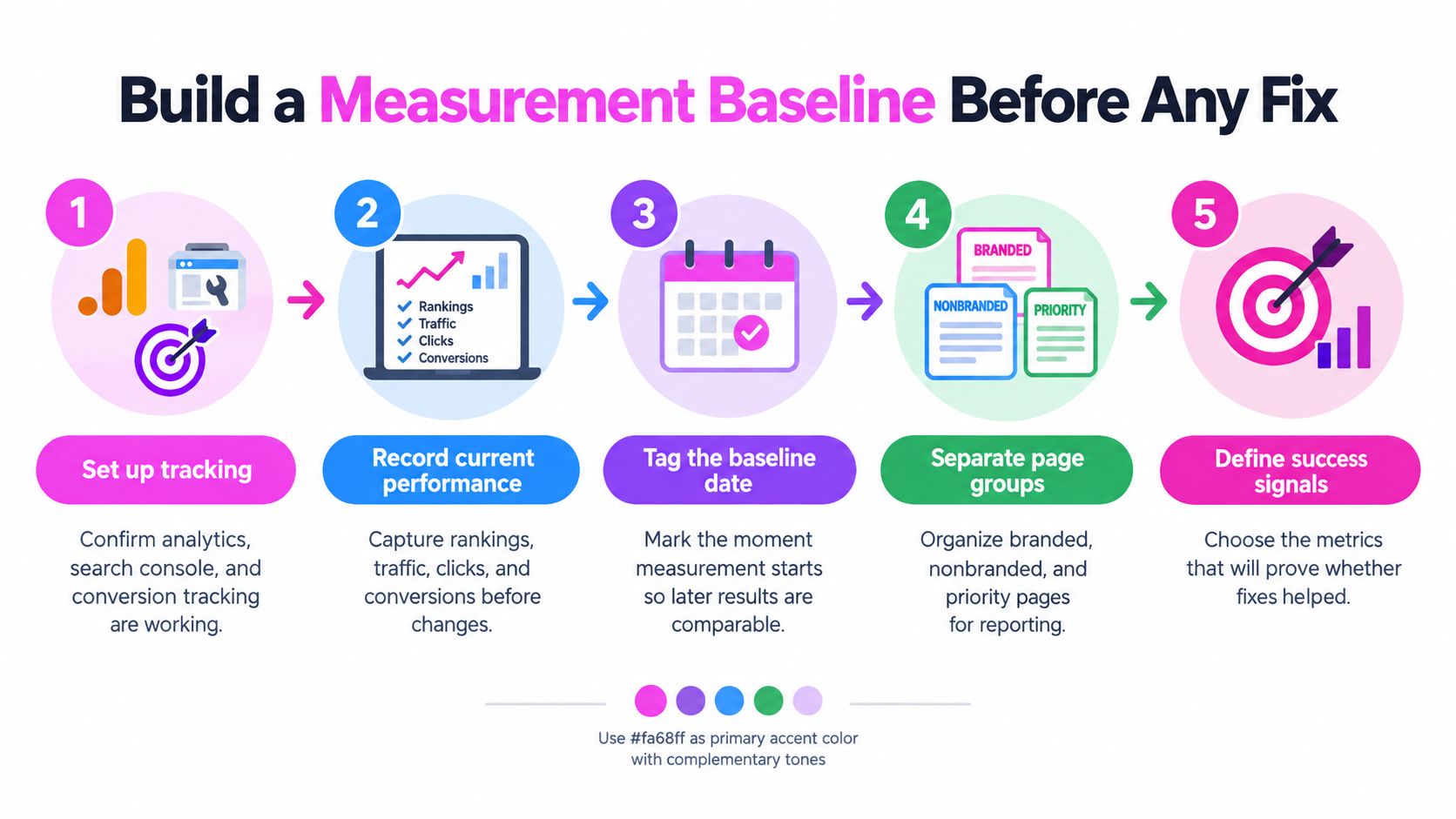
Next I segment by URL, intent, country, device, and brand versus non-brand. That last split matters more than many admit. Branded demand can hide a non-brand decline for months, and I've seen reports celebrate growth that was really just a press mention driving name searches.
Then I rank fixes by expected organic impact, implementation effort, and business value, and I annotate every deployment before comparing periods. If we can't date the change, we can't credit it or clear it.
Acceptance Criteria I Put in the Handoff
I never write "make it faster" in a ticket. I write thresholds a developer can test against. At the 75th percentile, I use Largest Contentful Paint at 2.5 seconds or less, Interaction to Next Paint at 200 milliseconds or less, and Cumulative Layout Shift at 0.1 or less, which matches Google's page experience guidance for field-data evaluation.
I also spell out what "not done" means. The needs improvement bands are LCP above 2.5 and up to 4 seconds, INP above 200 and up to 500 milliseconds, and CLS above 0.1 and up to 0.25, with higher values classified as poor in Google's Core Web Vitals status definitions. A developer shouldn't have to guess where the line is.
Diagnostics differ by metric, and I keep them separate in the ticket.
- Slow LCP on a template: If every product page is slow because the hero image is oversized, compressing one URL for a screenshot doesn't fix the client. Fix the shared template.
- Poor INP: Image weight won't solve a checkout button blocked by long JavaScript tasks. Profile the interaction.
- High CLS: Reserve layout space for images, ads, and embedded modules instead of chasing content edits.
Failures I Won't Repeat
I've made the common ones. Shipping without annotations. Mixing brand and non-brand in one trend line. Judging a JavaScript-heavy page only from crawler output. Presenting a passing score as proof of SEO success.
That last one still bothers me because clients believe it. Strong page-experience numbers don't guarantee top rankings. Relevance and content quality still decide a lot of the outcome, so I report qualified organic conversions, leads or revenue, indexed high-value pages, and non-brand visibility alongside the technical work. The score is a gate. It isn't the result.
Map One Intent to One Page Brief
If I had to pick one habit that saves client budgets, it's this. One primary search intent gets one canonical page. When I ignore that rule, we publish near-duplicates, split internal links, and spend the next quarter wondering which URL Google prefers and why neither one converts well.
I start by exporting target queries and the competitor URLs that already rank for them. I want the exact pages, not just domains, because a competitor's guide and their product page tell me different things about intent. Then I label each query as informational, commercial investigation, transactional, or navigational. That label drives the format. A transactional query doesn't need a long educational intro, and an informational query usually won't be satisfied by a sales page with a paragraph bolted on.
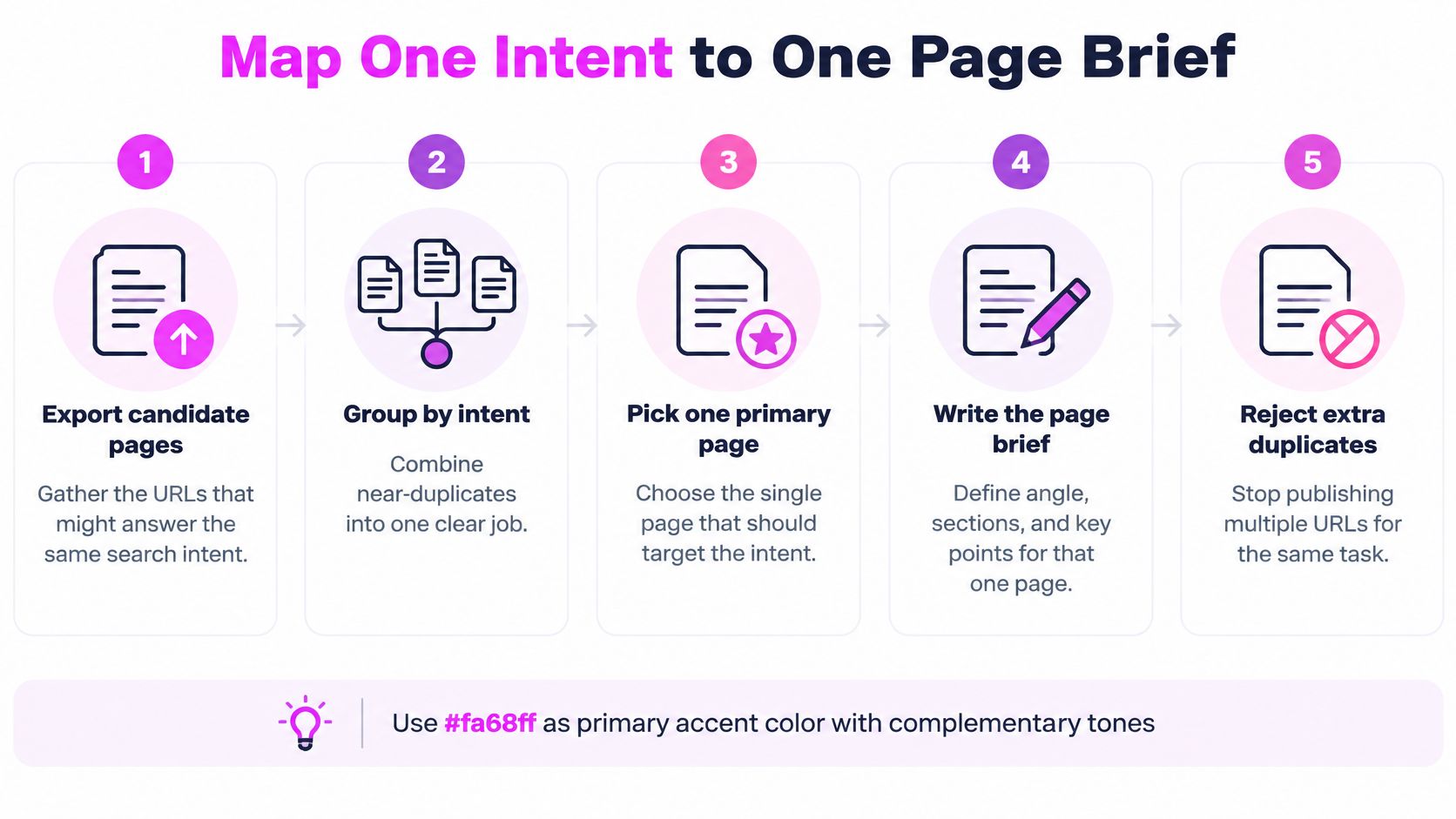
I cluster close variants only when one page can satisfy them without awkward repetition. If I have to force two different jobs into one outline, they aren't one cluster. Then I assign one canonical URL and the internal links that should support it. That decision goes in writing before production starts, not after two writers have drafted overlapping posts.
What Goes in the Brief
My brief isn't a keyword list. It's a document a writer, developer, and client reviewer can all use.
- Target intent and terms: Primary term, secondary terms, and the user job the page must complete.
- Required sections: Coverage checked against the live SERP for format, freshness, and identifiable needs.
- Internal links: Which pages link in, which pages this one supports, and with what anchor context.
- Schema type and conversion event: What markup we'll add, and what action counts as success.
- Cannibalization check: The URL Google already associates with the query, its canonical, and whether we're improving it instead of competing with it.
That last step has saved me more than once. Sometimes the right move isn't a new page at all. It's fixing the page Google already chose.
Structured Data Is a Clarity Layer
I implement JSON-LD because it's Google's recommended format, but I only add markup that accurately describes visible content with all required properties, as set out in Google's SEO starter guide guidance on structured data. Eligibility doesn't mean a rich result will appear. I say that to clients in plain language so nobody sells a star rating we can't promise.
For ecommerce, I keep price, availability, reviews, and shipping synchronized between the rendered page and the markup. My QA includes missing prices, out-of-stock items, variant URLs, and reviews that load only after a click. Those edge cases expose stale markup fast. I also follow Google's guidance that structured data can help it understand content and may support special features, without treating it as a ranking shortcut.
Schema can't compensate for thin content, wrong intent, blocked resources, or the wrong canonical. It clarifies a good page. It doesn't rescue a confused one.
After publishing, I check indexing first, then impressions, clicks, and conversions. I judge the page on qualified clicks, assisted conversions, and sustained visibility for that URL, not a position bump that disappears next week. If the page earns impressions for the wrong intent, I don't celebrate. I revisit the brief.
Run Link Outreach You Can Defend
I don't sell link counts. I know that's an awkward position when a prospect asks how many links they'll get each month, but I'd rather lose that argument early than explain a manual action later. Links, for me, are a compliance workflow first and an acquisition channel second.
Here's the workspace where I review prospects before anyone sends a pitch.
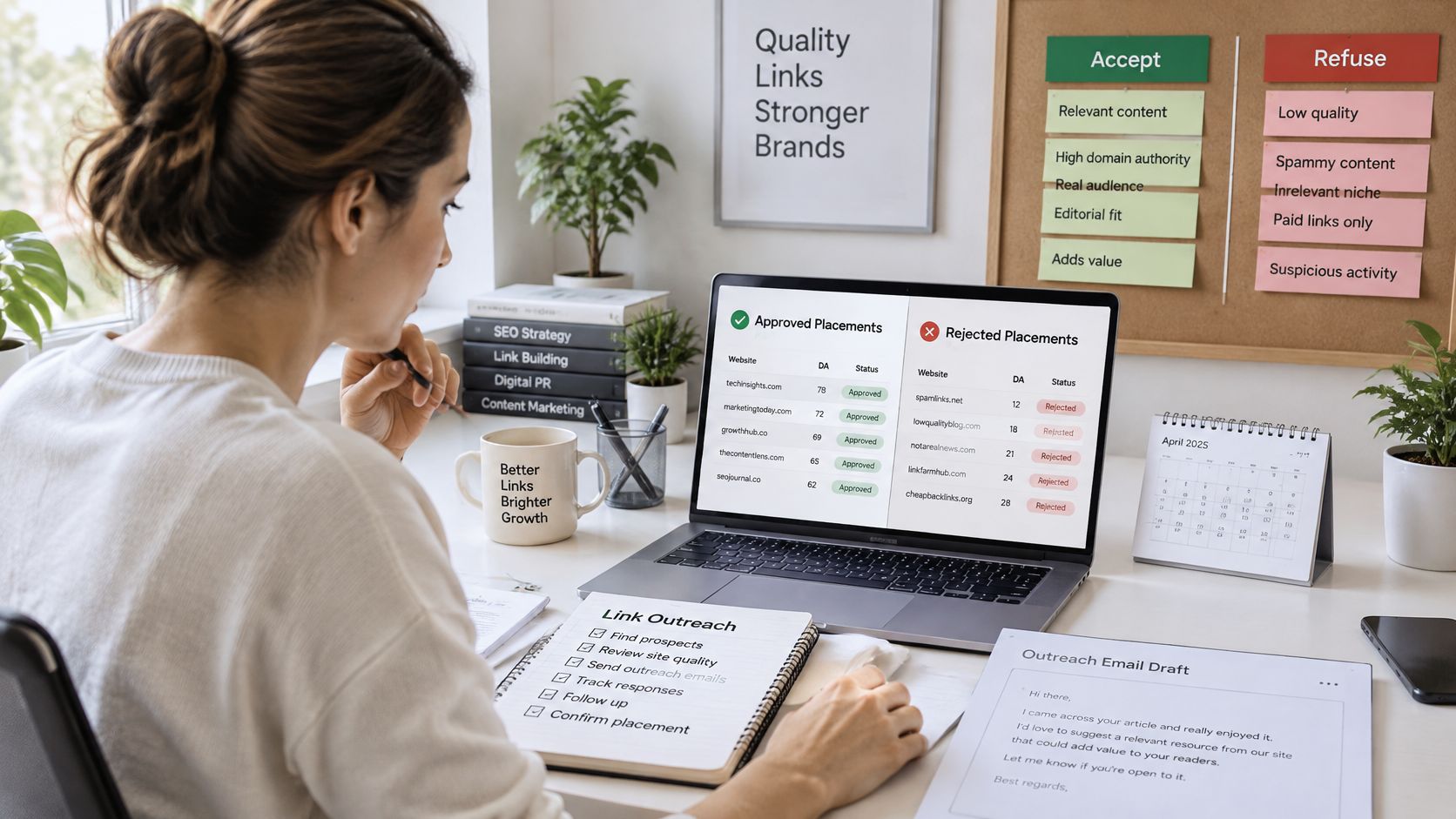
Google defines link spam as creating links primarily to manipulate rankings, and policy violations can be detected by automated systems or human review and can result in a manual action under Google's spam policies on manipulative link building. That definition changes how I brief a client. It also changes what I'm willing to approve.
What I Reject Without a Long Meeting
I reject bulk placements on unrelated sites. I reject templated guest-post networks where the topic bends to fit any anchor text. I reject any campaign whose only success metric is the number of followed links we secured.
For each prospect that survives, I write down why the publication would want the story on its own merits, whether the placement is editorially justified, and whether we're really just asking to pass a ranking signal. If I can't answer the first question, we don't pitch it. That single test removes a surprising amount of bad outreach.
The video below is useful context for how I think about outreach discipline, but the standard I apply is the audit trail described here.
The Paid Placement Edge Case
Legitimate sponsorships happen. I don't pretend they don't. I separate the commercial relationship from the editorial claim and require appropriate link treatment instead of disguising an advertisement as an organic recommendation. Clients don't always love hearing that, because they paid for visibility and want ranking value too. My job is to explain the risk clearly and document the decision.
I keep a prospect-level record for every campaign: publisher, target page, topic relevance, outreach angle, placement type, and evidence of editorial value. If a client, a new agency, or an internal reviewer asks a year later why a link exists, we can answer without digging through inboxes.
One mistake I call out directly is copying a competitor's backlink total as a strategy. A large count doesn't tell you whether those links are relevant, earned, risky, or even helping. I've reviewed competitor profiles full of placements I'd never replicate for a client I intend to keep.
I'd rather show a client fewer placements that can send referral traffic and survive scrutiny than a long list nobody can defend.
I also use unlinked brand mentions and broken-link recovery, but only as reclaim work. There has to be a reason the original publisher would add or restore the link, such as a citation that lost its attribution or a resource that moved. If the reason is only that we want the link, it belongs in the reject pile with the rest.
Choose Research Tools That Match the Work
I don't evaluate research tools by feature count. I match each retainer job to the data it needs, then check whether the workspace can connect those jobs. If it can't tie a query to a ranking URL, a link prospect, and an AI answer citation, I'll end up rebuilding the spreadsheet problem from the start of the engagement.
Keyword discovery is the obvious entry point, but volume and difficulty alone don't finish the job. I need Słowa kluczowe domeny to see what competitors already earn, Luka w słowach kluczowych to find terms worth closing, and the exact ranking URL for each term. A domain-level view hides whether Google rewards their guide, their category page, or their local landing page, and that distinction changes my brief.
| Retainer job | Data to pull | Decision it supports |
|---|---|---|
| Keyword and page planning | Volume, difficulty, exact ranking URL, clusters | Which one page we build or improve |
| Competitor review | Domain keywords, top pages, traffic share | Which gaps are worth closing first |
| Link prospecting | Referring domains, anchors, backlink gap | Which publishers we pitch or reject |
| SERP change checks | Historical results and feature presence | Whether to rewrite, redirect, or expand |
| AI answer visibility | Keywords triggering mentions and cited URLs | Which pages earn citation and which don't |
Long-tail, People Also Ask, and People Also Search suggestions help me expand a brief, but only after I've applied the one-intent rule. Without that order, question lists turn into bloated outlines that try to answer everything. Grupowanie is where I group queries into page-level topics so two URLs don't fight each other. I trust a cluster only when the live results suggest the same page type can satisfy the group.
Links and SERP History Need Their Own Checks
For links, I want referring domains, pages by links, anchors, and a backlink gap view showing domains that link to competitors but not to my client. I also use unlinked mention and broken-link findings for the reclaim work described earlier. What I don't want is a prospect list with no topic or anchor context. That pushes outreach toward volume, and we've already decided where that leads.
SERP history over about twelve months is what I check before recommending a rewrite. If intent shifted from guides to product pages, editing headings won't fix the mismatch. If volatility is high, I tell the client we need a stronger format decision, not weekly copy tweaks.
Local clients add another layer. When a retainer includes location pages, I also compare Google Business Profile audit tools so profile checks don't get improvised in a separate spreadsheet with no owner.
Where One Workspace Fits
In practice, I'd use SemDash (SemDash). It's a cloud workspace for Google and Bing research with a 6.6-billion-keyword set, a 2.7-trillion-link index, URL-level keyword mapping, clustering, AI-assisted briefs from live results, competitor traffic share and top pages, and optional placement on 300-plus news sites. I care less about the size claims than the joins between datasets. I can move from a gap term to the competitor URL, cluster it into a brief, check who links to that page, and see whether the domain is cited in AI Overviews without exporting four files and reconciling them by hand.
That doesn't make the tool the strategy. It means the tool can feed the decisions I've already defined. If a platform you use does those joins well, keep it. If it doesn't, you'll feel the friction in every handoff.
Report Outcomes and Set the Next Retainer
Rankings are stable but traffic is down. If you run retainers, you've had that call. My earlier instinct was to hunt for a technical break or a content failure. Sometimes that's right. Often now, the results page itself changed, and our report has to separate our work from shifts in click behavior.
The reporting structure I follow draws on the principles in this guide to structuring agency SEO reports around outcomes, but the interpretation has to come from the client's own query mix. Aggregate traffic won't tell the story anymore.
What the AI Overview Numbers Change
A 2025 analysis summarized findings from more than 3,100 informational queries across 42 organizations, reporting a 61% decline in organic CTR for queries with AI Overviews, from 1.76% to 0.61%, between June 2024 and September 2025, while queries without overviews also declined 41% year over year, according to reporting on that AI Overview CTR study. Pages cited in overviews received 35% more organic clicks in that study, with the researchers noting the association doesn't establish causation.
User behavior data points the same way. A 2025 Pew Research Center analysis of roughly 900 U.S. adults found users clicked a traditional result in 8% of searches with an AI Overview versus 15% without one, only 1% clicked links inside the summary, and 26% ended the session after seeing an overview versus 16% without one, as reported in coverage of the Pew AI Overview click findings.
I don't use those figures to excuse weak work. I use them to ask a better question. Was the brand represented and cited inside the answer, and did that visibility connect to later branded search, direct visits, leads, or sales? Presence alone doesn't prove impact, and I say so.
The Report I Actually Send
- SERP feature timeline: When overviews or other features appeared for priority queries, marked against our deployments.
- Query segmentation: Intent and AI Overview presence split out, with brand and non-brand kept separate.
- Position-adjusted CTR: Click performance judged against the position held, not against last year's raw traffic.
- Citation status: Which client URLs are cited, which queries cite competitors instead, and which pages changed.
- Business outcomes: Qualified leads or revenue, assisted conversions, and indexed high-value pages.
I won't call every traffic loss an SEO failure. I also won't call every citation a commercial win. Both shortcuts destroy trust, and clients can tell when we're grading our own homework.
Declining clicks can coexist with useful exposure. Optimizing only for clicks can make a client undervalue visibility that influences the next visit.
My next step with a current client is one working session, not a new deck. We annotate the last release, export non-brand queries for the money templates, mark which URLs are cited in AI Overviews, and agree on the next cycle's priority pages and the link prospects we can defend. That's SEO for clients that holds up when the results page shifts again. It's less exciting than a ranking screenshot, and it's far more honest.
If you're running a retainer and your keyword, backlink, SERP history, and AI Overview citation data still live in separate exports, SemDash (SemDash) brings them into one workspace so you can connect each query to its ranking URL, its link prospects, and its cited answer. Start with one client, map the money templates, and build your next report from evidence you can defend.