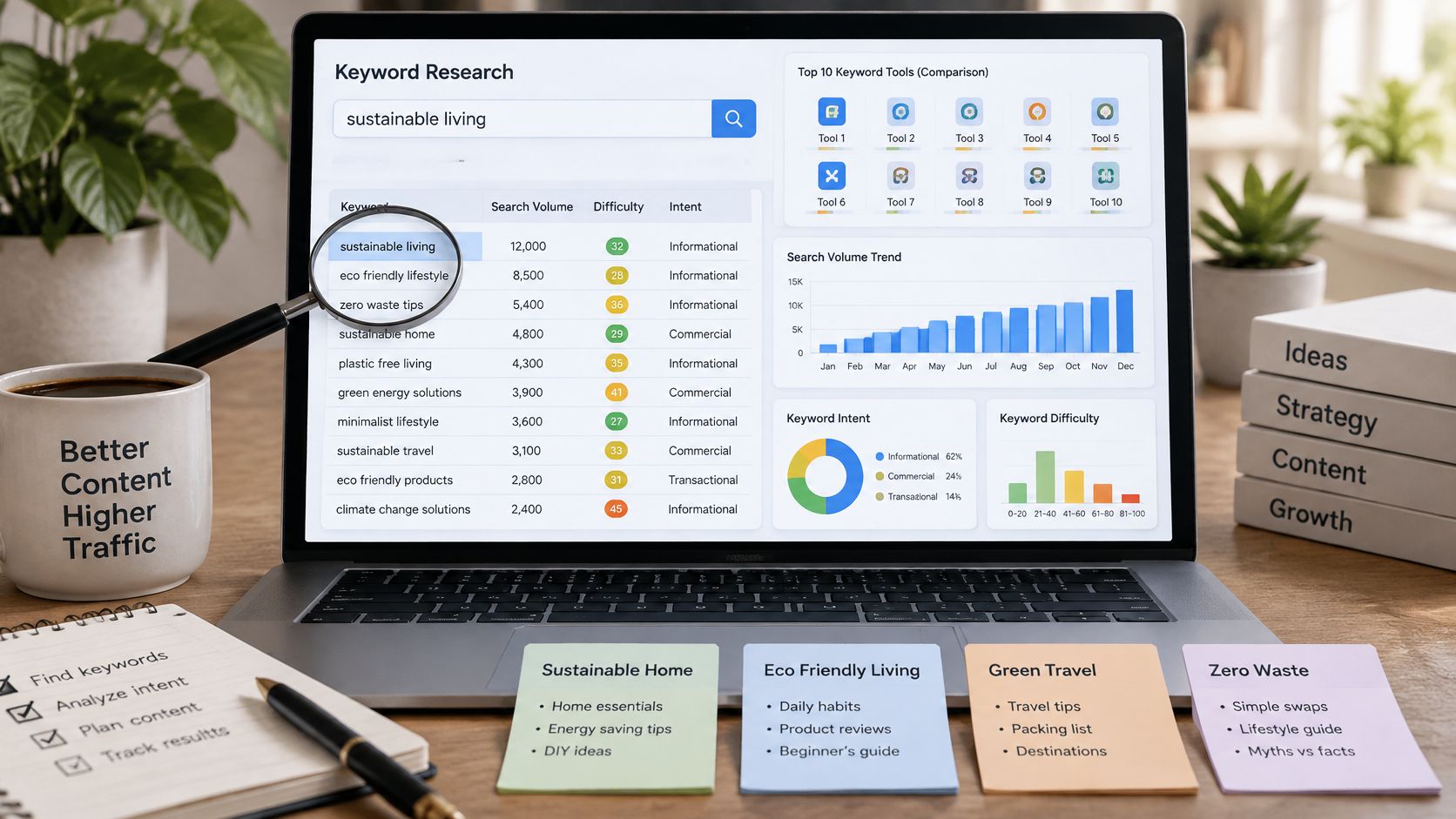
The most popular advice on hiring a search marketing agency is to compare rankings, traffic, and monthly fees. I don't start there. I start by asking how the agency will prove that its work created business value, especially when search results answer more questions before a user clicks, and whether the contract gives the team enough room to fix hard problems instead of producing easy-to-count activity.
A useful engagement connects search intent to the right page, the right auction, and an outcome the business can measure. If an agency can't explain how it will make those connections, a polished pitch deck and a longer keyword list won't fix the gap.
Spis treści
- What a Search Marketing Agency Actually Does
- Core Services Behind SEO PPC and Analytics
- How I Evaluate and Hire the Agency
- KPIs When Clicks Fall but Demand Holds
- Pricing Models That Can Fund the Work
- Use Cases Where an Agency Earns the Fee
- What to Do Before You Sign
What a Search Marketing Agency Actually Does
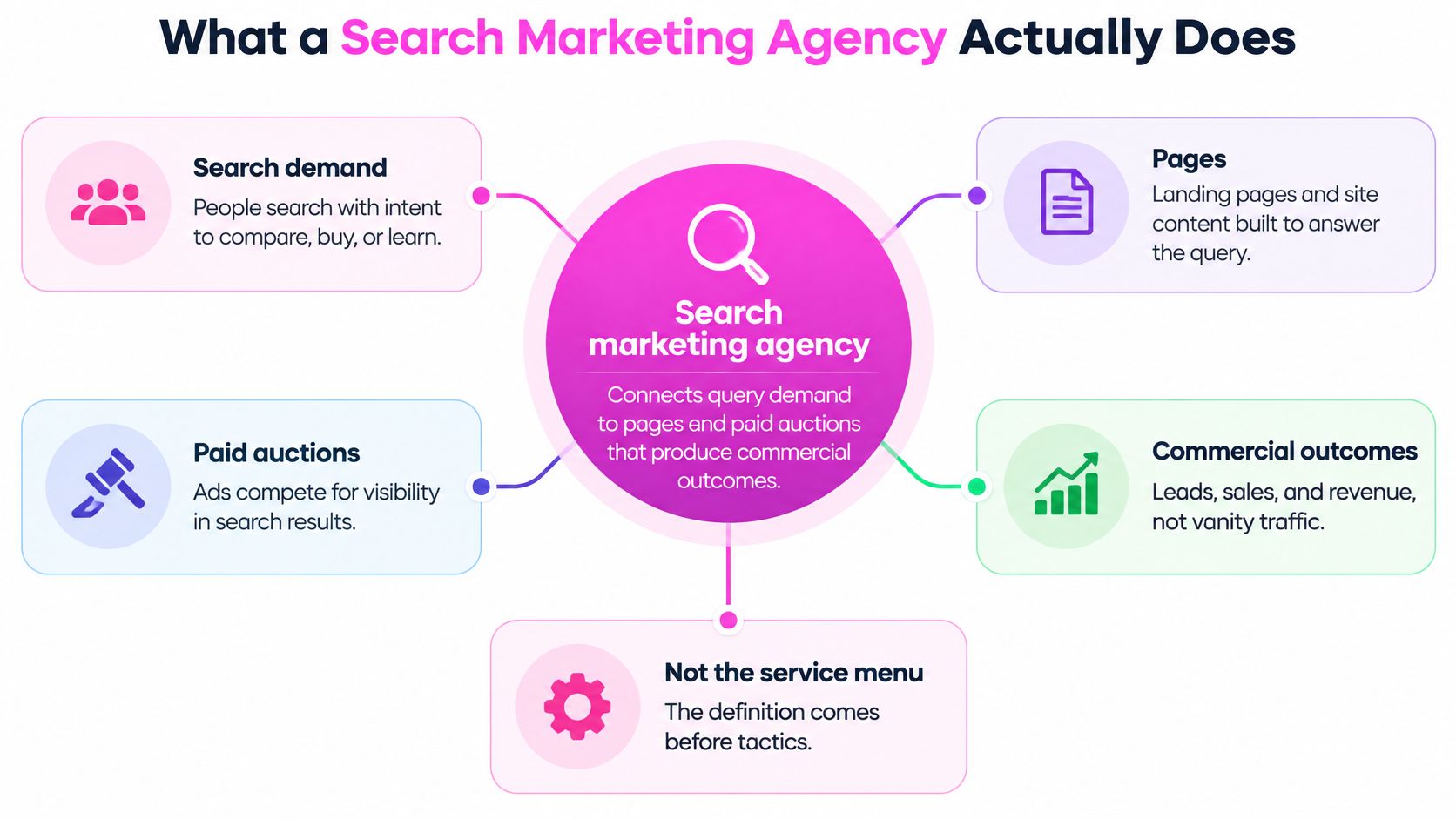
A search marketing agency isn't just a supplier of rankings and ads. I expect it to connect query demand to pages and paid auctions that produce commercial outcomes. That means discovering what potential customers search for, deciding which pages should meet that intent, and measuring whether organic and paid visibility contributes to leads, sales, or revenue.
The work breaks down when SEO, paid search, and reporting sit with separate vendors who don't share a page map or agree on what counts as a conversion. One team may optimize an informational article, another may send paid traffic to a generic landing page, and a third may report rising sessions without showing whether either route produced qualified opportunities. I'd rather have one accountable strategy for how search demand reaches the business, even if specialists execute parts of it.
Discovery is part of the job
The first task is to understand how people search, what pages the business has, and where competitors already capture attention. I map priority queries to specific ranking URLs, then compare those pages with paid landing pages and conversion paths. A keyword export that lists promising terms but ignores the pages responsible for revenue is research without a decision attached.
The second task is recurring analysis. Search demand and search results change, so the agency has to track whether pages remain relevant, whether competitors have moved into a gap, and whether paid campaigns are buying useful traffic. That includes Google and, where the audience and account warrant it, Bing. The point isn't to cover every channel mechanically. It's to follow the audience and the commercial opportunity.
A useful general explanation of how agency services fit together is Silva Marketing's guide to agency marketing for service businesses. For search specifically, I use the same basic test: can the team connect what people are looking for to the pages and campaigns that can serve them?
The economics behind the role
Search has become a major performance-marketing infrastructure, not just a visibility tactic. One commercial forecast valued the global digital marketing agency market at $7.23 billion in 2025, projected $8.27 billion in 2026 i $24.11 billion by 2034, and estimated SEO's share at about 24% in 2025. The publisher projects a 14.32% compound annual growth rate from 2026 to 2034, but this is a commercial forecast, not an official statistical series, so its scope depends on how agency revenue is defined. Reed Intelligence's digital marketing agency market estimate
Google's advertising revenue rose from $209.497 billion in 2021 to $264.590 billion in 2024, with a secondary compilation reporting $294.691 billion in 2025 based on Alphabet filings. Google Search and other advertising accounted for $198 billion in 2024 i $224.532 billion in 2025, according to the same compilation. These figures show the scale of the search advertising business, not what any particular campaign will earn. The Google advertising revenue compilation
The agency's job exists because search combines discovery, investment, and measurement. The deliverable isn't a pretty keyword spreadsheet. It's a coherent view of which opportunities matter, which pages and campaigns should address them, and how the team will assess their contribution.
Core Services Behind SEO PPC and Analytics
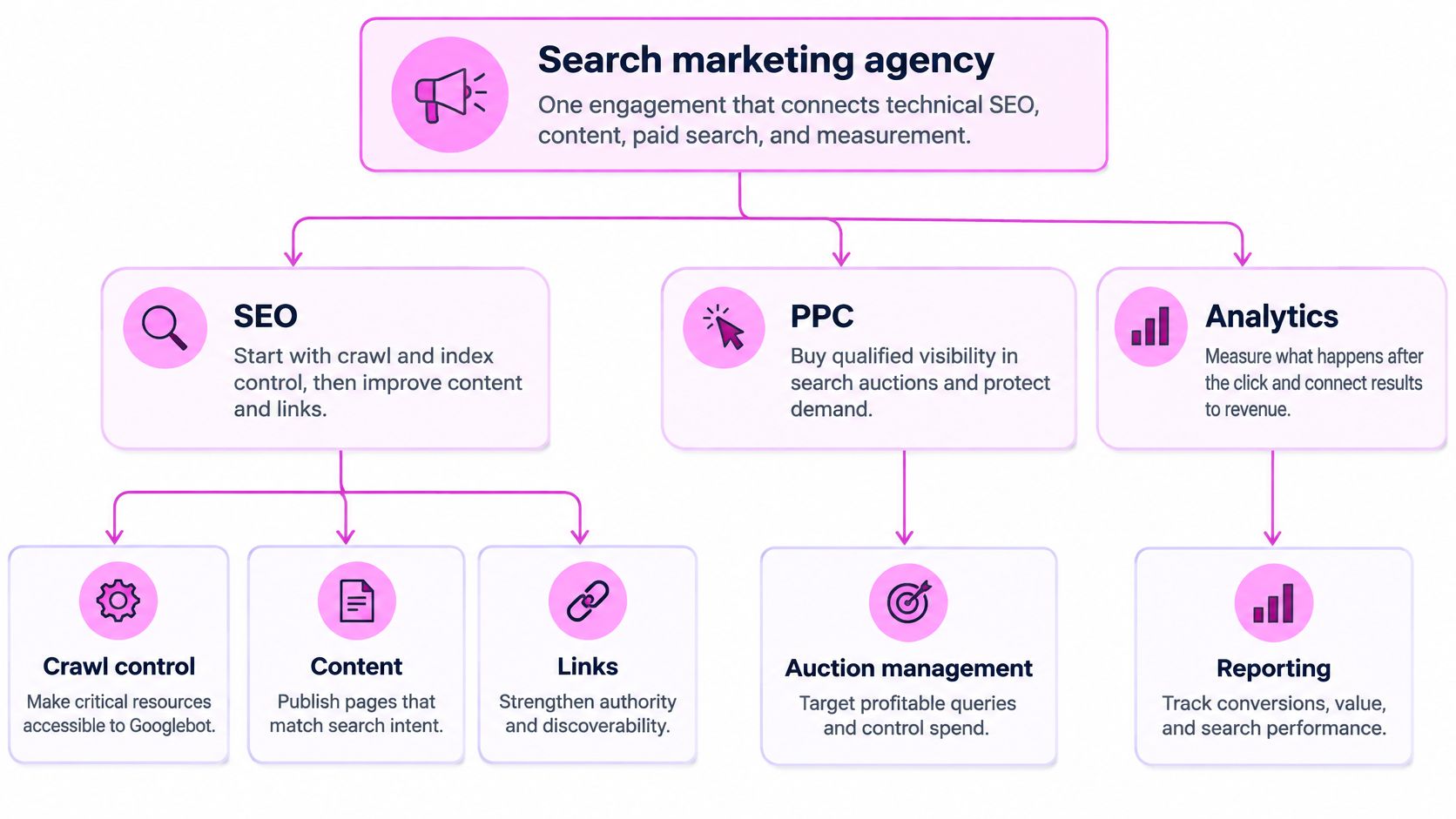
A search marketing engagement works best as one operating system: technical SEO makes priority pages accessible, content answers the intent behind a search, paid campaigns compete for relevant demand, and analytics connects activity to business results. I don't scale publishing or link acquisition before checking that search engines can discover and understand the pages those investments are supposed to support.
SEO starts with crawl and index control
I begin with a keyword-to-URL map: each priority query or topic should have a clear page intended to rank. Then I check whether the page is discoverable, crawlable, indexable, and canonicalized to the URL the business wants in search. Googlebot needs access to the same critical resources an ordinary browser can reach. Blocked JavaScript or CSS, orphan pages, redirect chains, incorrect canonicals, and weak internal links can keep good content from being discovered or interpreted properly.
A recurring crawl-to-index audit brings those checks together. I compare status codes, robots directives, canonicals, sitemap URLs, internal links, and indexed pages, then look for anomalies on URLs that matter commercially. Structured data can clarify page meaning and make a page eligible for some enhanced search displays, but it can't make an inaccessible page crawlable or guarantee special treatment. Google's SEO Starter Guide is a useful reference for the underlying discovery and technical principles.
Once access and page targeting are sound, I assess content and links. Content should answer the query better than a generic page, while link outreach should aim to earn relevant editorial references rather than manufacture ranking credit. Google defines link spam as creating links primarily to manipulate rankings. I don't sell link volume or promise that removing suspicious links will automatically restore performance. Google's spam policies
Treat page experience as a quality gate
Core Web Vitals are a template-level quality check, not a standalone ranking trick. Google's field thresholds are LCP at or below 2.5 seconds, INP below 200 milliseconds, a CLS below 0.1. These measures use real-user data and are evaluated by URL groups in Search Console, so I inspect product pages, articles, and landing pages separately rather than trusting a site-wide average. Google's Core Web Vitals guidance
I prioritize templates that combine meaningful organic impressions with weak field performance. Large images, excessive JavaScript, third-party tags, and unstable interface components can slow rendering or frustrate interaction. But a passing score doesn't guarantee high rankings: relevance, content quality, and other signals still matter. I validate technical changes against both Search Console trends and business measures such as engaged sessions and revenue per organic visit.
Paid search and analytics complete the loop
PPC connects the search query to an ad, a landing page, and a controlled budget. I review search terms and landing-page fit before changing bids or broadening targeting. An audit recommendation isn't automatically an improvement; the person proposing a change needs to understand what the account is already doing well and what the business needs from it.
Analytics closes the loop. The reporting should connect impressions and clicks to landing-page engagement, conversions, and value. For a service business, that might mean distinguishing a qualified appointment request from a low-intent form submission. Teams building appointment-setting capacity can also consider how LatHire appointment setters fit into the follow-up process, because lead generation only has commercial value if the business can respond and convert.
How I Evaluate and Hire the Agency
Hiring a search marketing agency is a proof problem. Almost any team can produce a polished deck; far fewer can show the analysis that sits behind a decision. So I evaluate the working method before I review the pitch, and I test whether the proposed scope can fund real technical and content work rather than a monthly reporting routine.
Ask for evidence before the proposal
Four questions come before any scope discussion:
- Which pages make money? The agency should name the pages or journeys it treats as commercially important and explain how it would validate that view.
- Who owns the data and content? Confirm access, ownership, and what happens to work products if the engagement ends.
- What counts as a strategic deliverable? A dashboard refresh is not a prioritized technical plan, a page map, or a recommendation with a named owner.
- How do pauses and missed milestones work? Rollovers, pauses, cancellations, and delays belong in the contract, not in a follow-up email.
Then I sample the work. I ask for a crawl-to-index audit, a keyword-to-URL map, a paid-search query review, and a report that includes business measures. The samples don't need to expose another client's confidential data. They do need to show the agency can move from observation to a specific action.
I add one more test now that I didn't five years ago: how would the team prove value in a quarter where organic clicks fall because AI answers absorb the query, but qualified demand still reaches the business? An agency that only reports traffic will call that quarter a failure even when the work held up. I also ask where the retainer's hours go. If most of the fee funds reporting activity, there's no budget left for the technical fixes and content production that change results.
A proposal built on competitive discovery should show which competitor pages attract relevant demand, where keyword coverage differs, and whether link opportunities have editorial relevance. Guesswork produces a broad target list with no explanation of which page should compete or why the opportunity is worth the spend.
Judge the method and the workspace
Tooling earns its cost when it improves a decision, not when a big database becomes a sales prop. For competitor research and tracking, SemDash combines keyword and backlink analysis, SERP history, page-level ranking URL mapping, content planning, and AI Overviews citation tracking in one workspace. Its listed capabilities include a 6.6 billion-keyword database with volume, traffic estimates, and Keyword Difficulty, plus a indeksem 2,7 biliona linków with Referring Domains, Anchors, and Backlink Gap reports.
I judge those features by the questions they answer. Can the agency identify which competitor URL ranks for a relevant query? Can it find gaps without assigning the same intent to several pages? Can it inspect result history instead of treating a current ranking as permanent? SERP Checker lists historię 12 miesięcy, and AI Overviews citation tracking can surface the exact cited URL rather than a domain-level mention. The interface is available in English, German, Polish, and Spanish, and an optional featured-on-news-sites offer is listed. I'd still assess link quality independently; a placement offer isn't proof of earned authority.
A useful first test is a free SEO consultation or an equivalent discovery call where the agency asks for context before prescribing changes. My scorecard stays simple: sound diagnosis, clear priorities, named deliverables, appropriate tools, and a willingness to state what it doesn't know.
KPIs When Clicks Fall but Demand Holds
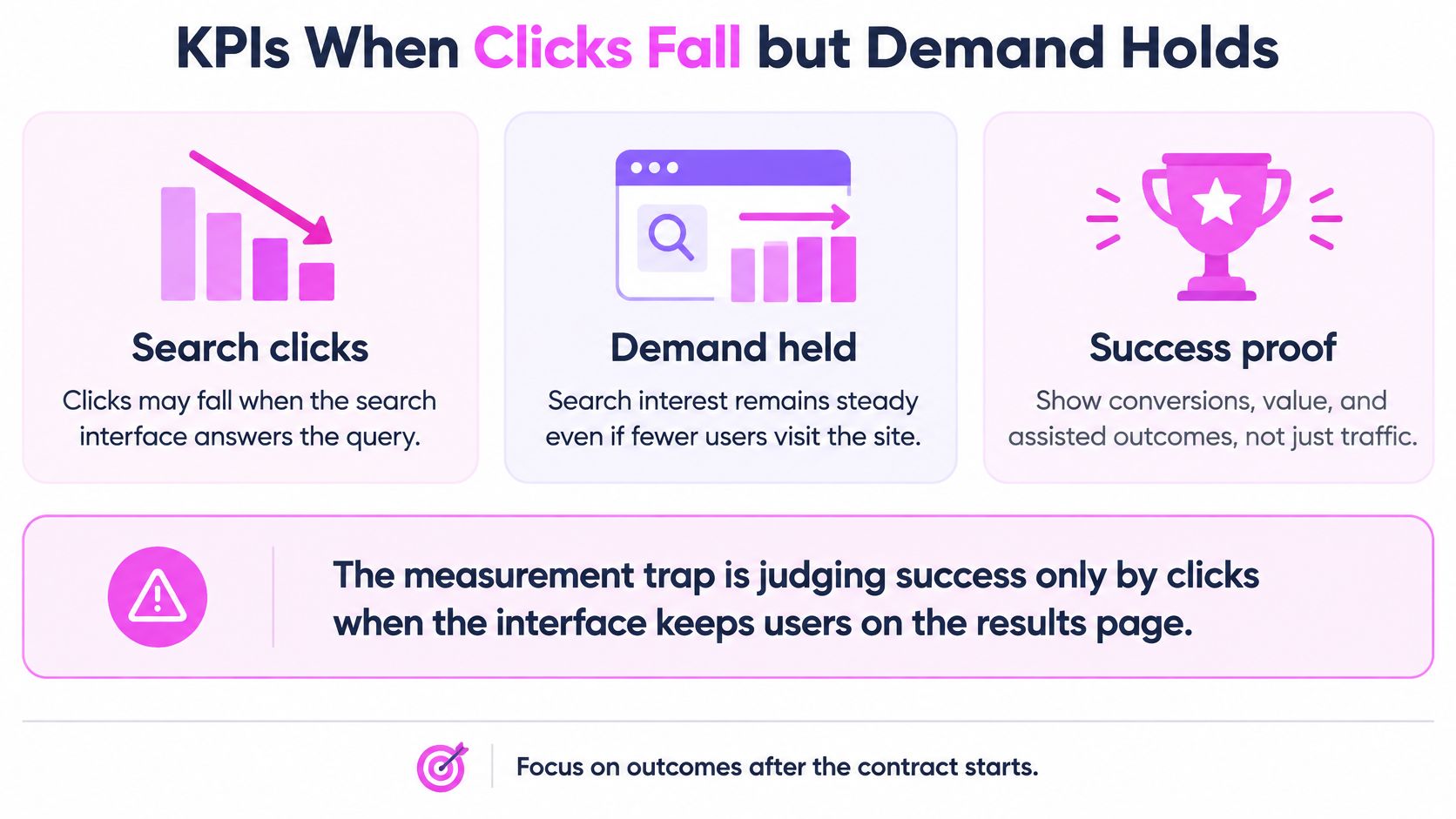
A declining traffic line is weak evidence on its own. When the search interface answers a question before anyone visits a site, rankings, sessions, and last-click conversions miss part of what the work produced. I still review those measures, but I don't let a drop in visits settle whether the agency earned its fee. I want to know what changed in discovery, whether qualified demand still reaches the business, and whether the work shows up in assisted outcomes rather than only in click totals.
Read the interface shift carefully
Google reported in May 2025 that AI Overviews had reached more than 1.5 billion monthly users across over 200 countries and territories. Google also reported that usage of Google increased by more than 10% for AI Overview-triggering queries in the United States and India. Google's account of AI Overviews and search usage
Higher usage does not mean higher click-through for the sites feeding those answers. Independent reporting on Pew Research data found that users clicked a traditional result far less often in sessions where an AI summary appeared than in sessions without one. That pattern matches what I see in client analytics on informational queries.
The measurement trap runs in both directions. One mistake is reading fewer organic visits as proof that demand disappeared. The other is claiming AI visibility as a win without showing any effect on the business. I look at several signals together and separate informational queries, where a direct answer may satisfy the search, from commercial queries, where a citation can still contribute to consideration.
Build a reporting view that follows the evidence
My reporting agenda pairs conventional visibility with signals that help explain value:
- Qualified organic traffic and rankings: Check whether the intended pages are visible for the right topics, then assess whether visits are relevant rather than treating all sessions alike.
- Exact URLs cited in AI answers: Record the cited page, not just a domain mention. A supporting article may be cited while the page designed to convert remains absent.
- Branded-search demand: Track whether brand interest changes alongside the content and discovery work, while avoiding unsupported claims of direct causation.
- Assisted conversions and revenue per visit: Review whether organic discovery appears earlier in journeys that later convert and whether visits carry commercial value.
- Intent-level visibility: Separate informational searches from commercial and comparative searches, so shifts in click behavior don't blur unlike opportunities.
I also check the page behind the metric. If clicks fall on an informational article while commercial pages continue to attract qualified visits, publishing more articles may be the wrong response. Consolidating overlapping pages, improving a commercially useful resource, or correcting a page that AI systems cite is more defensible work.
AI Overviews and AI Mode don't create a separate technical shortcut. Google says these features rely on pages that meet the normal requirements for appearing in Search with a snippet. I first verify crawlability, indexability, and whether the page clearly answers the underlying query. Special schema is not a guarantee of inclusion. Google's guidance on AI features in Search
A reporting format should make these measures visible without burying the client in charts. For a practical model, compare the approach in this guide to SEO reporting for agencies, and insist that every reported change leads to a decision, a test, or a clear explanation of what remains unknown.
Pricing Models That Can Fund the Work
A low monthly fee can be expensive if it only funds recurring reports while the work that could address the underlying problem stays out of scope. I want a price tied to named deliverables, realistic capacity, and clear terms for pauses or exit. The question isn't whether a retainer is good by default or a fixed-scope project automatically safer. It's whether the model fits the work the account needs.
A 2025 survey of 273 U.S. marketing-agency owners, executives, and senior leaders wykazała, że 97% were raising prices, 63% experienced unpredictable cash flow, a 97% dealt with late client payments. Subscription or package billing and hourly billing each represented 28% of primary pricing models in the survey. These figures describe the surveyed agencies, not every search marketing firm. They do underline why I ask how the contract supports sustained work rather than assuming the lowest quote is the best value. The 2025 survey on agency pricing and cash flow
| Model | Najlepsze dopasowanie | Cash-flow risk | Exit protection |
|---|---|---|---|
| Fixed-scope | A defined audit, research task, or implementation with a clear endpoint | The client pays for an agreed scope; additions require a new agreement | Confirm what counts as complete and how changes are approved |
| Retainer | Ongoing work that needs priorities to shift as evidence changes | Recurring revenue can support continuity, but vague scope can turn into activity reporting | Name monthly deliverables, notice terms, and what happens to unfinished work |
| Subscription or package | Repeatable services with clearly bounded inclusions | Package limits can leave complex technical or content work unfunded | Specify included work, exclusions, rollover rules, and cancellation terms |
| Hourly | Advisory or implementation work where the effort is difficult to predict | Costs can rise without a clear outcome unless hours and approvals are controlled | Agree on reporting, caps or approvals, and ownership of work produced |
| Performance-linked | A clearly measurable outcome with reliable data and shared control | Payment can become contentious when attribution or external factors are unclear | Define the measurement method, data access, exclusions, and termination process |
Price the work, not the appearance of activity
For each quote, I ask what happens every month and what sits outside the fee. Are tools, digital PR, content publishing, and link reclamation included, or priced separately? Who owns the analytics accounts, research, and published content? What happens if a planned technical fix is blocked by the client's development queue, or if a milestone is missed?
A financially pressured agency may gravitate toward work that is easy to report, such as routine updates or a list of completed outreach attempts. Harder work may involve technical remediation, consolidating overlapping content, or recovering authority through relevant editorial outreach. Those tasks can take investigation and coordination, so I want the contract to make space for them when the diagnosis supports doing them.
For AI visibility, I'd also separate monitoring from claims of guaranteed inclusion. A useful comparison of what agencies might sell and measure appears in OGTool's AI visibility approach. Whatever the offer, ask which work is included, what evidence will be reported, and what the agency will do if the expected signal doesn't appear.
I reject a quote that can't name its deliverables. A fair scope should tell me what the team will do, how decisions will be made, what the client must provide, and how both sides can pause or exit without arguing over work that was never defined.
Use Cases Where an Agency Earns the Fee
I'd take an engagement when the business has a clear search problem, access to implement changes, and enough evidence to judge whether the work is helping. The details vary by account, but the decision always depends on what I can test and what result would make me change course.

A JavaScript-heavy ecommerce or SaaS site
Suppose product or solution templates earn search impressions but have field-performance problems and gaps between submitted URLs and pages that are indexed. I'd begin by sampling the templates, tracing rendering and internal links, and finding out whether the pages expose their main content to crawlers. Then I'd work with the client's developers on a prioritized fix list and establish a baseline for engagement and revenue per organic visit.
The fee is justified if the team can get changes shipped and assess whether priority templates improve. I'd pause or rescope if the client won't provide development access or if the proposed work repeatedly misses the same business-critical templates without a credible path to implementation. A mistake I've seen waste a retainer is commissioning new content before anyone checks whether search engines can reliably find and render the existing money pages.
A multi-market brand with unfocused outreach
Here, the problem is not a shortage of outreach messages. It's that the team doesn't know which competitor pages attract relevant links, whether those referring sites fit the brand, or which market and page should be prioritized. I'd map keyword and backlink gaps by market, inspect the destination pages and anchor context, then redirect outreach toward useful resources that publishers might genuinely cite.
I'd stop or change the campaign if the proposed prospects don't have a sensible audience fit or if the only claimed deliverable is a growing link count. Buying exact-match anchors in bulk is a poor shortcut: a report can look busy while the campaign creates compliance risk instead of durable audience value.
A content site losing informational clicks
If informational pages lose clicks while commercial pages still convert, I wouldn't automatically order more blog posts. I'd look for overlapping pages, check which URLs earn citations, and determine whether the site has a clear, useful answer for the queries that still matter to the business. The first phase would establish which pages to retain, combine, improve, or redirect, then track commercial outcomes alongside visibility.
I'd stop expanding the content plan if new pages repeat the same intent without a reason to exist. The common waste is confusing publishing volume with coverage. A smaller set of strong pages can be more useful than a larger set that divides relevance and makes results harder to interpret.
The work I'd decline
I wouldn't take a client who demands guaranteed rankings or a package defined by link count. Those promises sidestep the core decisions: which pages deserve investment, what the agency can control, and whether the proposed activity is likely to help. If the buyer won't agree to a credible measurement plan or give the team a way to implement necessary work, the fee is unlikely to produce a useful engagement.
What to Do Before You Sign
Signing a search marketing retainer is a proof problem, and most buyers run the proof after the contract instead of before it. I run a short sequence first. It forces both sides to agree on what matters before anyone debates activity levels or price.
- Name the money pages. Identify the pages and journeys that contribute to qualified leads, sales, or another business outcome.
- Demand a keyword-to-URL map. Check that priority topics have an intended ranking page rather than competing, overlapping candidates.
- Confirm crawl and index access. Ask how the agency will verify that important pages can be discovered and interpreted.
- Agree on a KPI set that survives click declines. Combine visibility, qualified traffic, cited URLs where relevant, assisted outcomes, and commercial value.
- Compare pricing only after scope is clear. Read the deliverables, exclusions, ownership terms, pause provisions, and exit protections together. A cheaper retainer that cannot fund technical fixes or serious content work will buy you dashboards, not progress.
Bad hires taught me to refuse retainers built around activity alone, require template-level technical work before scaling link volume, and keep one reference source for reported metrics. A small set of agreed definitions and a decision log beats several dashboards that disagree about what happened.
One more step pays for itself. Before your first sales call, pick one competitor domain and one money page. A consolidated research workspace such as SemDash, which brings keyword, backlink, and SERP research together, lets you pull the competitor's ranking URLs, keyword gaps, and link gaps in advance. Then ask each prospective agency to explain what it would prioritize and why. You walk in with evidence to judge the proposal against, instead of waiting for someone to sell you a strategy.