%20(1)-B86R08ZzwhPzS6UZbG3mSxRWPCwGwn.png)


PR Newswire Alternatives for SEO Agencies in 2026

W skrócie:
- Semdash is the leading PR Newswire alternative for SEO agencies because it combines press release distribution with backlink tracking and keyword analysis in one workflow. It provides measurable SEO results, client-ready reports, and a flexible credit-based pricing model, unlike traditional wires. Agencies shifting to Semdash observe stronger backlinks and improved search visibility, enhancing client retention through outcome-focused reporting.
For SEO-focused agencies, Semdash is the strongest PR Newswire alternative because it consolidates press release distribution, backlink tracking, and keyword research into a single workflow rather than forcing you to stitch together three separate subscriptions.
- Integrated SEO value: Semdash ties press placements directly to backlink discovery and keyword movement, so you can show clients measurable SERP impact, not just an outlet list.
- Client-ready reporting: Exportable reports map placement data to link status and search visibility, which is exactly what agency deliverables require.
- Lower cost structure: A credit-based model means you pay for what you distribute, without the per-release premiums and add-on fees that legacy wires charge.
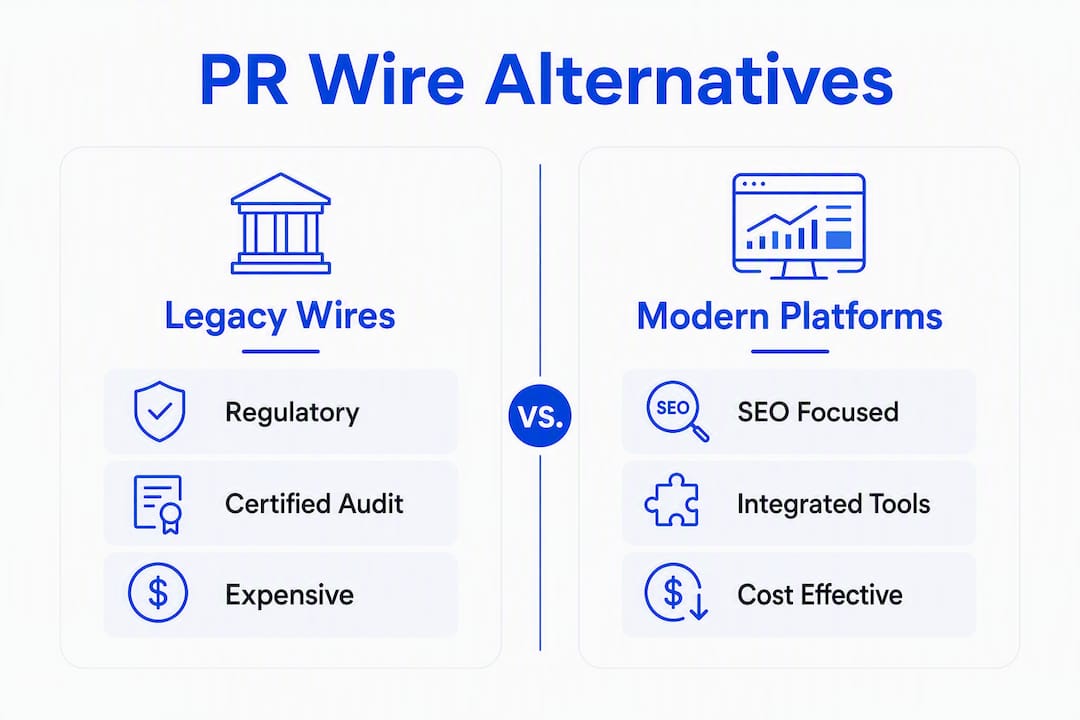
One caveat: if your client is a public company that needs SEC-grade regulatory disclosure, a legacy wire with a certified audit trail remains a compliance requirement, not a preference.
What kinds of PR Newswire alternatives exist?
The PR distribution market has bifurcated: enterprises keep regulatory-grade wires for compliance; growth-stage brands and agencies increasingly prefer platforms that produce measurable SEO outcomes. Before you pick a vendor, you need to know which category actually fits your objective.
- SEC/regulatory wires (e.g., GlobeNewswire, Business Wire): Required for public-company filings. Provide certified audit trails. Not necessary for most agency clients.
- Budget syndication wires: Low fixed cost, wide endpoint coverage. Many syndicate to the same destinations as major wires (Yahoo Finance, MarketWatch, Benzinga), so the SEO reach gap is narrower than price suggests. The gap widens at journalist inbox pickup.
- Human-curated distribution services: Editorial review plus targeted outreach. Better for quality backlink acquisition than pure syndication, but at a mid-range price. Wire-only distribution can create duplicate-content issues that dilute SEO value.
- Newsroom/PRM platforms: Ongoing media relationship management. Best for brands running sustained outreach campaigns rather than one-off releases.
- Integrated SEO + PR platforms: Combine keyword research, distribution, and backlink monitoring. Best for agencies that need to tie every release to a measurable SEO outcome.
| Category | Najlepsze dla | SEO/backlink value | Model cenowy |
|---|---|---|---|
| SEC/regulatory wire | Public-company filings | Low (compliance focus) | Per-release + add-ons |
| Budget syndication wire | Low-cost volume distribution | Moderate (endpoint overlap) | Subscription or low fixed fee |
| Human-curated service | Editorial pickup, quality links | High (curated outreach) | Mid-range per-release |
| Newsroom/PRM platform | Ongoing journalist relationships | Umiarkowany | Monthly SaaS |
| Integrated SEO + PR tool | Agency SEO workflows, backlinks | High (keyword-to-placement) | Credits or tiered SaaS |
How do you evaluate PR distribution alternatives?
Six criteria matter most for agency workflows. Work through them in order before signing any contract.
- Workflow and reporting fit. Ask vendors: can you export placement data with link status and domain authority in a client-ready format? Agencies now treat reporting clarity as a primary selection factor, not a nice extra.
- Backlink quality. Syndication volume is not the same as backlink value. Ask whether placements produce dofollow links from indexed, authoritative domains. Wire-only distribution often yields nofollow or duplicate-content pages that carry minimal link equity.
- Distribution endpoints. Confirm which outlets actually index your release vs. which ones just republish a feed. A list of 500 “outlets” means little if 450 are low-authority aggregators.
- Pricing model and cost drivers. Costs vary widely: legacy wires charge per release with add-ons for word count, geography, and multimedia; budget wires offer subscriptions or flat fees; integrated platforms use monthly SaaS pricing or credits. Calculate your per-release cost at realistic volume before comparing.
- Compliance and audit trail. If any client is publicly traded, confirm the vendor provides an SEC-grade distribution record. Most SMB-focused alternatives do not.
- Time to placement and SLAs. Standard turnaround on most platforms runs 24–48 hours; some offer same-day. For campaign-timed releases tied to product launches or earnings, confirm the SLA in writing.
Wskazówka Pro: If your agency needs to monitor competitor press releases as structured data rather than send them, scraping public feeds via tools like Apify is faster and cheaper than paying for a read-side API from a legacy wire.
Why Semdash works for SEO-focused agencies
Semdash addresses the core problem agencies face: press distribution and SEO measurement live in separate tools, which means extra reconciliation work and weaker client reports. Semdash consolidates keyword research, backlink tracking, content gap analysis, and press release distribution into one interface, removing that gap entirely.
Key capabilities that matter for agency workflows:
- Keyword-to-release alignment: Map target keywords to each release before distribution, so every placement reinforces your existing SERP strategy.
- Backlink discovery and monitoring: Track which news-site placements produce live, indexed backlinks and monitor their status over time.
- Exportable client reports: Pull placement data, link status, and keyword movement into reports you can hand directly to clients.
- Semantic clustering and AI Overview monitoring: Widok Narzędzie do sprawdzania AI Overview tracks whether your content surfaces in AI-generated search results, a metric that legacy wires cannot touch.
- Credit-based pricing: Pay per distribution run rather than committing to a high annual contract. This suits agencies managing multiple clients at different activity levels.
Pricing follows a tiered, credit-based model where distribution runs are purchased separately from the core SEO subscription. The per-release cost drops as volume increases, which rewards agencies running regular campaigns across multiple clients.
The most valuable metric for agencies in 2026 is client-facing SEO impact (backlink authority + keyword movement) rather than raw syndication count. Legacy wires report outlet lists; Semdash reports search outcomes.
One boundary to keep in mind: if a client requires SEC-grade regulatory disclosure, Semdash’s press distribution is not a substitute for a certified wire. Use it for SEO-driven campaigns and keep a regulatory wire on standby for compliance filings.

How to switch from PR Newswire in 30–90 days
A clean migration takes three phases. The goal is zero data loss and no gap in client reporting.
Days 1–30: Setup and audit
- Export all historical release data and placement reports from PR Newswire before canceling.
- Review your current contract for termination clauses and notice periods. Many legacy wire contracts auto-renew; missing the cancellation window costs you another billing cycle.
- Create your Semdash account and connect your target domains.
- Uruchom keyword research audit to map existing release topics to current keyword targets.
- Configure backlink monitoring for each client domain so you have a pre-switch baseline.
Days 31–60: Pilot and calibrate
- Run one pilot release through Semdash for a lower-stakes client campaign.
- Compare placement quality, backlink acquisition, and reporting output against your PR Newswire baseline.
- Update your client reporting templates to reflect the new data fields.
- Brief clients on the change: frame it around improved SEO visibility reporting, not just cost savings.
Days 61–90: Full migration
- Migrate remaining active campaigns to Semdash.
- Archive historical PR Newswire placement data in your own records (do not rely on the vendor to retain it).
- Confirm that all backlink monitoring alerts are live and that automated link recovery is configured.
| Phase | Milestone | Owner |
|---|---|---|
| Days 1–30 | Data export, contract review, account setup, keyword audit | Agencja |
| Days 31–60 | Pilot release, reporting template update, client briefing | Agency + Semdash support |
| Days 61–90 | Full campaign migration, archive historical data, monitoring live | Agencja |
Wskazówka Pro: Run your pilot release on a client with a flexible timeline. If the placement report reveals gaps in endpoint coverage for a specific niche, you have room to adjust before migrating high-priority accounts.
What agencies actually gained by switching
Agencies that have moved away from legacy wire services toward integrated SEO and PR platforms consistently report the same pattern: the outlet count goes down slightly, but the measurable SEO outcomes go up. The reason is straightforward. Wire syndication spreads a release across hundreds of endpoints, many of which are low-authority aggregators that contribute little link equity. Targeted distribution to indexed, authoritative news sites produces fewer placements but stronger backlinks.
The shift also changes how agencies present results to clients. Instead of delivering a PDF listing 300 outlet names, they can show keyword ranking movement, new referring domains, and domain authority changes tied directly to specific release dates. That kind of reporting builds client retention in a way that an outlet list never did.
Human-curated distribution services sit between budget wires and enterprise solutions in both price and editorial support, and agencies that have tested them report higher journalist engagement than pure syndication. The tradeoff is turnaround time: curated outreach takes longer than automated wire distribution, which matters for time-sensitive campaigns.
The agencies seeing the best results combine targeted placement with integrated SEO platform automation to close the loop between distribution and search performance tracking, rather than treating PR and SEO as separate workstreams.
Kluczowe wnioski
The single most important decision when choosing a PR Newswire alternative is whether your goal is regulatory compliance or measurable SEO impact, because those two objectives require fundamentally different tools.
| Punkt | Szczegóły |
|---|---|
| Match tool to goal | SEC/regulatory filings need a certified wire; SEO backlink campaigns need an integrated platform. |
| Backlink quality beats volume | Curated placements on authoritative, indexed domains outperform mass syndication for link equity. |
| Reporting is a selection criterion | Choose a vendor whose exports show link status and keyword movement, not just outlet names. |
| Migration takes 30–90 days | Export historical data first, run a pilot release, then migrate fully with a baseline already set. |
| Semdash for agency workflows | Semdash combines keyword research, press distribution, and backlink monitoring in one interface for measurable SEO outcomes. |
Why workflow fit beats outlet count in 2026
The conventional wisdom in PR distribution has always been: more outlets equals more reach equals better results. That logic made sense when press releases were primarily a media relations tool. It holds much less water when the primary objective is SEO backlink acquisition and client-facing search visibility reporting.
The 2026 market split between enterprises keeping regulatory wires and growth agencies moving to integrated platforms is not just a pricing story. It reflects a genuine shift in what agencies are accountable for. Clients no longer accept “we got you 400 placements” as a deliverable. They want to see domain authority movement, new referring domains, and keyword ranking changes. That requires a tool built around SEO measurement, not just distribution logistics.
The agencies that will win the long game are the ones measuring backlink quality and search visibility improvement per release, not syndication breadth. An outlet list is an input. A ranking change is an outcome.
Semdash gives agencies an integrated SEO + PR workflow
If you’re running press distribution as part of an SEO strategy, managing it through a legacy wire and a separate SEO platform means double the reconciliation work and half the reporting clarity. Semdash closes that gap: keyword research, press release distribution for news site backlinks, and backlink profile analysis all live in one interface, with exportable reports your clients can actually read.

In your first 7–14 days with Semdash, you would connect your client domains, run a keyword-to-release audit to align upcoming campaigns with target SERPs, and configure backlink monitoring so every placement is tracked from day one. The credit-based model means no long-term contract commitment before you’ve validated the workflow. Start with bezpłatnych narzędzi Semdash to test backlink and keyword features, or go straight to the early-bird pricing if you’re ready to run your first campaign.
Sources and further reading
- The 10 Best PR Newswire Competitors & Alternatives (in 2026) — category-level guidance on matching alternative type to business goal; covers duplicate-content risks and backlink quality tradeoffs.
- 7 PR Newswire Alternatives Compared (2026) — The Next Gen Nexus — market bifurcation analysis, syndication endpoint overlap data, and reporting criteria for agencies.
- 7 Best PR Newswire Alternatives & Competitors in 2026 — MentionAgent — pricing model breakdowns across legacy, budget, and SaaS distribution options.
- Seven PR Newswire Alternative Services for Startups, Agencies, and Growing Brands — human-curated distribution services and their editorial pickup advantages.
- Top PR Newswire Alternatives, Competitors — CB Insights — competitive landscape overview including enterprise-tier alternatives.
For agency-specific case studies or a walkthrough of Semdash’s reporting exports, contact the Semdash team directly via semdash.com.
FAQ
What is the best PR Newswire alternative for SEO agencies?
Semdash is the strongest option for SEO-focused agencies because it combines press release distribution with keyword research and backlink tracking in one platform, producing client-ready SEO impact reports rather than just outlet lists.
Do cheaper press release services reach the same outlets as PR Newswire?
Many budget wires syndicate to the same major endpoints (Yahoo Finance, MarketWatch, Benzinga) as legacy wires, so the SEO reach gap is narrower than pricing implies. The real difference shows up in journalist inbox pickup and editorial engagement.
When do you still need a legacy wire like PR Newswire?
Public companies that require SEC-grade regulatory disclosure and a certified audit trail must use a legacy wire. For most agency clients focused on SEO backlinks and brand visibility, a legacy wire is not necessary.
How long does it take to switch from PR Newswire to a new platform?
A structured migration runs 30–90 days: data export and account setup in the first 30 days, a pilot release and reporting calibration in days 31–60, and full campaign migration by day 90.
How do you measure the SEO impact of a press release campaign?
Track new referring domains, backlink authority scores, and keyword ranking movement tied to specific release dates. Semdash’s backlink research tool monitors placement-driven links over time, giving you the before-and-after data clients expect.