
Most advice on how to track brand mentions in AI search starts with the wrong instruction. I'm told to pick a tool, type in my brand name, and watch a visibility score go up or down. I've stopped doing that, because that score usually blends two different outcomes into one number and hides the only gap that tells me what to fix.
I track whether an answer names my brand and whether it cites a page as two separate events. I can be recommended in the text while a competitor, a review site, or an old forum post supplies the evidence. I can also be cited as a source while the answer never recommends me at all. If I merge those, I end up celebrating mentions I can't influence and ignoring citations I can.
What follows is the panel system I use. It's boring by design. Same prompts, same fields, same day each month, so that when something moves I can tell whether the answer changed or I changed the measuring stick.
Spis treści
- Build a Prompt Panel Before You Measure Anything
- Log Mentions and Citations as Separate Fields
- Choose Your Tracking Method Before the First Run
- Run the Panel Every Month, Starting This Week
- Attribute Each Citation to a Source and Page
- Reading Trends Without Fooling Yourself
- Set Alerts and Fix What the Panel Reveals
Build a Prompt Panel Before You Measure Anything
I build the panel before I look at a single answer, because every rate I calculate later is only as honest as the prompts underneath it. I aim for 50 to 100 prompts taken from customer language, not from my keyword list, and I pull that language from sales calls, support tickets, and the Ludzie też pytają questions in my category.
Here's the default split I start from for a 75-prompt baseline.
| Cluster | Example prompt | Prompts (of 75) | What it reveals |
|---|---|---|---|
| Category discovery | best CRM for small law firms | 20 | Whether you appear before a buyer knows your name |
| Comparison | Tool A vs Tool B for remote teams | 15 | Which side of a head-to-head you are placed on |
| Alternatywy | alternatives to [competitor name] | 10 | Whether you surface when a competitor is rejected |
| Problem-solving | how do I stop client feedback getting lost | 15 | Whether you are named as a fix for a pain point |
| Branded (kept separate) | [your brand] pricing and reviews | 10 | Accuracy of what AI says about you |
| Geography and intent | best CRM in Germany for agencies | 5 | Regional variation in recommendations |
Why branded prompts sit in their own group
I never blend branded prompts into the discovery score. If I ask about my own pricing, of course I'm named. That tells me about accuracy, not about whether a buyer who has never heard of me will meet me in an answer. The GTechMe AI search visibility benchmark reports a 47% answer-volatility rate, which is why I repeat the panel monthly instead of trusting a snapshot.
I also freeze the exact wording before the first run. Changing "best CRM for small law firms" to "best CRM for law firms" next month breaks the comparison, and I won't know whether the model changed or my question did.
Praktyczna zasada: If you couldn't rerun this panel next month without changing a word, it isn't a panel yet. It's a list of interesting questions.
Two QA habits save me hours later. I classify ambiguous brand names conservatively and manually review matches, because automated string matching confuses companies named after common words with ordinary text. And I keep a notes column for near misses, so a product name, a founder name, or a misspelling doesn't inflate my count.
For each cluster I calculate mention share, meaning the percentage of prompts in that cluster that name the brand. I don't average the clusters into one headline number at this stage. A strong branded score can mask a discovery cluster where I'm completely absent, and that absence is usually the finding that matters.
Log Mentions and Citations as Separate Fields
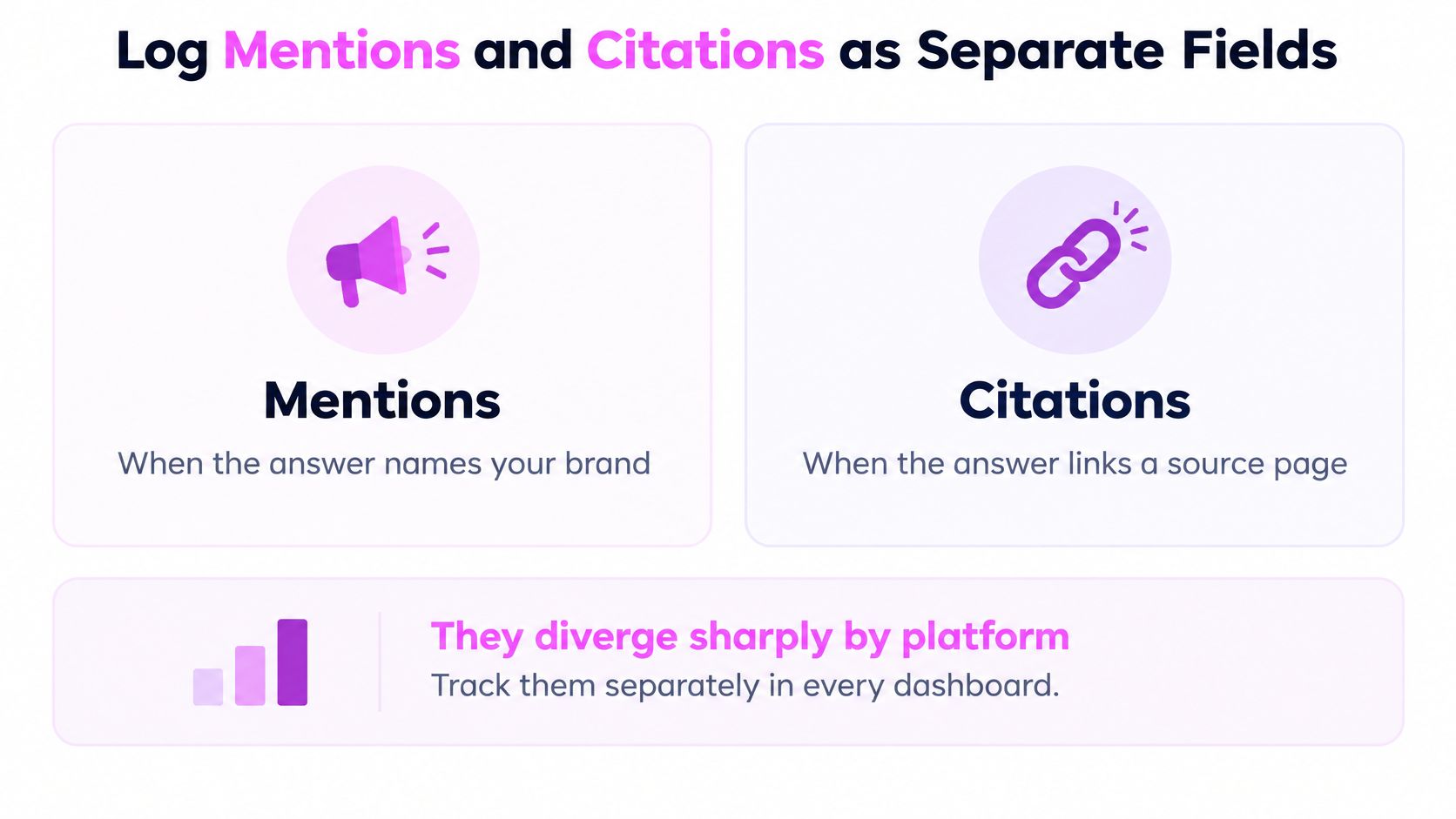
When I first logged mentions and citations in the same column, my reports looked clean and said almost nothing. Splitting them changed what I could act on. A mention means the answer names the brand. A citation means the answer links to a source page. Those two events frequently diverge, and they diverge differently on each platform.
The Semrush ghost citations study examined 3,981 domain appearances across 115 prompts in 14 countries and found that 61.7% were "ghost citations", where the system linked to a page but didn't name the brand. Only 13.2% of appearances were both cited and mentioned, while 25.1% were mentioned without a citation.
The platform split is what convinced me to stop using one combined score. In that study, Gemini named brands in 83.7% of appearances but linked them only 21.4% of the time, whereas ChatGPT linked sources in 87% of appearances but named brands in just 20.7%. If I report only citations, I overstate how visible I am in the conversation. If I report only mentions, I can't tell whether a reader can reach anything that supports the claim.
The fields I log on every row
- Named flag: Whether the brand appears in the answer text at all.
- Cited flag and URL: Whether a URL is linked, and the exact URL, not just the domain.
- Owned or third party: Whether that page is mine or someone else's.
- Mention position: First named, buried in a list, or mentioned only to be dismissed.
- Sentiment and context: Recommended, neutral, comparative, or negative.
- Raw answer, engine, and date: The full text, the system that produced it, and when I captured it.
From those fields I calculate mention rate, citation rate, co-occurrence rate, owned-versus-earned citation share, a ghost citation rate, each split by platform, country, and prompt cluster. The citation-to-mention ratio is the one I watch closest, because it separates "the model knows us" from "the model can substantiate us."
A high mention count with a low citation rate isn't an authority win. It usually means other people's pages are doing the persuading for you.
That distinction changes my next move. Mentioned but never cited points to a missing citable page on my own site. Cited but never named points to content that's useful as evidence but weak as positioning, which is a page-level rewrite, not a PR problem.
Choose Your Tracking Method Before the First Run
I pick the capture method before the baseline run, because the method decides which fields survive. If I discover in month three that my tool doesn't store the raw answer, I don't have a trend. I have three incompatible spreadsheets.
Manual logging in a spreadsheet costs nothing and forces me to read every answer, which is useful for the first cycle. I catch tone, wrong pricing, and odd competitor framing that a score would flatten. It drifts fast, though. The second person to run it changes a date format, skips a locale, or pastes only the links and not the text. I use it to stabilise the template, not as the permanent system.
Search Console is the option my clients reach for first, and I have to talk them out of treating it as the answer. It can show me which of my pages earn impressions and clicks, but it doesn't give me a clean field for what an AI answer said about my brand, whether I was named without a link, or which competitor was recommended instead. It's a useful join later. It isn't a mention tracker.
When a dedicated tracker earns its cost
A dedicated tracker removes the copy and paste, and it earns its cost once the panel grows beyond a few hundred prompt and engine combinations a month. Below that, I'm mostly paying to avoid an afternoon of tedious work. Above it, manual capture becomes the biggest source of error in the whole system.
Whatever I choose, I test it against my field list using a real run, not a demo. It has to store and export:
- The raw answer text: Not a summary, not a screenshot I can't search.
- A timestamp and the engine: So I can explain a change instead of guessing.
- Every cited URL: Page level, not domain level.
- Separate named and linked flags: If these are merged, I walk away.
If a tool can't export those, it hides the exact gap my panel exists to expose, and I'll end up rebuilding the log by hand anyway. My rule is simple. I run the first baseline manually for one cycle, I lock the template, and only then do I move it into a tool.
Run the Panel Every Month, Starting This Week
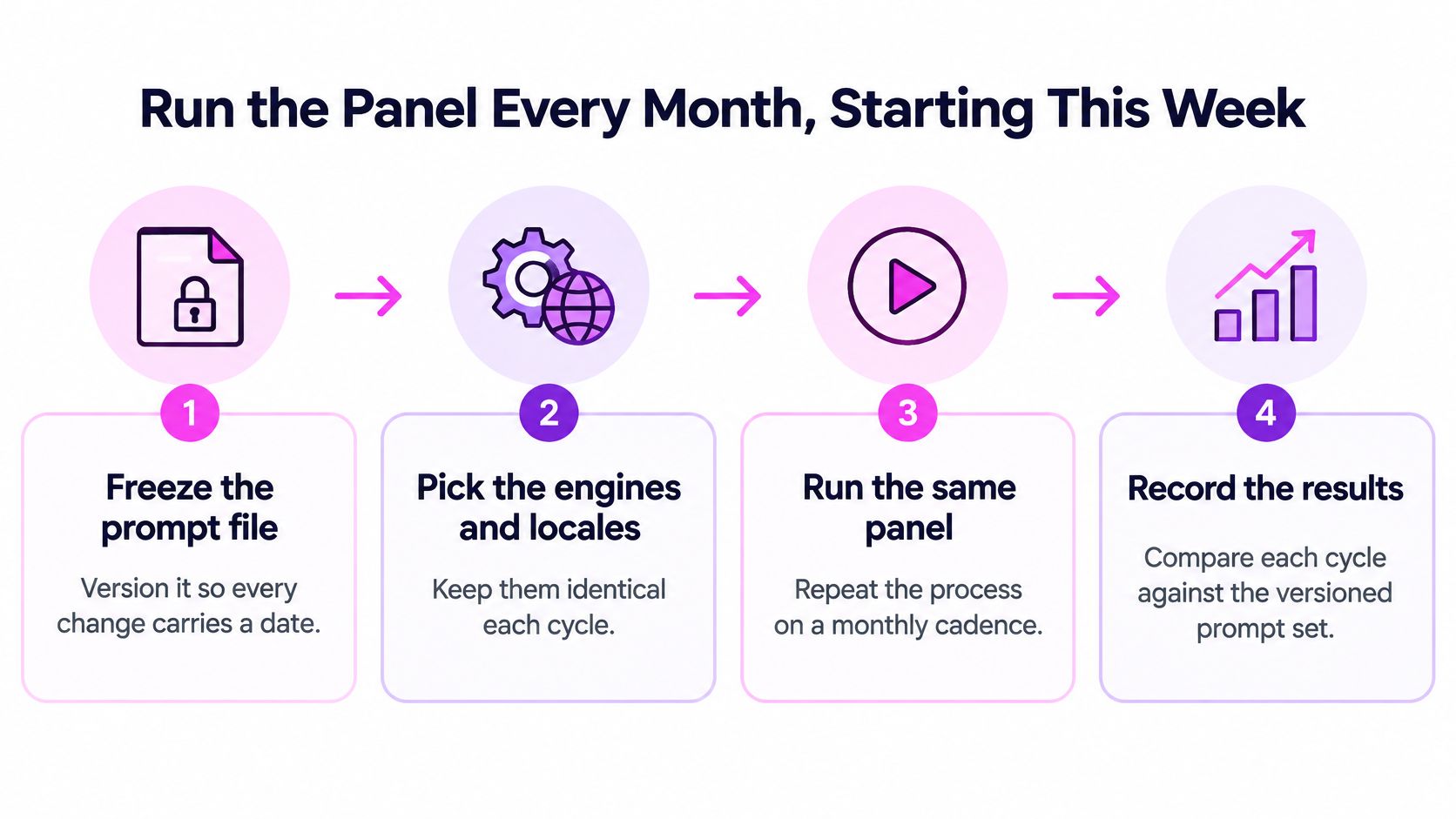
I freeze the prompt file first and version it, so every edit carries a date and a reason. Then I run each cycle the same mundane way. Mundane is the point. AI answers aren't fixed result pages, they shift with engine, geography, language, account context, model version, and wording, so I control everything I'm able to control and record the rest.
My monthly procedure
- Pick engines and locales, then keep them identical. I write them at the top of the file. Answer formats differ enough between systems that mixing them inside one average produces a number nobody can interpret.
- Run each prompt from a clean session. I record the date, the engine version where it's shown, the language, and whether I was signed in. Personalisation I don't record becomes noise I later mistake for a trend.
- Save the raw answer and every cited URL the same day. Sources disappear, pages get edited, and citation order changes. If I only keep my scores, I can't audit my own scoring next month.
- Score each row before looking at totals. Named, linked, position, sentiment, and competitor presence, row by row. Scoring after seeing the headline number is how I end up grading generously.
- Rerun on the same day each month. Not when someone asks for a report. A fixed cadence is what turns anecdotes into a series.
The Sona study of brand mentions across AI platforms measured 177 brands across eight AI platforms and reported that 89.8% were largely absent from AI search. I keep that in mind during a first pass. An empty cluster is a valid result to record, not evidence that my run is broken.
Supporting data helps me separate answer noise from durable change. We show which keywords trigger Google's AI to mention a site, including competitors' sites, and the precise URLs Google cites in its AI-generated answers, and we also detect unlinked brand mentions across blogs, news sites and directories. I use that kind of URL-level and historical view as a cross-check, never as a replacement for my own archived answers.
The slips I see most often are editing prompts between periods, counting a repeated domain as several wins, and ignoring regional personalisation. My action for this week is unglamorous. I choose the 75 prompts, I separate the branded ones, I lock the file, and I run the baseline once without reacting to it.
Attribute Each Citation to a Source and Page
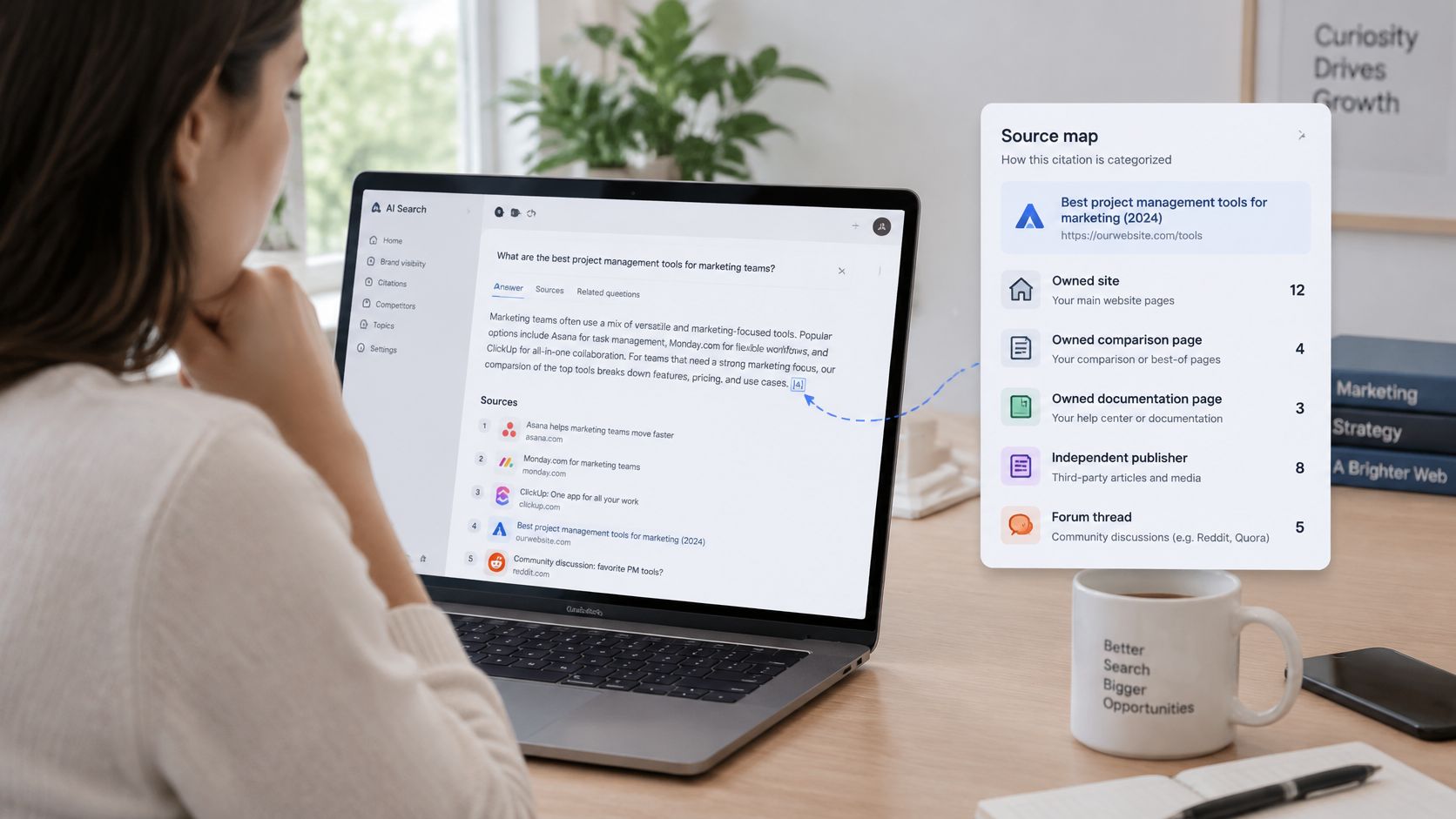
A citation only counts as a win for me when it supports the statement the answer made about my brand. I've seen my domain listed among sources for a claim my page never makes, and counting that would flatter the report while teaching me nothing. So I read the cited page, and I record the exact URL and page type.
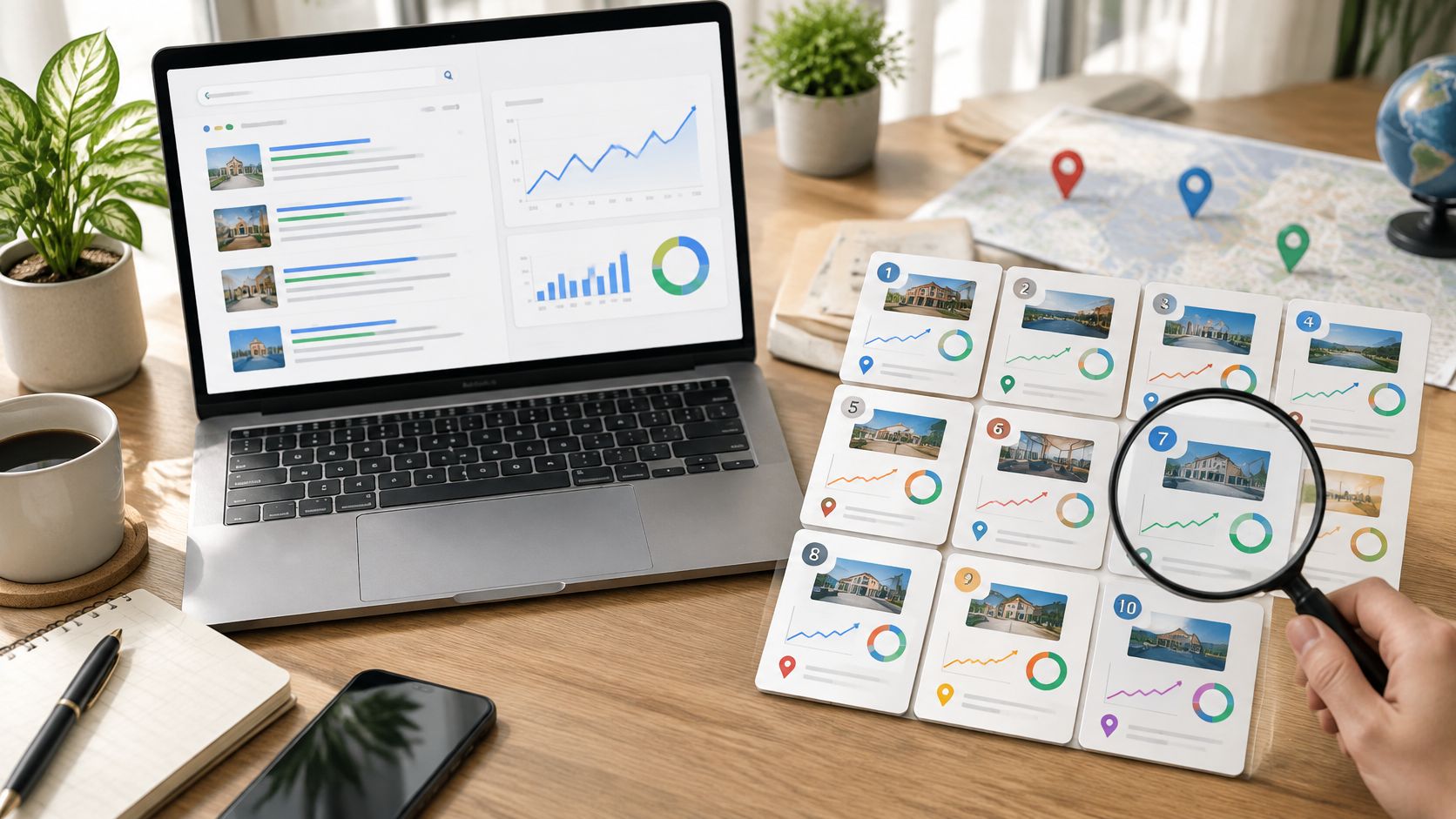
The visual below shows the kind of source map I'm building toward, where each answer is tied back to the specific pages behind it.
Google's own documentation matters here. The Google Search guidance on AI features says AI Overviews and AI Mode links are included in Search Console's Performance report under the Web search type, rather than as a separate reporting category. There's no dedicated AI mention field waiting for me, so I build one from my sampling and then join it to page-level performance.
| Source class | How much you control it | What AI tends to use it for | First move |
|---|---|---|---|
| Owned site | Wysoki | Product facts, pricing, specifications | Fix outdated pages before anything else |
| Owned comparison or docs page | Wysoki | Evidence for comparison and how-to prompts | Add dated, sourced comparison criteria |
| Independent publisher | Niski | Category roundups and expert opinions | Pitch accurate briefs and correct factual errors |
| Review platform | Średni | Ratings, pros and cons | Ask satisfied customers and answer negative reviews |
| Community or forum | Niski | Real user experiences | Answer questions openly; do not seed posts |
| Video | Low to medium | Demos and walkthroughs | Publish or sponsor accurate demos |
| Retail or marketplace listing | Średni | Price and availability | Keep listings synchronized with your site |
| Reference or encyclopedic site | Niski | Definitions and background | Verify facts and request corrections through proper channels |
I score each source on controllability, difficulty of change, commercial proximity, a sentiment. That scoring stops me spending a month chasing a low-influence directory while a review platform next to the purchase decision describes a feature I retired. It also keeps owned-versus-earned honest, which is the same distinction I apply when I work through our guide to brand mentions for SEO.
Two pages on one domain can carry completely different positioning, so domain-level reporting misleads me. A homepage citation signals broad relevance. A documentation citation signals that my how-to content is doing the work. A comparison page citation tells me I'm being used as evidence in a buying decision, and that's the one I'd protect first.
This short walkthrough shows how I think about moving from a cited URL back to the claim it supports.
Reading Trends Without Fooling Yourself
Trend lines are where I've fooled myself most often, usually by treating a correlation as a lever. The MarketSplash analysis of AI answer ranking variance reported a 0.664 correlation between branded web mentions and visibility in Google AI Overviews, compared with 0.218 for backlinks or referring-domain strength. That's a signal worth monitoring. It isn't proof that buying mentions will buy me inclusion.
The same analysis reported that 26% of brands had no mentions at all in Google AI Overviews. I record absence as a value in the series rather than leaving a blank, because a blank looks like missing data and a zero looks like a finding. They're not the same, and my future self needs to know which one happened.
Compare clusters with clusters
Intent changes the baseline so much that a blended average is close to useless. In that analysis, comparative queries produced a 43.3% brand-mention rate, versus 18% for informational queries, podczas gdy informational queries achieved an 89.3% citation rate. If my informational cluster has a low mention rate, that may be normal for the intent rather than a failure I need to fix.
I report share of answers by cluster and engine, and I track URL replacement over time, meaning which cited page got swapped for which other page. When I want a competitive frame for that share, I use a share of voice SEO guide to keep the definition consistent instead of inventing a new denominator each quarter.
To credit an action, I split the panel. I hold back prompts I don't touch, or I use a market split, or I run a before and after cohort on identical prompts, and I report intervals when the sample is large enough to support them. Then I read prompt-level movement, because a flat overall share can hide a slide from positive recommendations to neutral name-checks, or from authoritative sources to weak ones. I also count repeated citations from one domain once. Three links to the same roundup is one source relationship, not three wins.
Set Alerts and Fix What the Panel Reveals
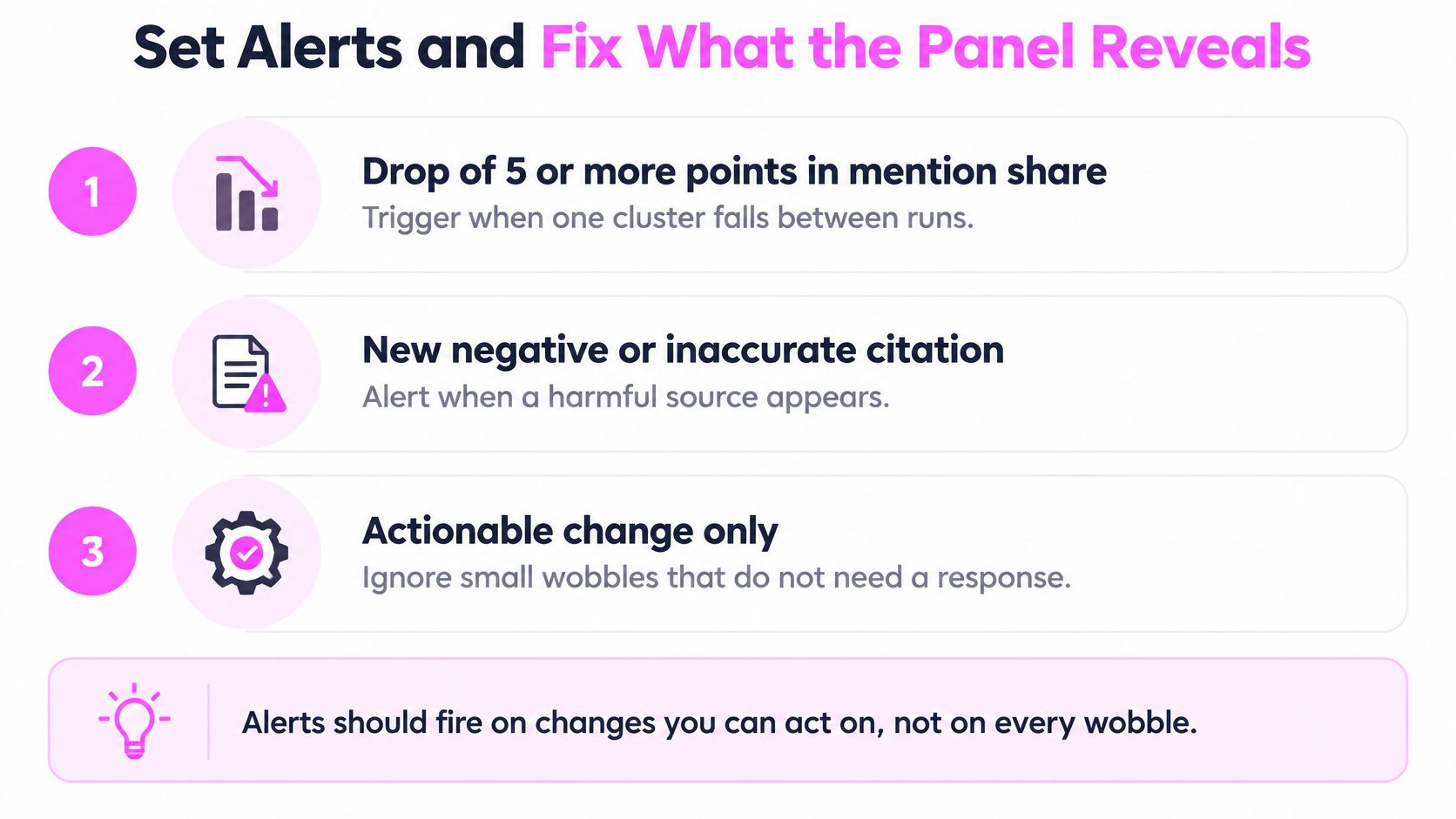
I set alerts on changes I can act on, not on every wobble. If an alert fires weekly and I ignore it, I've built a noise machine. My starting thresholds are a drop of 5 or more points in mention share for one cluster between runs, any new negative or inaccurate description, a competitor appearing in a prompt where I used to be named, and a cited URL switching from my page to a third party.
| Signal | Likely cause | Response |
|---|---|---|
| Mentioned but never linked | No citable page answers that exact prompt | Publish a sourced page that answers the prompt directly |
| Cited URL is an old third-party review | Outdated third-party source | Publish updated owned data, then request a correction from the publisher |
| Competitor replaces you in comparison prompts | Competitor has stronger comparison evidence | Build a fair comparison page with stated criteria |
| Negative or inaccurate description | Old reviews or wrong facts on high-trust sites | Fix your own facts first, then request correction at the source |
| Sudden drop across every cluster | Prompt drift or engine change | Verify the prompt file and rerun before reacting |
| Strong mentions, few clicks | The answer resolves the query without a visit | Track brand search and the page's own traffic; do not chase clicks blindly |
I work the table in order of who controls the fix. My own facts come first, because I can change pricing, feature lists, and comparison criteria today, and because asking a publisher to correct something my own site still gets wrong wastes the one polite email I'll get read. That's also where I spend effort on the pages AI already reaches for, following the approach in our AI Overview optimization guide.
If every cluster drops at once, check the panel before you check the strategy. Prompt drift and an engine change look exactly like a real loss.
The mistake I made early was declaring victory after one good run. Now I retest the same prompt cohort after 30 days and I only call a fix successful if the change survives that rerun. I'd rather report a slow, durable gain than a spike I have to retract next month.
Build your panel this week, log mentions and citations in separate fields, and use SemDash (SemDash) to see which keywords trigger Google's AI to mention your site and your competitors, down to the precise URLs cited in each answer. Start with your category discovery and comparison clusters, find where you're named but never linked, and fix that gap first.