

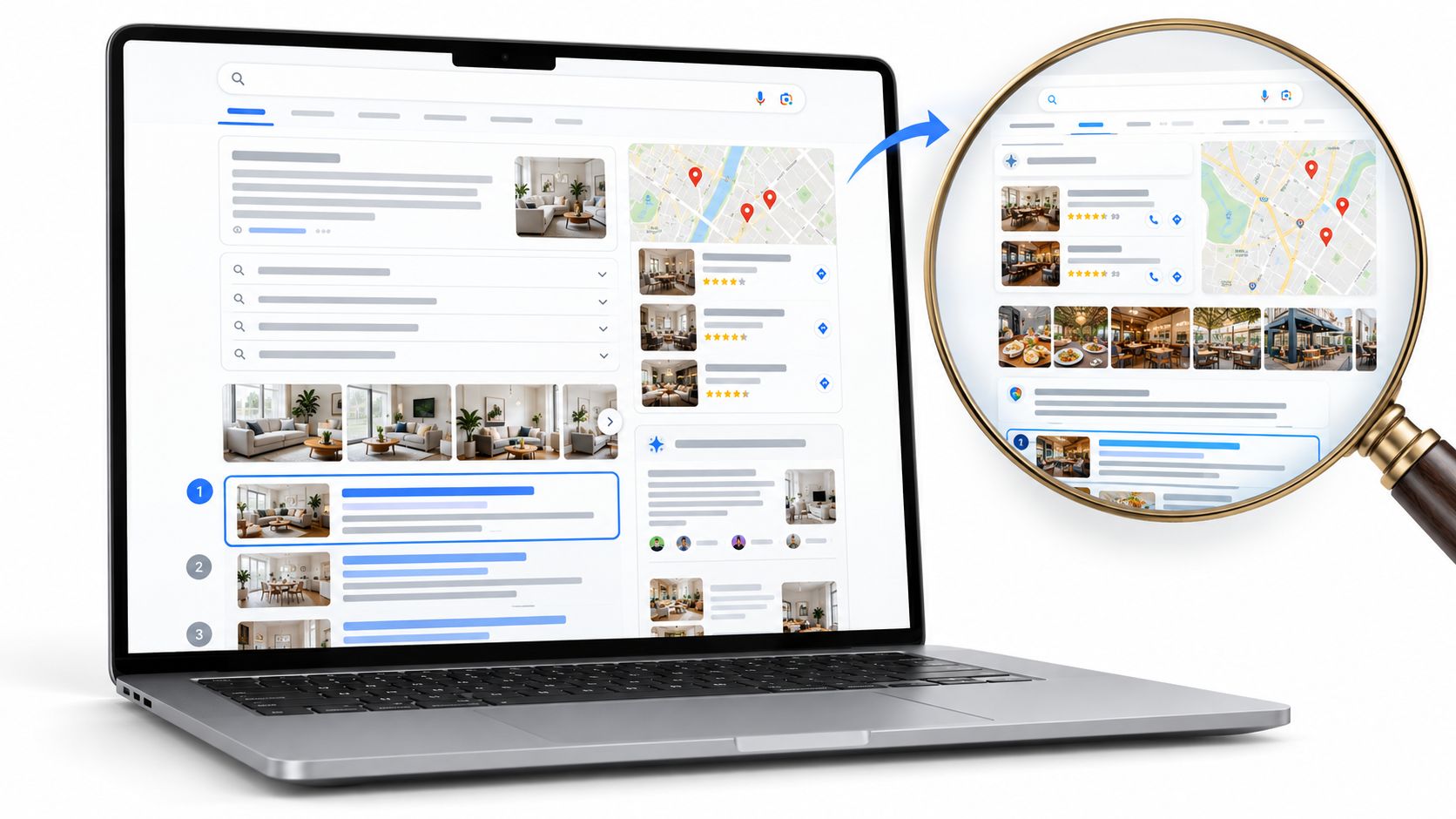
A SERP is the page a search engine returns for a query, and it can mix blue links, images, video, local modules, and direct answers rather than a fixed list of ten links.
The usual advice is to find a keyword, check its search volume, and aim for the highest organic position. I'd reverse that order: inspect the live page, identify what the searcher wants, and decide which result you can realistically earn before using volume to prioritize the work.
A rank number alone doesn't tell you whether your exact URL appears in an answer, whether a map occupies the screen, or whether anyone needs to click. Treat the SERP as a contextual answer interface, not a leaderboard.
Spis treści
- What a SERP Contains Beyond Blue Links
- How a Query Becomes the Page I See
- Why Two People See Different SERPs
- How Features Get Chosen and Owned
- How Intent Rewrites the Layout
- Reading Rank When AI Answers First
- Check the Live SERP Before You Edit
What a SERP Contains Beyond Blue Links
SERP stands for search engine results page. For an audit, I'd treat everything visible after the query as part of the competitive environment, rather than counting only conventional organic listings.
That distinction matters when you interpret reporting. According to Google's Search Console measurement documentation, results pointing to a website can include ordinary links, images, and videos, and an image result can require two clicks before you reach the site. You can also break performance down by Search appearance, rather than assuming every impression represents the same presentation.
What each major SERP feature shows
Keep this inventory beside your saved SERP. The placement column describes common arrangements, not a guaranteed ordering.
| Cecha | What the searcher sees | Usual place | What I record |
|---|---|---|---|
| Organic blue links | Title, URL and snippet | Main results column | Position, exact URL, snippet match |
| Featured snippet | A short answer, then the source | Often above the organic list | Paragraph, list or table, plus source URL |
| Ludzie też pytają | Expandable related questions | Mixed through the results | Questions shown and any snippet inside them |
| Image results | Thumbnail grid | Top, side or the Images tab | Whether the site needs two clicks |
| Video results | Thumbnail and duration | Mixed in or the Videos tab | URL and whether it is a watch page |
| Local pack | Map and business listings | High on local queries | Pack presence, not only web rank |
| Knowledge panel | Entity facts | Right rail, or top on mobile | Whether the brand is the entity |
| Sitelinks | Extra links under one result | Under a strong navigational hit | Which URLs were chosen |
| Przegląd AI | Generated summary with citations | Above organic results on many queries | Cited URLs, separate from blue-link rank |
Read the live page from the first visible result downward. Don't assume the order in an export matches the order in which you encounter modules on screen, especially when comparing a desktop capture with a phone.
For each relevant module, save what appears, where it appears, and the destination or cited URL. If you own an ordinary listing but a competitor owns the answer above it, record both observations. Otherwise, your report can show a stable organic position while hiding a meaningful change in exposure.
Audit rule: Record the layout around your result, not just the number beside it.
Also distinguish the initial view from expanded interactions. An unopened related question and its expanded answer aren't the same observation, and a citation visible only after opening a panel deserves its own note.
This is why I wouldn't diagnose a weak click-through rate from average position alone. First check whether your listing makes a useful promise and whether the surrounding interface already supplies the answer. Those require different fixes.
How a Query Becomes the Page I See
Say you publish a running-shoe category page and can't find it for your target query. Before rewriting the copy, separate discovery from selection: can Google access and index the page, or has Google indexed it but chosen other results?
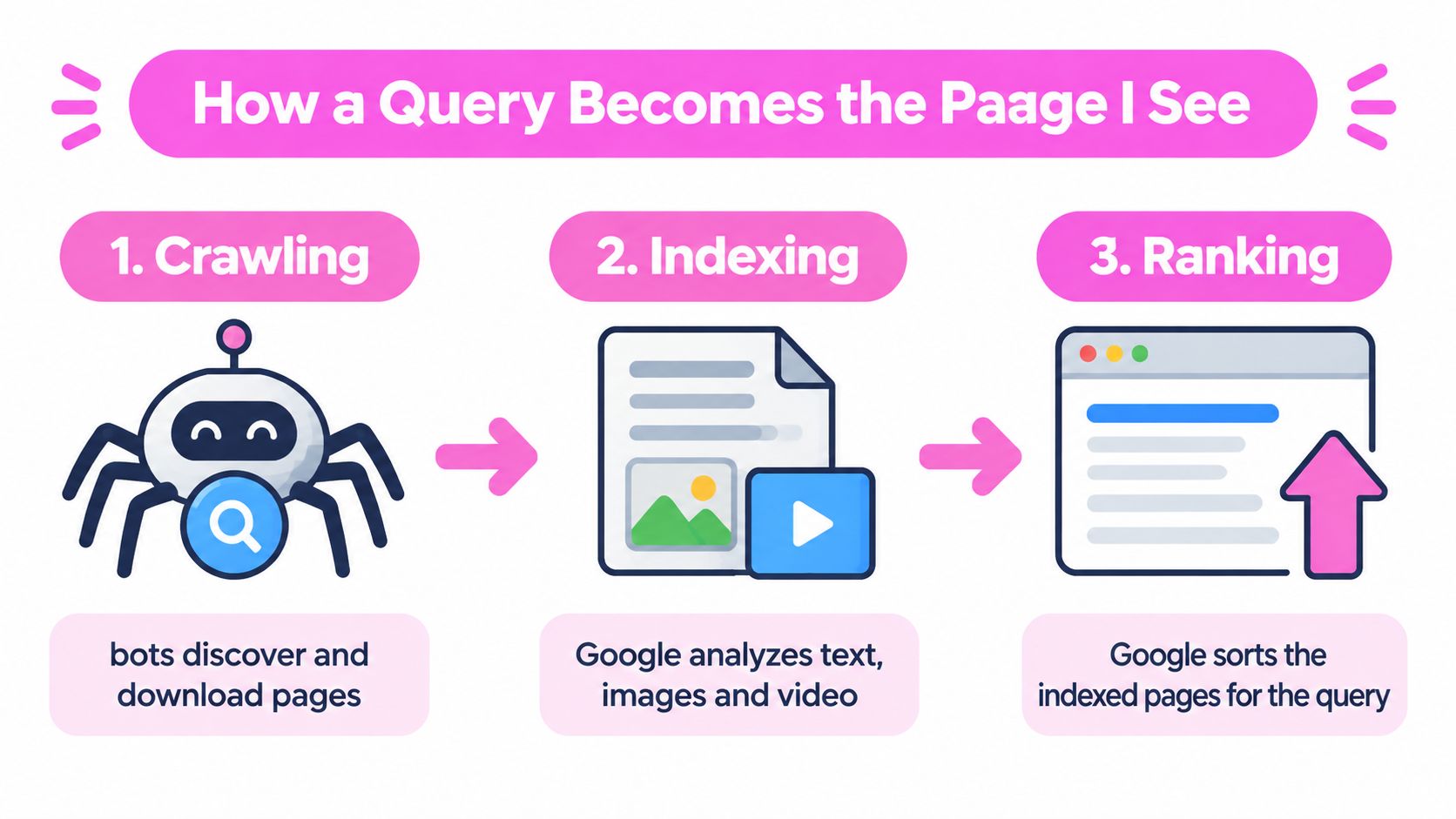
Google's explanation of how Search works describes three stages: crawling, indexing, and serving results. Think of a library: acquiring a book isn't the same as cataloguing it, and cataloguing it isn't the same as recommending it for a particular question.
The process diagram separates those jobs.
Separate an indexation problem from a ranking problem
- Crawling: Check whether Google can discover and retrieve the intended URL. Review internal links, access restrictions, and the response your server returns.
- Indexing: Use Search Console's URL Inspection to examine the indexing status and selected canonical. Don't assume a submitted sitemap means the page is indexed.
- Serving and ranking: Once indexation is established, compare the page with the results chosen for the target query.
For the shoe category scenario, a mistaken noindex directive calls for a technical correction, not a longer buying guide. If Google instead selects a different canonical URL, investigate duplication and canonical signals before polishing the excluded version.
If the intended page is indexed, move to relevance and page-level competition. Google's ranking systems guide describes systems designed primarily to evaluate individual pages, alongside some site-wide signals, so I'd map the actual ranking URL before recommending a rewrite.
A domain isn't a single ranked document. You might need a supporting guide for an informational query and a category page for a purchase query, even when both concern the same product.
Fix the failed stage first. Editing titles can be worthwhile, but it doesn't resolve a discovery or indexation failure.
Why Two People See Different SERPs
Search for pizza from different cities and you shouldn't expect the same nearby businesses. Compare a phone capture with a desktop capture and you may also encounter a different arrangement of results, even when you type the same words.
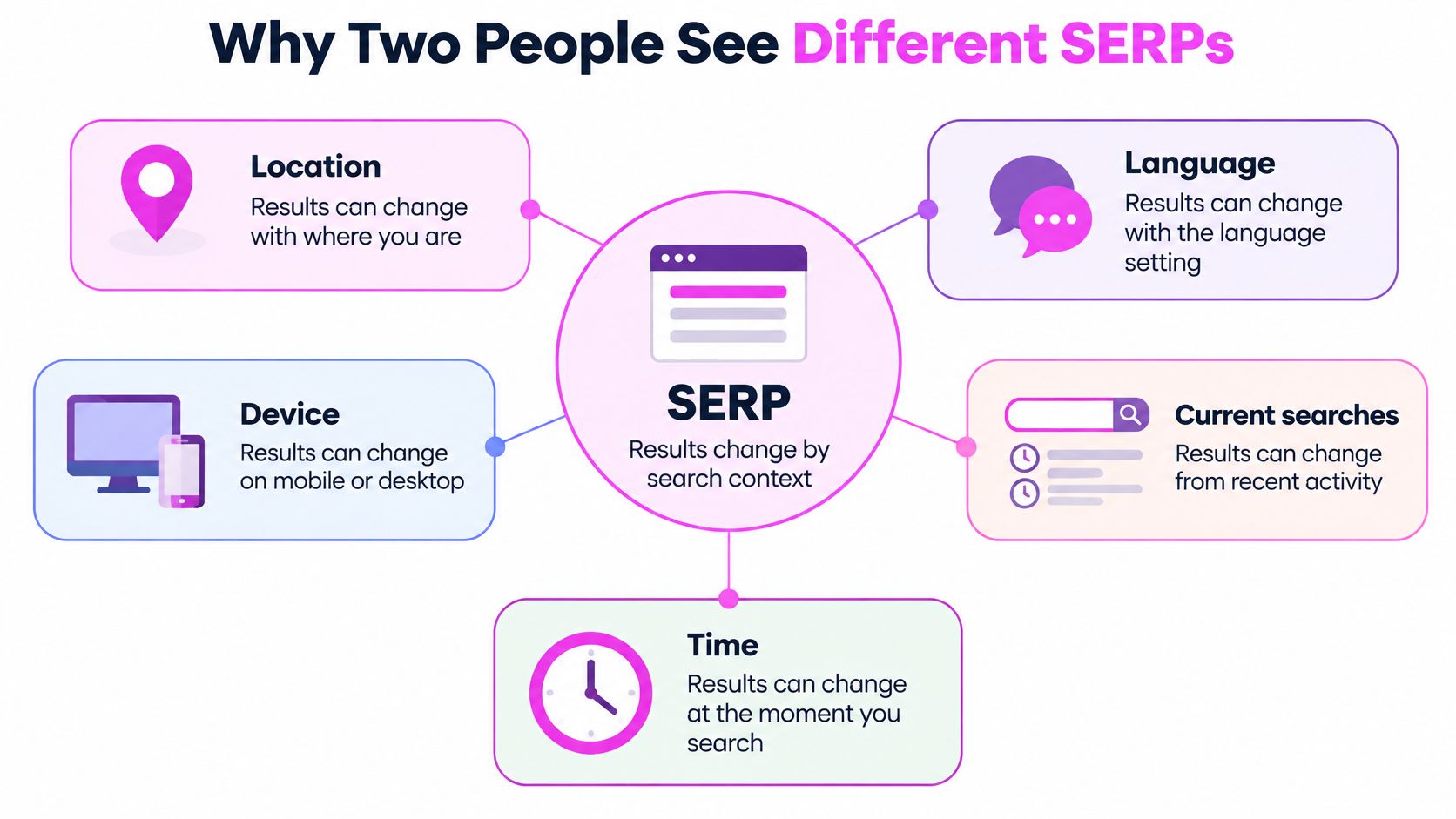
Google's guidance on personalized results identifies location, language, device, current searches, and enabled account activity or search history as reasons results can differ. Turning personalization off doesn't remove all context.
The practical problem isn't that variation exists. It's that you can accidentally present variation as a ranking gain or loss.
This diagram summarizes the context worth controlling.
Make the comparison reproducible
For every capture, I recommend a log with these fields:
- Exact query: Preserve the wording, modifiers, and spelling rather than grouping similar phrases prematurely.
- Market and language: Record the country or city and search language. For local work, don't use a national observation as a substitute for the target service area.
- Device and user state: Note mobile or desktop, whether you're signed in, and the personalization setting.
- Capture time: Save the date, time, and screenshot so you're comparing evidence rather than memory.
- Result inventory: Save feature types, ranking URLs, and repeated appearances from the same domain.
For broader ranking comparisons, Google's explanation of ranking results also identifies relevance, usability, source expertise, location, language, device, and settings among the signals involved. Your log won't reveal the weighting of those signals, but it will prevent avoidable mismatches.
Compare like with like before attributing a change to an algorithm update.
Suppose your agency's report shows a decline while your client's screenshot shows an improvement. Start by reconciling the search environment, not by choosing whichever observation supports the preferred story.
If the screenshots came from different cities, treat them as separate local observations. If they came from different devices, compare each against its own baseline.
Decide whether the movement warrants action
After matching the environment, inspect what changed. Did a competitor replace your URL, did Google select another page from your own site, or did an added module push ordinary listings farther down?
Those aren't interchangeable problems. A competing page may justify a content comparison; an internal URL swap may call for clearer targeting; a layout change may require a different visibility objective.
Even a controlled comparison doesn't prove causation. It gives you a cleaner observation from which to investigate, which is much more useful than reacting to every fluctuating rank.
How Features Get Chosen and Owned
I'd separate eligibility, visibility, a feature ownership before making implementation decisions. Eligibility asks whether your page can qualify for consideration; visibility asks whether it appears; ownership asks whether your exact URL supplies the answer or enhanced result you're targeting.
Use the displayed result as evidence of selection, not as proof that a particular markup change caused it.
Match the answer before changing the markup
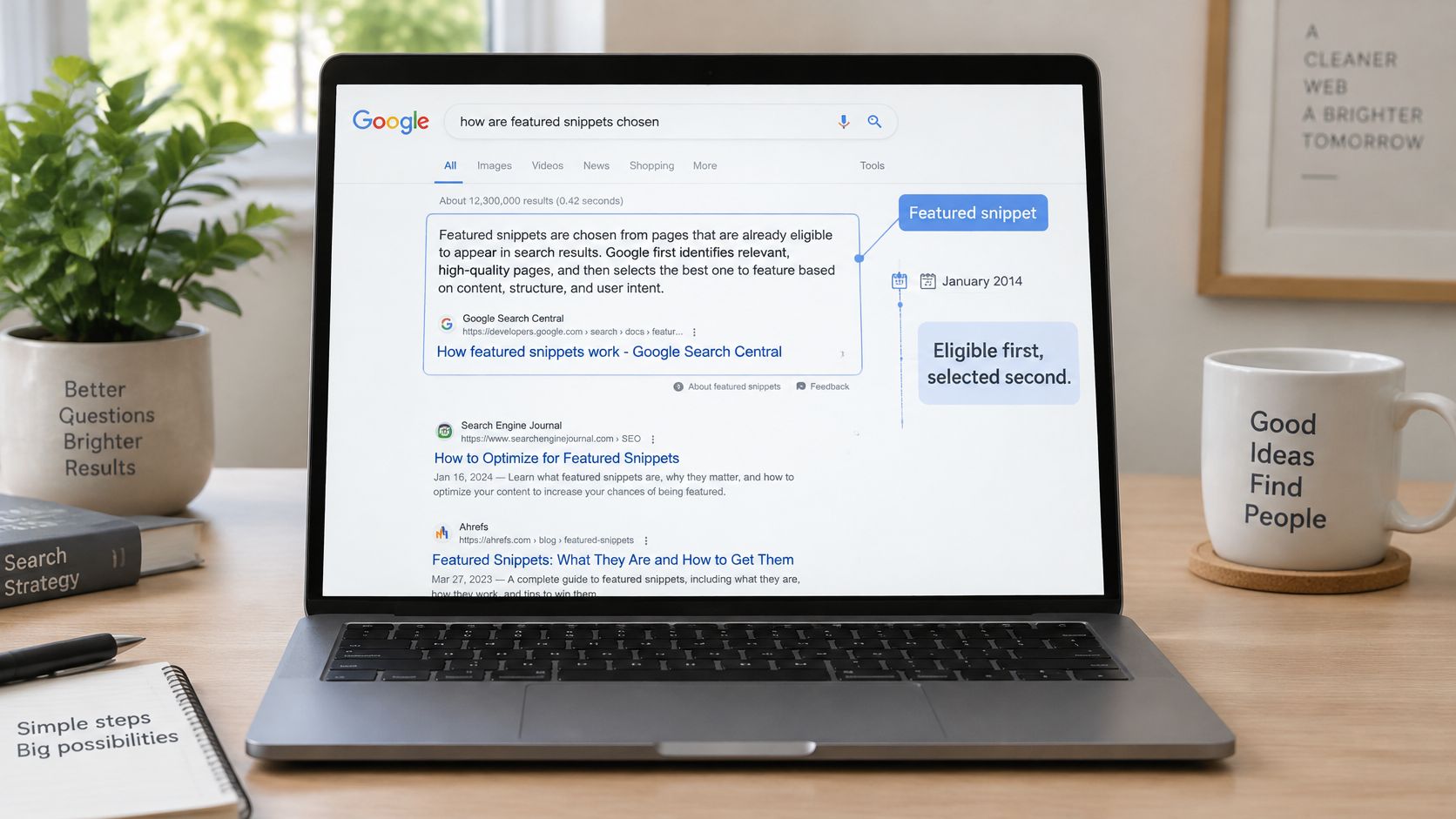
For featured snippets, Google's explanation describes a presentation that emphasizes an extracted answer before its source link. You can encounter that answer at the top of results, within related questions, or beside Knowledge Graph information.
Don't confuse this with earning a rich result through structured data. In Google's featured snippet documentation, selection concerns the descriptive answer shown first, including answers within related-question groups. A useful audit therefore checks the passage itself, not just the page title.
For a question asking for a definition, I'd place a self-contained explanation immediately beneath the relevant heading. For a process, I'd use ordered steps; for a comparison, a table can make distinctions easier to retrieve and understand.
That's an editorial recommendation, not a guarantee of selection. Don't turn every paragraph into a short answer or remove necessary qualifications just to imitate the current snippet.
Implement supported markup accurately
Wprowadzenie do danych strukturalnych Google describes markup for entities and attributes, supports JSON-LD, Microdata, and RDFa, and recommends JSON-LD. The same guidance makes clear that valid markup doesn't guarantee a rich result.
My implementation recommendation is to:
- Choose the supported type: Match the page, such as a product, recipe, article, or breadcrumb hierarchy.
- Describe visible content: Keep marked-up properties consistent with what you show visitors.
- Validate the rendered page: Use Google's Rich Results Test and resolve required-property errors.
- Verify selection separately: Check whether the intended treatment appears for the relevant query and environment.
Use the video alongside the page-level checks, not as a substitute for validating your own implementation.
A technically valid page can still receive a plain text result. Conversely, you can earn an extracted answer without implementing a special featured-snippet schema.
Don't report implementation as an outcome. Markup deployed, validation passed, feature displayed, and traffic generated are separate checkpoints. Keeping them separate makes it easier to identify what worked and what still needs testing.
How Intent Rewrites the Layout
Before choosing a page template, I'd open the live SERP and ask what you're trying to accomplish with the query. Topic relevance isn't enough: learning about running shoes and buying running shoes require different destinations.
Use the following patterns as inspection prompts, not promises about today's results. Confirm the actual modules in your target market before committing a content brief.
Intent types and the layout they produce
| Intencja | Example query | Modules that dominate | Page I would build |
|---|---|---|---|
| Informacyjne | what is serp | Featured snippet, People Also Ask, AI Overview, guides | A definition page with the answer up front |
| Badanie komercyjne | best seo tools | Listicles, reviews and ads | A comparison built on explicit criteria |
| Transakcyjne | buy running shoes | Shopping and product results | A product or category page |
| Lokalne | pizza near me | Map pack and reviews | A Business Profile plus a local page |
| Nawigacyjne | gmail login | One domain and sitelinks | The destination page, not a blog post |
For an informational page answering “What is SERP?”, you need a direct definition and enough explanation to support the next decision. You don't need to delay the answer behind a brand introduction.
For commercial investigation, I'd prioritize explicit evaluation criteria. Explain who each option suits, what it lacks, and how you reached the comparison, rather than publishing an interchangeable list of product descriptions.
Transactional work needs a different brief. If the live screen emphasizes products and categories, adding a long article won't make your article a suitable shopping destination; build around selection, availability, specifications, and the purchase path.
Handle mixed intent without forcing a single page
A broad term such as SERP can refer to the search concept or appear in a product-related search. If your live results show distinct tasks, don't assume a single hybrid page will satisfy both.
Użyj search intent classification to organize the decision, then verify whether the proposed targets need separate pages. Split when you can define distinct purposes and useful destinations, not merely because keyword wording differs.
For local searches, don't substitute a national article for accurate business information and a relevant local destination. For navigational searches, help visitors reach the requested destination instead of intercepting them with an explanatory post.
Template test: If you removed the keyword from your brief, would the proposed page still help someone complete the task visible in the results?
Only after that test would I use search volume to prioritize production. A high-volume term isn't an attractive target if you can't provide the page type or service the search requires.
Finish by assigning the keyword to an exact URL. Don't default to optimizing the homepage when a supporting article, category, or local page is the better destination.
Reading Rank When AI Answers First
When an AI answer appears before conventional results, distinguish coverage from clicking behavior. You can gain a citation without gaining a visit, and you can retain a blue-link position while the route to your site becomes less direct.
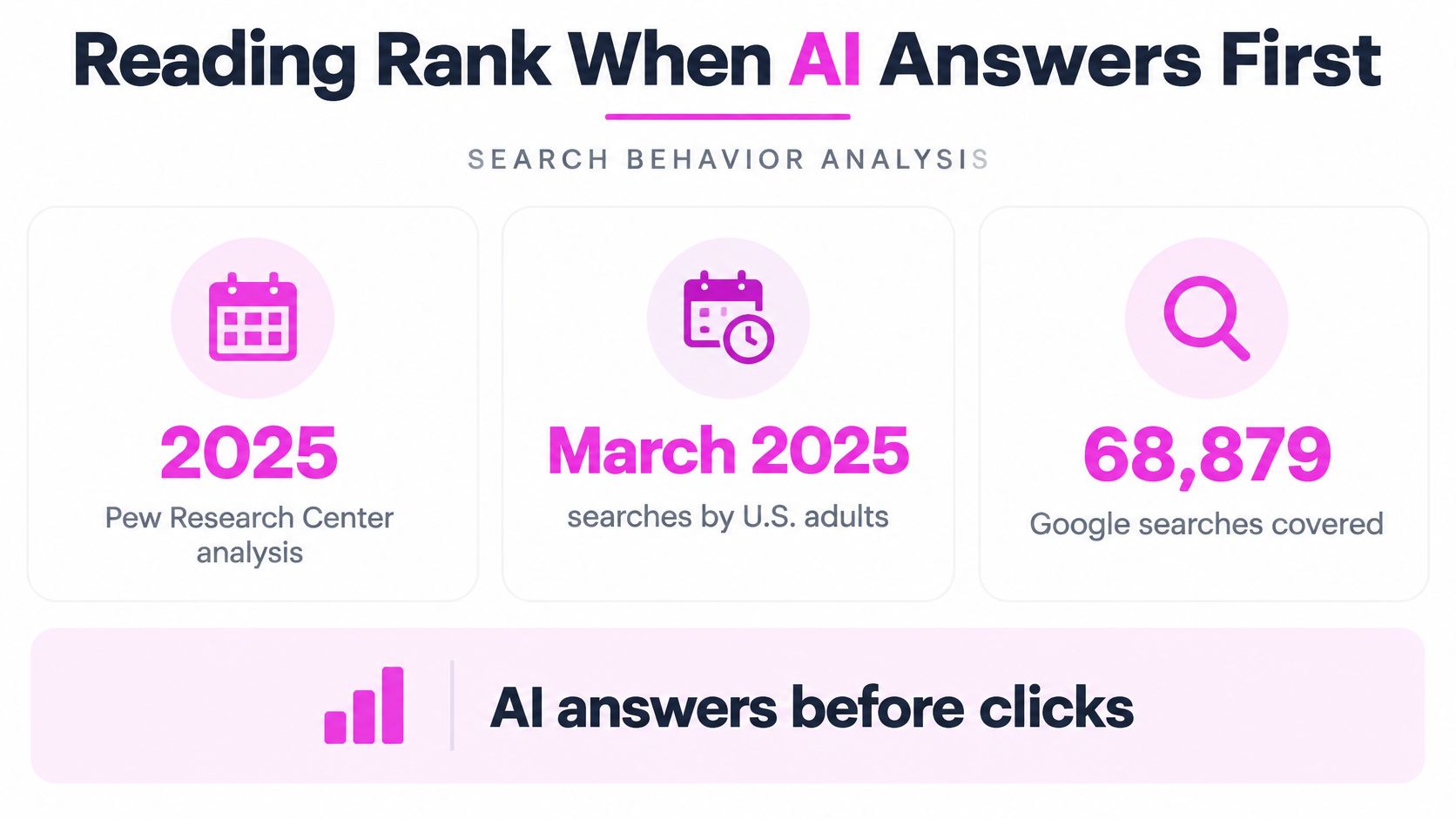
In its 2025 analysis of 68,879 Google searches from 900 U.S. adults, Pew Research Center found traditional-result clicks on 8% of visits with an AI summary, compared with 15% without one. In that analysis, AI summaries appeared in 18% of searches, while summary-link clicks occurred in 1% of visits.
A 2026 study published through the Association for Computing Machinery analyzed 11,500 real-user queries and found Google AI Overviews above organic results for 51.5% of representative queries. Don't treat those coverage figures as a continuous trend: the studies use different samples and designs.
The visual highlights the scope of the Pew analysis.
Log outcomes without inventing attribution
For a priority query, I'd track these outcomes separately:
- Cited: Does the summary link to your exact page, and does the surrounding answer represent it accurately?
- Chosen: Does your conventional listing attract clicks under comparable conditions?
- Remembered: Do you have separate evidence of brand recognition, rather than assuming a mention created recall?
- Visited: Do the resulting sessions produce the engagement or conversion you need?
You can inspect citations directly. You can measure clicks and visits through reporting. You can't establish memory from a SERP screenshot, so leave that outcome unproven unless you have an appropriate brand measurement.
For additional benchmarking context, Scale Rankings' Google organic versus AI search CTR resource is useful alongside your own query-level observations. Compare definitions and denominators before applying any benchmark to a forecast.
Choose the response by business objective
If your objective is lead generation, a citation without qualified visits isn't automatically success. If your objective includes expert visibility, dismissing that citation entirely would also be too narrow.
Użyj AI Overviews SEO workflow to separate citation work from conventional ranking work. I wouldn't rewrite a useful, cited page solely because sessions declined, but I would examine whether it gives visitors a compelling reason to continue to the site.
Visibility is evidence of exposure, not proof of commercial value. Preserve that distinction in client reporting.
Check the Live SERP Before You Edit
Before making a change, save a comparable baseline. Your next action should follow an observable mismatch, not a generic instruction to refresh content.
- Freeze the environment. Record the exact query, market, language, device, user state, and capture time.
- Inventory the screen. Note the modules present and which ones include your site.
- Save exact destinations. Capture ranking URLs and AI citations, not just domain names.
- Schedule a comparable recheck. Repeat under matching settings after a defined observation interval.
- Choose a bounded intervention. Document what you'll change and which outcome would justify keeping it.
In SemDash, you can view the SERP over 12 months for any keyword, identify the specific page Google sends traffic to for every keyword, and inspect which keywords trigger Google's AI to mention your site or competitors, including the precise cited URLs. Use that history and URL mapping to investigate whether you're facing a persistent mismatch or an isolated observation.
Decision after the saved SERP
| Signal in the saved SERP | Move | Why |
|---|---|---|
| Right page type, but loses snippet or citation | Rewrite the ranking URL | The target is right; the answer format is the problem |
| One keyword mixes two intents | Build a new URL | One page cannot serve both modules well |
| Page already earns the feature | Add or fix structured data, then validate | Markup helps only where the page already qualifies |
| Absent on a query with an answer box | Draft in the box's format | The format is what the SERP rewards |
| Cited in AI summary, sessions down | Keep the page, track the citation | The page is doing a different job |
Treat these as starting decisions, not automatic diagnoses. Check factual completeness before blaming answer format, confirm distinct tasks before splitting URLs, and apply structured data only where an appropriate supported type exists.
Keep a short change log beside the saved capture. If you alter the template, copy, internal links, and markup together, you won't be able to isolate which intervention helped.
Use SemDash to compare historical SERPs, map keywords to exact pages, and inspect citations in Google's AI-generated answers. Visit SemDash (SemDash) and start with a priority query so your next edit targets the result you can earn, not just a rank number.