


The most common advice I hear is still wrong. Export every keyword your competitors rank for, sort by volume, and start publishing. I've run that playbook. It produces a long spreadsheet, a busy content calendar, and pages that look busy without answering anything better than what's already ranking. Content Gap SEO works when I treat a gap as a missing user task, not a missing row in a tool. If nobody on my site owns the comparison, the implementation steps, or the troubleshooting decision a searcher came to make, that's a gap. If I don't rank for a phrase yet, that might be nothing at all.
Spis treści
- Why Keyword Counts Miss the Real Content Gaps
- Mining Competitor Domains and Mapping Gaps by Intent
- Scoring Gaps With a Four-Dimension Priority Model
- A Real Audit Walkthrough on an E-commerce Cluster
- Closing Gaps With Page Architecture, Not More URLs
- Measuring Results at the Query-URL Pair Level
- Your 90-Day Content Gap SEO Rollout
Why Keyword Counts Miss the Real Content Gaps
I stopped trusting keyword counts after watching gap exports turn into dozens of thin pages. Each one chased a variant, none added evidence, and several competed with pages we already had. The work looked productive until you opened the URLs side by side and saw the same answer rephrased.
Google formalized the risk with its Helpful Content work. Google's August 2022 announcement of the Helpful Content Update described a site-wide signal meant to reward satisfying visits and reduce visibility for content made primarily for search traffic, with rollout starting August 25, 2022 and finishing about 15 days later on September 9 per that same announcement. Google later incorporated that system into core ranking in March 2024, which is why I don't treat helpfulness as a periodic cleanup.

How I define a real gap now
A real gap has four parts I can write down before I open a brief. There's a distinct search task, a result set that proves users want that task handled, no suitable owner URL on my site, and something defensible I can add. Defensibility might be firsthand testing, proprietary data, clearer constraints, or a decision framework competitors skip.
- Missing topic: We have no page for a task users clearly search for, and no existing page can own it without diluting its intent.
- Weak section: We have the right page, but it skips implementation, tradeoffs, or troubleshooting that competing pages cover.
- Intent mismatch: We rank with the wrong format, such as a broad guide where searchers want a comparison or product selection help.
- Citation gap: We rank organically, but the page lacks a concise, verifiable claim that an AI Overview could extract and attribute.
My working rule: If I can't name the user decision a page helps complete, I don't have a content gap yet. I have a keyword.
That definition changes the questions I ask. Instead of asking how many terms we're missing, I ask which decisions we're failing to support, which URL should own each decision, whether the SERP will still reward that format, and whether we can say something competitors can't copy from each other.
Mining Competitor Domains and Mapping Gaps by Intent
Two queries can sit in the same export and still need completely different pages. "Trail running shoes explained" wants a definition. "Trail running shoes for wide feet" wants sizing constraints before a purchase. Merging them because they share a product noun is how teams ship pages that rank for nothing, so I mine competitor domains at the URL level and refuse to let a domain rollup do the grouping.
My pull is deliberately narrow: Słowa kluczowe domeny i Luka w słowach kluczowych reports for a handful of genuine search competitors, meaning the sites that take our clicks. Every query keeps its exact ranking URL attached, because the winning format (guide, category page, comparison, tool) is the first thing I need to know about a cluster.
The export itself is raw material. Here's the workspace where I pull competitor keywords, gap terms, and URL mappings into one view before clustering.
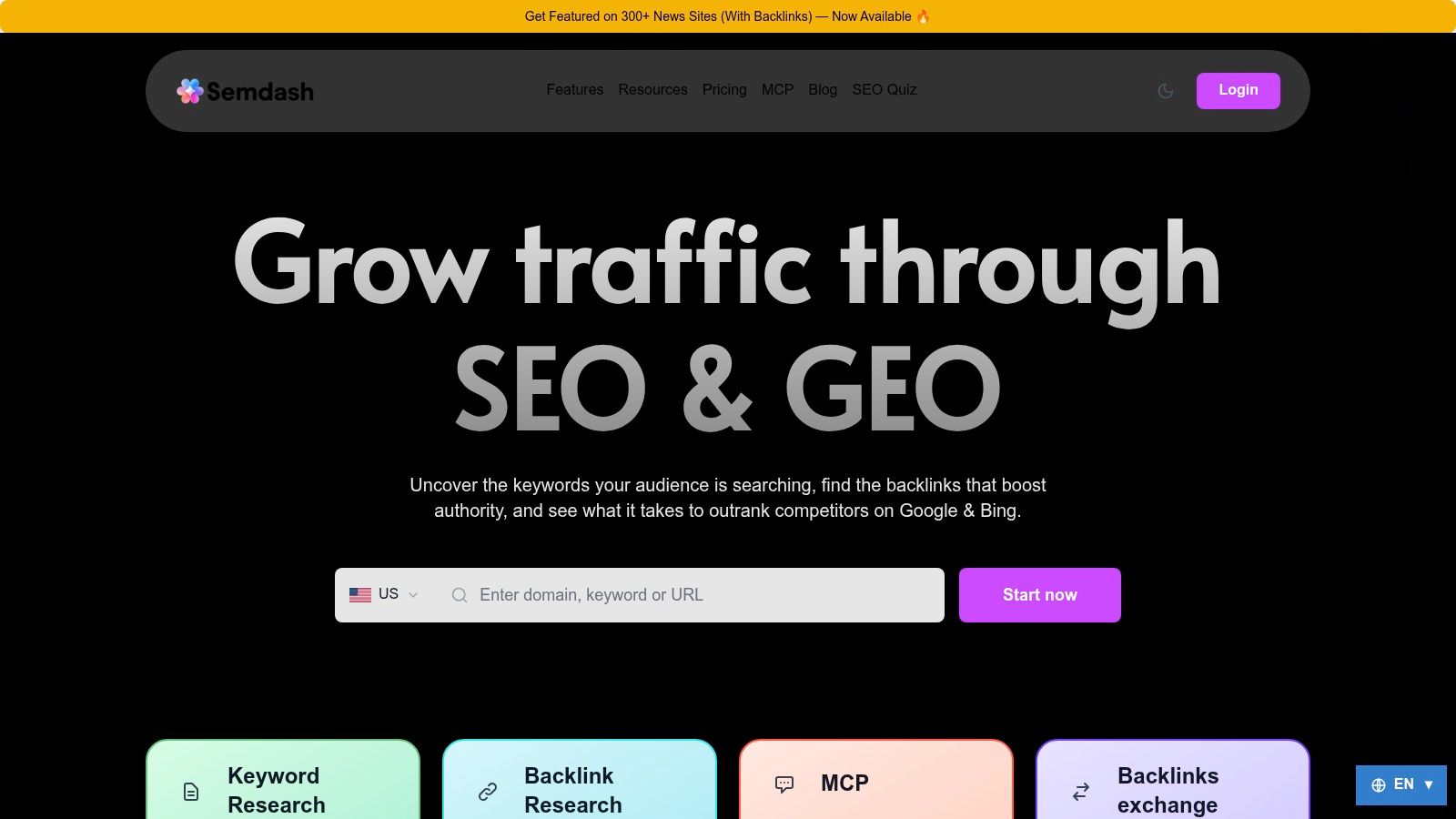
In SemDash I combine Luka w słowach kluczowych with URL level competitor mapping, then expand with PAA and PASF data to surface adjacent questions before grouping anything. I group terms by the task the searcher is trying to finish. For a companion on turning exports into targeting decisions, I point peers to how to outperform competitors with SEO when they stall at the list stage, and I keep our guide on classifying keyword search intent from the live SERP open while labelling, since a tool's intent tag still needs a human check.
Before any cluster moves forward, it survives one review pass. I open the live SERP and check its history, because a cluster that was informational last quarter can flip commercial once product pages and comparisons take over. Brand modifier terms get stripped, since demand for a competitor's name looks like a gap in the export and almost never becomes a durable page for us. Then I search our site and Search Console data for an existing owner, flag consolidation wherever two of our URLs split impressions on near identical queries, and write down the evidence or constraint we'll add that the ranking pages lack. While I'm there, I also mark which competitor URLs AI Overviews cite, because those pages show me the claim format worth matching.
When a peer asks why I validate intent manually instead of trusting the export, this short walkthrough shows the kind of SERP level inspection I mean.
What writers receive from all this is an intent map. Each cluster carries one proposed owner URL, the format the SERP currently rewards, the competitor pages worth studying, and the reason the page deserves to exist.
Scoring Gaps With a Four-Dimension Priority Model
Volume plus difficulty is a shortcut I've learned to distrust. It tells me a term is popular and contested. It doesn't tell me whether the intent is stable, whether an AI Overview will absorb the click, or whether we can defend the page once competitors copy it. So I score each cluster on four dimensions and turn the score into an action.
The diagram below sums up the model I put in front of stakeholders when I need them to see why a high volume cluster can still lose.
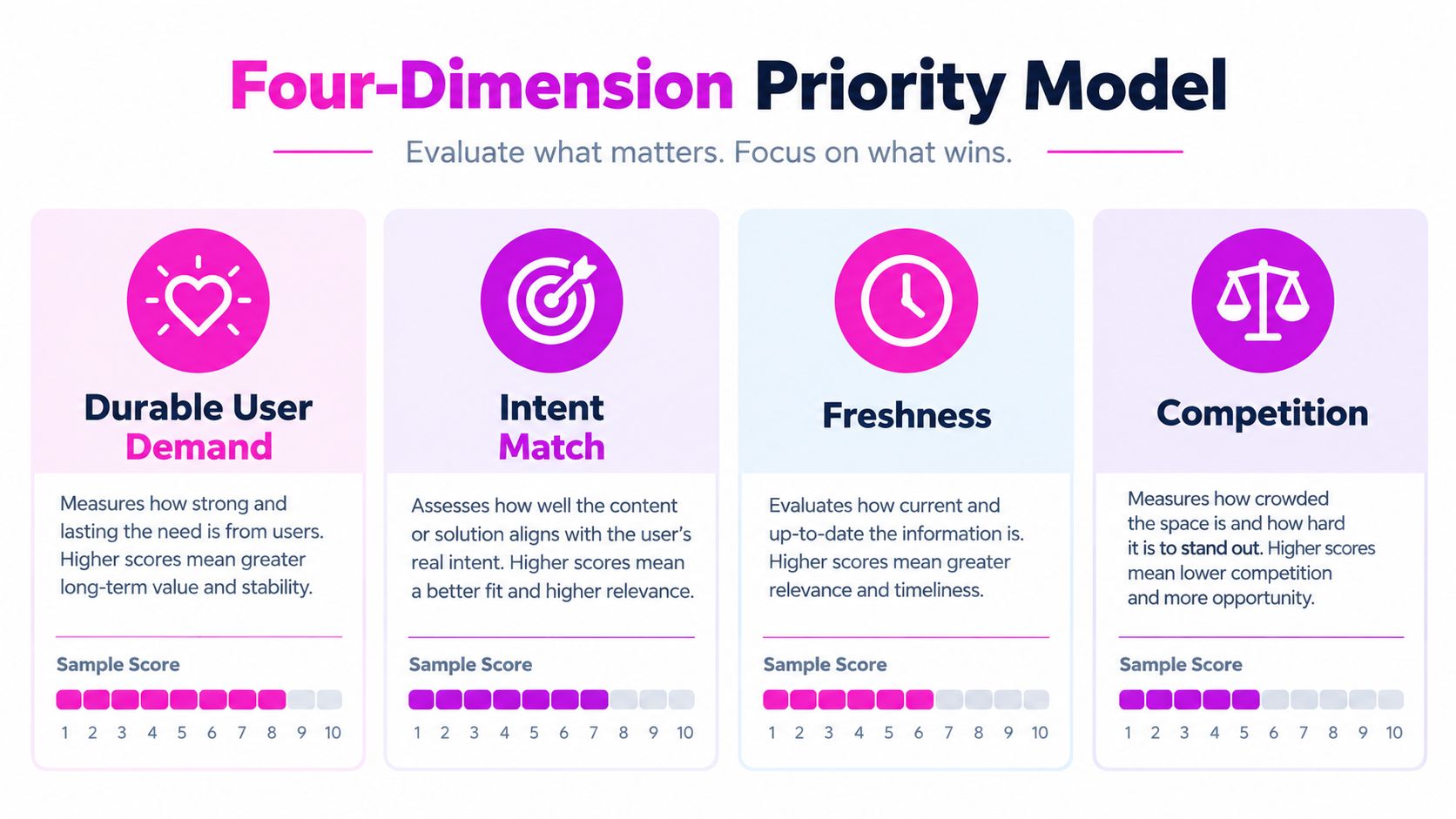
Four-Dimension Gap Priority Score
| Wymiar | Question to answer | Source | Default weight |
|---|---|---|---|
| Durable demand | Is this a recurring task or a spike | Search Console, keyword history, sales and support questions | Wysoki |
| Intent stability | Has the winning format held over time | SERP history and live SERP review | Wysoki |
| Citation likelihood | Can we supply an extractable, verifiable claim | AI Overview checks and cited competitor URLs | Średni |
| Defensibility | Can we add firsthand evidence others lack | Testing, proprietary data, original examples | Wysoki |
Stability matters more than many teams admit. Search Engine Land's reporting on AI Overview prevalence shifting during 2025 described growth from 6.5% of queries in January to nearly 25% in July, then a decline to below 16% in November, in one large keyword analysis cited there. A static screenshot of today's SERP can't forecast value in that environment.
Citation likelihood needs equal realism. The Decoder's summary of Pew findings on AI Overview clicking behavior reported traditional result clicks on 8% of searches with an AI Overview versus 15% without one, and clicks on cited sources inside the overview only 1% of the time. I still pursue citations for authority and qualified visits, but I don't score a cluster as traffic ready just because a citation looks attainable.
Position economics complete the picture. Sixth City Marketing's compilation of Google statistics reported a 22.4% click-through rate for the top organic result and a combined 7.31% click-through-rate decline for desktop informational queries in the first four positions, citing Advanced Web Ranking in that compilation. That's why I prioritize clusters where a page can credibly reach the first page, especially positions one through four, instead of counting hundreds of distant terms.
My action labels stay blunt. Build when demand, stability, and defensibility are strong. Expand when the right URL exists but misses a task. Merge when clusters overlap. Skip when we have nothing original to add, however loud the volume column looks.
A Real Audit Walkthrough on an E-commerce Cluster
On a specialty coffee equipment site, the first export made everything look urgent. Competitors ranked across beans, brewers, grinders, and gift terms we barely touched. If I'd sorted by volume, we'd havebriefed three broad guides immediately. Scoring slowed us down in a good way.
This flow shows the sequence I followed, from raw competitor terms to three mapped decisions.
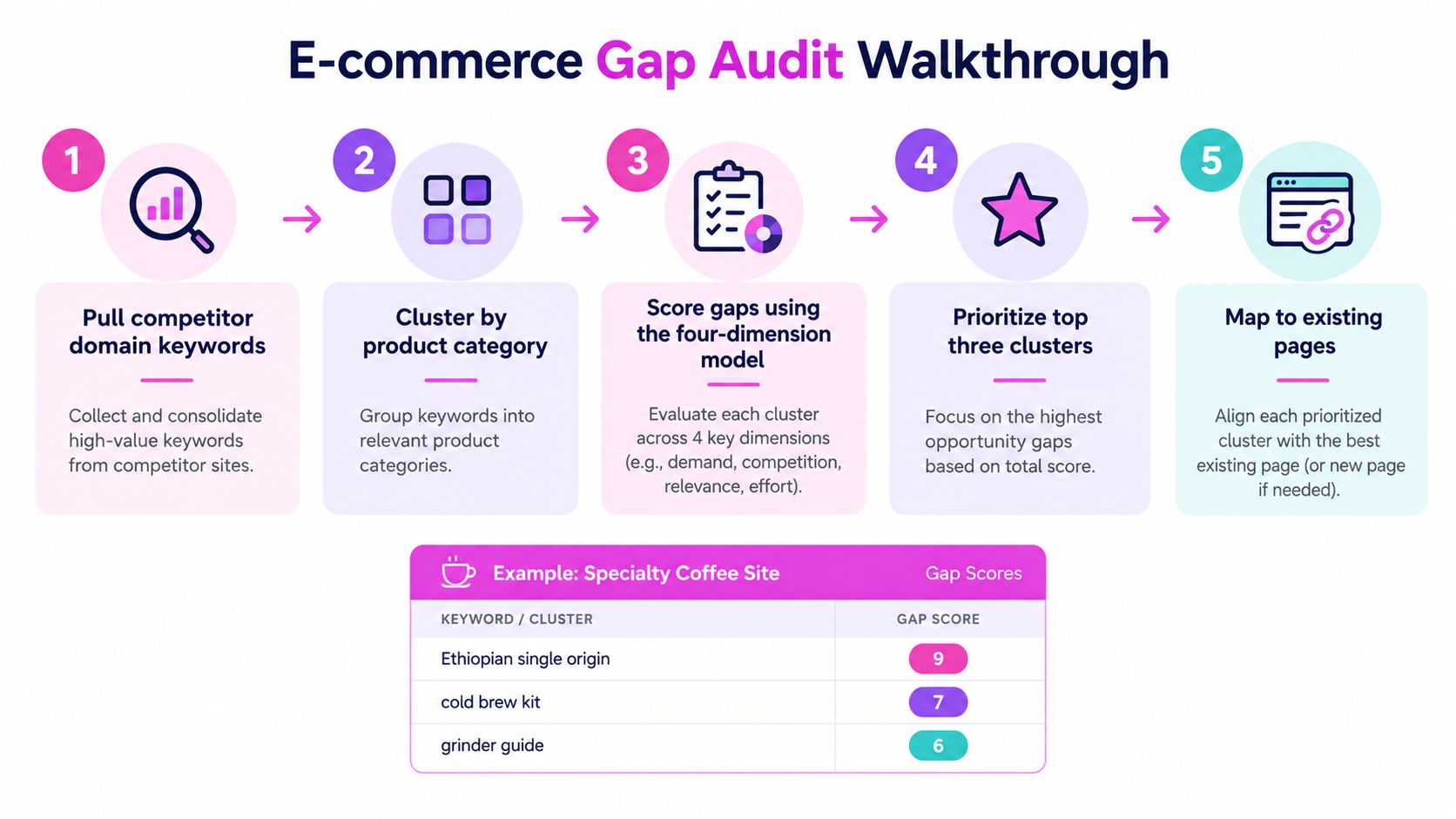
Where the score changed our mind
Two high volume clusters failed on defensibility. One covered generic grinder advice we couldn't support with hands on testing. Another chased broad cold brew interest where our range was thin and the SERP already had strong, specific roundups. Publishing either page would've meant summarizing competitors.
We merged the grinder questions we could answer into an existing buying guide and dropped the rest. That decision was hard to sell until I showed the stakeholder the intended owner URLs. The proposed new page and the existing guide would've targeted the same comparison task, split internal links, and forced users to choose between two similar answers.
Skipping a cluster isn't a failure of ambition. It's what keeps the pages we do publish from competing with each other.
The winner was a mid volume comparison cluster around single origin coffee selection. Searchers weren't asking for another definition. They wanted origin, roast, and brew method tradeoffs they could apply before buying. That task scored well on citation likelihood because it lent itself to short, verifiable statements tied to specific products, and we had tasting notes from our own team to make it defensible.
My brief for that page named the owner URL, the exact competitor pages to beat, the claims we needed to verify, and the sections we would not write. That last part mattered. It stopped the draft drifting into a general bean guide and kept it focused on the decision that made the gap worth closing.
Closing Gaps With Page Architecture, Not More URLs
The fastest way to waste a good gap analysis is to turn every row into a new URL. I've watched a 40-cluster audit become a 40-page publishing calendar, and within two quarters the site had near-duplicate guides splitting internal links and impressions between them.
One page owns the primary intent. Supporting pages get created only when they answer a materially different task: implementation, measurement, troubleshooting. If two proposed URLs would hand the searcher the same answer, I merge them and put the effort into the stronger one.
That discipline pays off beyond cannibalization. The scoring model rewards citation likelihood i defensibility, and both improve when evidence is concentrated. A single deep page with verified claims and first-hand examples is easier for an AI Overview to cite than three thin pages that each repeat part of the answer. Google's guidance on creating helpful, reliable, people-first content asks whether content demonstrates first-hand experience and leaves readers informed without needing another search, and Google states there is no preferred word count. Missing evidence is the gap. Page count won't close it.
Links get planned alongside the draft, not after it. For each page I record the source URL, destination, anchor text, and the reader question the link answers at that point in the page. Google's SEO Starter Guide advice on linking important pages says every important page should be reachable from at least one other discoverable page, which is the minimum I enforce at launch. Anchors describe what the reader will get, and every link uses a real href in an HTML anchor, since Google's documentation on crawlable links notes JavaScript click handlers and elements without href may not be reliably parsed. For the structural thinking behind parent and child pages, site architecture best practices for rankings covers the logic, and I pair it with our reference on web page architecture for SEO when mapping clusters to templates.
One check remains before anything ships. Google's spam policies definition of scaled content abuse covers generating many pages primarily to manipulate rankings when the output adds little original value, regardless of whether automation was involved. Automation can cluster queries and draft briefs in my workflow. A human verifies the claims, examples, product behavior, and links. A page that only swaps a modifier doesn't publish.
Measuring Results at the Query-URL Pair Level
A sitewide average position can improve while the project fails. The wrong URL can be the one ranking. Clicks can stay flat. One strong query can mask dozens of weak appearances. I score gap work at the query and URL pair, because that is the level where cannibalization and intent mistakes become visible.
Before anything ships, I freeze a baseline over a fixed date range: query cluster, intended landing URL, impressions, clicks, click-through rate, and topmost position. Google Search Console's Performance report documentation explains that average position reflects the topmost result from a site across the queries where it appeared, not a mean of every listing. That one detail has explained more false celebrations in my reporting than any other quirk.
After launch I compare the same query set and ask one question per pair: does the intended URL own it? Google's Search Console metric definitions for impressions, clicks, and position count an impression each time a link is seen and rank position 1 as the highest slot, so impressions rising with flat clicks tells me the result is being seen without earning the click. That distinction decides what I fix first.
| Signal in the delta | Likely cause | First move |
|---|---|---|
| Impressions up, clicks flat | Intent or snippet mismatch | Test title and snippet before writing more copy |
| Clicks up, conversions flat | Weak commercial relevance | Review offer fit and next step clarity |
| Several URLs surfacing for one cluster | Cannibalization | Consolidate or sharpen internal links until one owner wins |
| Average position up, traffic flat | One strong query hiding many weak ones | Re-segment the report by pair |
Ranking mechanics are only half the read. On clusters where an AI Overview appears, I also log whether our URL gets cited, because a cited page can hold qualified traffic while classic positions shuffle underneath it.
The checkpoint I trust stays narrow: the right URL, winning the right queries, earning more qualified clicks than its baseline.
Older gap pages get the same pair-level watch. When peers ask how to systematize it, I share how to catch content decay early since a decay table sits cleanly beside the baseline without extra tooling. If a pair slides, I rerun the four scores before touching a word: durable demand, intent stability, citation likelihood, defensibility. Demand moves and claims expire. Which one broke decides whether the page earns a rewrite, a merge, or a retirement.
Your 90-Day Content Gap SEO Rollout
Ninety days is enough if I sequence decisions instead of rushing drafts. I spend the first two weeks mining competitors, clustering by intent, and mapping each cluster to a proposed owner. The exit signal is simple. Every cluster has a format, an owner, and a stated differentiation, or it leaves the queue.
Weeks three and four are for scoring and hard calls. I score durable demand, intent stability, citation likelihood, and defensibility, then label each cluster build, expand, merge, or skip. If SERP history shows the intent flipped recently, I pause and recheck rather than forcing a brief. If we can't add firsthand evidence, I merge or skip, even when a stakeholder loves the volume.
The build and review checkpoints I enforce
From weeks five to eight, we produce only approved pages and expansions. Each brief includes the target task, claims to verify, competitor URLs, internal link sources, and descriptive anchors. Nothing launches as an orphan. Nothing launches as a modifier swapped duplicate.
- Week five checkpoint: Briefs name one owner URL per cluster and list evidence we possess.
- Week six checkpoint: Drafts answer the task early, then support it with examples, constraints, and comparisons.
- Week seven checkpoint: Internal links, anchors, and crawlable HTML are checked before publication.
- Week eight checkpoint: Baselines are frozen so post launch reporting cannot rewrite history.
From week eight onward, I run the query and URL measurement protocol on a fixed cadence. I look for the intended URL taking ownership, clicks moving with impressions, and AI Overview citations where we targeted them. Volatile clusters get scheduled rechecks instead of permanent verdicts. Pages that split a cluster get merged. Pages that win impressions but not clicks get intent and snippet work before any expansion.
My final quality review fits on one page. Does each published URL own a distinct task? Can we defend its claims firsthand? Is it linked from relevant pages with helpful anchors? Are we measuring the exact query set we targeted? If any answer is no, I fix that before opening another gap export. That's how Content Gap SEO stays a discipline instead of a publishing treadmill.
Start your next audit by pulling competitor keyword gaps, URL level rankings, SERP history, and AI Overview citations into one workspace, then score clusters before you brief a single page. Visit SemDash (SemDash) to run that workflow on your own domain and turn missing keywords into decisions you can defend.