%20(1)-B86R08ZzwhPzS6UZbG3mSxRWPCwGwn.png)


Content Gap Analysis: A Step-by-Step SEO Guide

W skrócie:
- A content gap analysis identifies missing topics, keywords, and signals on your site and provides a prioritized plan to address them. Running ongoing audits, focusing initially on near-miss pages, and using impact-effort scoring helps improve rankings and AI visibility efficiently. Continuous review and integration of multiple data sources enable sustained traffic growth and better search performance.
A content gap analysis identifies the topics, keywords, and signals your site is missing, then produces a prioritized roadmap to close them. The one-line workflow: audit your existing content → compare against competitors and SERPs → prioritize by impact and effort → act with targeted updates or new pages.
Three things to do this week:
- Pull your data first: Export Google Search Console queries filtered to positions 6–20, run a full site crawl, and grab a competitor keyword export from a tool like Semdash’s analizy konkurencji SEO.
- Highest-impact 90-day fix: Update pages already ranking in positions 6–15 before building anything new. These near-miss pages need depth and internal links, not a brand-new URL.
- Measure early success by: tracking rank movement on updated pages, impressions growth in GSC, and whether any updated pages begin appearing in AI Overviews.
What types of gaps does a content gap analysis actually cover?
Most practitioners think of gap analysis as a keyword exercise. It is that, but it is also five other things, and skipping any of them leaves real traffic on the table.
Keyword gaps are the most familiar type: queries your competitors rank for that your site does not. A home-improvement site ranking for “how to install crown molding” but missing “crown molding corner cuts” is a classic example. Topic gaps go one level deeper. Your site may cover a keyword but miss the full topic cluster around it, leaving users to bounce and find a more complete resource elsewhere.
Media gaps are easy to overlook. A competitor’s tutorial page outranks yours not because of keyword density but because it includes a step-by-step video and a downloadable template. Users signal preference through engagement, and Google reads that signal. Technical and crawlability gaps are where things get counterintuitive: a page can be well-written and still fail to rank because it is blocked in robots.txt, buried under five redirect hops, or orphaned with no internal links pointing to it. High-quality content can still fail to rank because of site architecture or weak link profiles, so a proper gap analysis always includes a crawl.
Backlink gaps explain why a competitor’s thinner page outranks your more thorough one. If their page has 40 referring domains and yours has 3, authority is the gap, not content. Finally, AI/LLM visibility gaps are the newest category. AI Overviews draw from a small set of pages, and if your competitors appear in those answers and you do not, you are losing visibility that never shows up in a traditional rank tracker.
These types overlap. A technical crawl issue can create what looks like a content gap. A backlink gap can suppress a page that would otherwise rank on merit. Treating them as separate silos is where most audits go wrong.
Why does running a gap analysis move the needle on traffic and conversions?
The business case is straightforward: you already have pages that almost rank. Getting a page from position 11 to position 4 can multiply its click-through rate several times over without the cost of creating something from scratch. Mapping content gaps to the buyer journey adds a conversion layer to that traffic argument. Missing informational content means you never capture users at the research stage; missing transactional content means you lose them right before they buy.
Beyond organic rankings, SERP feature wins (featured snippets, People Also Ask boxes) and AI Overview inclusions are increasingly where visibility lives. Pages structured for short, factual answers and lists are more likely to be pulled into LLM summaries, which means gap analysis now has a direct line to AI-driven traffic.
| KPI | What it measures | Revenue/engagement connection |
|---|---|---|
| Organic impressions | How often your pages appear in SERPs | Signals topical authority growth |
| Organic clicks | Actual visits from search | Direct traffic impact |
| Średnia pozycja | Where you rank for target queries | Predicts CTR and traffic potential |
| Click-through rate (CTR) | Clicks divided by impressions | Reveals title/meta optimization gaps |
| Organic conversions | Goal completions from organic sessions | Ties content updates to revenue |
| AI Overview mentions | How often your pages appear in AI answers | Emerging visibility channel |
A practical goal template: “Recover a significant portion of lost impressions on pages currently ranking in positions 6–15 within a few months by expanding topical depth and adding internal links.” That kind of specific, time-bound target gives your team a clear signal for when the analysis is working.
How to run a content gap analysis step by step
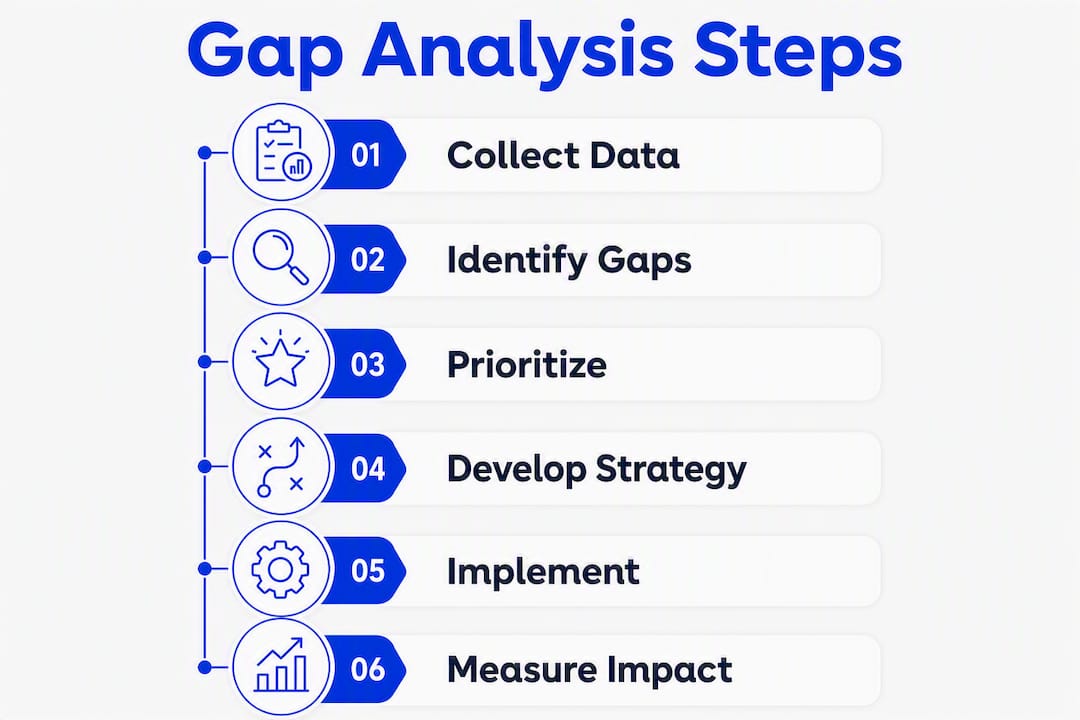
A practical six-step content gap workflow covers keyword gap analysis, content auditing, buyer journey mapping, roadmap creation, underperformer analysis, and regular review. Here is how to execute each phase with specific exports and deliverables.
Step 1: Scope the project. Define your target URL set (full domain, a subfolder, or a topic cluster), name 3–5 direct competitors, and set a 90-day measurement window. Deliverable: a one-page brief with URLs, competitors, and success metrics.
Step 2: Collect your data. Pull four exports simultaneously:
- GSC Performance report filtered to the last 12 months, sorted by impressions, exported as CSV.
- GA4 organic landing page report showing sessions, engagement rate, and conversions.
- Full site crawl using Screaming Frog or a comparable crawler: export all URLs with status codes, indexability, word count, and internal link count.
- Backlink export for your domain and each competitor domain.
Step 3: Run competitor and SERP analysis. Competitor keyword exports are the fastest way to find topics competitors rank for that your site does not. Export each competitor’s ranking keywords, then diff them against your own. Flag every keyword where at least two competitors rank in the top 10 and you do not appear in the top 30. Also run manual SERP checks on your highest-priority gaps: look for missing sections, FAQs, schema types, and media formats in the top-ranking pages.
Step 4: Identify and categorize gaps. Combine your GSC data with the competitor diff. Tag each gap by type (keyword, topic, media, technical, backlink, AI visibility) and by funnel stage (informational, commercial, transactional). Deliverable: a prioritized gap spreadsheet with columns for URL, gap type, funnel stage, current position, competitor benchmark, and recommended action.
Step 5: Map gaps to intent and funnel stage. A keyword like “best CRM for small business” is commercial; “what is a CRM” is informational. Mixing them up in your content plan wastes effort. Group gaps by stage so your editorial calendar addresses the full funnel.
Step 6: Assign recommended fixes and build a 4-week sprint.
- Week 1: Complete data exports and gap spreadsheet.
- Week 2: Prioritize top 10 gaps, write briefs for the top 3.
- Week 3: Publish or update the first two pages.
- Week 4: Measure rank movement, impressions delta, and AI Overview appearance.
Deliverables across the sprint: CSV exports, a prioritized gap spreadsheet, 3 content briefs, and a baseline KPI snapshot.
Which tools and data sources should you use for each step?
The right tool depends on which layer of the analysis you are running. No single platform covers all six gap types, but a well-chosen stack of three or four tools handles the full workflow.
| Tool category | What to export or run | Na co zwrócić uwagę |
|---|---|---|
| Search analytics (GSC) | Performance report: queries, pages, impressions, clicks, position | Queries in positions 6–20 with high impressions but low CTR; pages losing impressions YoY |
| Web analytics (GA4) | Organic landing pages by sessions, engagement rate, conversions | Pages with high traffic but low conversion; pages with declining sessions |
| Site crawler (Screaming Frog or similar) | Full crawl: status codes, indexability, word count, internal links, canonical tags | Orphaned pages, thin content, redirect chains, blocked URLs |
| Backlink tool | Domain-level and page-level referring domain counts for your site and competitors | Pages where competitors have 3x+ more referring domains |
| SERP/AI Overview monitor | Track target keywords for featured snippets, PAA, and AI Overview inclusions | Competitor pages appearing in AI Overviews that yours do not |
| Keyword research / competitor tool | Competitor keyword gap export; semantic cluster report | Keywords where 2+ competitors rank top 10 and you rank below 30 |

Semdash covers several of these categories in a single interface. Its narzędzie do badania słów kluczowych runs competitor keyword gap exports and semantic clustering so you can identify missing topic clusters without switching platforms. The Narzędzie do sprawdzania AI Overview tracks which of your pages appear in Google’s AI-generated answers, a signal most traditional rank trackers still miss. For backlink comparisons, the badań linków zwrotnych exports referring domain counts for your domain and competitors side by side.
Wskazówka Pro: When running a competitor keyword gap export, filter immediately to keywords where at least two competitors rank in positions 1–10. Single-competitor gaps are often niche or brand-specific; multi-competitor gaps signal genuine topical demand your site is missing.
A modern gap analysis must go beyond keyword volumes to include technical crawlability, backlink comparisons, and AI/LLM visibility checks because pages may fail to rank even when content quality is high. The tool stack above covers all three layers.
How do you decide which gaps to close first?
Not all gaps are equal. A keyword with 50,000 monthly searches sounds exciting until you realize it is a transactional query in a category you do not sell, or a topic that would require six months of content production to compete. The impact × effort framework cuts through that noise.

Score each gap on two axes, then multiply them to get a priority score.
| Czynnik | What to score (1–5) | Notes |
|---|---|---|
| Search volume | 1 = under 100/mo; 5 = over 10,000/mo | Use monthly search volume from your keyword tool |
| Intent fit | 1 = poor fit; 5 = exact match to your product/service | Match the query’s intent to your funnel stage |
| Conversion potential | 1 = informational only; 5 = high commercial/transactional | Transactional and commercial queries score higher |
| Current ranking position | 1 = not ranking; 5 = positions 6–15 | Near-miss pages score highest |
| Content creation effort | 1 = major new pillar; 5 = small update to existing page | Invert this: low effort = high score |
| Technical complexity | 1 = requires dev work; 5 = content-only fix | Invert this too |
Priority score formula: (Search Volume + Intent Fit + Conversion Potential + Current Position) × (Content Effort + Technical Complexity) ÷ 2
Pages already ranking in positions 6–15 are often the fastest path to measurable ranking gains. They score high on “current position” and often require only a content expansion rather than a new URL, which keeps effort scores low too.
For a small in-house team, cap your sprint at the top 5 gaps by priority score and focus exclusively on near-miss updates before creating anything new. An agency with bandwidth can run parallel tracks: updates for near-miss pages and new pillar creation for high-volume informational gaps. An enterprise SEO team should layer in a governance column to track page ownership, so updates do not stall waiting for approvals.
Prioritize pages close to ranking (positions 6–15) for updates before building entirely new pages; these are consistently the fastest path to measurable ranking gains across site types and industries.
How to fill gaps: briefs, format decisions, and the update-vs-create call
The update-vs-create decision
Before writing a single word of new content, check whether an existing page already covers the topic. Expanding a page that ranks on page 2 or 3 delivers higher ROI than creating a new page in most cases, because the existing page already has some authority and indexing history.
Use this decision flow:
- Does a page on your site already target this topic or keyword cluster? If yes, go to step 2. If no, create a new page.
- Does that page rank in positions 11–30? If yes, expand it. If it ranks below 30 or not at all, assess whether the page has strong internal links and a reasonable backlink profile before deciding.
- Does the page cover the core subtopics the top-ranking competitors cover? If it misses more than two major subtopics, a targeted expansion plus internal link updates is the right call. If the page is fundamentally off-intent, canonicalize it and create a new one.
Content brief template
Every gap that moves to production needs a brief. Required fields:
- Target keyword and intent: Primary keyword, search intent (informational/commercial/transactional), and 3–5 secondary keywords.
- Audience and objective: Who is reading this, and what should they do after reading it?
- Recommended sections: H2/H3 outline based on top-ranking competitor pages and PAA questions.
- Required entities: Named tools, standards, or organizations that must appear to match topical depth.
- Suggested internal links: 2–4 pages on your site to link from and to.
- CTAs: What action should the page drive (trial signup, download, contact form)?
- Measurement criteria: Which KPIs will confirm this page is performing (rank, CTR, conversions)?
Implementation checklist for publishing
- [ ] Internal links added from at least 2 relevant existing pages
- [ ] Schema markup applied (Article, FAQ, HowTo as appropriate)
- [ ] Meta title and description updated to match current intent
- [ ] Images or video added where competitors use media
- [ ] CTA aligned to funnel stage
- [ ] Page submitted for indexing via GSC URL Inspection
- [ ] Baseline KPIs captured in your reporting dashboard
For A/B testing, run title tag variants using GSC’s performance data as a proxy: change the title, wait 4 weeks, and compare CTR before and after. Full split testing on content requires a dedicated tool, but title and meta testing is accessible to any team with GSC access.
How to measure the impact of gap fixes and report to stakeholders
Short- and mid-term metrics to track
Rank movement is the first signal to watch, but it is not the only one. Impressions often increase before clicks do, so a page gaining impressions in GSC is a leading indicator that the update is working. Clicks and CTR follow as rankings stabilize. Engagement metrics (time on page, scroll depth, bounce rate in GA4) tell you whether the updated content is actually satisfying user intent once they arrive.
Conversions are the lagging indicator. Expect 6–12 weeks before content updates show meaningful conversion movement, especially for informational pages that feed a longer funnel.
| Metryka | Reporting cadence | Stakeholder relevance |
|---|---|---|
| Rank movement (target keywords) | Co tydzień | Shows immediate impact of updates |
| Organic impressions | Co tydzień | Leading indicator of topical authority growth |
| Organic clicks | Co tydzień | Direct traffic impact |
| CTR | Miesięczny | Signals title/meta effectiveness |
| Engagement rate (GA4) | Miesięczny | Confirms content quality improvement |
| Organic conversions | Miesięczny | Ties updates to revenue |
| AI Overview mentions | Miesięczny | Tracks emerging visibility channel |
Reporting cadence
Weekly sprint updates should cover rank movement on pages updated that week, any new AI Overview appearances, and a quick flag if impressions dropped on any priority page. Keep these to a single dashboard screenshot and three bullet points.
Monthly impact reports compare the current month’s organic clicks and conversions against the prior month and against the baseline captured before the gap analysis began. Include a “wins” section (pages that moved from page 2 to page 1) and a “watch list” (pages that have not moved after 6 weeks).
Quarterly strategic reviews are where you reassess the full gap list, retire closed gaps, and add new ones based on fresh competitor exports and SERP changes.
Attribution guidance
Separating the impact of a content update from external factors (seasonality, algorithm updates, competitor changes) is genuinely difficult. The most practical approach: document the exact date of every content change in a shared log, then compare GSC impressions and rank data for the 4 weeks before and after each change. When a ranking spike coincides with an algorithm update rather than your change, note it in the log so stakeholders do not misattribute the gain.
Why treating gap analysis as a continuous loop changes your results
One-off audits produce a spreadsheet that goes stale within 90 days. Competitors publish new content, Google updates its ranking signals, and AI Overviews reshuffle which pages get cited. Many teams treat gap analysis as a one-off audit; the real advantage comes from embedding the analysis into a recurring team rhythm so findings continuously feed content, technical, and outreach work.
The continuous loop has four phases: detect (run monthly exports from GSC, your crawler, and your competitor tool), act (update or create based on the priority matrix), measure (track KPIs against baseline), and iterate (feed results back into the next detection cycle).
AI/LLM monitoring steps
A modern SEO gap analysis should assess AI Overview inclusion because AI-generated answers draw from a small set of pages and can displace traditional SERP visibility. To monitor this:
- Track which of your target keywords trigger an AI Overview in Google Search.
- Check which competitor pages appear in those overviews and analyze their structure: are they using FAQ schema, numbered lists, or short definitional paragraphs?
- Update your pages to match those structural signals. Pages structured for short, factual answers, lists, and FAQs are more likely to be pulled into LLM summaries.
For broader AI search visibility, monitor whether your brand or pages appear in ChatGPT, Perplexity, or other LLM-based tools when users ask questions in your topic area. This is still a manual process for most teams, but it is worth a monthly spot check on your top 10 priority topics.
Wskazówka Pro: Assign AI Overview monitoring to one person on your team as a standing monthly task. Even 30 minutes of spot-checking your top 20 keywords for AI Overview appearances will surface structural changes you need to make before competitors lock in those citations.
Team rhythm recommendation
| Role | Monthly task | Quarterly task |
|---|---|---|
| SEO lead | Run GSC and crawler exports; update priority matrix | Full competitor keyword gap refresh |
| Content strategist | Brief and assign top 3 gaps | Review funnel coverage and topic cluster map |
| Developer/technical SEO | Clear crawl errors flagged in monthly crawl | Audit site architecture for orphaned pages |
| Analytics lead | Publish monthly impact report | Attribution review and KPI recalibration |
Kluczowe wnioski
A content gap analysis is most effective when it runs as a continuous loop covering keyword, technical, backlink, and AI visibility gaps, not as a one-time keyword export.
| Punkt | Szczegóły |
|---|---|
| Start with near-miss pages | Pages ranking in positions 6–15 are the fastest path to measurable gains; update before creating new content. |
| Cover all six gap types | Keyword, topic, media, technical, backlink, and AI/LLM visibility gaps each require different data sources and fixes. |
| Use an impact × effort matrix | Score each gap on search volume, intent fit, conversion potential, position, and effort to build a defensible priority order. |
| Measure with a KPI stack | Track impressions, clicks, CTR, engagement rate, organic conversions, and AI Overview mentions across weekly and monthly cadences. |
| Semdash for the full workflow | Semdash covers keyword gap exports, AI Overview monitoring, SERP tracking, and backlink comparisons in one platform. |
The gap analysis mistake most teams keep making
The conventional wisdom says: find the keywords your competitors rank for, write pages targeting those keywords, and watch your traffic grow. That framing is not wrong, but it is incomplete in a way that costs teams months of wasted effort.
The most common failure mode is treating gap analysis as a content production trigger rather than a diagnostic process. Teams export a competitor keyword list, brief 20 new articles, publish them, and then wonder why nothing moved. The answer is almost always one of three things: the new pages are thin (they target the keyword but do not match the depth of the top-ranking pages), the site has crawlability issues that prevent new pages from being indexed efficiently, or the pages have no internal links pointing to them and no referring domains, so they start with zero authority.
The fix is to run the diagnostic before you brief a single piece of content. Pull the crawl first. Check internal link counts on your near-miss pages. Compare backlink profiles before deciding whether a content update or a link-building campaign is the right lever. Only after that diagnostic should you open a content brief.
There is also a subtler mistake: over-prioritizing high-volume informational keywords because they look impressive in a report. A 50,000-search-per-month informational query that converts at 0.1% is worth less than a 500-search-per-month transactional query that converts at 8%. The prioritization matrix in this guide forces you to score conversion potential explicitly, which is the only way to avoid chasing vanity traffic.
The teams that get the most out of gap analysis are the ones who treat it as a standing process, not a project. Monthly exports, a shared priority spreadsheet, and a clear owner for each gap type. That discipline compounds over time in a way that a quarterly audit never does.
Semdash gives you the gap analysis workflow in one place
Running a full gap analysis typically means juggling four or five tools, exporting CSVs from each, and manually reconciling the data in a spreadsheet. Semdash consolidates the core steps: competitor keyword gap exports, semantyczne grupowanie słów kluczowych, SERP tracking with historical data, AI Overview monitoring, and backlink comparisons all live in a single interface.
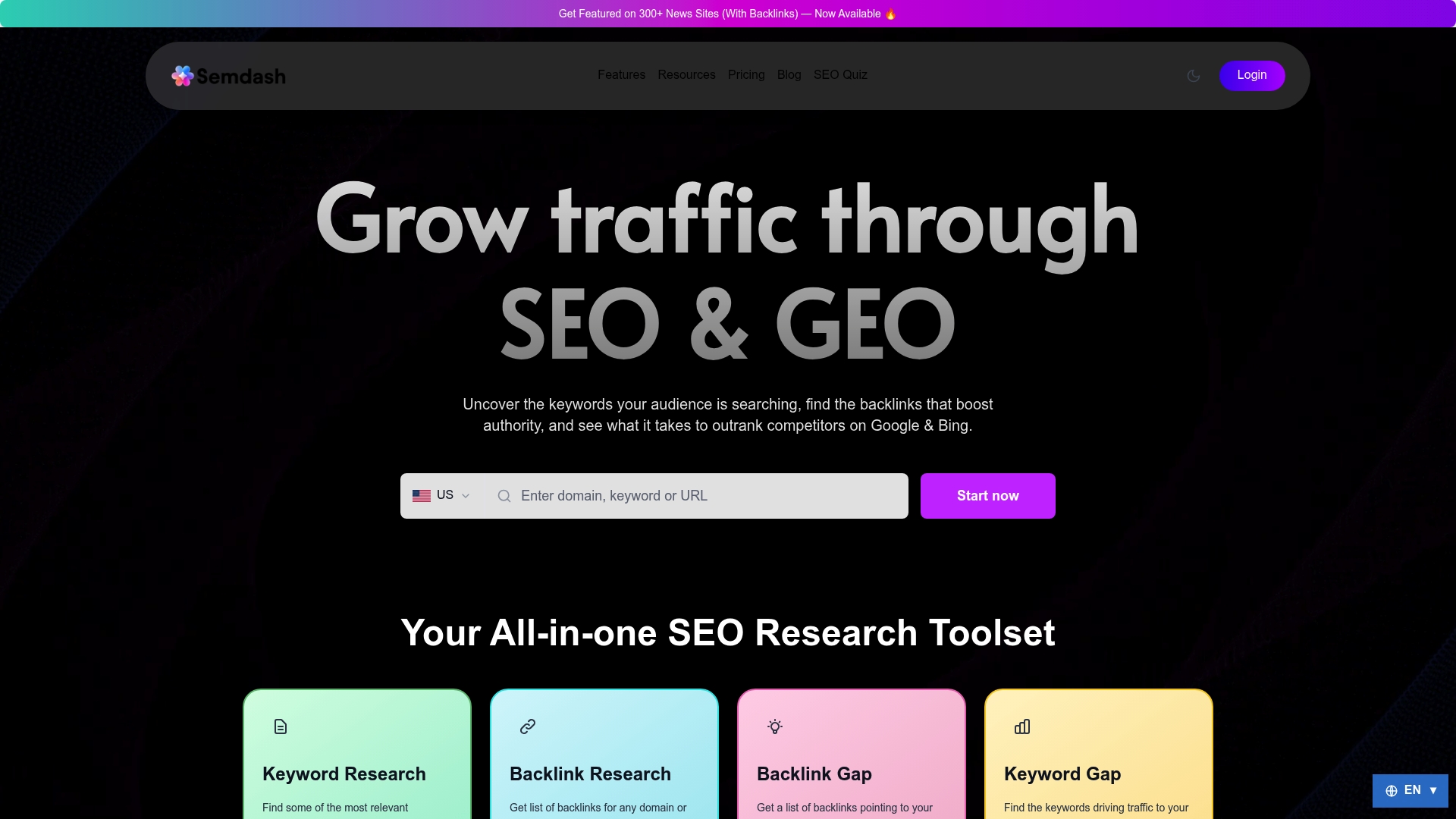
For teams running this workflow for the first time, the practical starting point is a competitor keyword gap export using Semdash’s competition analysis tool. Enter your domain and up to five competitors, filter to keywords where two or more competitors rank in the top 10 and you do not, and export the list. That single export typically surfaces 30–50 high-priority gaps a team can act on immediately. Pair it with the AI Overview checker to flag which of those gaps already have AI-generated answers your competitors appear in, and you have a prioritized list that covers both traditional SERP and AI visibility in one pass.
Semdash runs on a tiered, credit-based subscription, and the free tools page lets you run an initial export before committing to a plan. Start there, apply the prioritization matrix from this guide, and you will have a defensible 90-day content roadmap within a few hours.
Przydatne źródła i dalsza lektura
| Resource | What it covers | Why it is useful |
|---|---|---|
| Shopify: Content Gap Analysis Guide | Six-step workflow, buyer journey mapping, deliverables | Solid operational framework with practical examples |
| HubSpot: Content Gap Analysis and Marketing Strategy | Funnel stage mapping, conversion-focused framing | Best resource for connecting gap analysis to conversion goals |
| Backlinko: Content Gap Analysis | Near-miss page strategy, update vs. create guidance | Practitioner-focused; strong on prioritization logic |
| Neil Patel: What Is a Content Gap Analysis? | Competitor keyword exports, manual SERP review steps | Good on the mechanics of running competitor diffs |
| Search Engine Land: SEO Gap Analysis Guide | AI Overview inclusion, technical and backlink signals | Most current resource on AI/LLM visibility in gap analysis |
| Semdash: AI Search Visibility Guide | How AI-driven search affects organic visibility | Practical guide for extending gap analysis to LLM monitoring |
| Semdash: Competitive Keyword Analysis | Competitor keyword exports and strategy | Step-by-step guidance on running competitor diffs in Semdash |
FAQ
What are the three fundamental components of a gap analysis?
A content gap analysis covers three core components: identifying what content or keywords your site is missing relative to competitors, assessing why those gaps exist (content depth, technical issues, or backlink weakness), and prioritizing which gaps to close first based on impact and effort.
What is an example of a content gap analysis in practice?
A SaaS company runs a competitor keyword export and finds that two competitors rank in the top 5 for “CRM onboarding checklist” while their site does not appear in the top 50. They audit their existing CRM content, find a near-miss page ranking between 11 and 30, expand it with a downloadable checklist and FAQ section, and track rank movement over the following 6 weeks.
What are the four steps of a content gap analysis?
The four core steps are: (1) collect data from GSC, GA4, a site crawl, and competitor keyword exports; (2) identify gaps by comparing your rankings against competitors and SERP features; (3) prioritize gaps using an impact × effort scoring matrix; and (4) act by updating near-miss pages or creating new content based on a structured brief.
What should a content gap analysis report include?
A complete report includes a prioritized gap spreadsheet (with gap type, funnel stage, current position, and recommended action), content briefs for the top opportunities, a baseline KPI snapshot, and a reporting dashboard tracking impressions, clicks, CTR, organic conversions, and AI Overview mentions.
How often should you rerun a content gap analysis?
Run a full competitor keyword gap export monthly and a comprehensive audit covering technical, backlink, and AI visibility signals quarterly. Near-miss page performance should be reviewed weekly during any active sprint.