%20(1)-B86R08ZzwhPzS6UZbG3mSxRWPCwGwn.png)


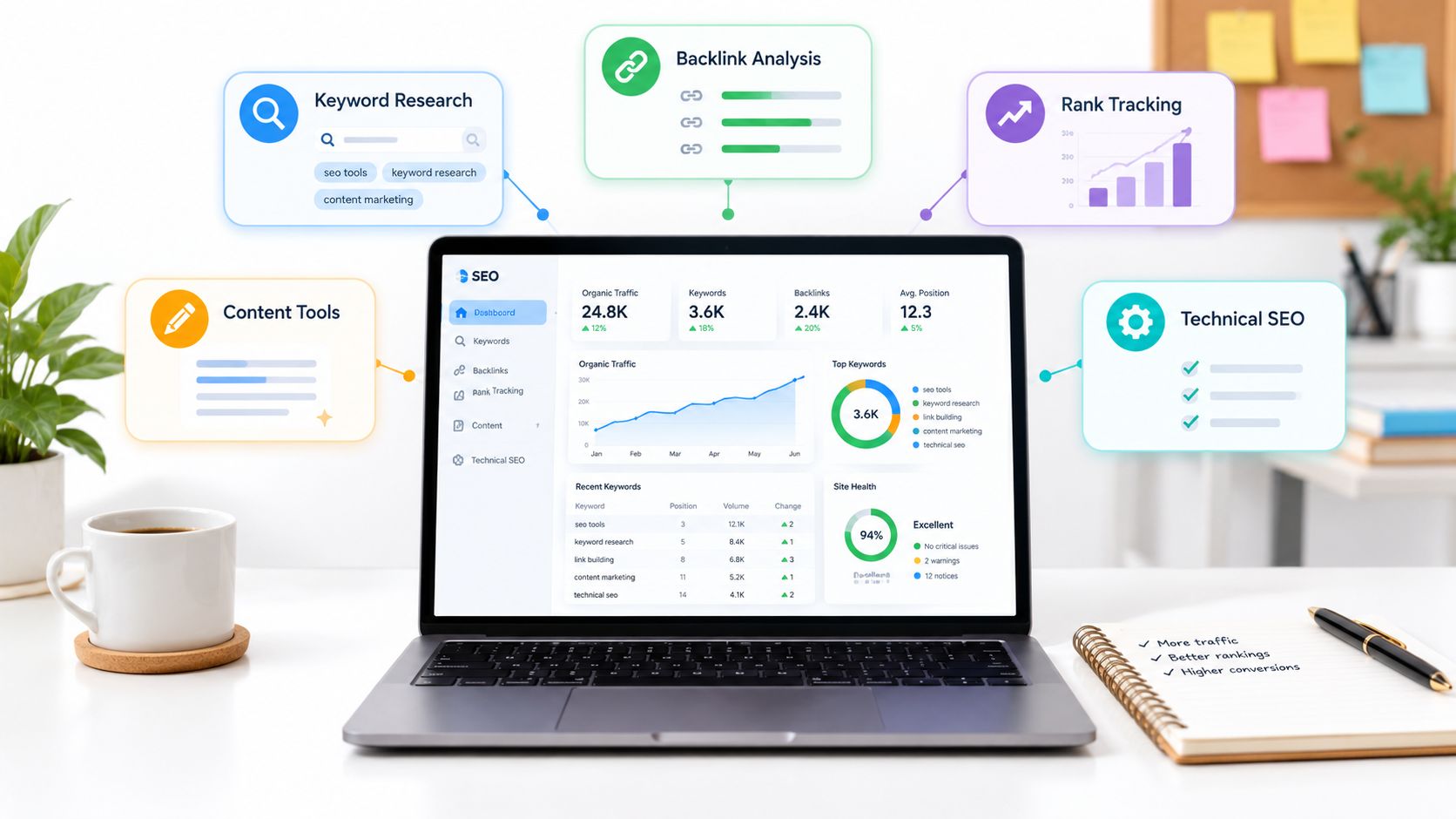
The biggest SEO platform isn't automatically the best one. A large dashboard can still leave your team guessing about which page to update, which competitor link to pursue, or whether a ranking change reflects a real problem.
I choose software for SEO by the recurring job it needs to perform: finding opportunities, validating search intent, tracking movement, improving pages, auditing technical issues, and earning links. I then compare data coverage, workflow speed, usage limits, collaboration, reporting, and total cost. A platform that looks impressive in a demo but slows down daily research is a poor investment.
This list is organized around those jobs rather than feature checklists. SemDash is especially relevant for teams that want keyword, backlink, SERP, competitor, content-planning, and link-reclamation workflows in one workspace. I also use specialist tools when a focused crawler, link index, or content editor does a job better than an all-in-one suite. The same principle applies to video SEO for creators, where the right workflow matters more than buying the broadest marketing platform.
Spis treści
- 1. SemDash
- 2. Ahrefs
- 3. Semrush
- 4. Moz Pro
- 5. SE Ranking
- 6. Serpstat
- 7. Majestic
- 8. Screaming Frog SEO Spider
- 9. Surfer
- 10. SpyFu
- Top 10 SEO Software Comparison
- Build the Smallest Stack That Covers the Job
1. SemDash
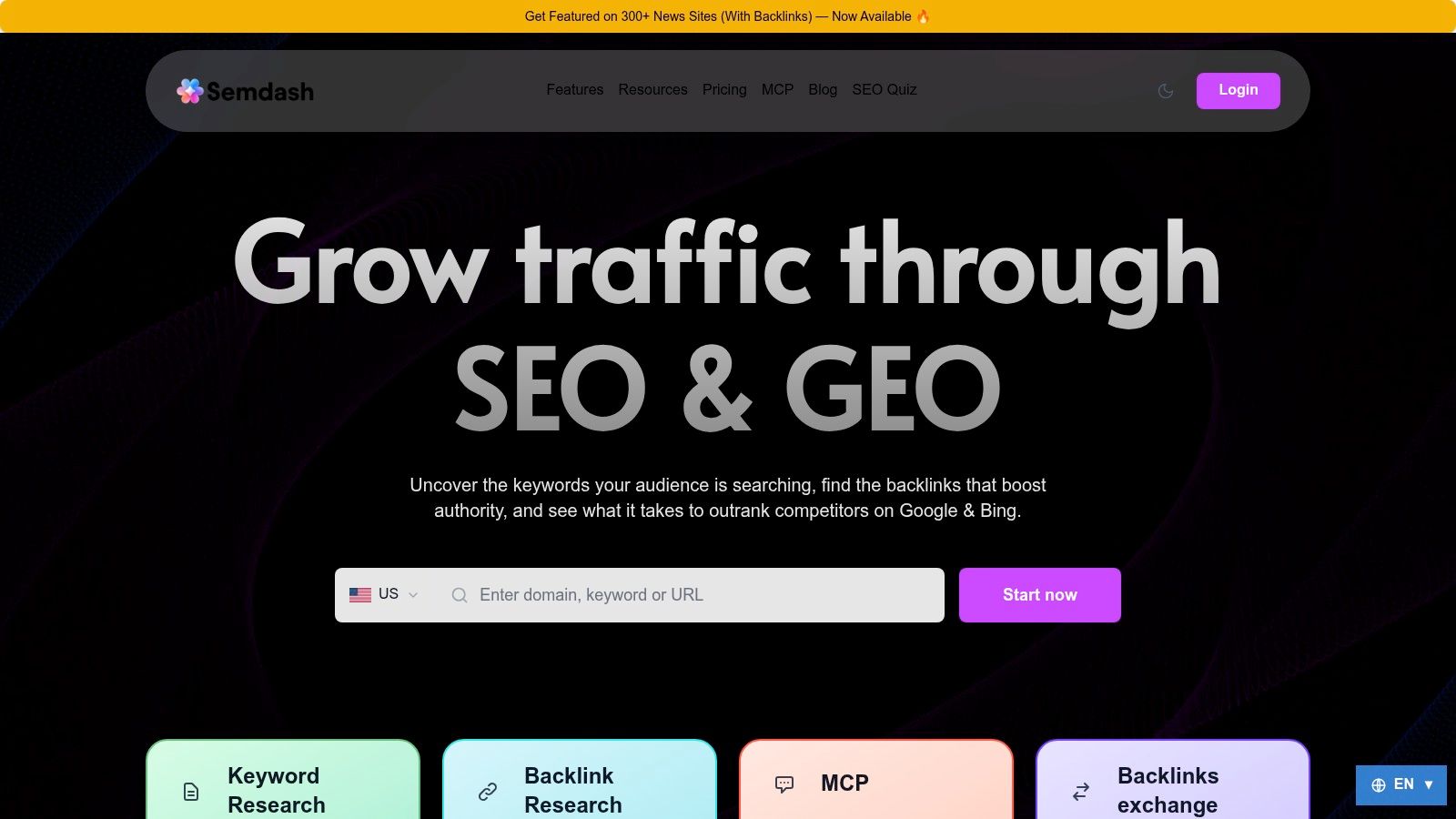
SemDash (SemDash) is the strongest fit here for teams that want competitive research and action planning in one browser-based workspace without starting with the complexity of a large enterprise suite. It brings keyword, backlink, SERP, competitor, and content workflows together, which matters because I rarely research a keyword in isolation. I want to know which URL ranks, what competitors cover, who links to those pages, and whether the query still deserves a new article.
The platform advertises a database of 6.6 billion Google keywords, a 2.7 trillion link index, and approximately 600 million SERPs, with the keyword database updated within the last 30 days, backlink crawling activity from the last 24 hours, and monthly SERP refreshes. These are advertised product capabilities, so I'd still validate coverage against my own market before making a long-term decision. The useful part isn't the headline scale alone. It's the URL-level mapping that connects a keyword to the precise page ranking for it.
Where SemDash saves workflow time
I'd start with Domain Keywords, Keyword Gap, Competitor Domains, and Top Pages. From there, I can build a page-level content plan instead of handing writers a list of disconnected terms. Long-tail suggestions, People Also Ask, People Also Search, clustering, and live SERP intent classification help reduce cannibalization before production begins.
The backlink workflow is equally practical. Backlink Gap identifies domains linking to competitors but not to the target site, while anchor context, unlinked mentions, and broken-backlink recovery turn research into outreach tasks. Its AI Overviews visibility feature also lists keywords that trigger domain mentions and the exact URLs cited, which is increasingly relevant as visibility extends beyond blue links. Google AI Overviews appeared in 13.7% of queries in an independent audit of 55,393 searches, so I wouldn't treat citation tracking as a novelty anymore (Cognizo's AI Overview study).
Praktyczna zasada: Use SemDash to identify the page and the opportunity first. Only then decide whether the task needs a new article, a refresh, internal links, outreach, or no action.
SemDash also offers AI-assisted briefs, MCP access for Claude and ChatGPT, SERP history, volatility checks, multilingual support, and an optional service for getting featured on news sites with backlinks. The trade-off is that some users report fewer returned keywords for certain domains than top-tier competitors, and bulk multi-domain analysis may be more limited. The free-start flow is attractive, but exact official plan prices aren't listed in the supplied product information. My verdict is straightforward: SemDash is a strong budget-conscious core platform, especially for agencies, SaaS teams, e-commerce sites, and content marketers who value speed and connected workflows. Validate depth for your niche before replacing a specialist tool.
2. Ahrefs
A competitor's strongest page can reveal more than a keyword list. With Ahrefs powiedział: Site Explorer, I can trace the page's organic keywords, traffic estimates, referring domains, and link profile, then decide whether to build a better resource, pursue a partnership, or use a different content format. That makes it a practical choice when competitor research and backlink discovery drive the workflow.
Content Gap and Competitor Gap are most useful for sites that already publish regularly but lack a clear publishing plan. I export the gaps, group terms by search intent, and inspect the live SERP before assigning a page. That final check prevents a keyword-driven brief from overlooking the format, authority, or search intent already winning. It also helps decide whether my response should be a better resource or part of a keyword-driven publishing plan (keyword research guide).
Site Audit covers crawl diagnostics, while Rank Tracker and historical data help distinguish a gradual decline from a sudden shift. Brand Radar adds AI visibility research, and Looker Studio connectors plus API options support reporting and custom workflows. Ahrefs Free gives verified site owners access to core data for properties they control.
Kompromis
Ahrefs is particularly strong for link index depth and historical competitor research. Its costs scale with users, credits, and add-ons, while daily rank updates are not the default. Weekly tracking is standard, so teams needing same-day alerts after a launch or migration may need another monitoring option.
The platform can be excessive for a small site that runs occasional keyword research. If the recurring job is technical crawling or content briefing, specialist tools may provide a better fit and avoid unused capacity. For teams that need detailed competitor reverse-engineering and can turn exports into assigned work, Ahrefs earns its place in the stack. Overseen as part of a smaller, job-based stack, it is less likely to duplicate tools bought for audits or rank tracking.
3. Semrush
Semrush powiedział: works best when SEO sits inside a wider marketing operation. Its Position Tracking, Site Audit, keyword research, competitor reports, Share of Voice, cannibalization analysis, reporting tools, and content and PR add-ons create a broad operating layer for agencies and in-house teams.
I find its value in the connections between reports. A team can move from a competitor discovery exercise to a keyword gap, then into tracking and client reporting without exporting every intermediate result. Higher tiers add deeper governance, multi-user workflows, and broader visibility reporting. Its AI Visibility reports are designed to monitor classic SERPs alongside AI surfaces, which fits teams already measuring brand presence beyond organic clicks.
Where it fits, and where it doesn't
Semrush is a good choice when several people need the same source of truth. An agency can standardize project tracking and reports, while an in-house team can connect SEO movement to competitive research and broader marketing reporting. I'd be more cautious with a solo consultant who needs only a clean keyword and backlink workflow.
The interface can feel heavy because the platform covers so many jobs. Limits also scale by plan, and useful features are often placed in higher tiers or add-ons. That creates a common failure mode: a team buys breadth, then uses only rank tracking and basic keyword research.
AI visibility deserves its own measurement framework. Recent coverage estimates that around 60% of searches end without a click, while another 2026 source estimates AI-enhanced search may already have reduced organic traffic by 15% to 25% and could reduce it further by roughly 25% by 2026 (G2's SEO statistics coverage). Those figures come from the cited coverage, but the operational lesson is mine: Semrush should be judged by whether its reports change content, brand, and distribution decisions, not by how many dashboards it contains.
4. Moz Pro
Moz Pro is the approachable all-in-one option. I'd put it in front of a team that needs campaigns, Site Crawl, Rank Tracking, Link Explorer, and Keyword Explorer without asking new users to learn an extremely dense interface on day one.
Campaign-based tracking is the main advantage. A team can monitor its site and competitors, review crawl issues, and keep recurring reporting in one place. Moz's documentation and learning resources also reduce the training burden, which matters when the person implementing SEO is a content lead, product marketer, or generalist rather than a dedicated technical SEO.
Najlepszy przypadek użycia
Moz Pro handles fundamentals well. Site Crawl can surface technical issues, Keyword Explorer supports discovery and prioritization, and Link Explorer adds domain and page-level link analysis. DA and PA metrics can be useful as directional comparison signals, provided the team doesn't confuse them with Google ranking factors.
The limitations become clearer in international and link-heavy research. Moz's link index depth and international keyword coverage can lag larger competitors in some markets. Advanced AI and LLM visibility coverage is also newer than in tools built more aggressively around that use case.
I'd choose Moz when usability and enablement matter more than maximum database depth. I wouldn't choose it for a specialist link prospecting operation or a multinational program that depends on the broadest possible regional coverage. Its strength is helping a team perform the basics consistently. That can beat a more powerful tool sitting unused because nobody understands the workflow.
5. SE Ranking
SE Ranking is one of the better fits for SMBs and agencies that need a full-stack platform with flexible limits. It combines daily rank tracking, site audits, competitor research, keyword grouping, backlink research, on-page checks, reporting, and collaboration features.
The daily tracking and multi-location support are useful for local and regional programs. I'd use it to monitor the same keyword across devices and locations, then connect ranking changes to a page audit or SERP review. The On-Page Checker is helpful when a writer or strategist needs a page-level task list rather than a raw crawl export.
Value without pretending it replaces everything
SE Ranking offers a 14-dniowego darmowego okresu próbnego, and its upgrade path is clear, which makes testing easier before a team commits. The platform also supports exports, reporting, collaboration seats, and an optional API. Its AI search visibility features include SERP and AI Overview tracking, although deeper GEO and AI limits require higher tiers or add-ons.
The trade-off is data depth. Some third-party databases are smaller than those of the largest incumbents, so I'd test representative competitors rather than assume equivalent coverage. That test should include the actual countries, languages, devices, and industries the team serves.
I'd recommend SE Ranking when reporting and day-to-day rank monitoring matter more than owning the deepest possible backlink database. It's also a sensible core platform for a small agency managing several clients, provided the team checks how location limits, crawl allowances, seats, and exports affect the recurring workflow. A lower entry cost only helps if the plan supports the work after the trial ends.
6. Serpstat
Serpstat brings keyword research, competitor analysis, rank tracking, backlink analysis, site audits, collaboration, and API access into one interface. It's a practical option for teams that want annual-plan value and larger-scale access without immediately moving to the most expensive enterprise platforms.
Its keyword and site research spans more than 230 regional databases, which can be useful for teams working across multiple markets. I'd use the platform to build regional keyword sets, compare competitor visibility, and monitor daily ranking movement before handing findings to content or account teams. White-label reporting also makes it relevant for agencies.
A capable platform that needs orientation
Serpstat's interface has enough depth that new users need a defined process. Without one, teams tend to jump between keyword, domain, and audit reports and collect data without turning it into decisions. I'd establish saved workflows for competitor discovery, content gaps, technical triage, and monthly reporting.
The platform includes AI Overviews tracking and growing AI or LLM visibility features, but advanced use cases still need careful validation. Backlink and keyword volumes may trail the biggest players in some markets, so I'd compare a fixed set of known ranking domains before buying on the basis of database claims alone.
Serpstat fits a team that values a broad toolkit, generous limits, and API or agency functionality. It isn't the obvious pick for a link specialist, and it may feel too involved for a beginner who only needs keyword suggestions. Its value appears when one workspace can replace several smaller subscriptions without creating a new training problem.
7. Majestic
Majestic earns a place when backlink intelligence is the missing piece in an otherwise capable SEO stack. It is not a keyword, content, or technical audit platform. Its narrower scope suits backlink profiling, link prospecting, topical analysis, and recovery work.
Majestic's Fresh and Historic indexes let you cross-reference current link patterns against past authority (backlink research workflows) to identify prospects worth outreach. Fresh data shows active relationships, while historical data can expose lost links, older authority patterns, and changes in a competitor's profile. Site Explorer, Link Context, Link Graph, Clique Hunter, backlink history, bulk tools, raw exports, and API access give specialists several ways to investigate.
Trust Flow i Topical Trust Flow help sort prospects by quality and relevance. For a B2B software page about technical audits, I prioritize prospects scoring above 30 on Trust Flow that also match the target page's topical cluster, rather than reaching for any high-metric domain. I then check whether the placement is editorially relevant, the page is live, and the outreach reason is credible. Metrics guide the shortlist, not the final decision.
A backlink tool should shorten the path from “this competitor has a link” to “this is a credible prospect with a reason to respond.”
The trade-off is clear. Majestic has limited keyword and technical SEO capabilities, and its utilitarian interface is less polished than broad suites. I would add it for serious link intersect, topical mapping, recovery, or raw-data work, not as the only platform for a content-led program. Teams needing only a first-pass backlink gap may get enough from an all-in-one platform.
8. Screaming Frog SEO Spider
Screaming Frog SEO Spider is the tool I reach for when the question is technical and URL-level. It crawls sites to expose broken links, redirect chains, duplicate content, rendering problems, internal linking issues, missing metadata, and custom data points that broad platforms often summarize too aggressively.
Its strength is configuration. Spider, List, and Compare modes support different audit situations, while JavaScript crawling, custom extraction, crawl comparisons, integrations with Google Analytics, Search Console, and PageSpeed Insights, scheduling, and Looker Studio reporting make it useful beyond a one-off crawl.
Use it before and after risky changes
For a migration, I'd crawl the old and new environments, compare status codes and canonical behavior, then segment the results by template or directory. For a content audit, I'd combine crawl data with Search Console exports and filter for pages that are indexable but weakly linked, duplicated, or missing important elements. That workflow is more useful than sending a developer a giant undifferentiated error list.
The trade-off is that it's desktop-based. Very large crawls depend on the machine's memory and configuration, and new users need time to understand filters, segmentation, rendering settings, and exports. It also isn't a keyword, backlink, or competitive research suite.
The tool is especially good when the team already has a core research platform and needs a technical specialist. I wouldn't replace Semrush, Ahrefs, or SemDash with it. I'd pair it with one of them when technical audits, migrations, JavaScript rendering, or custom extraction are recurring jobs.
9. Surfer
Surfer is built for the editorial part of SEO. Its Content Editor, Audit, Content Planner, AI-assisted briefs, NLP and entity suggestions, and SERP-based recommendations help writers turn a target query into a structured draft and then revise an existing page.
The useful distinction is that Surfer sits close to production. A strategist can study the live SERP, create a brief, give a writer guidance on topic coverage and structure, and review the page without handing over a raw keyword export. The optional Rank Tracker add-on can help connect content work to movement, while integrations support publishing and collaboration workflows.
Avoid optimizing for a score
Content scores are directional. I wouldn't instruct a writer to add terms until a meter turns green. That often produces repetitive copy, weak explanations, and pages that match competitors without offering a better answer. I use Surfer to identify missing subtopics, questions, entities, and format expectations, then apply editorial judgment.
Its limits are structural. Surfer is focused on on-page content and doesn't provide deep backlink or technical SEO capabilities. Modular add-ons can also make the total cost harder to predict, and some users perceive the pricing as having risen over time.
Surfer fits a content team that already knows which topics deserve investment. It isn't the right first purchase for a site that hasn't fixed crawlability, chosen a clear information architecture, or researched competitors. Use it to improve production quality and refreshes, not to compensate for weak strategy.
10. SpyFu
SpyFu is a competitive intelligence tool for teams that want SEO and PPC research in the same workflow. It reveals competitor ranking keywords, Google Ads history, ad copy, budget estimates, SERP tracking, and gaps that may inform both organic and paid planning.
I'd use SpyFu early in market research. Start with several genuine competitors, compare their organic and paid coverage, save recurring themes, and then validate promising terms in the live SERP. Seeing that a competitor repeatedly invests in a query can help a team understand commercial importance, but it doesn't prove that the query is right for the site.
Affordable does not mean automatically accurate
SpyFu offers an affordable entry point and unlimited searches on paid plans, while reporting, exports, an optional API, and the RivalFlow AI add-on support broader workflows. The PPC layer is the differentiator for marketers who need to understand how competitors divide attention between ads and organic results.
The estimates can differ from larger SEO suites, and its backlink and keyword databases are smaller than those of all-in-one leaders. I'd never present search volume, traffic estimates, or budget figures as ground truth without checking actual SERPs, Search Console data, and campaign performance.
SpyFu is a good complement for competitor reconnaissance and cross-channel planning. It's less suitable as the only platform for technical audits, link prospecting, or deep content operations. Buy it when paid and organic intelligence belong in the same decision, not because another keyword database sounds useful.
Top 10 SEO Software Comparison
| Narzędzie | Kluczowe funkcje | UX & Quality | Value & Pricing | 👥 Target audience | ✨ Unique selling points |
|---|---|---|---|---|---|
| SemDash (SemDash) 🏆 | Keywords (6.6B), Backlinks (2.7T), SERP history, Gap reports, AI briefs | ★★★★☆ Fast, simplified web app; AI Overviews | 💰 Budget-friendly, free trial (no public rates) | 👥 SEOs, agencies, SMBs, content & growth teams | ✨ URL-level mapping, AI-assisted briefs, unlinked-mention & broken-link recovery, optional PR backlinks |
| Ahrefs powiedział: | Site Explorer, Keywords Explorer, Site Audit, Rank Tracker, API | ★★★★★ Market-leading link depth & historical data | 💰 Premium; scales with users/add-ons | 👥 Consultants → Enterprise teams | ✨ Deep link index, extensive exports, strong historical trends |
| Semrush powiedział: | Position tracking, Site Audit, Keyword & Competitor research, AI visibility | ★★★★ Broad feature set; heavier UI | 💰 Higher tiers for full features & add-ons | 👥 Agencies, in-house marketing teams | ✨ Cross-channel reporting, PR/social integrations, Share of Voice |
| Moz Pro | Campaigns, Site Crawl, Keyword Explorer, Link Explorer | ★★★★ Approachable UI; strong docs | 💰 Mid-tier, approachable pricing | 👥 Small teams, beginners, local SEOs | ✨ Gentle learning curve, solid fundamentals & education |
| SE Ranking | Daily rank tracking, Site Audit, Keyword grouping, SERP/AI overviews | ★★★★ Value-focused UX | 💰 Flexible, cost-effective plans; 14-day trial | 👥 SMBs & agencies needing reporting seats | ✨ Transparent limits, reporting/collaboration features |
| Serpstat | Keyword & backlink across 230+ DBs, Rank Tracker, Site Audit, API | ★★★☆ Good mix; steeper orientation | 💰 Cost-effective annual plans | 👥 Agencies seeking value & APIs | ✨ Regional DB coverage, white-label reporting |
| Majestic | Fresh & Historic link indexes, Link Graph, Clique Hunter | ★★★☆ Utilitarian UI; fast crawl cadence | 💰 Specialist pricing for link analysis | 👥 Link builders, outreach specialists | ✨ Trust Flow/Topical metrics, deep backlink tools |
| Screaming Frog SEO Spider | JS crawling, crawl comparison, custom extraction, integrations | ★★★★ Highly configurable; desktop-dependent performance | 💰 Very cost-effective for audits | 👥 Technical SEOs, devs, migration teams | ✨ Deep technical crawl, custom extraction & reports |
| Surfer | Content Editor/Audit, NLP term suggestions, Content Planner, AI briefs | ★★★★ Writer-friendly, practical recommendations | 💰 Modular/add-on pricing | 👥 Content teams, writers & editors | ✨ SERP-driven on-page guidance, AI briefs & planner |
| SpyFu | Competitor keyword discovery (SEO & PPC), ad history, SERP tracking | ★★★☆ Affordable, useful competitor insights | 💰 Affordable entry; unlimited searches on paid plans | 👥 SMBs, PPC+SEO marketers | ✨ Combined PPC + organic competitor intelligence |
Build the Smallest Stack That Covers the Job
I don't start by asking which platform has the most features. I start by naming the work that repeats every week. If the main job is competitor discovery and content planning, I want a platform with reliable keyword gaps, page-level mapping, SERP context, clustering, and exports. If the main job is technical delivery, I want crawl control, rendering, segmentation, and comparisons. If the main job is link acquisition, I care more about index quality, context, intersect workflows, and prospect prioritization than about a polished keyword dashboard.
The first purchase should usually be one core platform. SemDash, Ahrefs, Semrush, Moz Pro, SE Ranking, and Serpstat can each serve that role in different situations. The right choice depends on whether the team values competitive depth, reporting breadth, usability, regional coverage, flexible limits, or a lower-cost connected workflow.
Test the work, not the demo
Before committing, I'd run the same test in every shortlisted tool:
- Use representative domains: Include your own site, a direct competitor, a smaller competitor, and a site in the market or language that matters most.
- Use real keywords: Test commercial, informational, branded, local, and long-tail queries instead of a single impressive head term.
- Compare against live SERPs: Check whether the reported intent, ranking URLs, SERP features, and competitors match what appears in Google and Bing.
- Run the actual handoff: Export a keyword gap, create a content brief, produce a link prospect list, and send a report to another person.
- Check limits early: Review projects, seats, credits, crawl allowances, rank frequency, exports, API access, and historical data before the trial ends.
AI search adds another test. Google AI Overview citations are not limited to classic top-ranking pages. A large Ahrefs analysis found that 76.10% of cited pages ranked in Google's top 10, 9.50% ranked between positions 11 and 100, and 14.40% didn't rank in the top 100 (the analysis reported by Phys.org). That means I'd ask every platform whether it can connect organic rankings with citations, mentions, and the exact URLs appearing in answers.
Don't let one volatile week trigger a rewrite. A 2026 study covering more than 100,000 keywords across six Google updates reported that rankings changed for 90.7% of top-10 results during the March 2026 core update, while 24% of top-10 pages dropped out of the top 100 (the SERP volatility study). I'd compare ranking movement with update dates, crawl health, intent changes, and Search Console data before pruning or rebuilding a page.
Add specialists only for a proven gap
A specialist earns its subscription when the core platform cannot perform a recurring job well enough. Add Screaming Frog for technical audits and migrations. Add Majestic for deeper backlink prospecting and topical link analysis. Add Surfer when an editorial team needs SERP-connected briefs and page optimization. Add SpyFu when PPC intelligence changes organic planning.
Usability deserves the same attention as database size. One 2026 comparison cites a G2 usability study in which medium-functionality tools with high user-friendliness achieved a 47% higher usage rate in small teams than feature-rich but complex tools, while clear interfaces were rated positively by 92% of users (the SEO.com AI tools comparison). I'd rather see a lean team complete a repeatable workflow every week than own an advanced suite that nobody opens.
Finally, price the recurring work, not the feature count. A tool that saves research time but adds expensive seats, restrictive exports, or mandatory add-ons may cost more than a simpler platform plus one focused specialist. Validate coverage in your market, document the decisions each tool enables, and keep the stack small enough that everyone knows where the source of truth lives.
SemDash brings keyword discovery, competitor gaps, URL-level SERP research, backlink analysis, content briefs, AI Overview citation tracking, and link-reclamation workflows into one workspace. If that combination matches your recurring SEO work, visit SemDash (SemDash) and test whether it can replace the gaps in your current stack.