

Większość porad dotyczących SEO for SaaS companies gets the order wrong. Teams are told to publish more, chase traffic, and “wait for compounding,” but that usually just creates a bigger blog with the same revenue problem. In the programs I've shipped, SEO only started working when we treated it like a funnel and product system, not a content calendar.
The difference is simple. A SaaS page has to do more than attract clicks, it has to pull the right buyer into the next stage, answer the evaluation question they have, and give sales or product-led motion a cleaner path to conversion. If the keyword map, the site structure, and the measurement model aren't built around that reality, the program stalls fast.
Spis treści
- Why Most SaaS SEO Programs Stall Before They Start
- Mapping Keyword Intent to the SaaS Funnel
- Building a Cluster Architecture That Scales
- Product-Led SEO and the Technical Substrate Under It
- Link Acquisition for Early-Stage SaaS
- Measuring SEO When the Conversion Isn't Last-Click
- Your 90-Day SaaS SEO Rollout
Why Most SaaS SEO Programs Stall Before They Start
The most common mistake is assuming SEO fails because the writing isn't good enough. I've seen the opposite. Teams publish thirty posts, the traffic graph barely moves, and the issue is that the work was never tied to buyer intent, site architecture, or a revenue model.
The three failure modes I see most often
First, the keyword plan is disconnected from the funnel. A lot of SaaS teams start with broad topics because they're easy to brainstorm, then wonder why those pages attract readers who will never become pipeline. That's a strategy problem, not a content problem.
Second, the site doesn't give search engines a clean substrate to work with. Pages compete with each other, internal links are random, and product surfaces are either underdeveloped or buried. Even strong content underperforms when the site structure sends mixed signals.
Third, measurement stops at sessions. That's the point where finance gets skeptical and product teams tune out, because traffic alone doesn't prove channel value. A healthy SaaS SEO program should show early signs in rankings and page engagement, then progress into qualified actions, assisted pipeline, and clear content clusters that own a theme.
Praktyczna zasada: if a page can't be tied to a buyer stage, a product surface, or an assisted conversion path, it's probably not the next page you should publish.
What healthy looks like over time
In the first few months, the work should look narrow and deliberate, not expansive. You want a small set of clusters, obvious internal linking, and pages that match real search intent rather than generic awareness topics.
By month six, you should see a few pages pulling consistent impressions, some cluster pages reinforcing each other, and the first signs that a content theme is beginning to own a query set. By month twelve, the site should feel less like a blog and more like a library of answers around the problems your buyer is already trying to solve.
The cleanest programs I've run didn't start with a big editorial roadmap. They started with a list of buyer problems, a handful of clusters, and a decision to stop publishing anything that couldn't support the funnel.
Mapping Keyword Intent to the SaaS Funnel
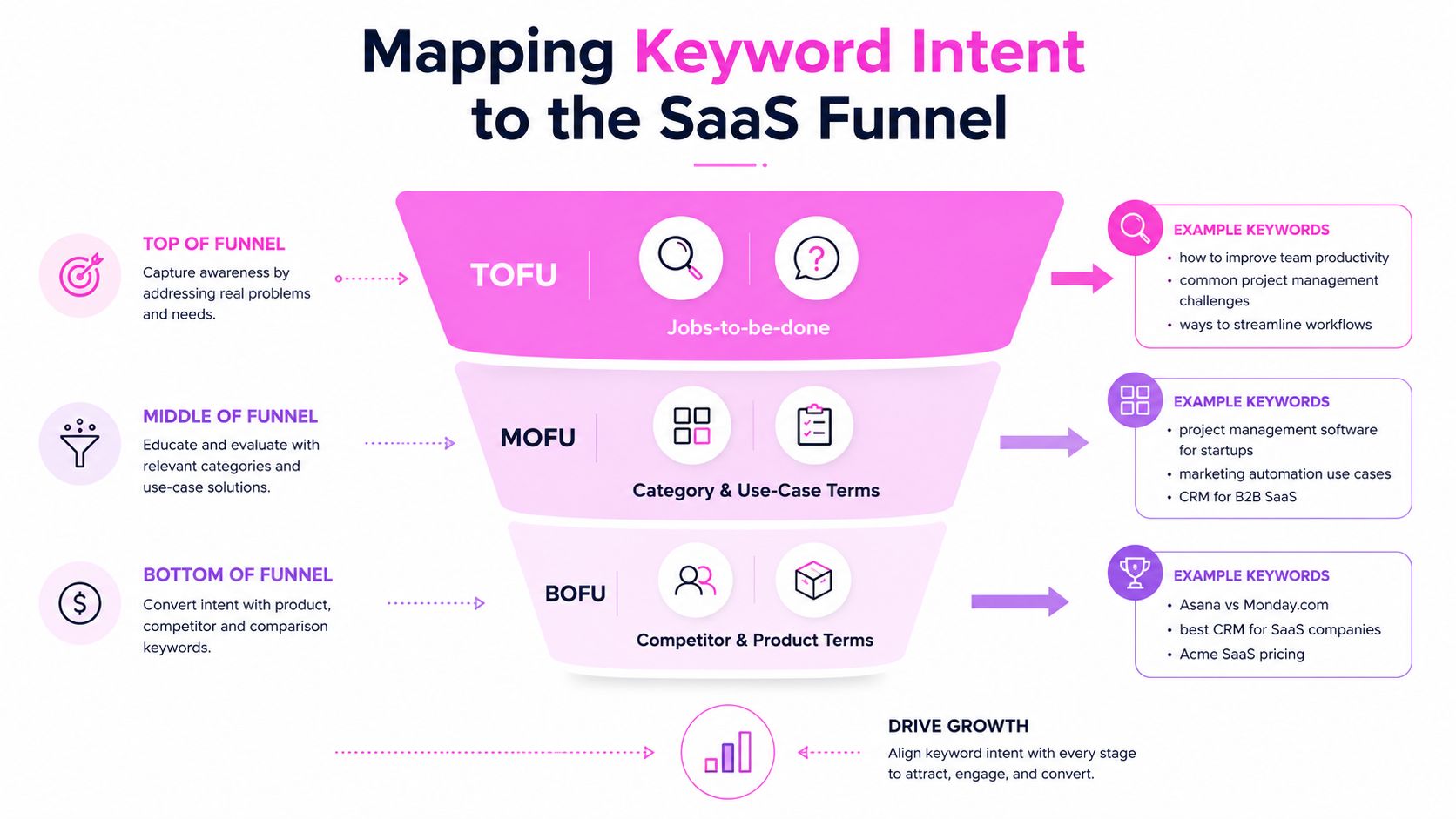
I start keyword research from the buyer's job, not from the keyword tool. That means I ask what the user is trying to do, then map that job into the searches they'll use while they move from problem awareness to vendor evaluation. That sequence keeps the content useful and keeps the cluster focused.
The sequence I actually use
I begin with jobs-to-be-done, then map those into TOFU, MOFU, a BOFU terms. First come problem-led topics, then category and use-case terms, then competitor and alternative pages. That ordering matters because it mirrors how SaaS buyers evaluate software, and it keeps each page focused on one intent instead of one vague theme.
Inside SemDash, the workflow is blunt and practical. I open Słowa kluczowe domeny i Luka w słowach kluczowych to see what competitors rank for that we don't, then I sort the list by difficulty rather than volume. That's the part teams get wrong. A lower-volume term can be a better move if three competitors already rank for it and our site doesn't, because that means demand exists and we're not in the conversation yet.
I also use the SERP itself as a filter. People Also Ask and People Also Search suggestions are useful for expanding a cluster without bloating it. If those suggestions keep returning the same question family, I know the topic deserves a page. If they scatter into unrelated angles, I keep the cluster tight.
Rule of thumb: a keyword is more attractive when competitors have already proven demand and your site has a clean path to win the page, not when the raw volume looks impressive on its own.
How I keep the map from drifting
A keyword map fails when it becomes a pile of related ideas instead of a decision tool. Every page needs one clear target, and every target needs a reason to exist in the funnel.
The simplest check is whether the query maps cleanly to one of three questions. Does the buyer need to understand the problem, compare categories, or choose a vendor? If the answer is fuzzy, I don't publish yet.
I'd rather build a smaller set of pages that each own a specific intent than publish a sprawling content calendar that cannibalizes itself. That discipline is what keeps SaaS SEO from turning into generic blog growth.
For a practical workflow reference, the keyword research approach in SemDash's keyword research workflow fits this intent-first model well because it keeps the research anchored to gaps, difficulty, and page-level targeting instead of vanity volume.
Building a Cluster Architecture That Scales
Once the keyword map is clean, the site structure has to match it. For SaaS, the easiest architecture to maintain is a hub-and-spoke cluster built around 3 initial topic clusters, each with 1 hub page and about 10 supporting pages. That gives you enough depth to signal authority without creating a mess you can't maintain.
The publishing cadence that actually compounds
I've had better results starting with 2 to 4 foundational articles per month and targeting keywords with KD under 20 than trying to force early wins on hard terms. That cadence is slow enough to stay focused and fast enough to build momentum. Once the first clusters begin picking up traction, I increase output to 4 to 8 articles per month, then add programmatic pages and begin link acquisition at roughly 5 to 10 quality backlinks per month before scaling further in the acceleration stage.
The reason this works is simple. A hub gives the cluster a home, the spokes create topical depth, and the internal links make the relationship obvious to search engines. If you publish without that structure, you end up with isolated articles that never reinforce each other.
SemDash's Grupowanie słów kluczowych is useful here because it groups queries into page-level topics, which helps prevent cannibalization before it starts. I also use Najpopularniejsze strony i Udział w ruchu to identify the content leaders in each cluster, because you need to know which pages are already winning organic attention before you decide how to attack the gap.
The publishing math matters more than people want to admit.
| Cluster element | What I build | Dlaczego to ważne |
|---|---|---|
| Hub page | One broad, authoritative page | Gives the topic a canonical home |
| Spokes | Roughly ten supporting pages | Covers adjacent intent without overlap |
| Internal links | Hub to spokes, spokes back to hub | Reinforces topical relevance |
| Częstotliwość | 2 to 4 foundational posts first | Builds momentum without stretching quality |
Where most teams break the architecture
The usual failure is writing spokes that are too close to one another. That creates cannibalization, weakens the cluster, and makes refresh work harder later. I've seen teams publish five pages that all target slightly different versions of the same intent, then wonder why none of them rank strongly.
Another failure is naming the hub too broadly. If the hub page tries to cover the whole market, it turns into a vague overview that no one links to internally with confidence. A good hub has a narrow enough theme that the spokes support it.
If you need a visual reference for the model, the cluster architecture example in the SemDash ecosystem aligns with the way I've seen successful SaaS sites organize hubs and spokes in practice, especially when the goal is to scale without cannibalizing the same topic from five directions.
Product-Led SEO and the Technical Substrate Under It
The highest-impact SaaS pages usually aren't generic blog posts. They're comparison pages, alternative pages, and product-led landing pages that answer a buying question while showing the product in context. That's the kind of content that ties SEO directly to pipeline instead of to passive readership.
The technical fixes I ship before more content
Before I write the next ten articles, I check whether the site is ready to earn and retain the traffic. Indexability comes first, then internal linking, then schema, then the product surfaces the site can lean on. If search engines can't crawl the page cleanly or understand how it fits into the site, content volume won't fix it.
I also look at URL-level keyword mapping and the pages that are already showing up in AI-driven search results. That tells me where Google is citing the site, which pages are being treated as authoritative, and which pages need to be rewritten with clearer openers. For SaaS comparison and alternative pages, the first one or two sentences matter more than many realize.
Put the clearest answer first, then support it with a specific comparison and a concrete proof point. That structure makes the page easier for both people and models to extract.
A useful habit is to write sections with the answer in the opening lines, then add a specific comparison and a named source if the claim needs support. I've seen pages perform better in AI-oriented search environments when the lead is direct and the language is specific rather than decorative.
If you want a broader resource on product surfaces and software-led discovery, find product led growth software is a practical reference point for understanding where these pages fit in the acquisition mix.
How I structure product-led pages
Comparison pages should not read like feature dumps. They need the use case, the trade-off, and the recommendation in plain language. Alternative pages work best when they explain why someone is looking for a switch in the first place, then show where your product fits and where it doesn't.
That honesty matters. SaaS buyers spot empty positioning instantly, and thin comparison content usually earns neither trust nor links. A clean page that names the rival category, the differentiator, and the evaluation criteria usually outperforms a bloated page that tries to sell too hard.
I keep the technical substrate tight by making sure the page can be discovered, linked, and summarized without friction. That means clear internal links, structured markup where appropriate, and page copy that answers the actual query instead of padding out the page to hit a word count.
For platform selection and workflow consolidation, the internal tooling overview at SemDash's SaaS SEO platform fits this kind of work because it combines URL mapping, keyword research, and AI visibility tracking in one place.
Link Acquisition for Early-Stage SaaS
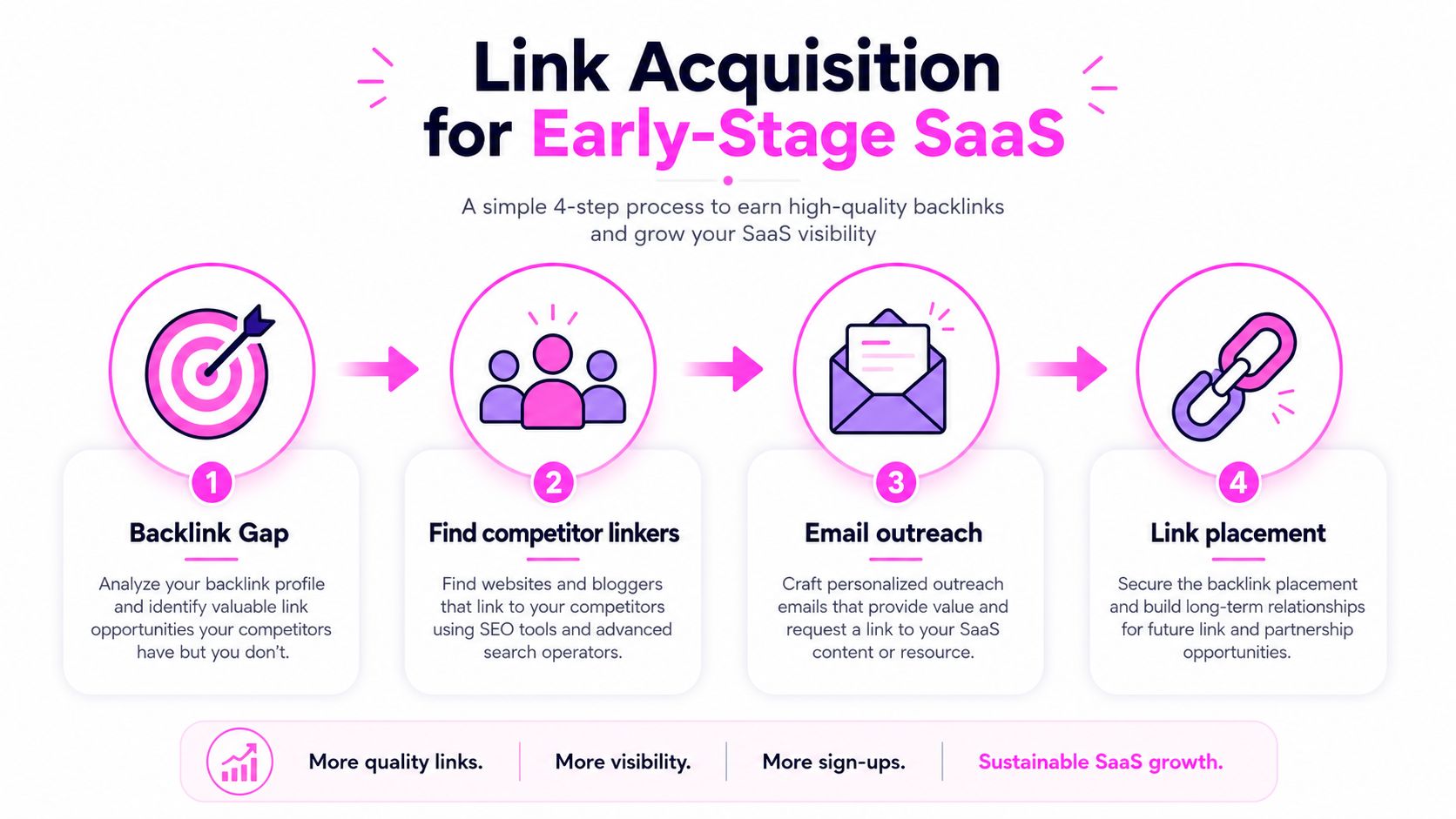
When a SaaS brand is new and the domain authority is low, I don't start with broad outreach. I start by finding websites that already link to two or three direct competitors but not to us. That's a cleaner signal than cold pitching from scratch, because the site has already shown that it links to the topic.
How I build the outreach list
I pull the Luka w linkach zwrotnych report, then check anchor context i Strony według linków to see exactly why those sites linked in the first place. That context changes the pitch. A mass email sounds like mass email, but a note that references the page type, the topic angle, and the missing resource reads like a real editorial fit.
The next choice is distribution. Sometimes the quickest move is a placement service for news sites, especially when the brand needs a few credible mentions early. Other times, digital PR works better because it creates a better story and gives you a stronger asset to pitch around. I use the service when speed and baseline credibility matter more than bespoke storytelling.
The cadence matters as much as the source list. I've had better results when each new article is written with linkability in mind, then gets its first links inside the first month after publication. That keeps the content from aging in isolation and helps the page pick up authority while the topic is still fresh in the site architecture.
The monthly pace I trust
Early on, I aim for 5 to 10 quality backlinks per month. Once the site has a stronger foundation and the content clusters are compounding, I'll push toward 15 to 20 per month. That pace is aggressive enough to matter without turning outreach into a spam operation.
What doesn't work is spraying the same pitch to every domain in a spreadsheet. It wastes time, damages response rates, and teaches the team the wrong lesson about link building. The work gets easier when the pitch is rooted in competitor backlink data and the page has a clear reason to exist.
The best link programs I've run treated backlinks as a consequence of useful positioning, not as a separate marketing stunt. That's especially true in SaaS, where the page you're pitching often needs to educate, compare, or clarify something that buyers are already searching for.
Measuring SEO When the Conversion Isn't Last-Click
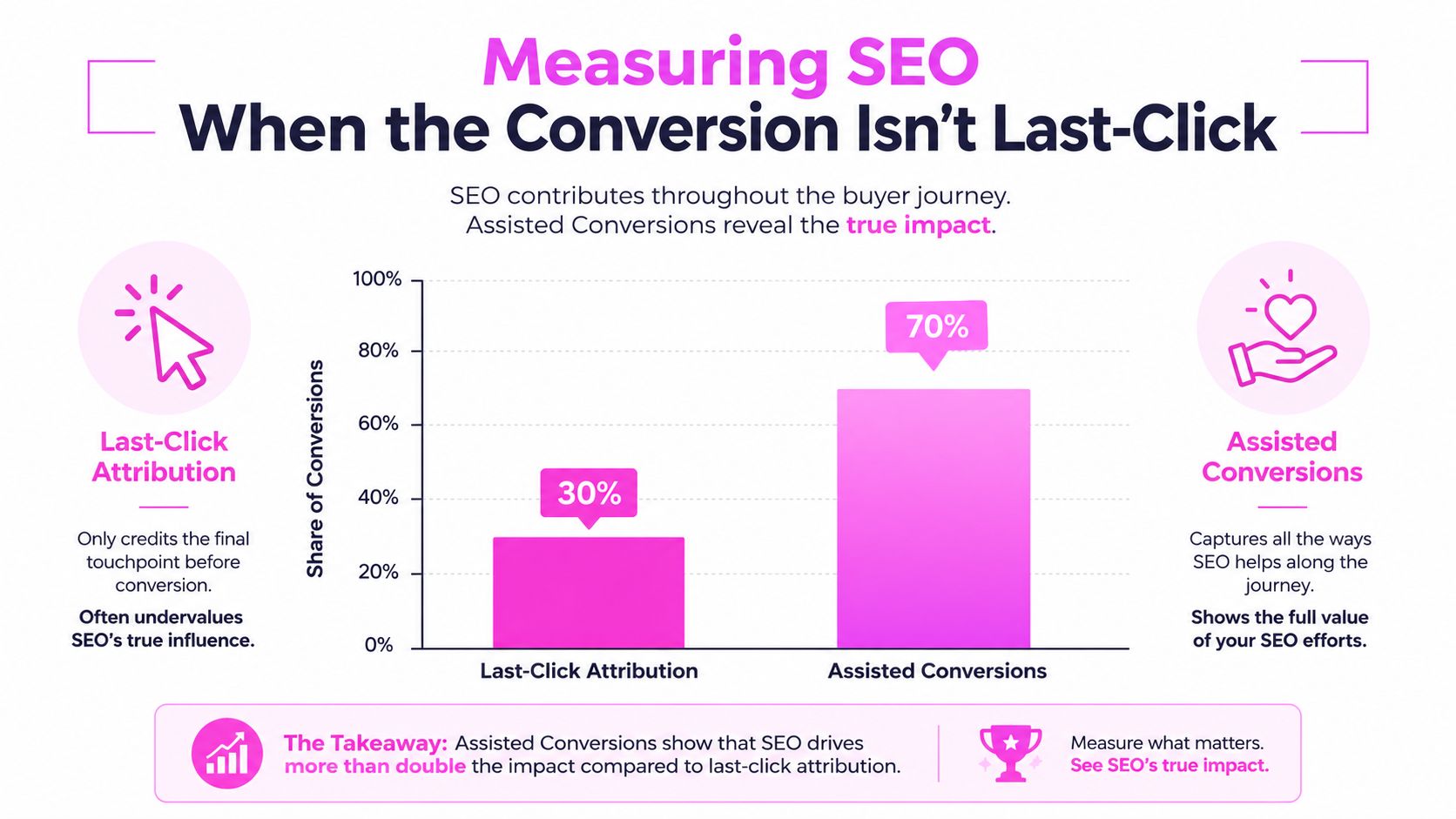
SaaS SEO is easy to undercount if you only look at last-click trials and demos. Organic often assists discovery, gets cited during evaluation, or shows up before a sales-assisted conversion happens later in the journey. If finance only sees the final click, the channel looks weaker than it really is.
The two metrics I now track
The first is AI citation rate, which is the percentage of relevant queries in a topic cluster where the brand appears in AI-generated answers. If the brand shows up in 3 out of 50 target queries, that's 6%. The second is share of voice in AI, which measures the percentage of citations that go to the brand versus competitors among all brands mentioned in those answers.
I use both because they answer different questions. Citation rate tells me whether the brand appears at all. Share of voice tells me whether we're winning once we're visible. A page can be present in an answer and still lose the visibility battle to a stronger competitor.
SemDash's Domeny konkurencji, Udział w ruchu, and historical SERP data are the datasets I'd use to ground that measurement, because they let me compare who owns the topic today, how visibility shifts over time, and which URLs are tied to the relevant queries. That's more useful than a flat ranking report when the buying journey is split across multiple touchpoints.
If a page helps discovery but doesn't close the deal, that doesn't make it worthless. It means you need a wider attribution model.
How I defend the channel internally
I never argue that SEO alone closed the deal unless the data supports that claim. I argue that SEO influenced the journey, increased visibility at the right stage, and created a durable acquisition asset that paid back over time. That's a more honest conversation, and it survives scrutiny better.
The mistake is trying to force all SEO value into the final conversion event. SaaS buyers often move through multiple pages, revisit the brand later, and convert through a mix of product-led and sales-assisted paths. If the reporting model can't account for that, the team ends up optimizing for the wrong signal.
This is also where the practical benchmarks matter. A separate SaaS SEO benchmarking source reports 2.1% visitor-to-lead conversion from SEO, an average 7-month breakeven, a 702% three-year ROI. I'd use those figures as planning anchors, then test my own assumptions against actual pipeline and sales cycle data before I trust them as operating targets.
Your 90-Day SaaS SEO Rollout
The fastest way to get moving is to stop treating SEO as a long abstract program and turn it into a week-by-week build. The first two weeks are audit and intent mapping. Weeks three through six are about shipping the first hub and three spokes, all aimed at KD under 20. Weeks seven through ten are where programmatic comparison and alternative pages start to matter, and link acquisition begins at about five quality backlinks a month. By weeks eleven through twelve, I'd instrument AI citation rate and share of voice alongside trials and pipeline so the reporting story matches the buying journey.
What good looks like by checkpoint
- Day 30: The keyword map is clustered, the first hub is live, and the internal links point somewhere useful.
- Dzień 60: The first spokes are published, comparison and alternative pages are drafted, and outreach is tied to specific URLs instead of generic domain-level asks.
- Day 90: AI visibility tracking is in place, backlinks are landing on the right pages, and the team can see which cluster is beginning to own demand.
The biggest mistake I'd avoid if I were starting over is waiting for a perfect keyword list before publishing the first hub. The second mistake is publishing without a cluster, then trying to retrofit structure later. The third is measuring only trials and demos while ignoring the pages that shape discovery and evaluation before the final click.
If you want a useful benchmark for startup execution, Data Hunters Agency's SEO playbook is a solid reference point for how lean teams sequence early content, links, and technical cleanup without pretending the channel pays back overnight.
If you're building SEO for SaaS companies and want a cleaner way to find gaps, cluster keywords, track AI citations, and see which competitors are winning the market share you want, visit SemDash (SemDash) and use it to plan the next cluster before you publish another generic post. The right workflow makes the difference between a blog that collects sessions and a search program that supports revenue.