



Nearly every guide to SEO for contractors opens with the same instruction. Build a page for every town within an hour's drive, publish something weekly, and fight your way into the map pack. That instruction is why so many contractor sites stall at position eleven and stay there for two years.
Rankings are an output, not a target. The target is booked jobs in territory the crew can reach at a profitable travel cost. When I pick up a contractor site, the first question isn't what it ranks for. It's which towns finished jobs came from last month and what those jobs earned. Those two answers decide what deserves a page and what deserves to be deleted.
The order below runs from the listing a homeowner sees before your website to the tracking that tells you whether any of it paid. Every fix carries a check, because a fix you can't verify this month is one you'll abandon by next quarter.
Spis treści
- The Fix Order That Wins Local Contractor Jobs
- How Google Picks Your Contractor Profile for a Search
- Service-Area Pages and Profile Boundaries That Hold Up
- Matching Keywords to Jobs You Can Actually Serve
- Service Pages That Match the Search
- Reviews That Build Trust and Local Relevance
- Technical Fixes That Keep Local Pages Loading
- Track Booked Jobs by Neighborhood Before You Expand
The Fix Order That Wins Local Contractor Jobs
The ranking obsession gets the order backwards. For a plumber running one shop and a thirty-mile radius, a keyword position in a town the crew can't reach before lunch is worth zero. What a homeowner sees first is the Google Business Profile, sitting above your website link and above your pricing.
That order isn't a preference, it's how the click behaves. Research published by Google and Ipsos on local search behavior wykazała, że 4 in 5 consumers use search engines to find local information, and the same study found that 50% of consumers who conducted a local search on a smartphone visited a store within one day, against 34% of those who searched on a computer or tablet. Swap "visited a store" for "called a contractor or sent a quote request" and the mechanic holds.
Here's the working order:
| Priorytet | Fix | Why it comes here | Check it by |
|---|---|---|---|
| 1 | Correct Google Business Profile categories, services and phone | Local results draw on these details first | Profile shows the right primary category in a search from your office |
| 2 | Service-area setup with named towns | Defines where you appear and where calls come from | Service areas list towns your crew staffs, not an arbitrary radius |
| 3 | One page per core service and main town | Matches the search a homeowner actually types | Page names the service, the town and a phone number above the fold |
| 4 | Review request after each completed job | Feeds trust and relevance signals | Recent reviews mention the services you want to rank for |
| 5 | Mobile speed and tap-to-call on landing pages | Visitors compare providers on phones | Pages pass Core Web Vitals in Search Console |
| 6 | Call and form tracking by page and query | Shows which fixes produce booked jobs | Each lead traces back to a landing page and a query |
Read it top to bottom and the logic collapses into one sentence: whatever the searcher sees first gets fixed first. A beautifully built service page sitting behind a profile with the wrong category sends the click to a competitor before the page is ever opened. That's the most expensive mistake in contractor marketing, and it costs nothing but an hour to correct.
Row five has a physical test. Open your own site on a phone and try to call yourself with one hand while standing up. If you need two hands, a scroll or a zoom, the button fails and the visitor taps the next company. No amount of content fixes a phone number that can't be reached.
Working rule: if a fix can't be checked with a specific test this month, it isn't a priority yet, no matter how good it sounds in a proposal.
The rest of this runs through each row in turn, including the ones where the honest answer is to stop rather than build.
How Google Picks Your Contractor Profile for a Search
A weak map position looks like one problem and is usually three. Google's guidance on local ranking states that local results are based primarily on relevance, distance and prominence, and I diagnose each separately because the repair is different for each.
Relevance is the factor you own
Start with a profile audit: primary category, service list, phone number and hours, all checked against the work the crew does. Then search your exact service phrase from your office and confirm the right category surfaces. Relevance is how closely the profile and the website match the query.
A roofing contractor should spell out roof repair, replacement, storm damage and commercial work in categories, services and page copy. Adding "roofing contractor" to the business name when it isn't the actual business name is not a shortcut, it's a policy violation waiting to be reported. Relevance is earned in the fields, not the title.
Distance and prominence are constraints, not settings
Distance is measured from the location term in the query. When the query names no town, Google estimates from what it knows about the searcher's location, which is why a business can rank strongly beside its own office and poorly twelve miles across the city with nothing technically wrong.
Prominence is how well known the business is, built from genuine reviews, local links and real mentions. Google's own documentation notes that a farther business can rank above a closer one when it is the better match for the search. Anyone promising a single citywide number one is selling something they can't deliver.
A useful comparison sits in the shape of a Tucson Arizona roofing contractor site built around one city, one trade and real local proof: that's the form relevance work should take.
The fix follows the diagnosis. Relevance problems get categories and service content. Distance problems get an honest service-area decision. Prominence problems get reviews and local links. Rewriting titles when the constraint is distance wastes everyone's quarter.
Service-Area Pages and Profile Boundaries That Hold Up
The rule I apply to every contractor is blunt: one profile per staffed location, not one per suburb. Google draws the boundary for you: its guidance for service-area businesses says a single profile should cover the central office with a designated service area, and the overall area should not extend beyond roughly two hours of driving time from the base. An arbitrary radius doesn't count either. The business must name cities, postal codes or other defined areas.
That two-hour line is the most useful number in local contractor SEO, because it turns a vague ambition into a decision about a map, and a map into a decision about which jobs the crew can profitably serve.
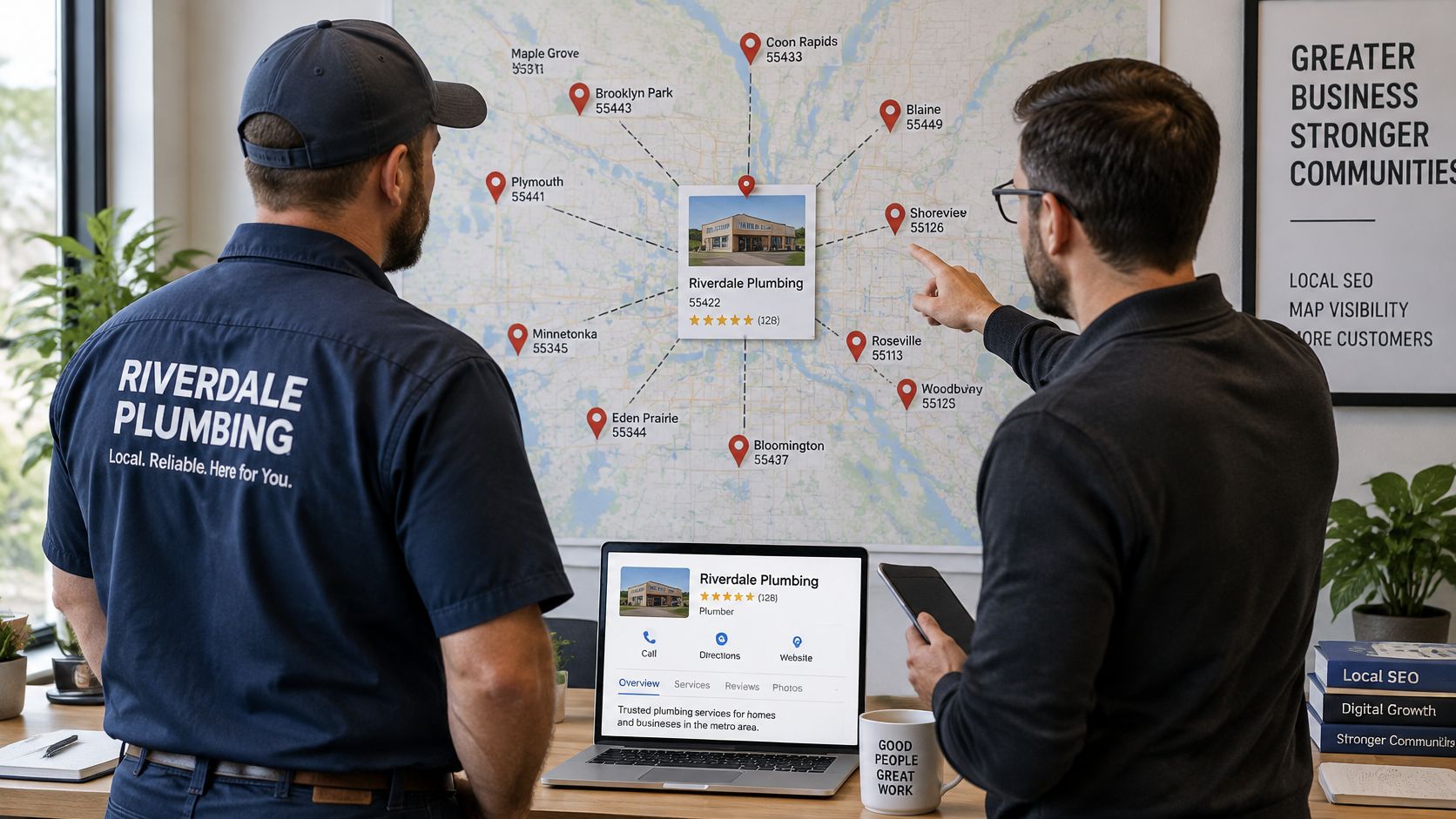
Here's the sequence I recommend, in order:
- Delete duplicates. Any listing for a town where nobody is staffed comes down first. Duplicates split reviews and confuse the map.
- Replace the radius with names. List the towns the crew serves, in the spelling customers use.
- Pull twelve months of calls and completed jobs and write down the towns they came from. This is the only evidence that matters for who gets a page, because it shows where booked, profitable work already exists rather than where you hope it might.
- Give dedicated pages only to towns with real jobs, project photos and a crew that can hit your normal dispatch window. A town that generates two small repairs a year hasn't earned a page. Smaller towns share one regional page with a short, distinct section each.
- Check every page carries the same name, address and phone as the profile, plus its own scope and local project examples.
Step one is where contractors hesitate, and it's the costliest place to hesitate. Separate listings for every suburb without a legitimate staffed location create eligibility and suspension risk rather than better rankings. A suspended profile produces zero booked jobs, which is a far worse outcome than ranking eighth for a town you can reach.
The same logic applies to how you present the business once the boundaries are set. Homeowners comparing local companies weigh accountability heavily, and the arguments in this piece on the risks of hiring freelance painters mirror what buyers in any trade look for: a verifiable local presence behind the promise. Your service-area pages are where you prove that presence, with real addresses, real photos and real jobs in named towns.
Markets beyond the two-hour drive are a separate decision. Either leave them outside the primary footprint, or plan a deliberate location strategy with a staffed base. A page with no crew behind it produces calls nobody can service, and a call nobody can service is a cost, not a lead.
For the next ninety days, list the towns that earn pages and the towns that stay out. Write the second list down. Most contractors only write the first.
Matching Keywords to Jobs You Can Actually Serve
Say a remodeler pulls a keyword export and it contains both a full bathroom remodel and a bathroom fan replacement. The remodel is a planned, high-value job worth its own page and its own budget. The fan swap is a $200 errand that's only worth taking when it rides along inside a bigger visit. One page plan treating both the same is a page plan that starves the valuable work.
An export is inventory, not strategy. Before a query earns a page, I score it on five things:
- Service. The exact work, not the trade. "Water heater repair" is a job. "Plumbing" is a category.
- Property type. Residential and commercial buyers read different pages and close at different rates, so the two don't share copy.
- Urgency. Emergency work converts on the phone at 11 p.m. Planned work converts on a quote form three weeks later.
- Project value. The fan and the remodel shouldn't share a ranking target, because one pays for the other.
- Serviceability. Can the crew reach the address inside your normal dispatch window without eating the margin?
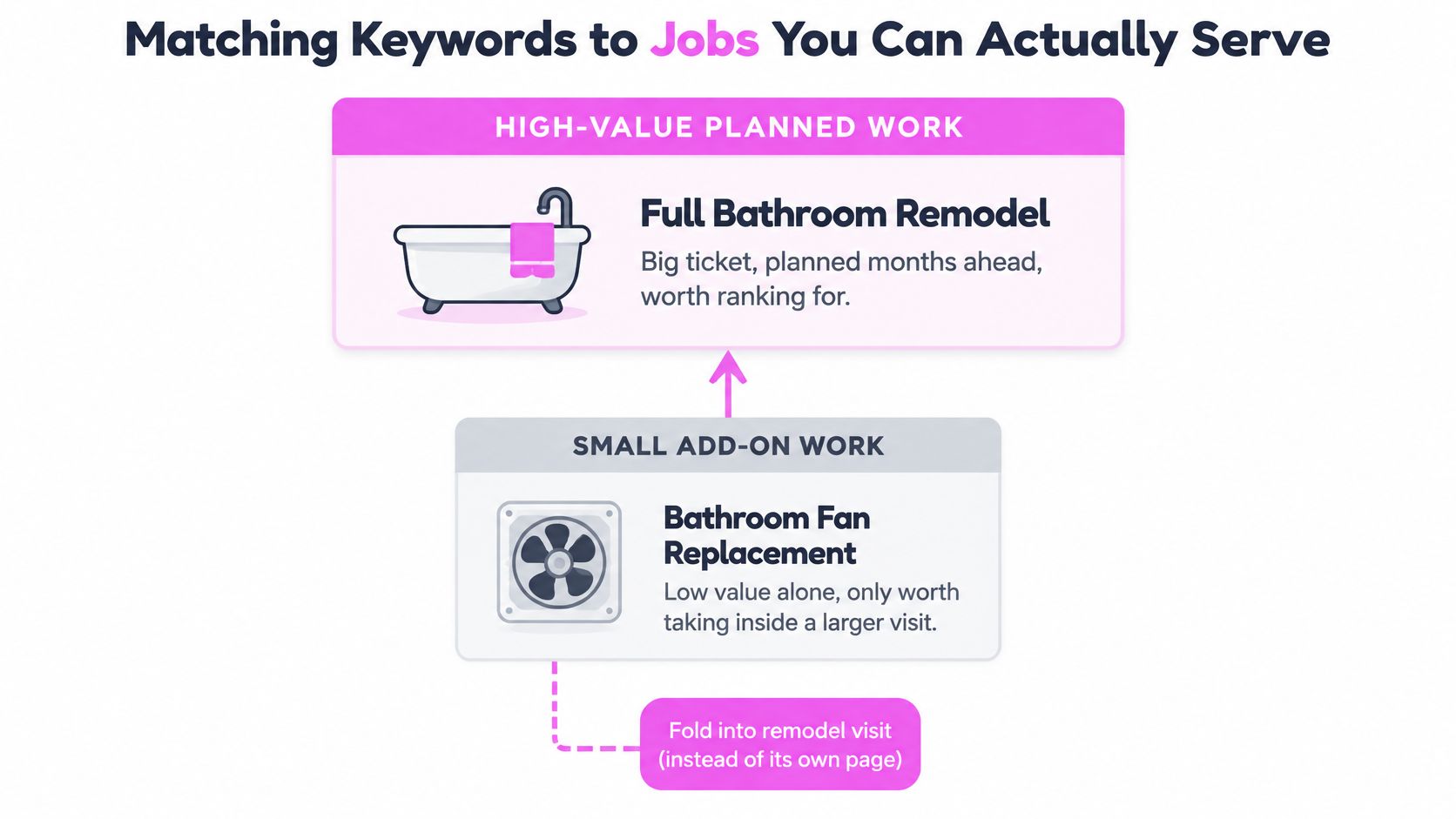
Keep one primary service-and-town target per page. If two pages already chase the same query, merge them rather than tuning both, because split signals weaken both and Google has to guess which one to show. The keyword research process covers how to pull a list apart into page-level groups before anything gets built.
Commercial work usually fails this scoring for the wrong reason. A buyer trying to find commercial landscaping contractors near me wants a maintenance schedule, insurance certificates and an account manager, not a one-off mow, so the page and the proof have to change with the buyer.
Classes that pass all five criteria move into the page plan. Classes that fail serviceability stay off the site even when the volume looks attractive. That single filter prevents most of the wasted spend on contractor sites.
Service Pages That Match the Search
The page is where a classified query becomes a booked job, and it fails or succeeds on specifics. Take a plumber covering Springfield. The water heater repair page should put water heater repair i Springfield in the H1, the phone number above the fold, two or three completed Springfield jobs with photos and dates, and the response window the crew meets.
Not "fast, friendly service." A real window, such as same day before 4 p.m. and next morning after that. Homeowners compare two or three tabs at once, and the one that answers the timing question wins.
The swap test
Here's the check I run on every draft before it goes live: swap the town name for a neighbouring one and read the page back. If every sentence still holds and nothing contradicts, you've written a template. Templates don't rank, and homeowners can smell them.
Smaller towns share one regional page with a short, distinct section each, naming the roads, the housing stock and the jobs you've finished there. Never thin duplicates of the main town page with a find-and-replace.
Cost and how-to pages earn their own budget
These searches behave differently from city queries. A third-party study of 512 local-services searches found AI Overviews on about 21% of city-based searches but 97% of cost and how-to searches, with business websites cited in 34% of the local AI Overview sources it analyzed (Make It Loud's local AI Overview research). The sample is one team's and the method differs from case to case, so treat it as a direction rather than a market average.
The direction still matters. Publish a price range by project type with the factors that move it: roof pitch, tear-off layers, permit fees, access. That gives a search engine something specific to quote, and gives the homeowner a reason to call the number that published it.
Then verify. Open Search Console and confirm each page ranks for the query it was built for. If a page ranks for another page's query, merge them. A page without a phone number, a town name and at least one real project isn't finished, whatever its word count says.
Reviews That Build Trust and Local Relevance
The response habit is worth more than the star rating, and the gap is measurable. BrightLocal's 2024 Local Consumer Review Survey, built on a representative panel of 1,141 U.S. consumers, found that 88% said they would use a business that replies to all reviews, against 47% for a business that does not respond to reviews at all. That's a 41-percentage-point gap created by a task that takes ninety seconds. The same survey found 75% of respondents always or regularly read online reviews when evaluating local businesses.
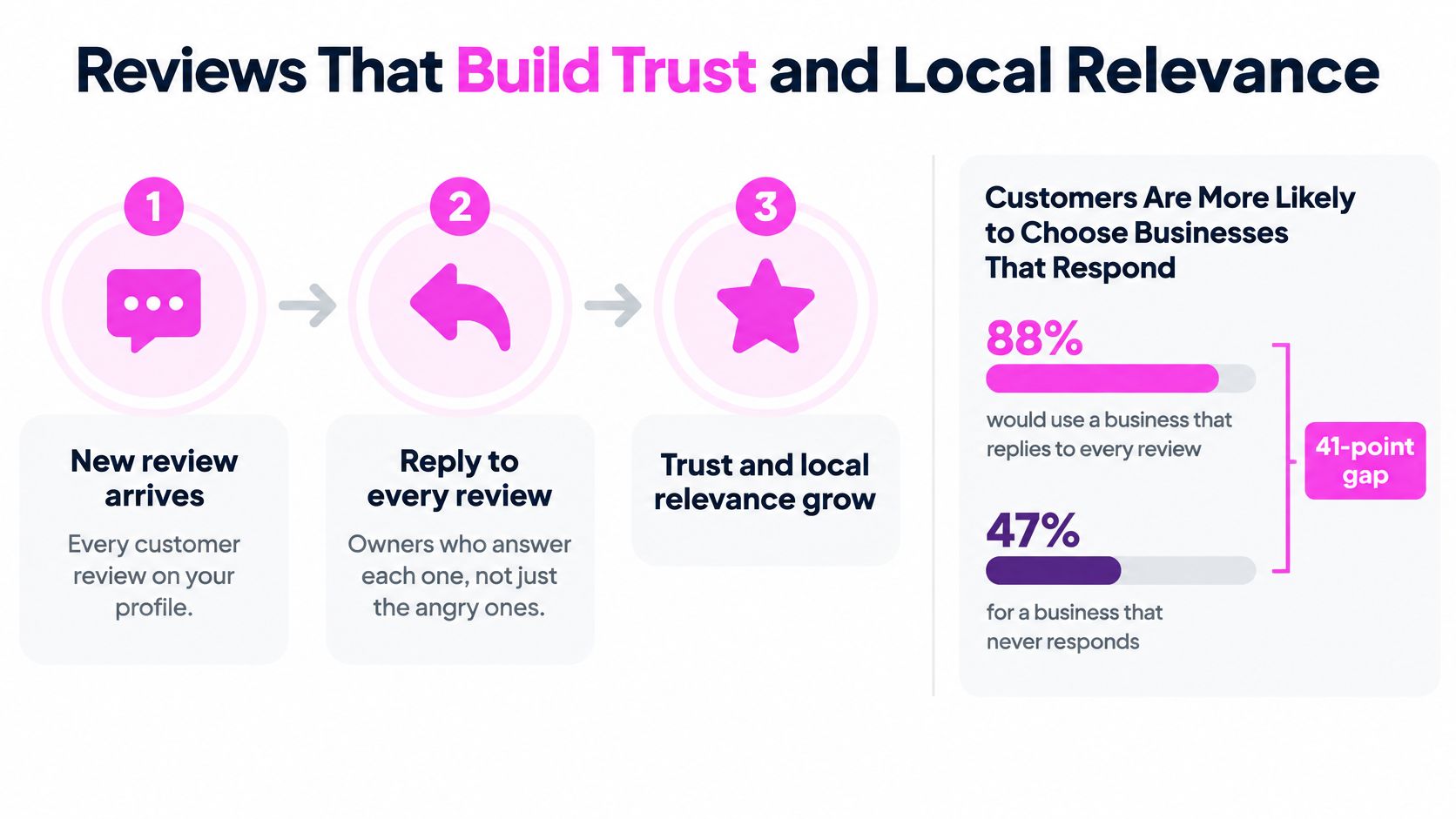
The workflow that produces those numbers, in order:
- Trigger the request when the customer confirms the work is done. Not the day the invoice clears, not two months later.
- Send one reminder. A series of four reads as pressure and lowers response quality.
- Ask for an honest account of the job. Not five stars, not a script. Scripted phrasing produces a pattern platforms flag.
- Make the link open in one tap on a phone.
- Log the job type internally, so you can see whether reviews mention emergency plumbing, HVAC installation or roof replacement.
Then reply to each review within a day or two, naming the town and the service. "Thanks for the kind words about the Springfield water heater install" does more for relevance than a generic thank-you, and it costs nothing.
The mistakes are predictable. Discounts for reviews skew feedback and break platform rules: BrightLocal's 2025 Local Consumer Review Survey, using a representative panel of 1,026 U.S. adults, examined how recency, volume and star ratings shape local decisions, and notes that major platforms generally prohibit manipulating or purchasing reviews and may penalize businesses when they detect it. Chasing the average rating while ignoring recency and volume is the other trap. A high average built on older reviews loses to a slightly lower rating earned this quarter.
Track four numbers weekly: new reviews, response time, how many name the services you want to rank for, and whether calls rise after a review spike.
Reviews serve conversion and local relevance at once. They only work as a signal, though, when they describe real completed jobs.
Technical Fixes That Keep Local Pages Loading
Every landing page that carries a phone number has a pass-fail line. Google's Core Web Vitals guidance draws it in three numbers, and a visitor comparing three contractors on a phone in a hallway with one bar of signal feels every failure.
| Metryka | Good threshold | Common cause | Fix |
|---|---|---|---|
| Largest Contentful Paint (LCP) | 2.5 seconds or less | Oversized hero photos and slow server response | Compress and size project photos, enable caching |
| Interaction to Next Paint (INP) | Under 200 milliseconds | Heavy main-thread JavaScript from chat and analytics | Defer nonessential scripts until after the phone button loads |
| Cumulative Layout Shift (CLS) | Under 0.1 | Late fonts, banners and images without dimensions | Set image width and height and reserve banner space |
LCP is usually a photo problem. A hero image straight off a camera is 6 MB and the page waits for it. Export at the display size, compress, serve from a cache or edge layer, and the metric falls without touching the design.
INP is usually a script problem. Chat widgets, heat maps and three analytics tags all compete with the tap on the phone button. Load the call interface first, defer everything else, and load the chat tool only after the visitor scrolls. The phone number is the conversion, not the chat bubble.
CLS is usually a reservation problem. Late-loading web fonts and invoices banners push content down while the visitor is already reaching for the number. Set explicit width and height on every image, reserve the banner space with a fixed container, and preload the one font you use.
Two checks, not one. Search Console's Core Web Vitals report reflects real users, while a lab test isolates a regression after a template change. Watch both.
Structured data sits on the same to-do list. Use one LocalBusiness entity per legitimate service location and the most specific subtype that applies, whether that's Plumber, Electrician or RoofingContractor, with the business name and physical address filled in, as Google's LocalBusiness structured data documentation requires. Validate with the Rich Results Test and URL Inspection. Google states that missing required properties can make a page ineligible for rich results, so validation is quality control, not an upgrade.
Two boundaries: don't mark up towns where you have no eligible presence. And understand what the markup does, which is describe the page. It doesn't guarantee a rich result, and it doesn't replace visible content about scope, licensing and service limits.
Track Booked Jobs by Neighborhood Before You Expand
Rankings for contractors aren't fixed across a city, so a single search from the office flatters everyone. Run each priority query from four or five points around the territory and record the position, the map-pack presence, the landing page and the outcome at each point. A strong result beside the shop next to weak results across town doesn't mean the homepage needs rewriting. It means the market may not be serviceable, and that's a different conversation.
Never report a ranking without the location, device, query wording and date. "Number one" alone is an incomplete sentence.
Attribution comes next, and it's the step that turns the previous seven into a business case. Tie every call and form to the landing page and query that produced it, then compare query classes by booked-job rate, revenue, gross margin and travel cost. SemDash shows the specific page Google sends traffic to for every keyword, which is how you find out whether the Springfield page or the homepage is earning the lead. The process for measuring SEO performance covers how to set that reporting up without drowning in dashboards.
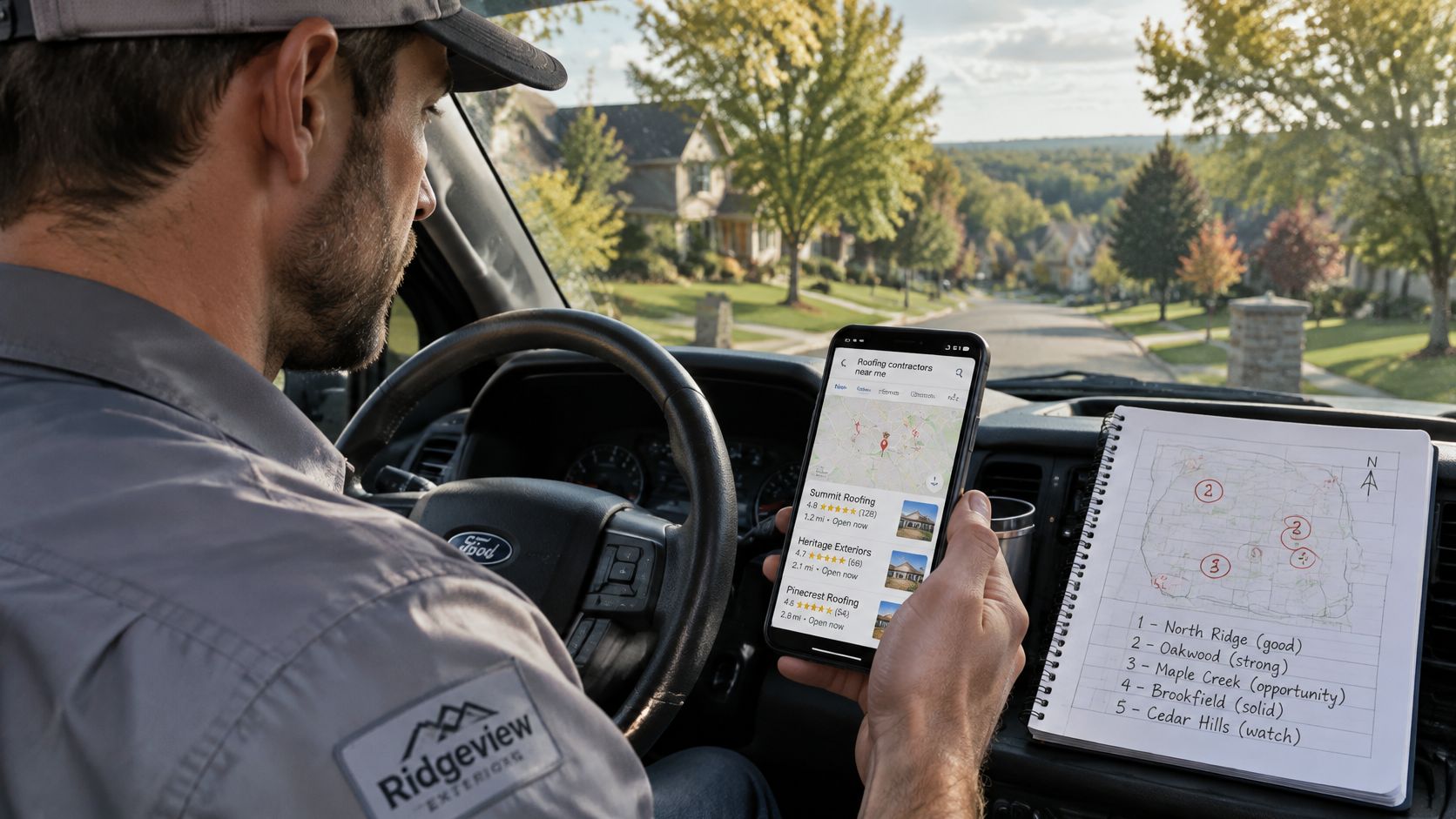
At sixty days, cut what doesn't pay. Drop the query classes that generate calls but no profitable work, and add pages for the high-margin, serviceable combinations. Impressions without booked jobs are a vanity number dressed as progress.
Then check the AI layer, because it's where the cost questions live now. For each cost and how-to query, note whether your page is cited in an AI Overview and whether those searches still produce calls. Being mentioned in an answer and generating a qualified lead are two different results, and only one of them pays a crew.
No tool, including ours, guarantees rankings or revenue. SemDash does not guarantee specific search rankings, traffic increases or financial outcomes. The booked-job numbers are the only honest scoreboard, and they're the reason to keep doing the unglamorous work.
Four steps to start this week:
- Pick the three services with the best gross margin.
- Run the neighborhood test on those three queries.
- Set up call and form attribution by page.
- After ninety days, choose the next town from the jobs data, not from a map.
The order holds whether you're one truck or twelve. Fix the listing, name the towns, build pages only where the jobs live, and let the booked-job rate decide what comes next.
If you want to see which pages and queries are producing your leads, SemDash tracks URL-level rankings, SERP history and AI Overview citations in one workspace, with more than 20 research tools and a free tier to start on. We also run free live calls where you can talk through your service area with an SEO specialist and get a straight answer about which towns are worth pursuing. Visit SemDash (SemDash) to start with the data rather than the guesswork.