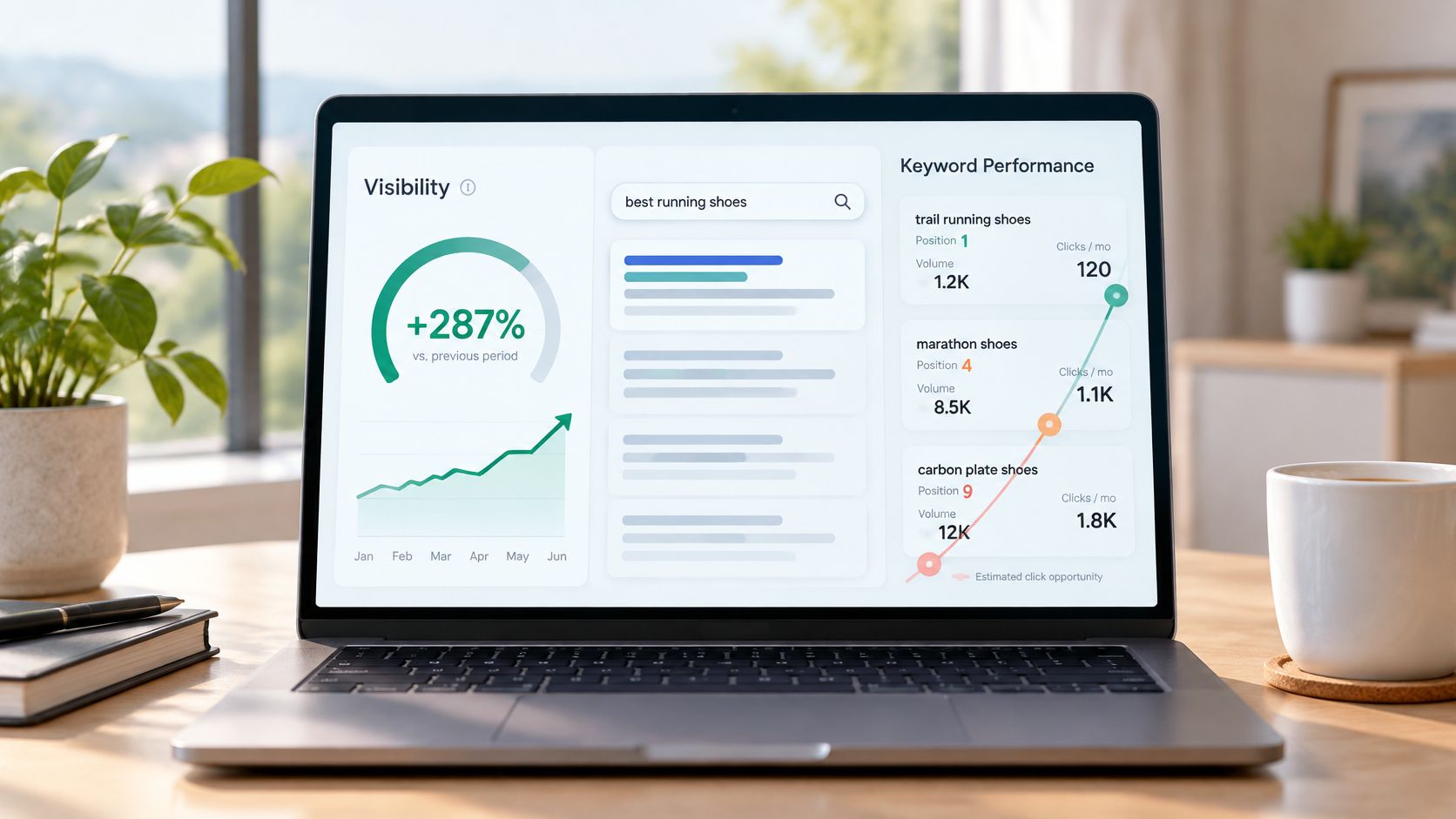


The most popular advice in SEO blog writing tells you to find a keyword, match the top result's length, and use the phrase a set number of times. I don't do that. I start with intent, prove originality section by section, and tie every choice to a metric I can check after publishing. That's slower to plan, but it saves you from rewriting a fluent post that never had a clear job.
Spis treści
- Pick the Search Intent Before the Keyword
- How to Write an SEO Blog Post in Seven Steps
- On-Page Elements and the Rule for Each
- Build Briefs and Internal Links Around One Cluster
- Write Original Evidence Into Every Section
- Measure Results, Refresh and Run Your Next Post
Pick the Search Intent Before the Keyword
I learned this rule after watching a polished essay stall. Say a team targets SEO blog writing with 2,000 words of definitions while the top five results all use numbered steps. The page sits around position 14 in that scenario because readers want a workflow and get an essay instead. The keyword matched. The job didn't.
Google's position supports starting with the reader. Its ranking systems prioritize "helpful, reliable, people-first" content created to benefit people rather than manipulate rankings, according to Google's Search Central documentation on helpful content. I read that as a practical instruction. Let the query's job choose the format, then use keywords to make the answer findable.
Search intent and the page format it needs
| Intencja | Example query | Page format | Proof to include |
|---|---|---|---|
| Informational how-to | how to write an SEO blog post | numbered steps with checkpoints | a worked example with real numbers |
| Commercial comparison | best SEO writing tools | side-by-side table on the same criteria | tested workflow notes and pricing dates |
| Definition | what is topical authority | short answer first, then explanation | one concrete example |
| Template or lookup | SEO blog post template | checklist with exact fields | the field list the reader can copy |
Run this ten-minute intent check before you outline anything. Open the top five results and count how many use steps, comparisons, definitions, or templates. Match the dominant format, then look for what those pages skip, because that gap is your opening.
If the results disagree, I choose the format that answers the first question fastest and cover secondary intents lower down. Our breakdown of search intent classification in practice shows how I sort mixed result pages before committing. Don't try to serve all four jobs equally, or you'll serve none of them well.
My rule: One post, one primary intent. I write it in one sentence at the top of the brief, and everything that doesn't serve it gets cut or moved.
How to Write an SEO Blog Post in Seven Steps
Here's the workflow I run, with the reason for each step and the slip I watch for. Skipping a step rarely saves time. It just moves the cost into editing or into a refresh three months later.
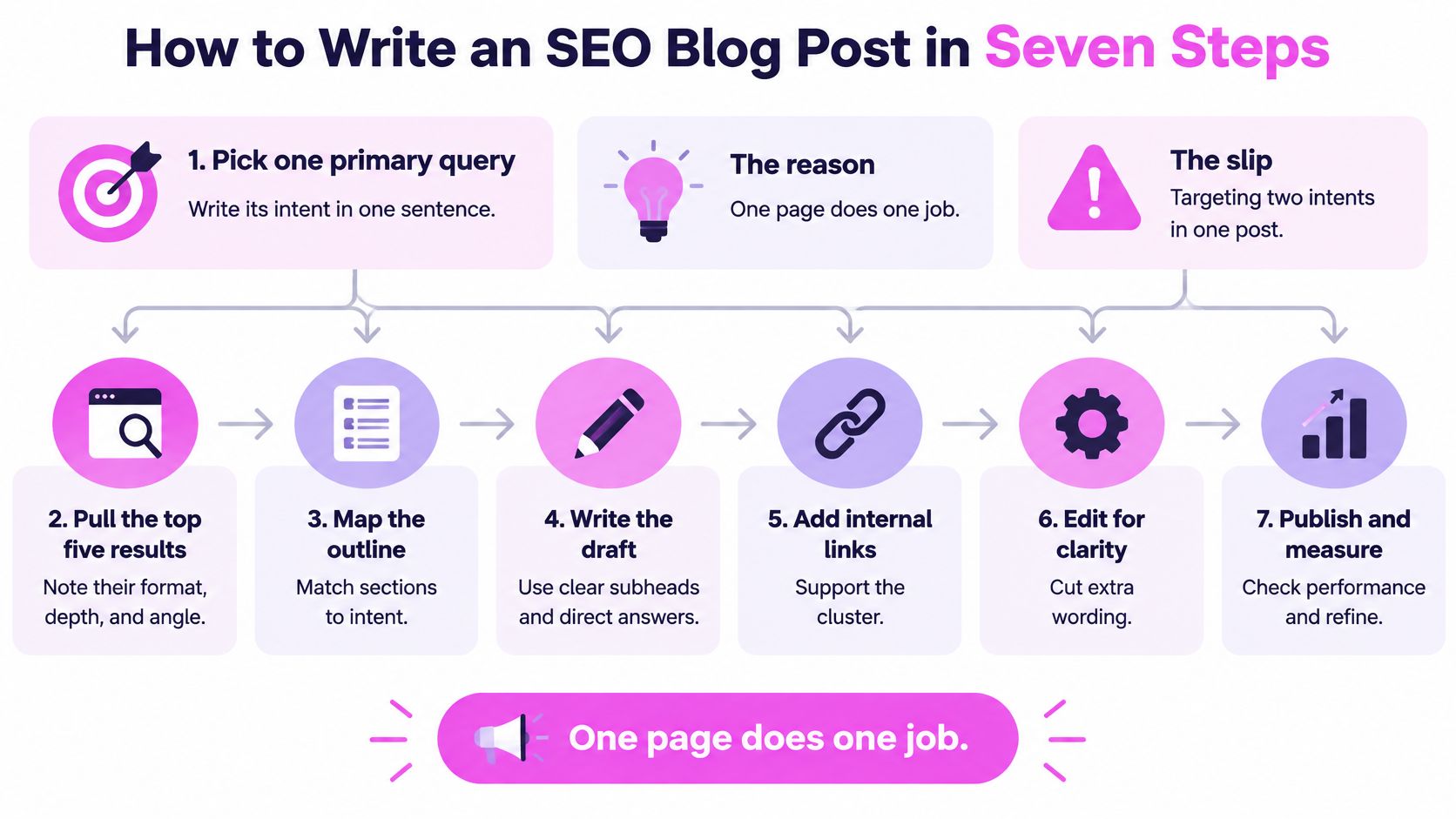
Steps one to three decide whether the draft can work
- Pick one primary query and write its intent in one sentence. One page does one job, so a post can't be both a workflow and a tool comparison. The slip is targeting two intents and wondering why neither section satisfies anyone.
- Pull the top five results and note format, length band, and shared gaps. You're looking for the format readers already accept and the question nobody answers well. The slip is copying the number one page's structure without understanding why it's built that way.
- Build the outline from People Also Ask questions and clustered subqueries. Give each reader question its own H2, in the order a reader would ask them. The slip is headings that repeat the keyword instead of asking something, which tells scanners nothing.
Steps four to seven protect the draft and the result
- Write the lead to answer the query within the first 100 words. Readers decide fast, and a direct opening also gives search systems a clear, quotable answer. The slip is opening with 300 words of topic history before the first useful sentence.
- Write each section around one piece of evidence you own. A test, a number, a decision, or a failed attempt all count. The slip is rephrasing the top five, which produces a page with no reason to exist.
- Set the title, meta description, slug, and internal links after the draft. Metadata should describe what the page delivers, not what you hoped it would. The slip is writing the title first and forcing a weaker draft to match it.
- Publish with a visible update date, then check the rendered title and snippet about 48 hours later. Google can show different text than you supplied, and you want to catch a mismatch before judging clicks. The slip is stuffing title variants in response instead of aligning title, heading, and opening around one intent.
I use one test before publishing. If the draft answers the query before the reader scrolls, and each section adds something the top five don't have, I ship it. If not, I fix the lead and the evidence first, not the keyword count.
On-Page Elements and the Rule for Each
The title mistake costs more clicks than any other on-page slip I see. A vague promise like "the ultimate guide to everything" gives readers nothing specific to match against their problem. Specificity beats scale every time, so I write titles that name the outcome and the method.
On-page elements, the rule for each and a common mistake
| Element | Rule | Example | Common mistake |
|---|---|---|---|
| Title tag | under 60 characters, keyword near the front, specific | How to Write an SEO Blog Post: A 7-Step Workflow | a vague ultimate guide to everything |
| Meta description | under 160 characters, a promise plus an outcome | Pick intent, structure the draft and check results after publishing | copying the first sentence of the post |
| H1 | one per page, matches the title's intent | the same topic as the title, phrased naturally | two competing H1s from the theme template |
| H2 | one per subtopic, phrased as a reader question | Which keyword should I target first? | headings that repeat the keyword string |
| URL slug | short, lowercase, hyphenated, keyword included | /seo-blog-writing-workflow | dates, IDs or stop words piled up |
| Internal links | three to five contextual links with descriptive anchors | the brief template from the cluster section | anchors that say click here |
When I move a draft out of a CMS or doc tool, stray markup often hides duplicate headings and broken anchors. I paste a copy through a utility to remove HTML formatting from text so I can check the plain heading order before the page goes live. It takes a minute and catches template H1s I'd otherwise miss.
Performance thresholds I treat as release criteria
I don't accept vague speed advice. Google's current "good" thresholds are Largest Contentful Paint at 2.5 seconds or less, Interaction to Next Paint at 200 milliseconds or less, and Cumulative Layout Shift at 0.1 or less, per Google's Core Web Vitals support page. Those numbers change what I ship. I compress the lead image, reserve its dimensions so nothing jumps, and delay scripts that compete with the article heading.
The common failure is a clean desktop lab score hiding a heavy hero image on mobile. I recheck field data after launch, because lab tests and real users answer different questions. The thresholds don't guarantee rankings, but they stop me publishing a strong article in a page that's frustrating to read.
Build Briefs and Internal Links Around One Cluster
My brief is a field list I finish before drafting, not a paragraph of good intentions. It holds the primary query, intent in one sentence, target reader, required H2s from People Also Ask, the word-count band from the top five, the proof each section needs, and the pages this post links to and from. If a field is empty, I'm not ready to write.
This diagram shows how those fields connect before a single paragraph exists.
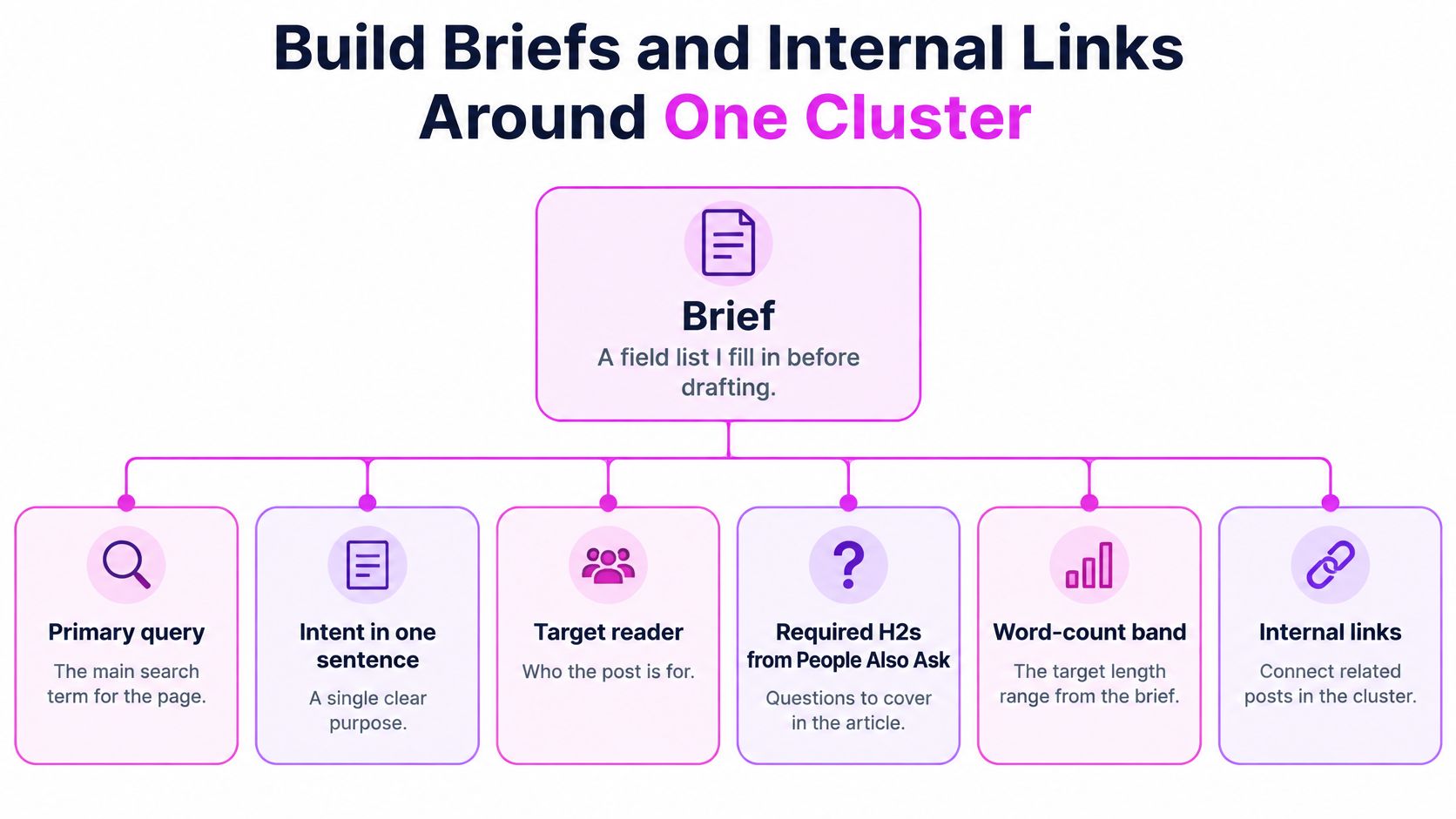
I also label every section. Each one is common knowledge, sourced evidence, original analysis, or actionable experience. That label tells me where the writing effort goes and stops me spending an hour polishing a paragraph anyone could produce. You can see the format in our worked SEO content brief example, labels included.
One pillar, one query per spoke
Take SEO blog writing as the pillar. The spokes handle keyword research for blog posts, blog post structure, and content refresh, each targeting one query. The pillar links to each spoke with its topic phrase, each spoke links back, and every link sits in the paragraph where the reader needs the next step.
Two posts chasing the same phrase is the cannibalization trap. Google alternates which one ranks, both underperform, and neither builds authority.
When that happens, I merge the posts or sharpen one down to a single distinct intent. I keep the brief in a shared document and revise it when the SERP changes, so the next writer inherits decisions, not just a draft.
Write Original Evidence Into Every Section
I'm going to push back on a popular fear here. AI drafts aren't the problem. Undifferentiated drafts are. Originality isn't a tone of voice, it's an evidence system I can check line by line.
This is the comparison I run on my own outlines before drafting.
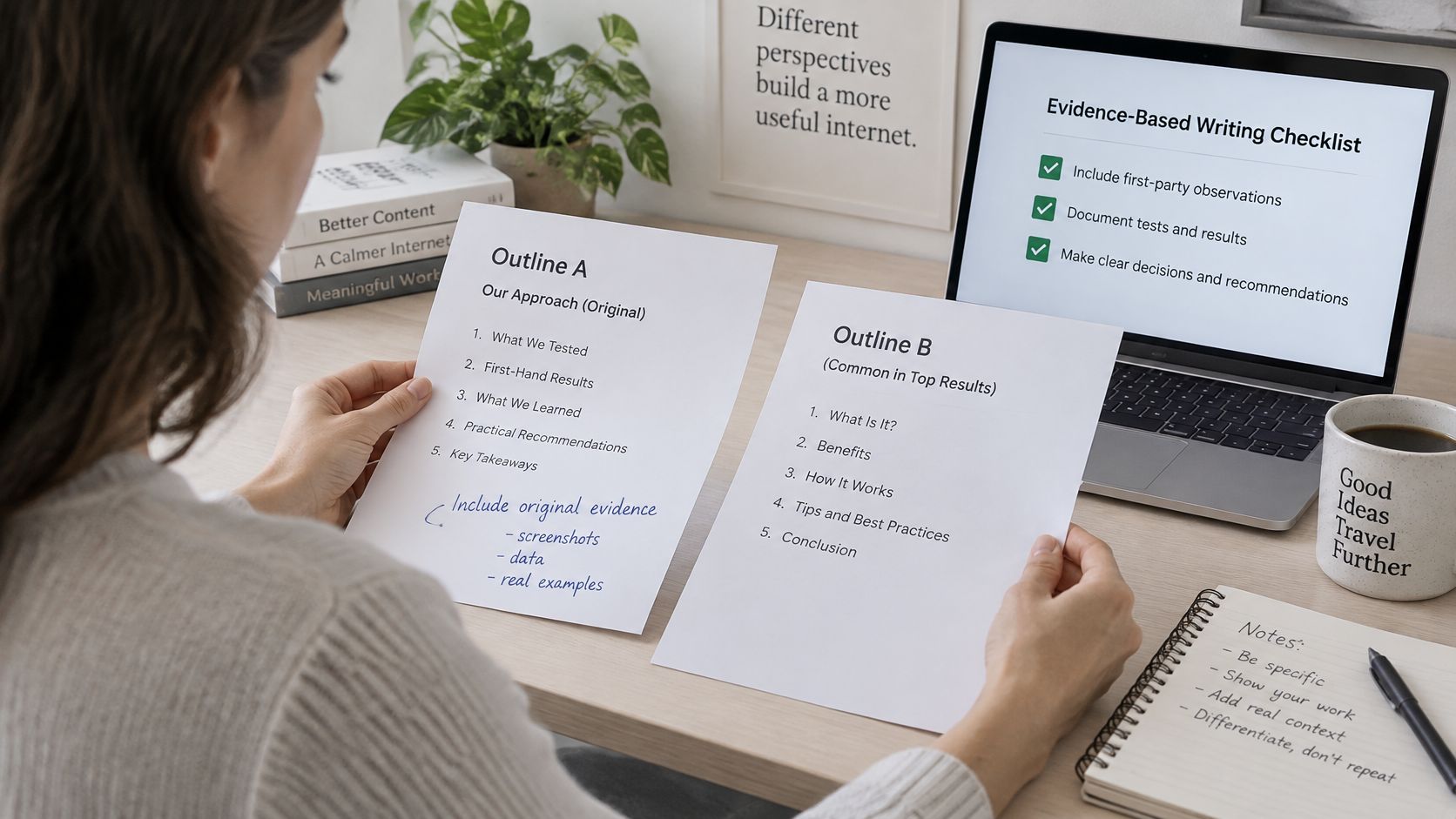
Each section needs at least one thing the top five don't have. A first-party observation, a documented test with dates, a decision criterion I applied, a failure case, or a number with its source and date all qualify. Compare two versions of the same advice. The generic one says "link to related content." The stronger one names the three links moved from a footer into the body, the anchor text used, and what changed in clicks over the following weeks.
The three-question human review pass
I let AI help with structure and first drafts, then I fact-check every claim and review the result for trustworthiness. My review pass asks three questions of each section. Is every claim verifiable, is anything distinct from the top results, and does the section help the reader make a decision? Grammar fixes come last, because clean sentences around empty claims still fail.
This short walkthrough shows how that review works on a real draft.
There's a trade-off I plan around. Original testing costs time, so I run two real tests per article instead of promising twenty shallow ones. The brief labels show an editor at a glance which sections carry evidence and which are still common knowledge waiting for work.
Measure Results, Refresh and Run Your Next Post
Start with the metric readers misread. In Pew Research Center's study of Google users' March 2025 browsing, users clicked a traditional result only 8% of the time when an AI Overview appeared, compared with 15% without one, and sessions ended 26% of the time versus 16%, jak wynika z The Register's report on the Pew study. So a falling click rate doesn't automatically mean your article failed. Check impressions and the queries behind them first, because your content may be getting consumed inside the result itself.
Post metrics, where to find them and when to act
| Metryka | Where to find it | What it tells you | Action when it misses |
|---|---|---|---|
| Impressions and average position | Google Search Console | whether the query matches the page's intent | rewrite the title and first section for that query |
| Clicks and CTR | Google Search Console | whether the title promises what the page delivers | test a new title and wait four to six weeks |
| Ranking page changes | Historię SERP | whether Google has swapped in a different page | match the structure of the new top page where it fits |
| Conversions by URL | web analytics | whether the traffic is worth something | add a relevant next step tied to the query |
| Engagement time | web analytics | whether the page answers the question | expand the weakest section with evidence |
Conversions belong beside rankings in that table for a reason. In the Content Marketing Institute's 2024 B2B benchmark, conversions were the most frequently used performance metric at 73%, podczas gdy 45% used search rankings. Rankings alone never tell you whether the traffic was worth attracting.
My refresh rule and the next-post loop
I refresh when the result composition shifts, such as a new summary block or video results entering the page, or when the intent behind the query changes. I never add keyword mentions to chase a number, because that treats a symptom and usually makes the writing worse. High impressions with low clicks point at the title and the promise of the first section, so I rewrite those and wait four to six weeks before judging the test.
For the next post, I pick one query, write its intent in one sentence, run the ten-minute SERP check, and fill the labeled brief. SemDash creates content briefs with integrated AI based on actual SERP data, which speeds up that planning stage without replacing the evidence decisions. Then I schedule the 30-day check before publishing, so the metric table has a baseline instead of a memory.
If you can't name the metric that will prove a choice worked, you haven't finished planning the post.
Ready to run your next post through this workflow with real SERP data behind every brief? SemDash gives you keyword discovery, intent classification, clustering, and AI-assisted briefs in one workspace, with more than 20 SEO research tools you can start using for free. Visit SemDash (SemDash) to plan your next article from evidence instead of guesswork.