


Moz still has name recognition, but name recognition doesn't fix a workflow that's outgrown the tool. When I'm choosing among Moz alternatives now, I'm not asking which platform has the longest feature page. I'm asking which one gives me the cleanest path from research to action, whether that means deeper keyword coverage, better link intelligence, or faster visibility into volatile SERPs and AI surfaces. That framing changes the shortlist fast.
For me, the biggest mistake is treating every replacement as a full Moz clone. Sometimes I only need a better keyword universe. Sometimes I need a stronger backlink index. Sometimes I need a lighter tool that doesn't bury a simple check behind an enterprise UI. The right answer depends on what you're trying to replace, not on which vendor shouts the loudest.
What follows is the practical version, based on how these tools behave in real SEO work, where they save time, where they create friction, and where they're the wrong buy entirely.
Spis treści
- 1. SemDash
- 1. SemDash
- 2. Ahrefs
- 3. Semrush
- 5. SE Ranking
- 5. SE Ranking
- 6. Serpstat
- 7. Mangools
- 8. SpyFu
- 9. Sistrix
- 10. Ubersuggest
- Top 10 Moz Alternatives Comparison
- My Final Verdict How to Choose Your Next SEO Suite
1. SemDash
SemDash is the first tool I'd put in front of anyone who feels Moz has become too small for serious competitive work. In practice, the gap shows up fast. Independent comparisons put Semrush at 27 billion+ keywords lub 27.9 billion keywords in 142 locations, while Moz is described as having about 1,25 miliarda słów kluczowych, which puts the larger dataset at roughly 22x the scale for keyword discovery and location coverage (comparison of Moz alternatives). That kind of breadth changes what shows up in your research queue, especially when you work across multiple markets or need to see beyond the obvious head terms.
What makes SemDash stand out in real work is that it keeps the research path tighter than Moz. I can move from domain-level keyword mapping to Najpopularniejsze strony, Udział w ruchu, Luka w słowach kluczowych, a Badania linków zwrotnych without rebuilding the same view several times. That matters when I'm tracing how a competitor wins traffic, because I need the exact URL Google is rewarding, not just a broad domain summary. It also makes migration work easier, since I can compare old Moz-style checks with a fuller dataset without stitching together extra tools.
Where SemDash Delivers Value
The strongest workflow is opportunity discovery. Its 6.6B-keyword database, 2.7T-link index, and 600M SERPs refreshed monthly are the kind of scale that helps on long-tail work, niche business terms, and content expansion (SemDash product site). I've also found it useful when I need to pressure-test a keyword list before a migration, because weak terms and thin opportunities stand out faster when the dataset is wider. If you want a direct comparison with Moz's current workflow limits, I'd start with the SemDash vs Moz breakdown and then judge whether the added coverage is worth the switch.
SemDash is strongest when the job is competitive research, content planning, and backlink review in one place. It is less attractive if your team only needs a light Moz replacement for quick checks and simple rank lookups. That trade-off matters. Bigger data helps, but it also gives you more to filter, so teams that want speed over depth may not use the full stack every day.
1. SemDash
SemDash is the first tool I'd put in front of anyone who feels Moz has become too small for serious competitive work. The reason is simple. Independent comparisons put Semrush at 27 billion+ keywords lub 27.9 billion keywords in 142 locations, while Moz is described as having about 1,25 miliarda słów kluczowych, which puts the larger dataset at roughly 22x the scale for keyword discovery and location coverage (comparison of Moz alternatives). That kind of breadth changes what shows up in your research queue.
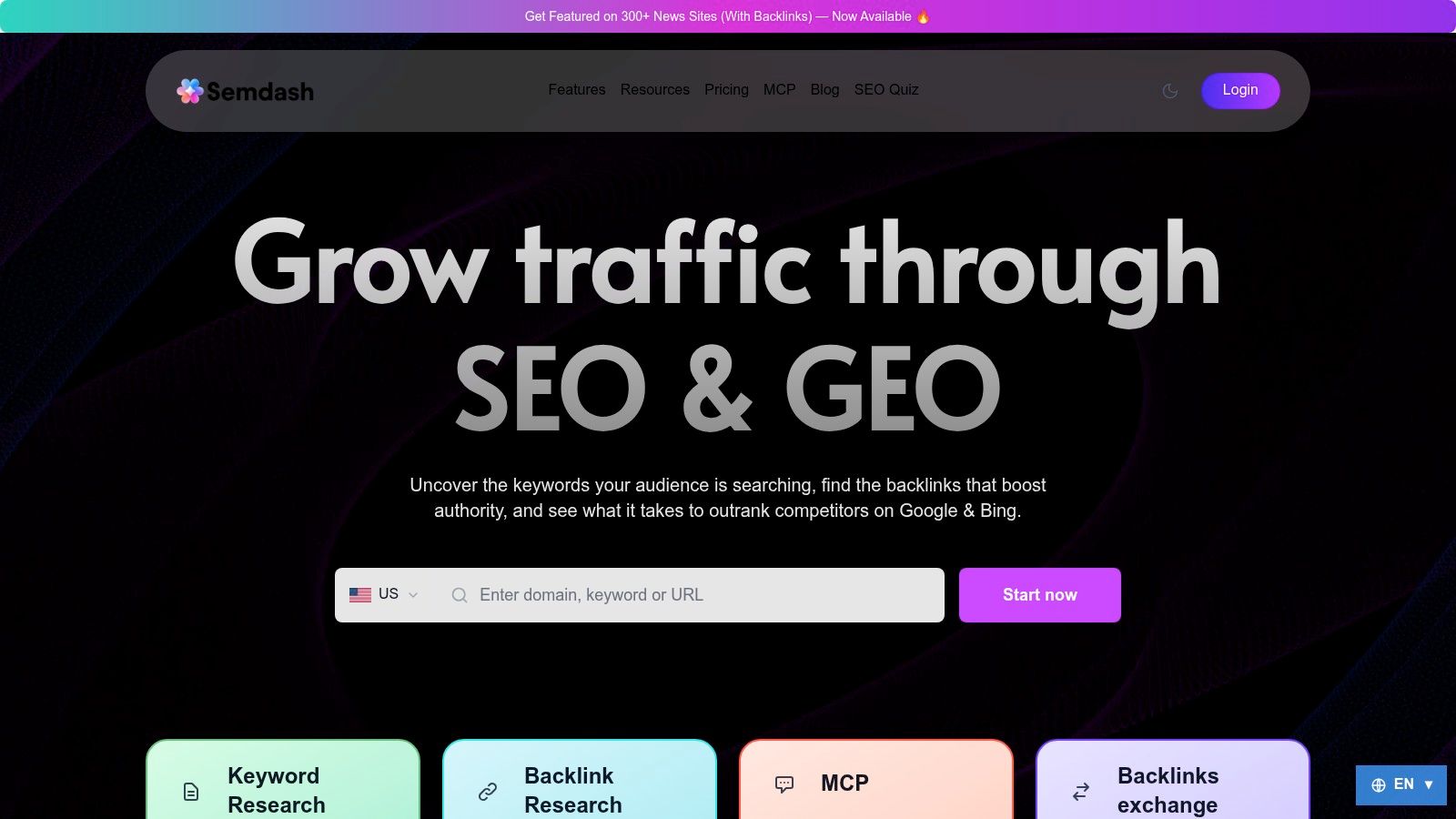
What makes SemDash stand out in practice is that it doesn't force me to bounce between disconnected tabs. I can move from domain-level keyword mapping to Najpopularniejsze strony, Udział w ruchu, Luka w słowach kluczowych, a Badania linków zwrotnych without rebuilding the same view three times. That matters when I'm reverse-engineering a competitor's content engine and I need the exact URL Google is rewarding, not just a vague domain summary.
Where SemDash actually earns its keep
The strongest workflow is opportunity discovery. Its 6.6B-keyword database, 2.7T-link index, and 600M SERPs refreshed monthly are the kind of scale that helps on long-tail work, niche business terms, and content expansion (SemDash product site). I've found that if a team keeps running into “no data” style dead ends in smaller tools, SemDash usually gives them something useful to work with.
It also has one of the more practical backlink workflows I've seen for day-to-day SEO. Luka w linkach zwrotnych, wykrywanie niepołączonych wzmianek, a odzyskiwanie uszkodzonych linków are not flashy features, but they're the ones that turn into actual outreach lists and reclaimed equity. If you do link building for clients, that saves hours of manual filtering.
Praktyczna zasada: if you're replacing Moz for competitive research, test whether the tool tells you not just who ranks, but which exact page ranks and why. URL-level mapping is where most content plans get sharper.
SemDash also leans into AI in a way that feels useful instead of ornamental. The platform's MCP-based integrations with Claude and ChatGPT are aimed at querying real SEO data, and its AI Overviews view is built to show which queries trigger domain mentions and which URLs are cited in Google's AI answers (SemDash product site). That's a meaningful shift if your team cares about modern SERP surfaces, not just blue links.
Best fit and caution
I'd put SemDash in front of SEO specialists, agencies, SaaS teams, e-commerce teams, and content marketers who want a fast competitive layer without stitching together multiple tools. The interface is clean, the workflow is direct, and the dataset breadth is real. The trade-off is that some enterprise-style bulk analysis is less prominent, so very large multi-domain teams may still want to validate whether it covers their heaviest reporting jobs before they migrate fully.
If you want a tool that helps you spot gaps, reclaim links, and plan content with less guessing, SemDash is the strongest all-around Moz replacement I've tested.
2. Ahrefs
Ahrefs is the tool I reach for when the question is link intelligence, not just “SEO suite.” It's the most natural move for teams that used Moz mainly for backlinks, competitor pages, and domain-level analysis. The internal reason I keep it on shortlists is that it stays focused on the workflows link builders use every week.
The product is built around Site Explorer, Keywords Explorer, Rank Tracker, Audyt strony, a Radar Marki. That combination gives you a clean path from discovery to monitoring, especially if you care about who links to whom, which pages attract traffic, and how rankings shift over time. For competitive audits, that's still one of the easiest interfaces to trust.
Ahrefs also feels more mature than many alternatives when you're dealing with content discovery. Its keyword clustering, intent work, and SERP history help you map a page before you write it, which reduces the usual problem of publishing into a topic cluster you don't fully understand. I still think it's one of the better choices for teams that need to reconcile content planning with link analysis in the same place.
The trade-off is cost discipline. Ahrefs can get expensive once you factor in seat add-ons and usage patterns, and its weekly rank-update cadence won't suit every team. If your reporting rhythm depends on more frequent check-ins, that limitation matters. I've seen teams buy it for the backlink graph, then realize they were really paying for a bigger research habit than they needed.
For a direct side-by-side perspective, I'd pair the product page with a focused comparison like this SemDash versus Ahrefs breakdown. That's useful if you're deciding whether you need the classic link-first stack or a broader competitive research layer.
3. Semrush
Semrush is the most feature-complete Moz replacement when a team wants SEO, competitive intelligence, reporting, and AI visibility in one place. The reason it keeps showing up in serious Moz alternative conversations is that it's not just a keyword tool. It's a broad marketing stack with enough depth to support SEO teams, content teams, and performance marketers at the same time.
I like Semrush when the job is bigger than research. Position tracking, site audits, keyword work, competitive data, and AI Search visibility across surfaces like Google Search, ChatGPT, Gemini, and Perplexity all sit inside the same ecosystem. That makes it easier to explain performance to stakeholders who don't want five dashboards and three exports just to answer one question.
Why teams keep choosing it
Independent comparison coverage notes that Semrush is repeatedly positioned as a leading Moz replacement because it combines keyword research, competitor intelligence, and backlink analysis in one stack, with a review citing ponad 55 narzędzi and a 6B+ keyword database (Moz alternatives comparison). That scale explains why larger teams often adopt it even when the interface feels heavier than they'd like.
The thing I've learned is that Semrush is best when you use the breadth. If you only need rank tracking and quick keyword checks, you'll probably pay for more than you need. But if your team moves between content briefs, share-of-voice reporting, and cross-channel analysis, the packaging starts to make sense.
Moja zasada: Semrush pays off when multiple people need the same dataset for different jobs. If one person is doing everything, the suite can feel larger than the workflow.
I also like that Semrush has become more relevant to AI visibility. Most older SEO tools still talk like it's 2019. Semrush is closer to where teams are now, especially when they need to know how often their brand appears across emerging answer surfaces.
Na co zwrócić uwagę
The main downside is packaging. Pricing grows with users and add-ons, and that can make the total cost feel less predictable than a simpler tool. You're buying breadth, not just a single feature, so I'd only choose it if your day-to-day workflow will use that breadth. If not, you're better off with a narrower platform and a cleaner bill.
5. SE Ranking
SE Ranking is the practical choice for teams that want a lower-friction Moz replacement without giving up the core SEO work. I usually mention it first to agencies and SMBs that need rank tracking, audits, keyword research, backlink work, and reporting, but do not want to buy a large stack they will only use in pieces.
Moz Pro is publicly listed in the market from $99 to $599 per month, so price becomes a real comparison point for teams that only need the functions they use weekly. SE Ranking starts at $52 per month and is positioned toward small SEO projects (SE Ranking comparison). That gap matters when you are budgeting for multiple clients or a lean internal team.
Gdzie najlepiej się sprawdza
SE Ranking works well for rank tracking plus baseline SEO research. I like it for local tracking, reporting cadence, and straightforward project management. If you are not trying to run an enterprise reporting operation, the setup stays manageable.
It also works well as a migration testbed. I often tell teams to mirror one live project in the old and new platform, then compare how each handles the same keyword set and reporting routine. SE Ranking is usually one of the easier tools to validate that way because the workflows stay clear and the learning curve is not steep.
For day-to-day SEO work, that simplicity has real value. My experience is that cleaner setup usually beats a feature list you never touch, especially when the team needs to keep moving and does not have time to babysit the tool.
What can trip people up
The trade-off is depth versus convenience. SE Ranking covers the essentials well, but if your process depends on very advanced data views or a broader suite of specialized modules, you may feel the limits sooner than you expect. That is not a flaw if your workflow is focused, but it does matter if you are replacing a heavier platform and want every edge case covered.
It can also feel more compact than some teams want after migration. When I have used it as a replacement path, the main question was not whether it could do the job, but whether the team needed the extra layers that came with the old tool. If your SEO process is built around repeatable audits, clean rank checks, and client-ready reporting, SE Ranking gives you a straightforward path without a lot of friction.
5. SE Ranking
SE Ranking is the practical choice when a team wants a lower-friction Moz replacement without giving up core SEO coverage. It's usually the first tool I mention to agencies and SMBs that want rank tracking, audits, keyword research, backlink work, and reporting without buying a giant stack they won't fully use.
Moz Pro is publicly listed in the market from $99 to $599 per month, so price becomes a real comparison point for teams that only need the functions they use weekly (Moz pricing comparison). SE Ranking gives you a more flexible starting point, with a starting price of $52 per month and a positioning aimed at small SEO projects (SE Ranking comparison). That's a meaningful gap when you're budgeting for multiple clients or a lean internal team.
Gdzie najlepiej się sprawdza
The best use case is rank tracking plus baseline SEO research. I like it for local tracking, reporting cadence, and straightforward project management. If you're not trying to run an enterprise reporting operation, the setup stays manageable.
It also works well as a migration testbed. I often recommend mirroring one live project in the old and new platform, then comparing how each one handles the same keyword set and reporting routine. SE Ranking is usually one of the easier tools to validate that way because the workflows are straightforward.
What can trip people up
The limits can vary by promotion and region, so I'd never buy it on the headline price alone. Check the actual project caps, keyword caps, and reporting expectations before you commit. That's where teams get surprised.
I'd also keep in mind that SE Ranking's database depth is good, but it's not built to compete head-on with the heaviest incumbents on raw breadth. For many small and mid-sized teams, that's fine. For massive research programs, it can feel like a compromise.
6. Serpstat
Serpstat is one of the smarter budget-conscious alternatives when I want a broad toolset without paying premium-suite prices. It gives you keyword and domain analysis, rank tracking, site audits, backlink analysis, and AI Overviews keyword tracking, which makes it a credible choice for teams that still want an all-in-one workflow.
The part I respect most is the regional coverage. Serpstat supports 230+ Google regional databases, which is useful if you manage campaigns across different countries or need more than a single-market view (Serpstat product site). That kind of coverage can be more valuable than a flashy feature you don't use.
I also like the way it handles usage. The platform is more transparent about daily search and export limits than some competitors, which helps with planning. If your team knows it's going to hit the research tool hard, that clarity matters.
Strong points and trade-offs
Serpstat is especially useful when you want generous project allowances. Higher tiers allow unlimited projects, which can be a real advantage for agencies juggling many smaller accounts. It also includes white-label options and AI or brand-opportunity reporting on stronger plans, so it can support client-facing work without immediately forcing a bigger spend.
The trade-off is that the UI depth doesn't quite match the market leaders in every module. I've found that backlink reporting, in particular, can feel less expansive on lower tiers. If your team lives and dies by link analysis, you may outgrow it.
For everyone else, it's a solid balance. I'd shortlist Serpstat when a team wants a functional, lower-cost SEO suite with enough breadth to replace Moz for common research and tracking tasks without overcommitting budget.
7. Mangools
Mangools is the easiest tool on this list to hand to a solo marketer or a small team that hates complicated software. It's lightweight, approachable, and focused on the basics, which is exactly why it works. I've seen plenty of people waste time in overbuilt suites when they really just needed a quick keyword and SERP workflow.
KWFinder does the heavy lifting for long-tail discovery. SERPChecker gives you the search result context you need before you write. LinkMiner adds basic backlink visibility, and Rank Tracker keeps the monitoring side simple. That's enough for a lot of small sites, especially when the owner is also the operator.
The big win is usability. Mangools has less setup friction than most of the heavier alternatives, and that means more consistent use. A tool that gets opened every day beats a larger one that sits untouched because the interface feels like a project.
Where it wins, and where it doesn't
The strength is focused work. Keyword discovery, SERP analysis, and basic rank tracking are easy to keep moving. For freelance SEOs, small businesses, and new teams, that's often the right balance.
The limitation is depth. The databases and backlink breadth are smaller than Ahrefs or Semrush, and you'll feel that on tougher competitive research. If you're trying to replace Moz for broad market intelligence, Mangools may not go far enough.
I'd still recommend it when the goal is simplicity. If your weekly workflow revolves around a few sites, a manageable list of keywords, and light link checks, Mangools is a clean fit.
8. SpyFu
SpyFu is the one I bring up when the Moz discussion is really about competitor history, paid search overlap, and fast querying. It's not trying to be the deepest backlink platform or the prettiest content suite. It's built for seeing what competitors have done and doing something with that information quickly.
That focus shows up in the product design. Domain and keyword research sit beside historical SEO and PPC data, so you can look at organic and paid behavior together. For teams that run SEO and ads in parallel, that's useful because the buying pattern often matters as much as the rank itself.
I also like SpyFu for lead generation and sales use cases. The ability to surface domain contacts and export competitive data makes it handy for agencies that need to turn research into outreach. It's one of the few tools that feels comfortable in both SEO and prospecting conversations.
The downside is obvious if you need deep backlink intelligence. SpyFu isn't a link-first product, and you'll notice that quickly if your Moz use case was mostly off-page analysis. It's more of a competitive intel layer than a full SEO replacement.
For budget-conscious teams that query a lot, though, it's a sensible buy. The interface is straightforward, the time-to-insight is quick, and you don't need much training to get value from it.
9. Sistrix
Sistrix is a serious option for teams that care about international visibility tracking, especially in European markets. The product's reputation comes from its Wskaźnika Widoczności, which gives you a clean way to watch search presence over time. For agencies and in-house teams managing cross-market SEO, that historical perspective is valuable.
The platform also gives you on-page crawls, keyword tracking, content tools on higher tiers, and API access. That makes it more flexible than many people expect if all they know is the visibility metric. I've found it especially useful when a team wants a data-led view of how a site is behaving across time, not just a snapshot of today's rankings.
Why it stands out
Sistrix feels built for disciplined monitoring. The pricing structure is transparent, the workflow is stable, and the add-ons make sense once you know what you need. If your market includes a lot of EU countries, the regional strength is a real advantage.
It's not the first tool I recommend for a U.S.-only team that mainly wants general keyword research. But for international work, it deserves more attention than it usually gets in generic Moz alternative lists. That's especially true when visibility history matters more than a huge one-off database.
The drawback is cost structure in euros and the way advanced exports or bigger project needs push you up the ladder. I'd verify the exact plan fit before committing, especially if your team is buying from the U.S. and exchange rate movement affects your budget.
10. Ubersuggest
Ubersuggest makes sense when price sensitivity is the top issue and the team wants a simple way to keep doing basic SEO work. It's not the deepest platform here, but that's not why people buy it. They buy it because it covers keyword ideas, site audits, rank tracking, and content suggestions without making the onboarding process feel like a second job.
I've seen Ubersuggest work best for freelancers, small businesses, and beginners who need a practical starting point. The interface is approachable, the learning curve is low, and there's enough utility to support routine checks without overwhelming the user. If someone is moving off Moz because they want something easier to justify, this often gets a look.
The trade-off is data depth. You won't get the same breadth as the larger suites, and lower tiers come with tighter limits on projects and reports. That's fine if your workflow is narrow. It's a problem if you expect it to behave like a heavyweight competitive research platform.
I'd treat Ubersuggest as a utility tool, not a full strategic engine. For basic ongoing audits and light keyword research, it does the job. For serious link work or deeper market analysis, you'll outgrow it fast.
Top 10 Moz Alternatives Comparison
| Narzędzie | Core features ✨ | Quality ★ | Value 💰 | Best for 👥 |
|---|---|---|---|---|
| SemDash (SemDash) 🏆 | URL-level keyword mapping, 6.6B keywords, 2.7T backlinks, 12‑mo SERP history, AI briefs ✨ | ★★★★☆ fast UI, fresh data | 💰 Budget-friendly, free trial, optional PR add-on | 👥 SEO specialists, agencies, content & growth teams |
| Ahrefs powiedział: | Deep backlink index, Site Explorer, Keywords Explorer, Rank Tracker ✨ | ★★★★☆ mature, trusted data | 💰 Premium plans, seat/add-ons can raise cost | 👥 Link-focused teams, enterprise researchers |
| Semrush powiedział: | All-in-one marketing suite, AI Search visibility, Position Tracking ✨ | ★★★★☆ broad feature set | 💰 Higher cost with add-ons | 👥 Large teams needing integrated stack |
| Majestic | Link-centric index, Trust Flow & Topical metrics, Link Graph ✨ | ★★★★☆ specialized link authority | 💰 Competitive for pure link work | 👥 Link builders, outreach specialists |
| SE Ranking | Rank tracking, Site Audit, competitor research, flexible limits ✨ | ★★★★☆ solid tracking & reporting | 💰 Good value, flexible plans & API add-ons | 👥 Agencies, SMBs with varied projects |
| Serpstat | Keyword/domain research, AI Overviews, daily rank checks ✨ | ★★★☆☆ reliable for price | 💰 Cost-effective, generous usage tiers | 👥 Budget-conscious teams, agencies |
| Mangools | KWFinder, SERPChecker, LinkMiner, clean UI ✨ | ★★★★☆ very approachable | 💰 Affordable for solo users | 👥 Solo marketers, small teams |
| SpyFu | Historical SEO & PPC data, unlimited exports on higher tiers ✨ | ★★★☆☆ focused competitive intel | 💰 Very budget-friendly for heavy queries | 👥 PPC+SEO analysts, sales teams |
| Sistrix | Visibility Index, EU-focused SERP datasets, content tools ✨ | ★★★★☆ strong EU historical data | 💰 EUR pricing, transparent limits | 👥 International/EU SEO teams |
| Ubersuggest | Keyword ideas, site audit, rank tracking, Chrome ext ✨ | ★★★☆☆ beginner-friendly | 💰 Low entry price, lifetime options | 👥 Freelancers, SMBs starting SEO |
My Final Verdict How to Choose Your Next SEO Suite
Switching SEO platforms is a big decision. I never tell a team to choose the tool with the longest feature list, because that's usually how you end up paying for modules you don't use. The better approach is to match the platform to the actual work sitting on your calendar.
My first filter is the core workflow. If your week revolves around link building, Majestic i Ahrefs powiedział: belong near the top. If you need broader competitive discovery and cleaner URL-level mapping, SemDash (SemDash) is a stronger fit. If you're running an agency and need a balanced all-in-one stack, SE Ranking, Serpstat, lub Semrush powiedział: make more sense.
The second filter is how often you'll use the data. A tool can have an excellent backlink index and still be the wrong choice if your team only checks backlinks once a month. I've watched teams overbuy because they wanted future-proofing, then underuse the platform because the workflow didn't match their habits. The right suite gets opened daily, not admired during procurement.
I'd also test the migration path before I'd trust any vendor pitch. One source recommends mirroring one active project across tools for two weeks, tracking the same keyword set, crawling the same sitemap, and exporting the same backlink segment, then comparing deltas rather than raw totals for links found, technical issues, and ranking volatility (migration workflow guide). That's the right way to do it, because different platforms often disagree on absolute counts.
The other thing I've learned is that database scale now matters more than it used to. Independent comparisons note that Semrush's keyword universe is far larger than Moz's, and other coverage points out that some tools return “no data” on niche business queries while larger datasets still surface volume and difficulty (Moz alternatives comparison, AI search and data coverage note). If your keyword research keeps hitting dead ends, you don't need a prettier dashboard. You need a deeper dataset.
Budget still matters, of course. Moz Pro sits in a public market range from $99 to $599 per month, and that spread reminds me to compare the actual plan, not the headline starting tier (Moz pricing comparison). I always check whether backlink data, keyword research, reports, and seats are all included before I compare numbers. Too many buyers think they're comparing like-for-like when they're not.
My actual shortlist is simple. SemDash (SemDash) if you want broad discovery, link reclamation, and AI-aware workflows. Ahrefs powiedział: if backlinks are the center of gravity. Semrush powiedział: if you need a large marketing stack. SE Ranking if you want a more affordable all-rounder. The best Moz alternative is the one that makes your weekly SEO work faster, clearer, and easier to repeat.
If you're replacing Moz because you need faster competitive discovery, deeper keyword coverage, and cleaner link workflows, SemDash is worth a serious look. It combines keyword research, backlink intelligence, SERP history, and AI-assisted planning in one place, which is exactly what a lot of Moz users are trying to preserve. Visit SemDash (SemDash) i sprawdź, czy pasuje do sposobu pracy Twojego zespołu.