%20(1)-B86R08ZzwhPzS6UZbG3mSxRWPCwGwn.png)


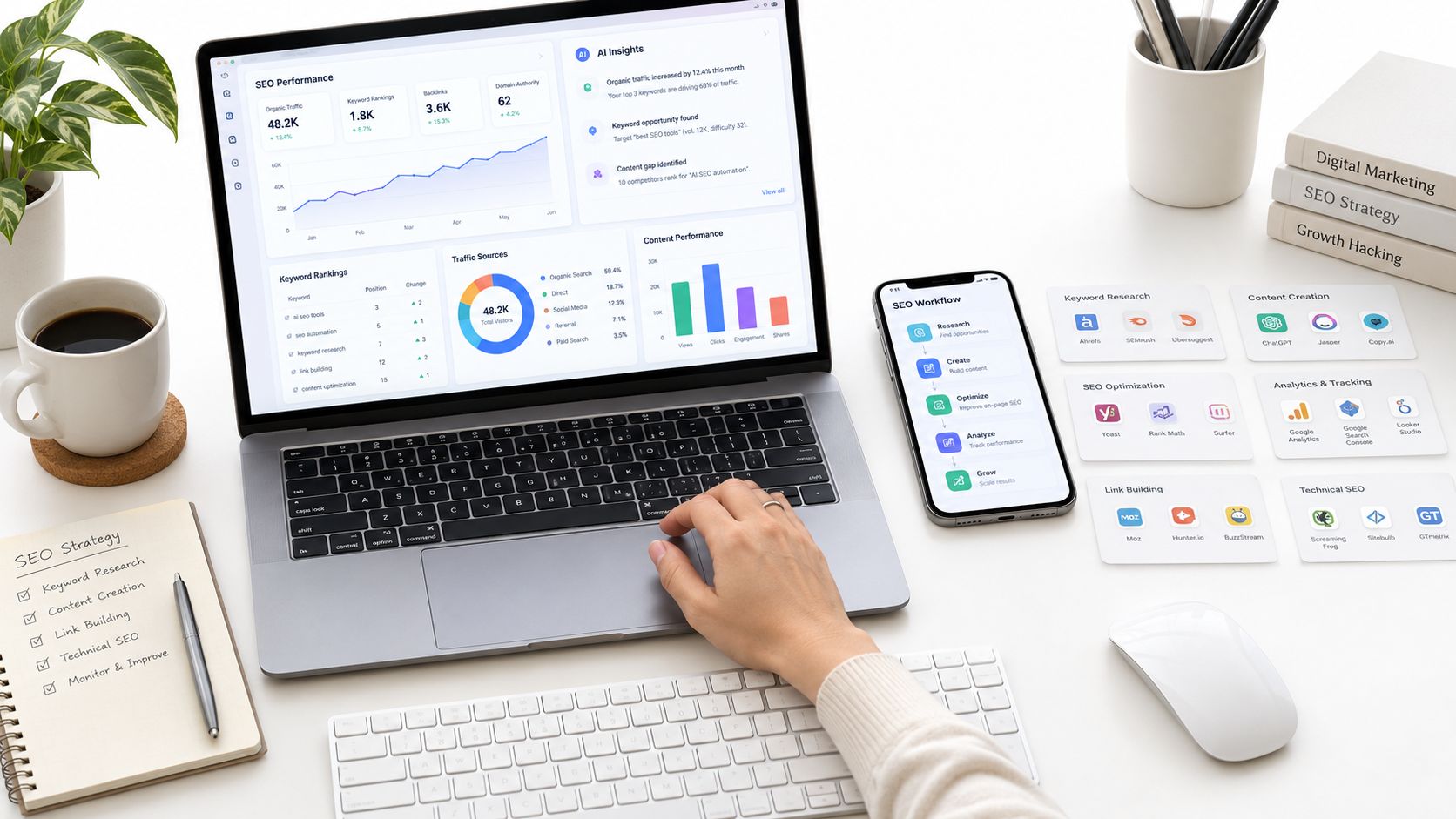
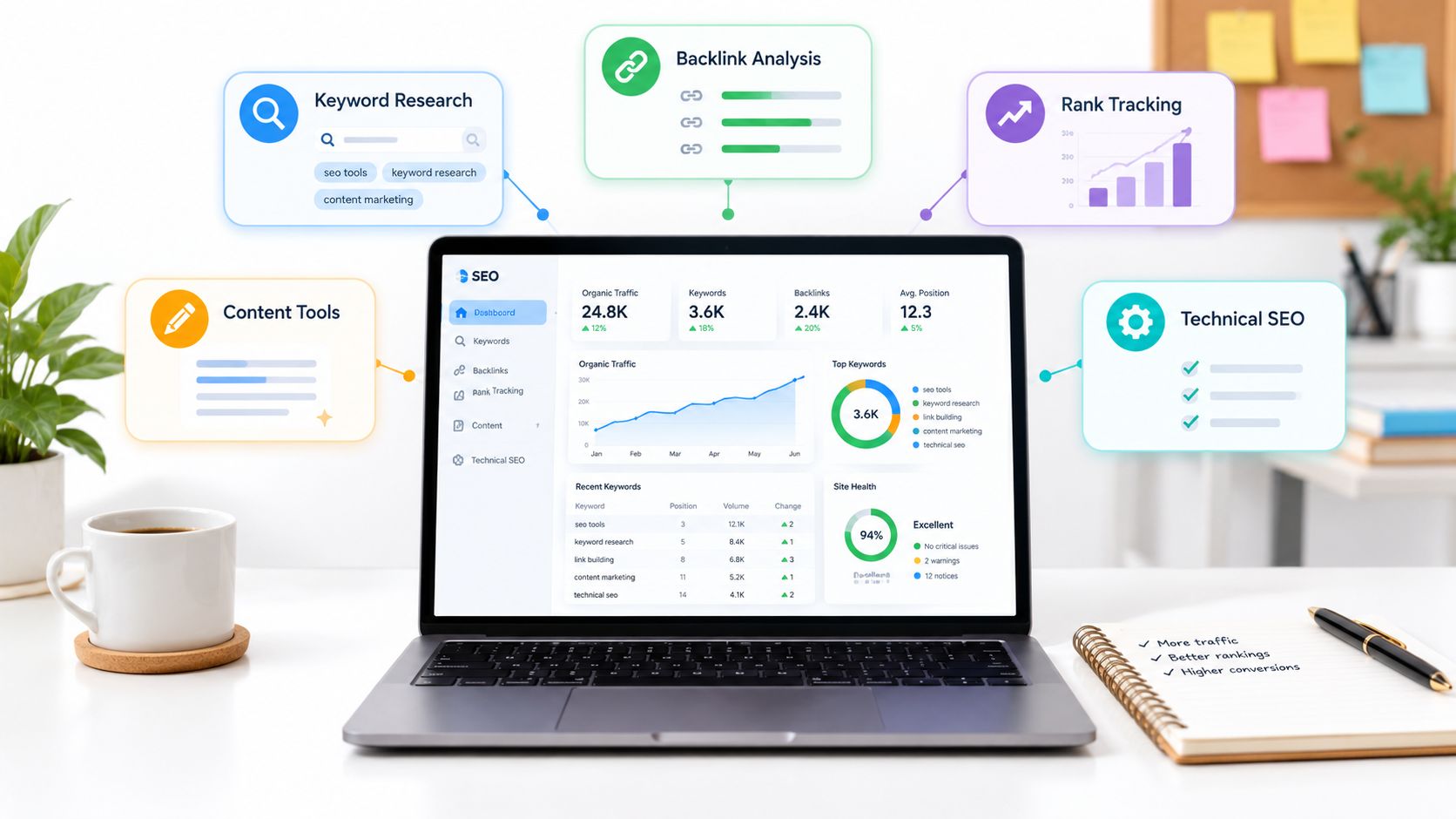
AI features don't automatically improve SEO decisions. They can make a weak brief faster, produce polished content for the wrong intent, and turn a visibility report into a dashboard nobody uses. The useful question isn't which platform has the most AI buttons. It's which tool performs a specific job well enough to survive a real workflow.
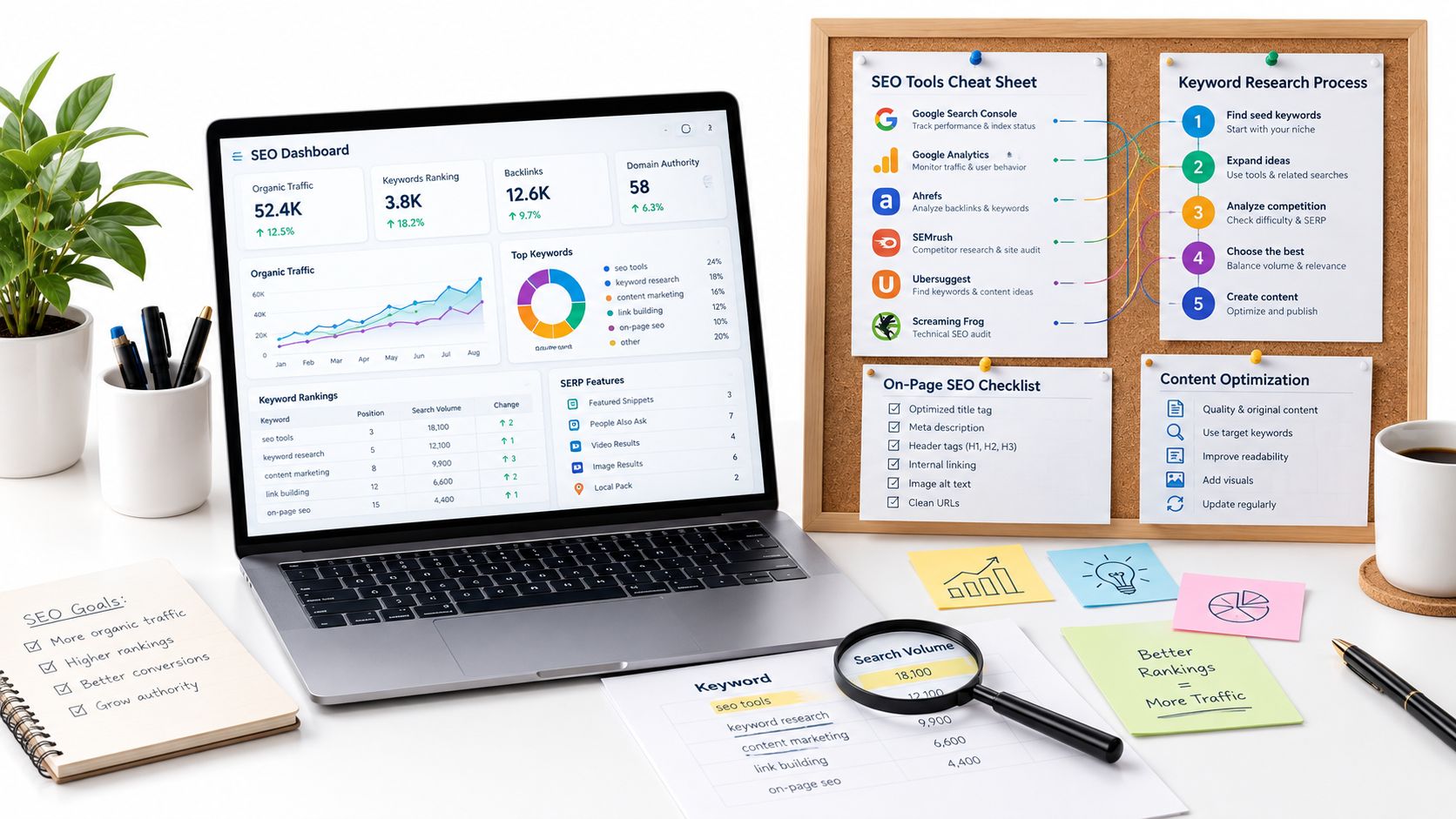
I evaluate AI SEO tools against data depth, SERP grounding, workflow speed, human review requirements, scalability, and practical limitations. That means testing whether a platform can uncover a page-level opportunity, map a keyword cluster, build a defensible brief, improve an existing draft, or show where a brand appears in AI-generated answers.
SemDash is my reference point for live keyword research, competitor analysis, clustering, backlink workflows, SERP history, and AI-assisted briefs. The comparison below treats each product as a solution to a job, not as a collection of feature checkboxes. That approach also fits the wider productivity-tool conversation covered in this time-saving tool roundup.
Spis treści
- 1. SemDash
- 2. Semrush
- 3. Ahrefs
- 4. Surfer
- 5. Clearscope
- 6. MarketMuse
- 7. Frase
- 8. Scalenut
- 9. Outranking
- 10. NEURONwriter
- Top 10 AI SEO Tools Comparison
- Build a Stack That Keeps Humans in Control
1. SemDash
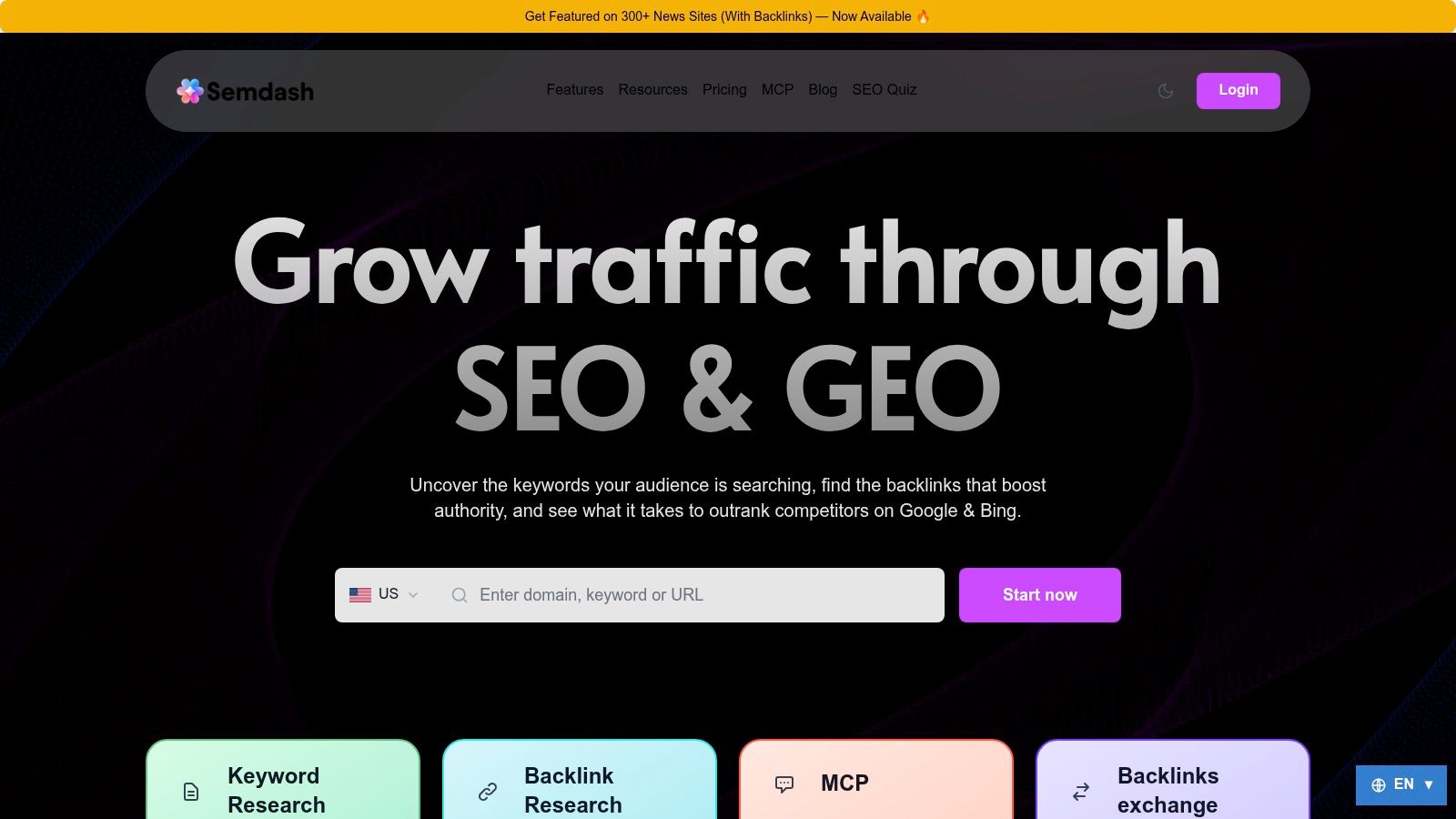
SemDash is the strongest starting point when the job is turning live search data into a practical SEO plan. I'd use it before drafting, because the platform connects keyword discovery, competitor reverse-engineering, page-level mapping, SERP analysis, clustering, and backlink research in one workflow.
Its scale is a meaningful advantage. SemDash reports 6.6 billion Google keywords updated monthly, a 2.7 trillion backlink index, more than 15 billion pages crawled in the last 24 hours, and 600 million SERPs refreshed monthly on its SEO research platform. Those figures matter less as marketing spectacle than as workflow infrastructure. Fresh data helps me check whether a keyword opportunity is current, whether a competitor's ranking page is still relevant, and whether a backlink gap is worth pursuing.
Where it earns its place
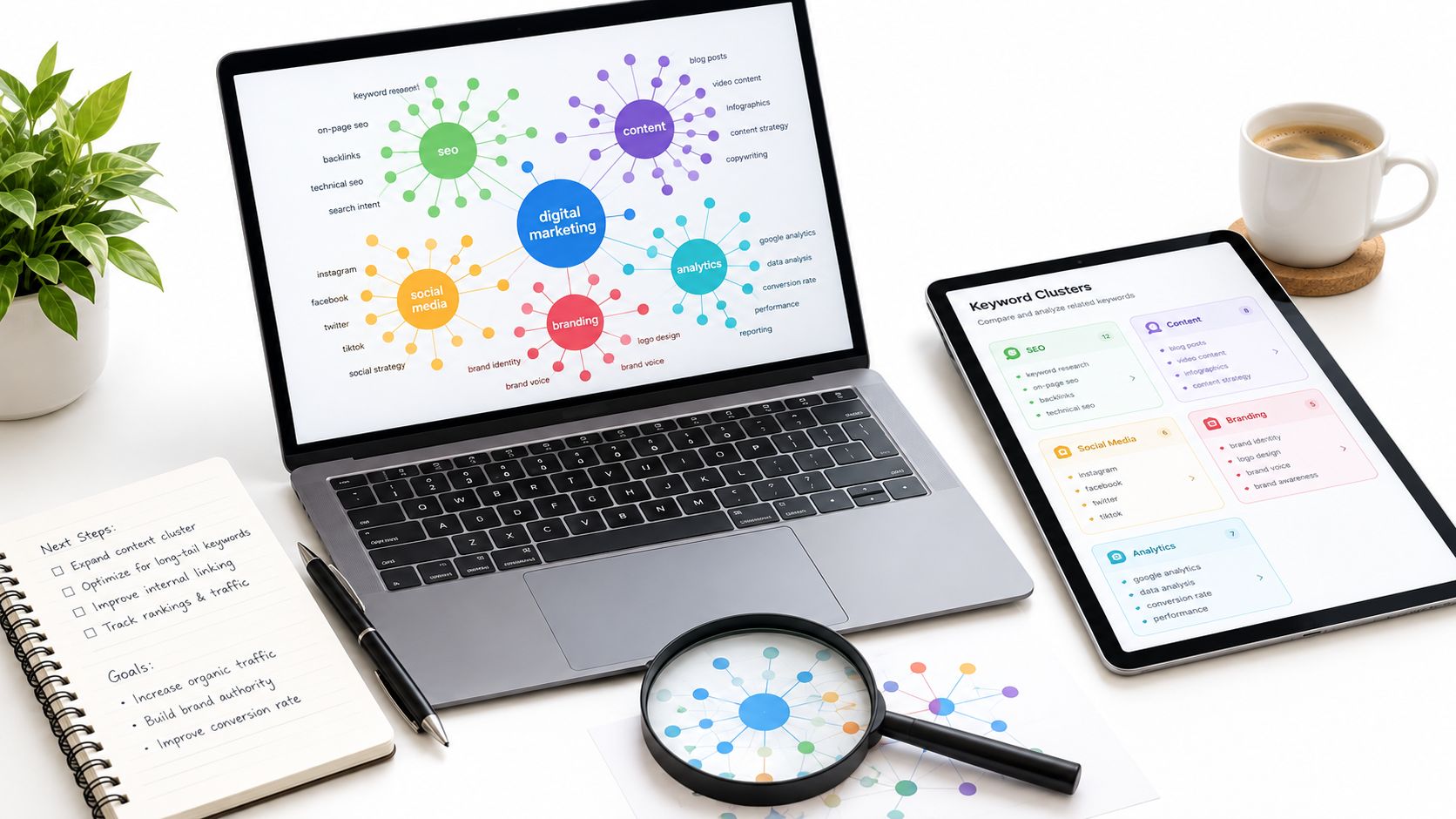
The most useful feature is the connection between keyword and URL. I can see which page ranks for a query, compare competing URLs, review 12-month SERP history, and classify intent before assigning a brief. Keyword clustering also helps prevent cannibalization, where several pages compete for the same query and divide authority instead of concentrating it on one URL. That fix aligns with the practical guidance on content clusters and keyword cannibalization.
SemDash also goes beyond classic research. Its AI Overviews visibility workflow identifies keywords that trigger domain mentions and shows the exact URLs cited. Backlink Gap, unlinked-mention detection, anchor context, and broken-link recovery turn research into outreach tasks rather than another spreadsheet.
Praktyczna zasada: I don't approve an AI-generated brief until I can trace its target page, intent, competing URLs, and content gap back to live SERP evidence.
The trade-off is that some enterprise teams may want broader bulk analysis or more returned keywords per domain than SemDash provides in particular queries. Multi-domain operations should test batch workflows directly. Advanced pricing and the optional service for getting featured on 300+ news sites with backlinks also need checking before purchase. Still, the simplified interface, free trial or free access to 20+ tools, learning resources, and live support make it a credible value-oriented alternative to heavier legacy suites.
2. Semrush
Semrush fits teams that want one broad operating system for SEO and AI visibility. Its traditional toolkit covers keyword research, rank tracking, competitor analysis, and site audits, while its AI Visibility features extend monitoring across Google Search, ChatGPT, Perplexity, and Gemini through the Semrush platform.
I'd choose it when several teams need shared reporting and a common source of competitive intelligence. Prompt tracking, AI sentiment monitoring, and brand-presence analysis are useful when stakeholders ask not only whether a page ranks, but whether the brand appears in generated answers and how it's presented.
The workflow trade-off
The all-in-one design reduces tool switching. An agency can move from a technical issue to a competitor gap, then into AI visibility reporting without rebuilding the project in another system. Published limits for tracked prompts and keywords make it easier to forecast capacity before a team commits.
The downside is cost control. Usage, additional users, reporting needs, and advanced AI visibility access can push the platform beyond the needs of a small content team. I'd avoid buying the broadest plan before testing one client report and one recurring research workflow.
Semrush is particularly useful for organizations that value centralized governance and reporting. It's less compelling if the immediate problem is a narrow page-level research task and the team already has strong technical and backlink coverage elsewhere.
3. Ahrefs
Ahrefs remains a strong choice when the job is deep backlink research combined with competitive SEO analysis. Site Explorer, Keywords Explorer, Rank Tracker, Site Audit, and SERP history give experienced practitioners the familiar foundations, while Brand Radar adds AI prompt tracking and brand research through the Ahrefs SEO suite.
Brand Radar is designed to research brands across 475 million or more organic prompts, according to the product information supplied by Ahrefs. That scale can help large teams build a substantial prompt universe, but the useful output still depends on choosing prompts that reflect real customers rather than collecting volume for its own sake.
Where it works best
I'd use Ahrefs for backlink gap analysis, competitor page discovery, historical SERP review, and link-quality investigation. Its optional Content Kit can support content grading and inventory work, while Project Boost adds AI assistance to audits and IndexNow workflows.
The platform's transparent limits for projects, prompts, and crawl credits are helpful during procurement. I can estimate whether a multi-project team will hit a boundary instead of discovering it after implementation. Optional prompt-tracking packages also provide flexibility when AI visibility is important but a complete plan change isn't justified.
The main limitation is stack economics. Some AI and reporting capabilities require paid add-ons, and costs can accumulate across projects and users. Ahrefs is a good fit when link data is central to the operation. If the team mainly needs editorial briefs and draft refinement, a focused content optimizer may offer a cleaner workflow.
4. Surfer
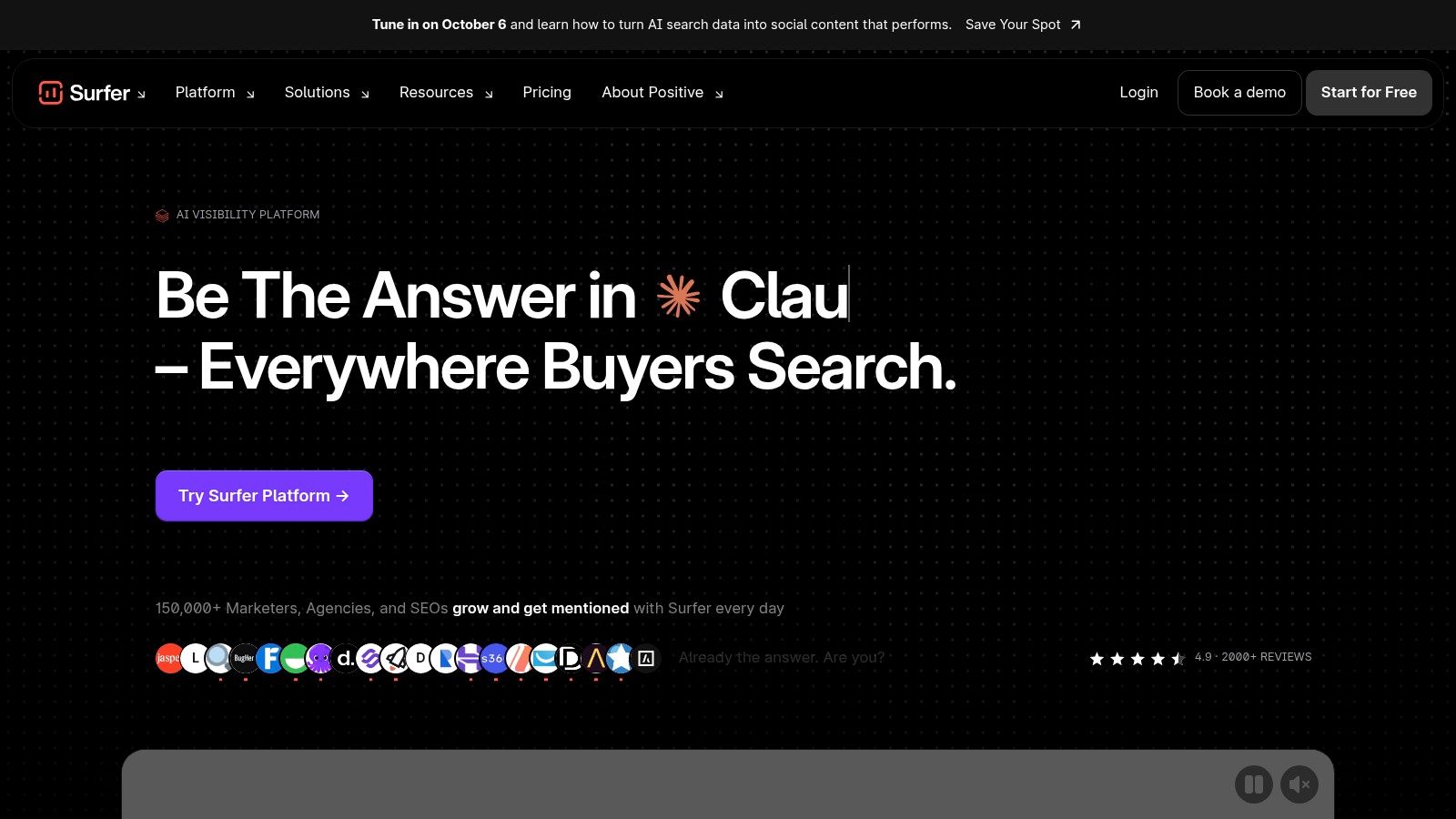
Surfer is built for the draft-to-optimization stage. Its Content Editor and Audits translate SERP patterns, entities, and content comparisons into recommendations that writers can apply while editing. The AI writing assistant, plagiarism checks, AI detection, and humanizing functions make it attractive to content teams that want one controlled production environment.
I'd put Surfer after keyword and intent validation, not before it. A high content score can't rescue a page targeting the wrong query, and SERP-derived recommendations can encourage teams to imitate competitors too closely if nobody adds original expertise.
What works and what doesn't
The editor is easy to understand. Writers can see missing concepts, structural suggestions, and competitive coverage without interpreting a large SEO export. Agencies producing many articles often benefit from that consistency, particularly when several writers need to follow the same optimization process.
Surfer also has a useful role in updating existing pages. I can compare an aging article against current results, identify changed topic coverage, and decide whether to expand, restructure, or leave the page alone. That last option matters. Not every score difference justifies a rewrite.
Pricing and plan structures have changed frequently, and some users report rising costs over time. I'd test the exact number of content tasks, audits, and seats required for a normal publishing cycle. Surfer is strongest as a content optimization layer, not as a complete replacement for live keyword, backlink, and competitor research.
5. Clearscope
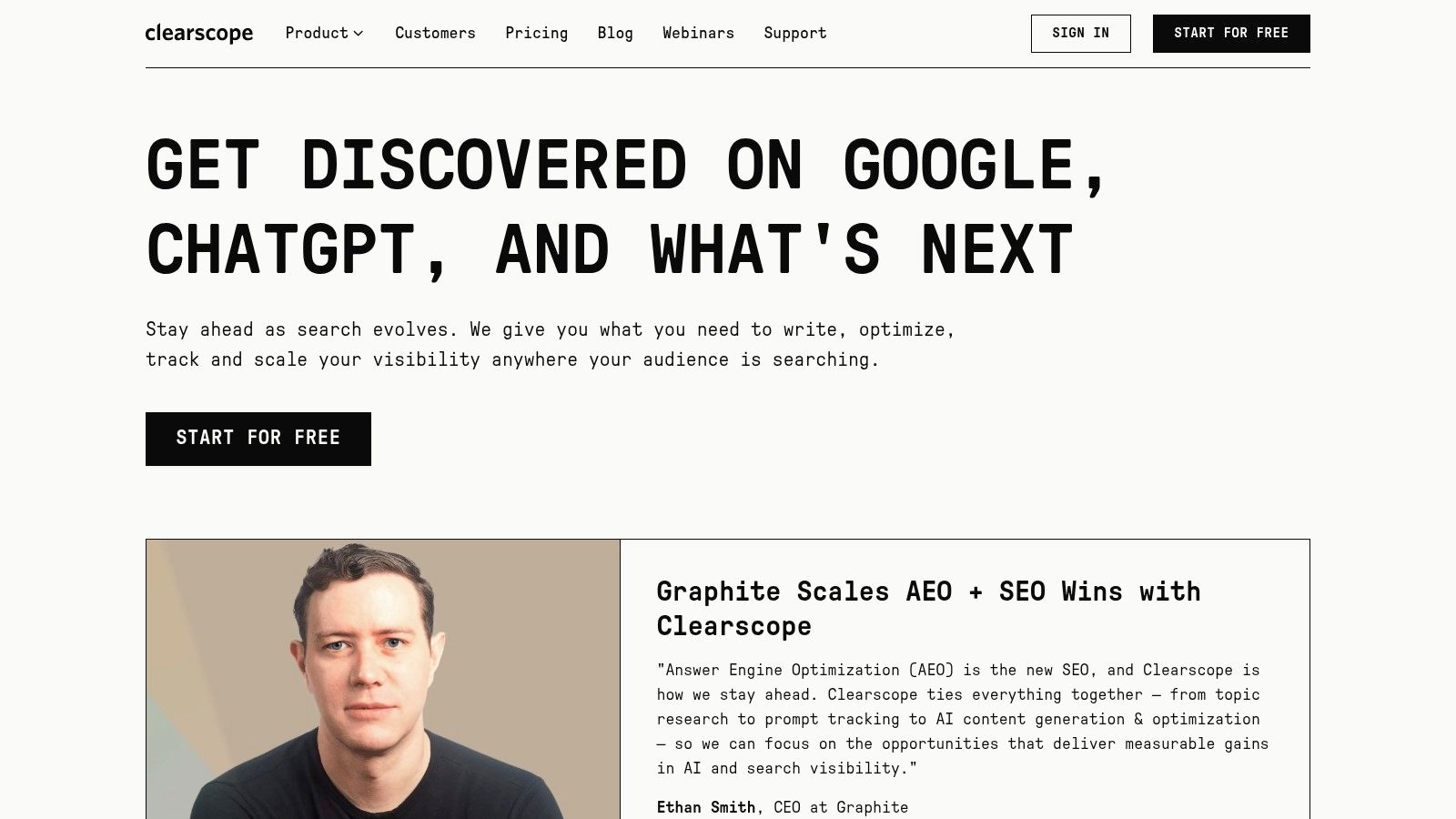
Clearscope is the cleanest option here for teams that need writer-friendly content optimization without a crowded interface. Its term recommendations, intent analysis, editor scoring, Topic Exploration, Draft with AI, and Content Inventory support a focused editorial process through the Clearscope platform.
I'd use Clearscope after a strategist has selected the target page and primary intent. The editor helps a writer improve topical coverage, but it shouldn't decide whether a new page belongs in the information architecture. That decision requires competitor URLs, existing performance, internal links, and cannibalization checks.
A dependable editorial layer
The interface is a major advantage. Writers can understand what to add, where a draft is thin, and how to improve readability without translating a technical audit into editorial instructions. The scoring model is also useful for consistent review across freelancers and in-house teams.
Clearscope's Prompt Tracking adds AI-answer visibility, using a credit-based model. That makes it possible to add measurement without buying a broad SEO suite, although capacity planning becomes important as prompt coverage grows. Inventory and Draft credits can also require add-ons for higher-volume operations.
For teams building the upstream research process, an AI content brief generator can provide a useful alternative when the brief needs live keyword, URL, SERP, and competitor context before it reaches the writer.
Clearscope is not the best choice for deep backlink research or technical diagnostics. It's a strong optimization and editorial-quality tool, especially when the team values stable scoring, clean outputs, and predictable review steps.
6. MarketMuse
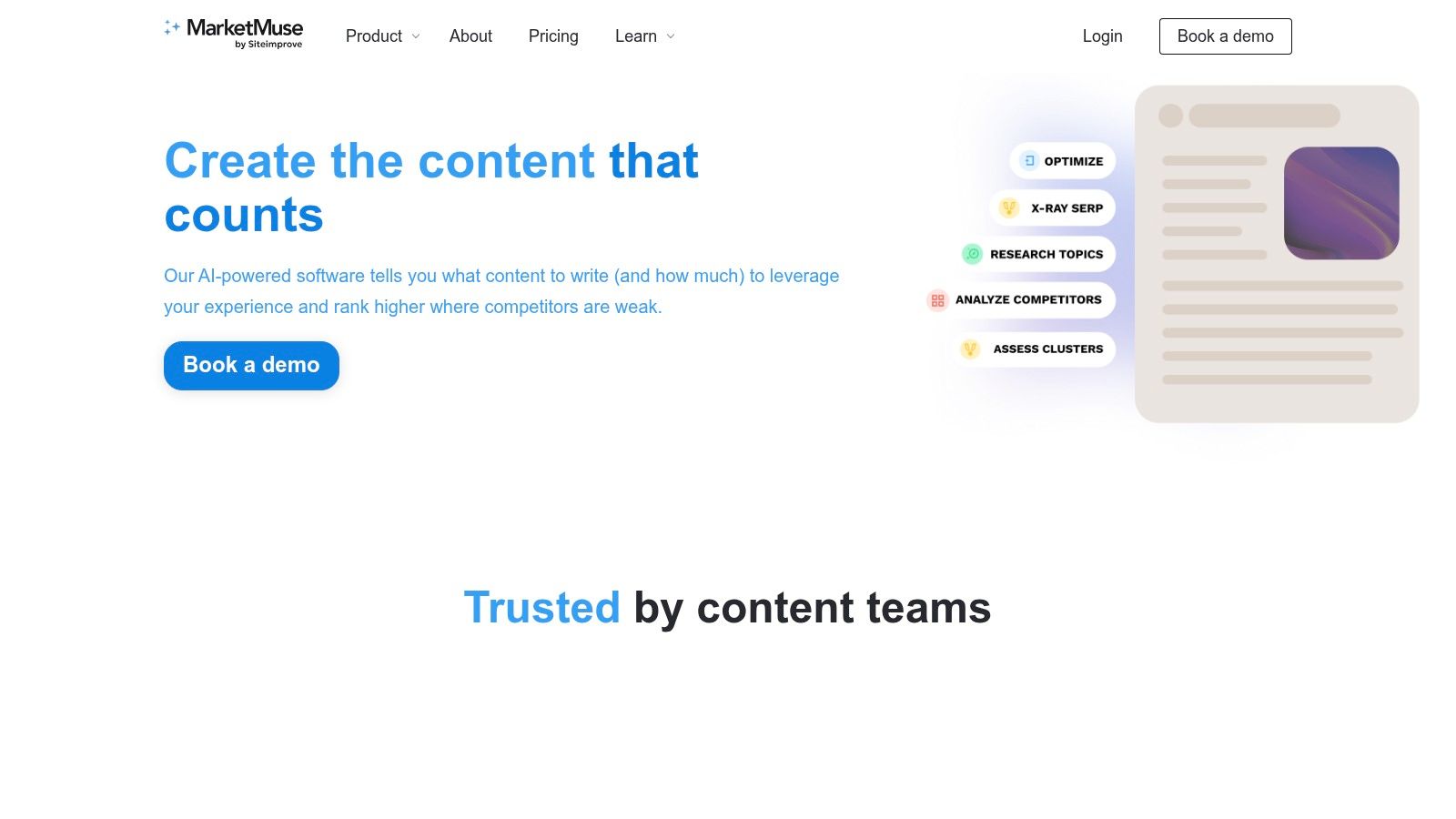
MarketMuse is designed for editorial planning and topic authority, not just page-level wording improvements. Its Content Inventory, tracked topics, personalized difficulty metrics, competitive-advantage analysis, topic modeling, and SERP heatmaps help teams decide what to create, update, combine, or deprioritize through the MarketMuse platform.
I'd bring MarketMuse into a mature content operation where the problem is portfolio management. A team with hundreds of pages needs more than a recommendation to add a term. It needs to understand whether a topic deserves a new page, whether an existing page should absorb the intent, and where the current inventory leaves a meaningful gap.
Planning beyond individual articles
The multiple brief types are practical because an article, comparison page, FAQ, and local landing page shouldn't follow the same content plan. MarketMuse supports those different intents while keeping the broader topic map visible.
Its strength is prioritization. The platform can help an editorial lead identify opportunities where the site has some authority but insufficient coverage, rather than publishing whatever keyword looks attractive that week. That makes it useful for quarterly planning and content refresh programs.
The drawback is procurement friction. Pricing isn't publicly listed by tier on the site, so teams generally need a sales conversation before they can compare the platform with self-serve alternatives. I'd request a workflow demonstration using a real section of the site, not a generic sample project.
MarketMuse makes sense for enterprise editorial teams and agencies managing strategic content inventories. Smaller teams may find the planning depth unnecessary if their immediate need is a fast brief or a straightforward content editor.
7. Frase
Frase targets the research, drafting, optimization, and publishing loop. It combines SERP-driven briefs, AI drafting in a chosen voice, on-page optimization, and publishing integrations for WordPress, Webflow, Sanity, and Wix through Frase.
I'd choose Frase for a small content team that wants fewer handoffs. The ability to push content into a CMS or use FraseCMS can reduce operational work, especially when writers currently copy drafts between separate systems and lose formatting or review context.
Where the end-to-end model helps
Frase's practical strength is continuity. Research feeds the brief, the brief feeds the draft, and the draft moves toward publishing without requiring a separate optimization tool for every article. Monthly article, audit, and AI-generation limits also make production planning easier than an open-ended credit system.
That convenience has a boundary. A high-volume team can hit article or audit caps quickly, and moving to a higher tier may be necessary before the workflow becomes economical. I'd measure the number of pages that reach publication, not just the number of drafts the platform can generate.
The biggest risk is confusing workflow completion with content quality. Frase can accelerate structure and first drafts, but subject-matter review, source checking, product accuracy, and original experience still belong to the team.
For practitioners comparing an end-to-end system with a modular stack, this overview of SEO tools with AI gives useful context. Frase is a good production hub, but it shouldn't replace independent SERP judgment.
8. Scalenut
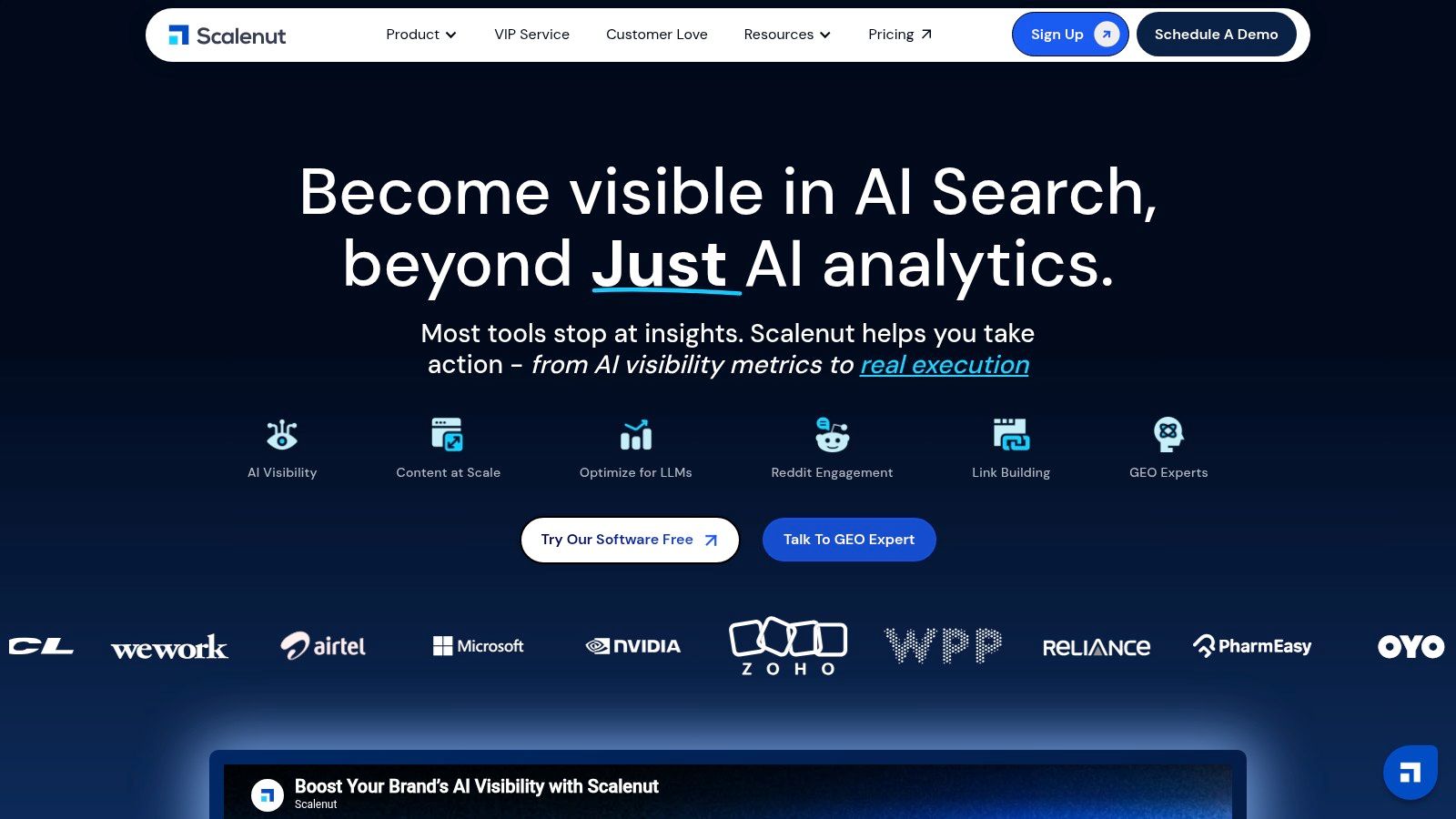
Scalenut combines classic SEO content workflows with generative search visibility tracking. It covers ChatGPT, Google AI Overviews, and Perplexity, while also offering keyword clustering, content audits, on-page optimization, internal linking, and topic-gap analysis through Scalenut.
That combination is useful for SMBs and agencies that don't want separate tools for drafting and AI visibility. I'd use it to connect an article update with a visibility question, such as whether a revised comparison page is appearing in AI answers and whether the cited source is the page I intended to promote.
Value with a monitoring caveat
Scalenut's Starter, Plus, and Professional plans present monthly limits for prompts, articles, and audits. A 7-day free trial gives teams a way to test the workflow before committing, as stated on the product site. That's enough time to run a real brief, update an existing page, and inspect the visibility workflow rather than judging the interface from a demo.
The platform also includes optional Social Upreach workflows and a pay-as-you-go Backlinks Marketplace. Those additions may suit teams that want execution options in the same workspace, although I'd assess outreach quality separately from software convenience.
Plan names, promotions, and included limits can change. I'd record the exact inclusions at purchase and repeat that check at renewal. Scalenut is attractive when a team wants AI visibility and content operations together, but teams with mature link research or technical auditing may still need focused tools beside it.
9. Outranking
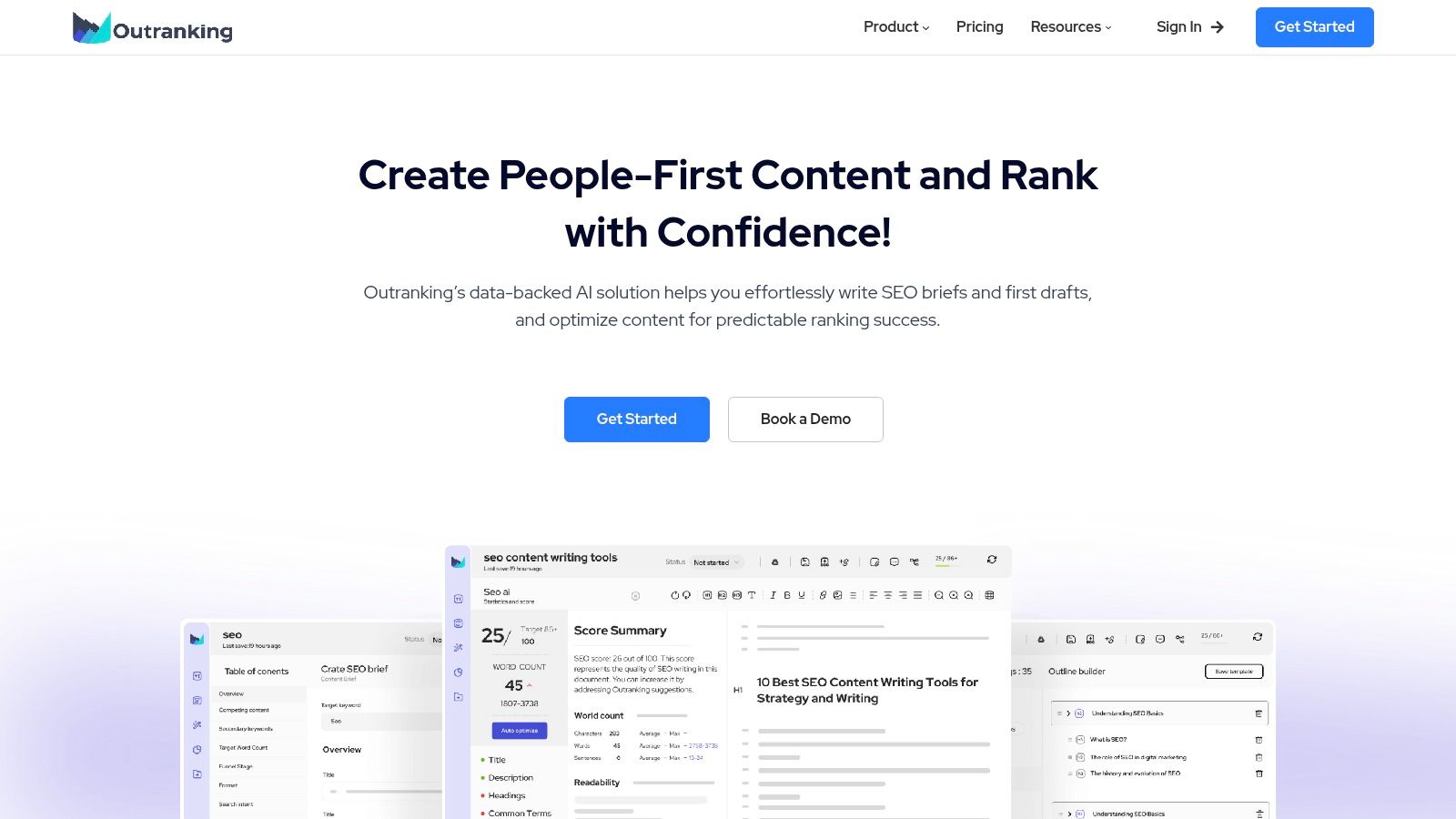
Outranking is aimed at teams that want to automate a broad portion of the strategy-to-publish workflow. It supports multi-draft AI writing, automated optimization, internal linking, hub-and-spoke structures, and a Strategist add-on for clustering and keyword prioritization through Outranking.
The appeal is systemization. Instead of asking each writer to invent a process, a team can define how keyword groups become briefs, how drafts are assessed, and how internal links are suggested. That consistency can help a scaling operation where the main constraint is process variation rather than a lack of ideas.
Automation needs supervision
I'd be cautious with multi-draft generation. Producing several outlines or drafts can speed up comparison, but it also increases the chance that a team selects the most fluent version instead of the most accurate one. Internal linking automation deserves the same review. A link can be topically related and still be wrong for the user journey, anchor context, or site architecture.
Outranking's full workflow coverage is its clearest advantage. It connects clustering, briefs, drafts, optimization, and linking more directly than a narrow content editor. The trade-off is cost. Public list prices are high compared with many SMB-focused tools, and current inclusions or promotions should be verified before purchase.
I'd recommend Outranking to a team with a defined editorial framework, strong reviewers, and enough production volume to benefit from automation. It's less suitable for a solo practitioner who needs highly focused research and prefers to control every recommendation manually.
10. NEURONwriter
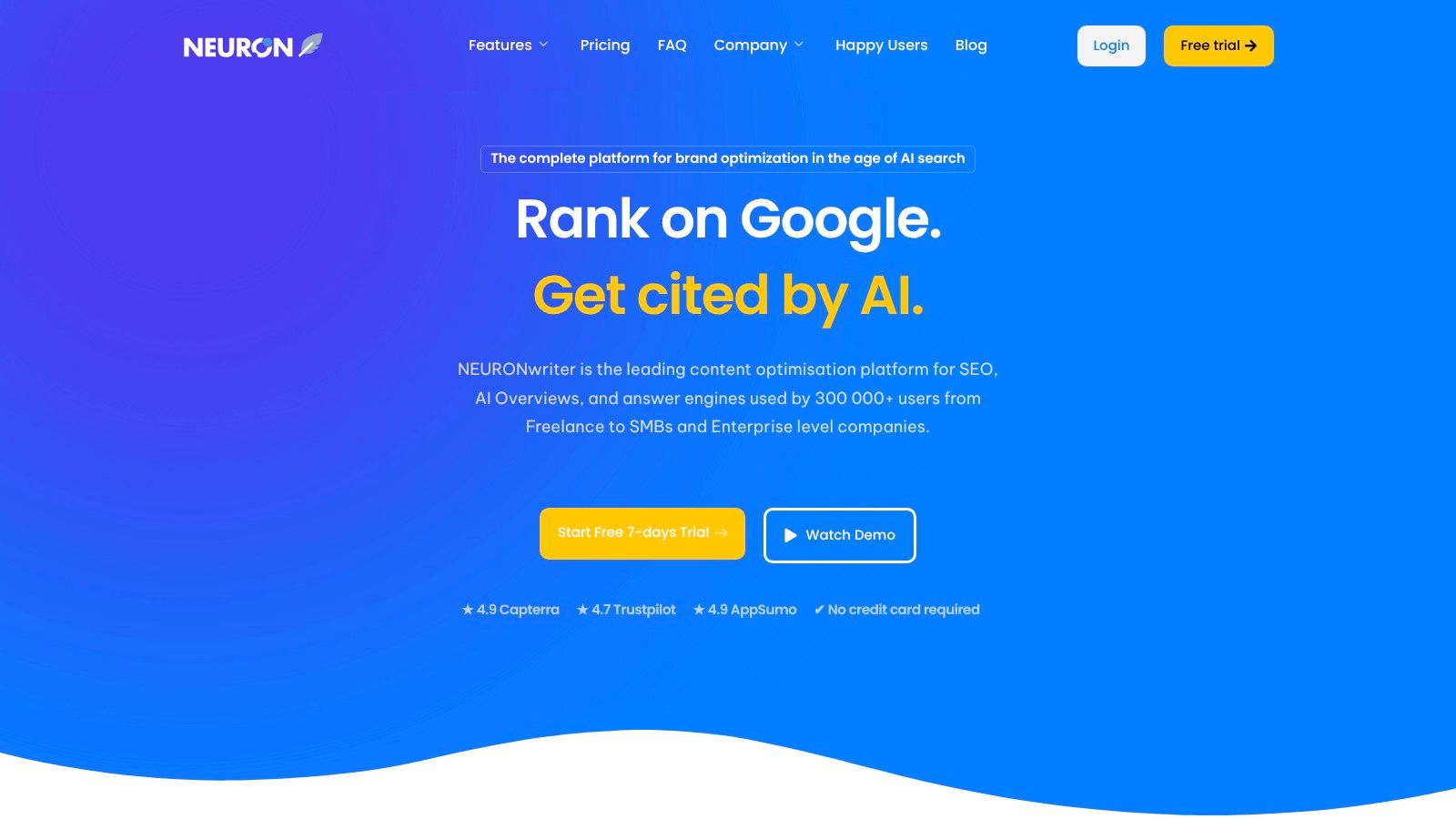
NEURONwriter is a practical choice for the budget-conscious drafting and optimization workflow. It combines SERP analysis, entity recommendations, a Content Designer for rapid drafts, plagiarism checks, and integrations with Google Search Console, WordPress, and Shopify through NEURONwriter.
I'd test it with a real product page or existing article rather than a blank blog brief. The useful question is whether its entity recommendations reveal a genuine content omission, or just encourage the writer to reproduce the vocabulary already present in competing pages.
Strong coverage, lighter polish
The feature-to-price ratio is appealing for freelancers and small agencies. Support for using your own OpenAI key can also give teams more control over model usage and operating costs. The AI Monitoring add-on extends coverage to Google AI Overviews, ChatGPT, Perplexity, and other large language model environments.
The platform's limits are mostly about refinement. The interface and templates aren't as polished as some enterprise competitors, and the broader feature set may feel less cohesive. That matters when several writers need a guided process, but it's less important for an experienced practitioner who already knows how to validate recommendations.
NEURONwriter works well as a focused tool for SERP-informed content production and economical AI visibility monitoring. I wouldn't buy it expecting the same strategic planning depth, reporting maturity, or enterprise polish as a larger suite. Its value comes from doing the core content job without forcing a small team into an oversized platform.
Top 10 AI SEO Tools Comparison
| Narzędzie | Core features ✨ | Standout USP 🏆/✨ | UX & Data Quality ★ | Grupa docelowa 👥 | Price/value 💰 |
|---|---|---|---|---|---|
| SemDash 🏆 | 6,6 miliarda słów kluczowych; 2,7 biliona linków zwrotnych; 600 milionów SERPów; mapowanie na poziomie URL; briefy AI | 🏆 AI Overviews (domain citations); backlink-gap & unlinked-mention recovery; keyword clustering | ★★★★☆ Fast, simplified UI; very fresh datasets | 👥 Agencies, SEOs, growth teams | 💰 Budget-friendly; free tier/trial |
| Semrush powiedział: | Keyword research, rank tracking, site audit, AI Visibility | ✨ All‑in‑one suite + AI visibility across LLMs | ★★★★☆ Comprehensive data; heavier UI | 👥 Marketing teams, enterprises, agencies | 💰 Premium, costs scale with usage |
| Ahrefs powiedział: | Site Explorer, Keywords Explorer, Rank Tracker, massive link index | ✨ Deep backlink intelligence; transparent limits | ★★★★☆ Robust, accurate data; powerful but complex | 👥 SEOs, link builders, agencies | 💰 Premium; add-ons can raise cost |
| Surfer | Content Editor, audits, AI writer, SERP-driven recommendations | ✨ Prescriptive draft‑to‑publish workflows & content scoring | ★★★★☆ Writer-friendly editor; clear recommendations | 👥 Content teams, publishers, agencies | 💰 Mid-tier (frequent plan changes reported) |
| Clearscope | Term recommendations, prompt tracking, content editor | ✨ Clean UX with stable scoring; credit-based add-ons | ★★★★☆ Simple, actionable outputs for writers | 👥 Writers, content teams | 💰 Mid‑to‑premium; credit model for scale |
| MarketMuse | Topic modeling, content inventory, prioritized briefs | ✨ Enterprise topic authority & planning workflows | ★★★☆☆ Deep planning tools; sales-led setup | 👥 Enterprise editorial teams | 💰 Enterprise pricing, contact sales |
| Frase | SERP-driven briefs, drafting, on‑page optimization, publishing integrations | ✨ Optional FraseCMS for end-to-end publish | ★★★★☆ Practical UX; monthly article/audit caps | 👥 SMBs, content teams, publishers | 💰 SMB-friendly tiers with production limits |
| Scalenut | AI visibility, keyword clustering, audits, internal linking | ✨ GEO focus + AI visibility across LLMs; backlinks marketplace | ★★★☆☆ Competitive data for price; evolving plans | 👥 SMBs, agencies | 💰 Competitive monthly pricing; 7‑day trial |
| Outranking | Multi-draft AI, automated optimization, internal linking | ✨ Strategist add-on for clustering & prioritization | ★★★☆☆ Feature-rich; higher list prices | 👥 Scaling content teams | 💰 Higher monthly list prices |
| NEURONwriter | Content Designer, SERP analysis, AI mode, GSC/WordPress integrations | ✨ Strong feature-to-price; use your own OpenAI key | ★★★☆☆ Cost-effective but UI less polished | 👥 Freelancers, small agencies | 💰 Cost-effective; generous mid-tier limits |
Build a Stack That Keeps Humans in Control
There isn't one universal winner among AI SEO tools because the workflow determines the right purchase. If I need broad competitive intelligence, technical coverage, reporting, and AI visibility in one environment, Semrush is the logical all-in-one candidate. If backlink research and historical SEO analysis drive the operation, Ahrefs remains a strong fit. If the main bottleneck is content refinement, I'd compare Surfer and Clearscope. For editorial planning and topic authority, MarketMuse is more appropriate than a page-scoring editor.
The production choice is different again. Frase suits teams that want a connected write, optimize, and publish loop. Outranking is better for operations that need heavier automation across briefs, drafts, and internal links. Scalenut works for teams looking to combine content workflows with AI search monitoring, while NEURONwriter offers a more economical route into SERP-informed drafting and optimization.
SemDash sits earlier in the process. I'd use it to identify the opportunity, understand the competitive terrain, map each query to the right URL, check SERP history, cluster related terms, investigate backlinks, and create a live-data brief. That makes it especially useful when the team wants focused research without buying another broad suite just because it includes an AI writer.
AI visibility deserves separate scrutiny. The search environment is volatile. Research cited by DesignRush's coverage of AI SEO tools reports that AI Overviews appeared on 6.49% of queries in January 2025, peaked near 24.61% in July, and settled at 15.69% in November. Those figures make a static visibility score inadequate. A report should show the prompts, the answer context, the cited URLs, and changes over time.
Ranking position alone also isn't enough. An Ahrefs analysis covered by Search Engine Journal stwierdził, że tylko 37.9% of cited URLs also appeared in the top 10 organic results for the same query, while 31.2% came from positions 11 through 100 and 31.0% came from beyond position 100. A separate Surfer study of AI Overviews found an average overview length of 157 words and an average of 5 cited sources per queryz 52% of cited sources also ranking in the top 10. The operational lesson is clear. Check both the organic SERP and the actual citation footprint.
Review the evidence, not just the recommendation. AI can identify a promising page or missing topic, but a human still needs to verify intent, accuracy, internal-link logic, brand risk, and business value.
Before committing to any platform, I'd run one representative workflow on a real site. I'd document the inputs, the target query set, the pages reviewed, the human approval steps, credit or prompt limits, output quality, and the work still required after the tool finishes. That test exposes more than a feature tour.
I'd also avoid four common mistakes. Don't treat generated recommendations as ranking causation. Don't publish an unedited draft because it sounds fluent. Don't use a content score as a substitute for expertise. And don't judge AI visibility without opening the cited URLs and checking the underlying SERP context.
The best stack usually combines focused tools. One platform finds the opportunity, another helps the writer execute it, and a visibility tracker shows whether the brand and intended page appear in the answers that matter. Humans should own the decisions, while AI handles the repetitive comparison and analysis that slows good SEO teams down.
SemDash brings live keyword, competitor, SERP, backlink, clustering, content-brief, and AI Overview citation workflows into one practical workspace. Test a real research-to-brief process on your site, then visit SemDash (SemDash) to see whether its data and workflow fit the way your team works.