%20(1)-B86R08ZzwhPzS6UZbG3mSxRWPCwGwn.png)


The popular advice is simple: choose Ahrefs for all-in-one SEO i Majestic for backlinks. That advice is useful as a starting point, but it breaks down during the audits where data history matters more than convenience. I've found that the core decision in Ahrefs vs Majestic is whether my workflow is primarily operational, focused on current rankings and content decisions, or historical, focused on reconstructing how a link profile changed over time.
Both platforms can reveal referring domains, link targets, anchors, and authority signals. They don't expose the web in the same way, though, and treating their reports as interchangeable can send an audit in the wrong direction. Ahrefs is the broader SEO workspace. Majestic is a specialist link graph with a particularly deep archive.
The comparison below reflects how I use both tools in client audits, competitor research, recovery work, and domain evaluation. I'm less interested in declaring one universal winner than in identifying the workflow each tool handles efficiently, the gaps it leaves, and the cost of choosing the wrong one.
Spis treści
- Why Comparing Ahrefs and Majestic Is Harder Than It Looks
- Where Each Tool Actually Sits in the SEO Stack
- Backlink Index Size, Freshness, and Historical Depth
- Domain Rating vs Trust Flow and Citation Flow
- Crawl Methodology and What Gets Missed in Each Tool
- UI, Reporting, API Access, and Integrations
- When Majestic's Historic Index Is the Right Choice
- Pricing Reality Check and the Buyer Decision Framework
Why Comparing Ahrefs and Majestic Is Harder Than It Looks
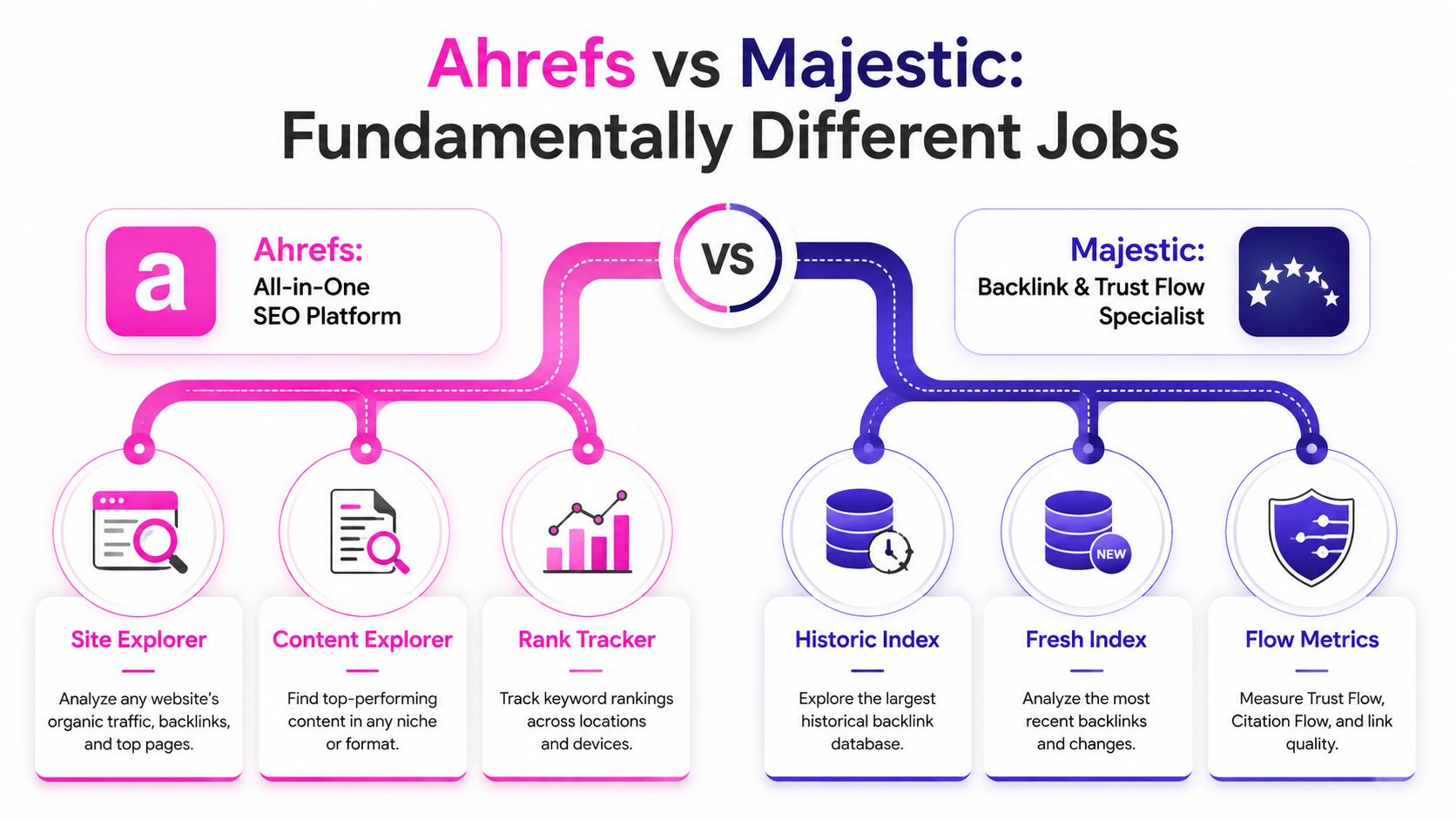
The first mistake I see in Ahrefs vs Majestic comparisons is treating both products as interchangeable backlink checkers. They overlap, but they were built around different operating assumptions. Independent comparisons position Ahrefs as an all-in-one SEO suite and Majestic as a backlink-focused specialist, and that distinction shows up immediately in a working audit.
Ahrefs places backlink data inside a wider workflow that includes keyword research, competitor analysis, content discovery, site auditing, and rank tracking. I can move from a competitor's top pages to the queries behind those pages, then inspect the referring domains supporting them. That reduces tool switching, which matters when I'm researching content and links at the same time.
Majestic starts from the link graph. Its Historic Index records backlinks dating back to 6 June 2006, while its Fresh Index is designed around the most recent 120 dni of newly discovered, deleted, and lost links, according to Majestic's description of its Historic Index. That architecture makes it unusually useful when the question is not just “who links to this site now?” but “what did this site's authority profile look like before the migration, acquisition, penalty, or ownership change?”
The comparison needs controlled tests
A fair side-by-side test needs more discipline than entering the same domain into two dashboards. I control for the date of the check, the site's size, the type of link being investigated, and whether I'm examining current or historical evidence. A fresh editorial link and a deleted directory link answer different questions, even if both appear in a backlink export.
That's why raw totals rarely settle an audit. Ahrefs may give me a faster operational view of a competitor's current link activity, while Majestic may surface historical relationships that no longer exist on the live web. Neither result automatically invalidates the other.
Praktyczna zasada: Decide whether the audit is about what exists now, what existed before, or how the link profile changed. Then choose the index that matches the question.
The workflow cost is real. If I choose a broad suite for a forensic job, I may spend hours rebuilding history from partial exports. If I choose a specialist archive for daily content planning, I may spend time moving keyword, SERP, and rank data into separate tools. The right choice depends on which form of friction my team can tolerate.
Where Each Tool Actually Sits in the SEO Stack
I place Ahrefs near the center of a general SEO stack. It combines backlink analysis with keyword research, site audits, rank tracking, competitor analysis, and content research, which is why it often replaces several narrowly focused subscriptions for a small team. Majestic sits one layer deeper, as a link intelligence system used to validate link quality, study link history, and process backlink data outside a broader content workflow.
That difference changes how I brief a team. A content strategist can work productively in Ahrefs without needing a separate backlink specialist for every decision. A link acquisition or penalty-recovery team usually needs more than a current snapshot, especially when it must inspect old referring domains, topical relationships, and link loss.
For broader discovery across SEO workflows, I also keep a curated list of top competitor analysis tools available when a client's needs extend beyond backlinks.
| Wymiar | Ahrefs powiedział: | Majestic |
|---|---|---|
| Primary role | Broad SEO platform | Backlink and trust-flow specialist |
| Przepływ pracy z linkami zwrotnymi | Competitor links, link gaps, content-supported link research | Link graph analysis, historical investigation, trust and topical analysis |
| Adjacent coverage | Keywords, content, rank tracking, site audits, competitor research | More limited coverage outside link intelligence |
| Historical orientation | Historical keyword data in Site Explorer goes back to May 2015, with historical SERP and ranking views | Historic Index provides long-range backlink history dating back to 6 June 2006 |
| Best operational fit | Daily SEO planning and current SERP work | Forensic audits, domain vetting, and link-history reconstruction |
| Best organizational fit | In-house and agency teams consolidating workflows | Specialist link teams, recovery consultants, and data pipelines |
What each tool replaces
Ahrefs can replace a collection of separate workflows when I need to move from a keyword opportunity to a page recommendation and then to a backlink gap. That convenience has a practical value beyond the feature list because every extra export introduces formatting, attribution, and version-control problems.
Majestic doesn't replace that broader stack. It strengthens the link layer. I use it when a domain's backlink provenance matters enough to justify a dedicated investigation, or when the team needs link metrics that can feed an external prospecting or reporting process.
Neither platform fully answers newer visibility questions around AI-generated answers and changing citation behavior. That's an important unserved area, particularly when a client wants to connect backlinks with URL-level visibility in volatile SERPs rather than treat link authority as the end metric.
Backlink Index Size, Freshness, and Historical Depth
Index size is one of the easiest parts of Ahrefs vs Majestic to misread. Ahrefs publishes 35.0 trillion external backlink history records, 493.9 billion pages, a 28.7 trillion internal backlinks on its big-data overview. Majestic's public figures, listed by 20 August 2026, show 4 502 566 935 407 unikalnych zaindeksowanych adresów URL i 21 743 308 221 308 unikalnych znalezionych adresów URL in its Historic Index, covering 06 Jun 2006 to 26 Mar 2024, as documented in its company reference above.
Those figures shouldn't be treated as a clean league table. Each vendor defines and presents its datasets differently, and a crawled URL, a discovered URL, a backlink history record, and a current live link aren't equivalent units. I use the numbers to understand scale and architecture, not to claim that one total is directly larger in practical coverage for every domain.
| Metryka | Ahrefs powiedział: | Majestic |
|---|---|---|
| Published backlink scale | 35.0 trillion external backlink history records | 21,743,308,221,308 unique URLs found in the Historic Index |
| Published page scale | 493.9 billion pages in its index | 4 502 566 935 407 unikalnych zaindeksowanych adresów URL |
| Internal backlink data | 28.7 trillion internal backlinks | The cited public figures focus on its URL and Historic Index counts |
| Historical window | Historical keyword data in Site Explorer goes back to May 2015 | Historic Index spans 06 Jun 2006 to 26 Mar 2024 |
| Freshness model | Broad operational index and historical SEO views | Separate Fresh Index covering the most recent 120 days |
| Audit strength | Current competitor, keyword, and ranking workflows | Historical provenance, deleted links, and long-range backlink analysis |
What the difference changes in an audit
For a new digital PR campaign, I want to discover current referring domains quickly and connect them to ranking pages, keywords, and competitors. Ahrefs fits that job because its backlink data is part of a larger operational view.
For an expired domain, the question changes. I need to know whether the domain built authority gradually, accumulated an unnatural anchor pattern, changed topic, or passed through multiple owners. A current export can miss the evidence that explains the domain's previous reputation. Majestic's archive is the safer starting point because it preserves a much longer view of link history.
The same logic applies to penalty cleanup and lost-link recovery. I compare current links with older records, inspect the source page and target page, and classify the link as retained, removed, redirected, or uncertain. A practical introduction to checking backlink data, especially for smaller teams, is available in this guide for UK SMEs.
I also use the distinction between fresh and historical data when backlink indexing becomes the bottleneck. A missing link may reflect discovery lag, a deleted source, a redirected URL, or a difference in what each crawler retained. The correct response is investigation, not immediately labeling one tool inaccurate.
Domain Rating vs Trust Flow and Citation Flow
I don't use Domain Rating, Trust Flow, or Citation Flow as interchangeable authority scores. They summarize different properties of a link graph, and each can produce a misleading result when used alone.
Domain Rating, or DR, is Ahrefs' domain-level authority signal. In practice, I use it for comparative prospecting and competitor research, especially when I need to sort a large list of referring domains. It's useful as a prioritization signal, not as proof that a site is trustworthy or relevant.
Majestic separates Trust Flow i Citation Flow. Trust Flow is intended to reflect the trust associated with a site's link neighborhood, while Citation Flow focuses more on link quantity and influence. Reading the pair together helps me distinguish a site with broad link volume from one whose links appear connected to trusted parts of the graph.
| Attribute | Domain Rating, Ahrefs | Trust Flow, Majestic | Citation Flow, Majestic |
|---|---|---|---|
| Main question | How strongly does the domain appear to be linked within the Ahrefs graph? | How trustworthy is the domain's link profile? | How much link influence or volume does the profile show? |
| Best use | Sorting prospects and comparing competitors | Evaluating link quality and topical trust | Assessing raw prominence alongside Trust Flow |
| Common mistake | Treating a high score as proof of traffic or editorial quality | Treating trust as a complete relevance verdict | Treating volume as quality |
| Safer interpretation | A comparative signal requiring validation | A quality-oriented signal requiring topical review | A quantity-oriented signal that needs Trust Flow context |
Where the metrics mislead
A link farm can accumulate many referring domains and produce a respectable DR. That doesn't mean the domains have genuine audiences, useful editorial standards, or topical relevance. I've seen teams approve prospects because a single score looked strong, then discover that the linking pages were templated, unrelated, or part of an obvious network.
Majestic's paired metrics help expose that pattern, but they don't remove the need for manual review. A high Citation Flow with comparatively weak Trust Flow is a warning to inspect source quality, anchor repetition, ownership patterns, and topical fit. It's a filter, not a verdict.
A national news outlet can create the opposite problem. It may have a very broad link profile, many unrelated sections, and links from pages that aren't tightly aligned with a client's topic. A high authority signal still doesn't guarantee that one placement will help a specific page.
I therefore make the final decision from several signals:
- Source quality: Is the linking page accessible, maintained, and editorially credible?
- Topical alignment: Does the source discuss the subject naturally?
- Link placement: Does the link support the main content, or sit in a low-value template?
- Profile consistency: Do anchors, destinations, and acquisition patterns make sense?
- Business relevance: Can the source deliver qualified discovery, not just a metric?
That combination prevents DR inflation and stops Trust Flow from becoming a substitute for judgment.
Crawl Methodology and What Gets Missed in Each Tool
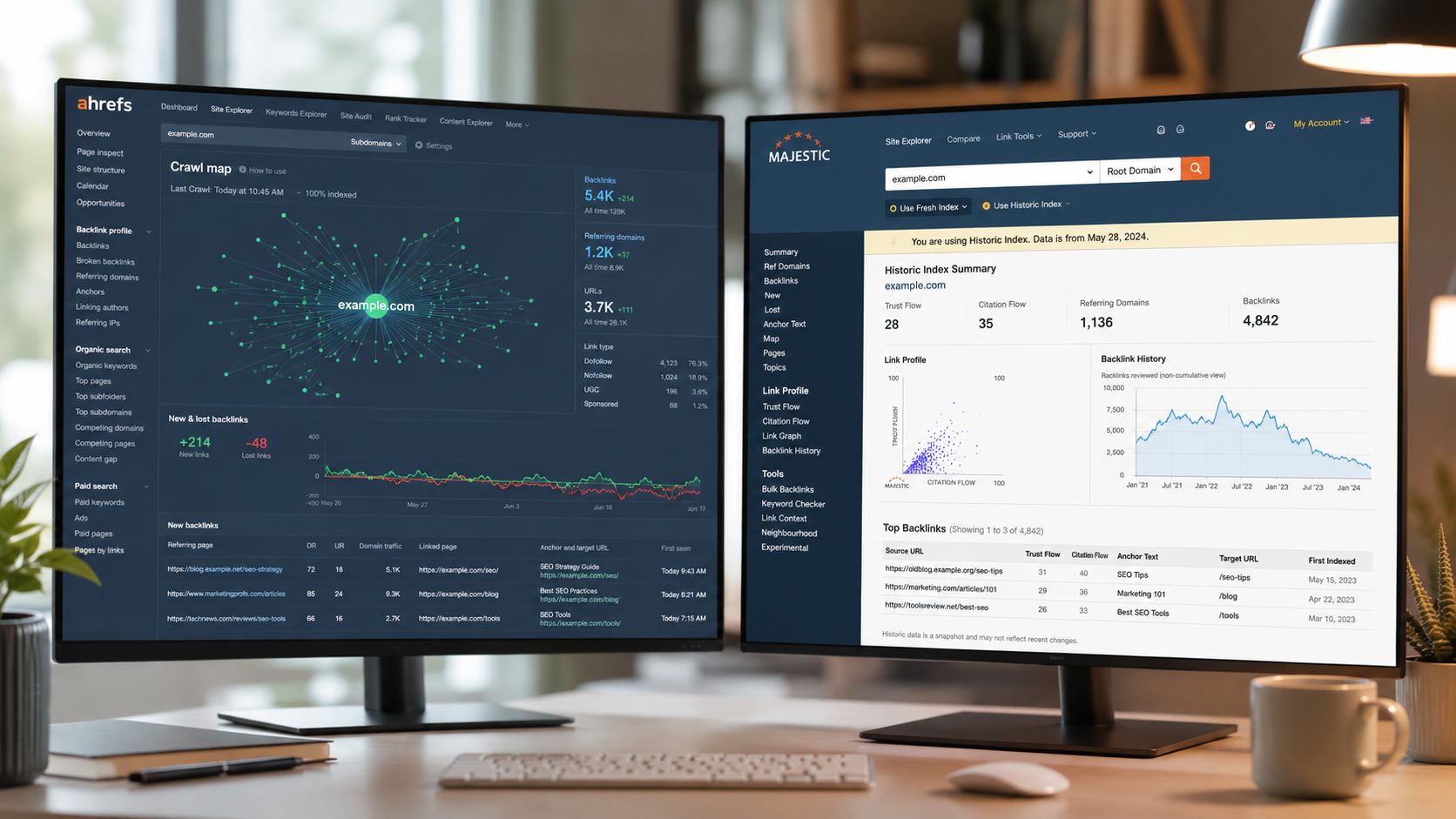
During a migration audit, I once compared the backlink profiles of a site that had lost visibility after changing its URL structure. The two platforms returned different lists, and the client initially assumed one of them had failed. The more accurate conclusion was that each crawler was showing a different layer of the site's history.
Ahrefs helped me connect current referring pages with ranking URLs, competitor movements, and the pages affected by the migration. Majestic helped me investigate older source URLs and links that no longer appeared on the live web. That combination made it possible to separate a genuine link loss from a reporting difference.
The practical sources of disagreement
I treat crawler differences as hypotheses to investigate:
- Current discovery: A newly published link may appear in one index before the other, particularly when the source page is rarely crawled.
- Deleted sources: A removed page may disappear from a current view but remain visible in a historical archive.
- Redirect interpretation: A JavaScript redirect or chained redirect can be classified differently depending on how the crawler renders and follows it.
- Rendered links: Links inserted or exposed through JavaScript may not be consistently recorded in the same way as static HTML links.
- Subdomain coverage: A new or lightly linked subdomain can take longer to appear in a broad crawl than a heavily linked primary host.
I don't assign a number to these gaps because they vary by site, source type, rendering behavior, and crawl timing. The important point is that a single-tool audit can under-report risk. A live index can omit old evidence, while a historical index can preserve links that no longer influence the current profile.
For active research, I pair the backlink report with a page-level investigation. I check whether the source URL resolves, whether the target returns the intended status, whether the anchor remains present, and whether the link passes through redirects. Teams starting that process can use Badanie linków zwrotnych SemDash as another current-data workflow, particularly when they need referring domains, anchors, and broken-link recovery signals in the same analysis.
What I'd do differently
I wouldn't begin a migration or penalty audit with a single export. I'd save dated exports from both tools, normalize source and target URLs, and mark each link according to its current state. That creates an evidence trail instead of a one-time screenshot.
The failed approach is treating disagreement as a data-quality contest. The useful approach is asking what each crawler knows, when it knew it, and whether the link matters to the decision being made.
UI, Reporting, API Access, and Integrations
The interface changes how often a team uses the data. Ahrefs is designed for movement between SEO tasks. I can inspect a domain, switch to organic keywords, review top pages, compare competitors, and turn the findings into content or link priorities without leaving the same general workspace.
Majestic feels more deliberate. Its center of gravity is the link profile, so the workflow is strongest when I already know the question. I can investigate referring domains, trust signals, anchor patterns, and historical records without being pulled toward keyword or content features that aren't relevant to the audit.
That focus can be a strength. A link specialist may work faster in a narrower interface because fewer screens compete for attention. It can also be a limitation when an agency needs a client report that combines rankings, traffic estimates, content performance, and backlinks.
Reporting and exports
For recurring client reporting, I care about whether an export preserves the context behind a metric. A CSV full of source URLs is useful for analysis, but it doesn't automatically explain why a link matters, whether it's current, or what action the client should take.
Ahrefs generally fits a broader reporting rhythm because its data connects naturally to keyword and competitor narratives. Majestic is more suitable when the deliverable is a link inventory, trust analysis, historical profile, or prospecting dataset.
I check four things before standardizing either platform:
- Export fidelity: Do source, target, anchor, date, and status fields survive the export?
- Scheduling: Can the team deliver recurring reports without manual rebuilding?
- API behavior: Will large pulls be practical under the available units, credits, and rate limits?
- Connector coverage: Does the platform connect cleanly to the agency's reporting stack, or will engineering work be required?
The hidden cost of integration
Majestic's narrower native integration footprint can push a team toward API work for automated pipelines. Ahrefs' broader workspace reduces some of that assembly, but large exports can still create friction when row limits, credits, or throttling constrain the collection process.
I've seen teams choose a platform because a dashboard looked efficient, then underestimate the hours required to clean exports, reconcile dates, and maintain a reporting connector. The subscription fee is only part of the cost. Analyst time, developer time, and the risk of inconsistent client reporting belong in the decision as well.
When Majestic's Historic Index Is the Right Choice
Majestic's Historic Index becomes the safer choice when the link profile itself is evidence. Its archive reaches back to 6 June 2006, and Majestic has described it as both a 15-plus-year and later an 18-plus-year archive in its published company material. That depth is not a decorative feature. It changes what I can prove about a domain.
Expired-domain vetting
I don't buy an expired domain because its current metrics look attractive. I inspect the domain's historical link sources, anchor movement, topic changes, redirects, and ownership transitions. A domain can look clean after old pages disappear while its earlier link activity still explains why the profile deserves caution.
Majestic is particularly valuable here because I can reconstruct older referring-domain patterns and identify links that were deleted or lost. I still validate the domain manually, but the archive tells me where to focus.
Penalty and reconsideration work
Penalty cleanup needs dated evidence. I want to know which links existed before the problem, which sources removed them, which URLs changed, and which suspicious patterns remain. A current-only view can leave out the historical context needed to explain how the profile developed.
I use the archive to build a broader source list, then classify links by relevance, ownership, editorial legitimacy, and current status. That doesn't guarantee a recovery, and no backlink tool can replace a careful technical and content review. It does make the evidence more complete.
Link reclamation and competitor forensics
For lost-link recovery, historical records can reveal that a valuable citation once existed on a page that now redirects or returns an error. That gives me a concrete reclamation target rather than a vague outreach list.
Competitor analysis benefits from the same approach. A competitor's current profile may hide an earlier campaign because the source URLs were removed. Historical records can reveal the sequence of link acquisition, topic relationships, and old authority sources that shaped the domain.
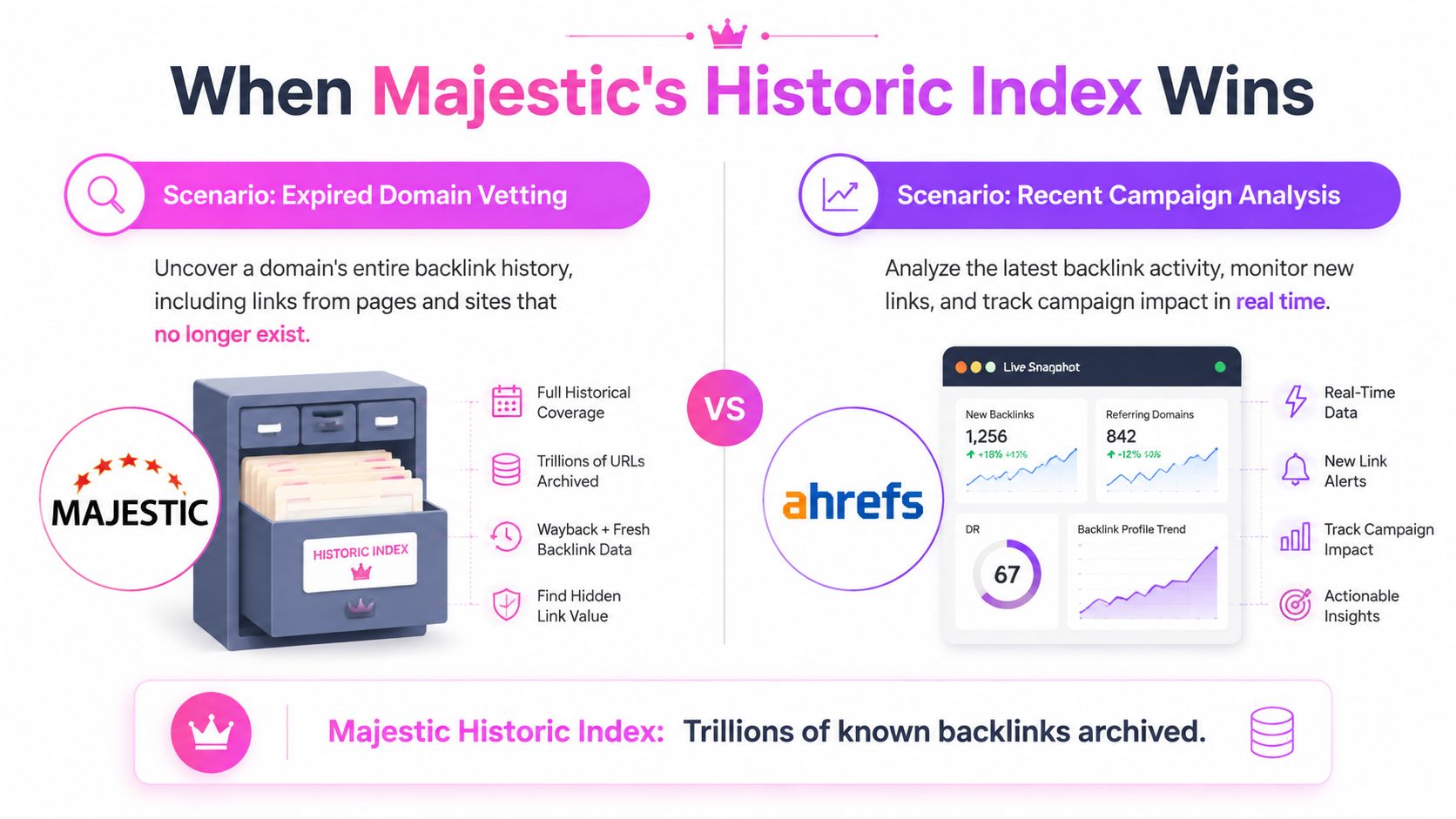
The best use of Majestic isn't checking one score. It's reconstructing a chain of events that a current snapshot can't show.
Pricing Reality Check and the Buyer Decision Framework
Price comparisons are often distorted by scope. Ahrefs charges for a broad SEO workspace, while Majestic lets a link-focused buyer pay for a narrower specialist workflow. If I only need backlink intelligence, paying for unused keyword, content, and rank-tracking capabilities can be wasteful. If I manage a full SEO program, assembling those capabilities elsewhere can cost more in staff time than the subscription difference.
The verified pricing point I use for Majestic is its Lite plan, which starts at $49.99 per month when billed quarterly lub $79.99 month-to-month, as reported by PCMag's Majestic review. I won't manufacture a complete 2026 price card for Ahrefs or unsupported annual totals, because plan prices, limits, and billing terms need to be checked directly before purchase.
| Plan | Monthly Cost, USD | Annual Cost, USD | Best Fit Persona |
|---|---|---|---|
| Ahrefs Lite | Verify current pricing | Verify current pricing | Solo SEO needing a broad operational suite |
| Ahrefs Standard | Verify current pricing | Verify current pricing | Agency or in-house team needing wider workflow coverage |
| Ahrefs Advanced | Verify current pricing | Verify current pricing | Larger SEO operation with broader reporting and research needs |
| Ahrefs Enterprise | Verify current pricing | Verify current pricing | Enterprise procurement and custom workflow requirements |
| Majestic Lite | $49.99 quarterly billing, or $79.99 month-to-month | Verify current pricing | Individual or small team focused on backlinks |
| Majestic Pro | Verify current pricing | Verify current pricing | Link-focused agency or specialist |
| Majestic API | Verify current pricing | Verify current pricing | Team building bulk link-data workflows |
Use the workflow test, not the feature count
I use four questions before renewing:
- Is the urgent problem current or historical? Choose operational coverage for live campaigns, and historical depth for recovery, vetting, or due diligence.
- Will the team use adjacent SEO features? If keyword research, content analysis, rank tracking, and site auditing happen in the same weekly workflow, Ahrefs' breadth may reduce tool switching.
- Does the team need bulk link data? A specialist link operation should evaluate exports, API access, limits, and cleaning effort before choosing a dashboard.
- Who will maintain the workflow? A solo consultant may value simplicity, while an agency may value integrations and repeatable reporting more than a lower entry price.
My practical test is a 14-day overlap on one client domain. Run the same current backlink audit, historical investigation, competitor comparison, and export workflow in both tools. Log missing links, duplicate work, analyst time, and the decisions each dataset changed. Renew the platform that reduces the cost of your real work, not the one with the more impressive feature page.
SemDash can add a separate workflow for keyword, backlink, and SERP research, including competitor gaps, historical SERP analysis, URL-level ranking views, and AI Overviews citation tracking. If you want to compare those visibility workflows with the backlink depth discussed here, visit SemDash (SemDash) and test the domain and page-level research process against one active project.